Sireniadugongs, manatees, and sea cows

Diversity
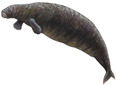
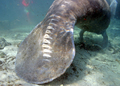
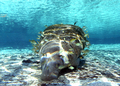
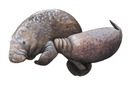
Sirenia is a small order, composed of just two extant families, Dugongidae and Trichechidae, with four current species. Family Trichechidae includes three species: West Indian manatees (Trichechus manatus), African manatees (Trichechus senegalensis), and Amazonian manatees (Trichechus inunguis). There is only one extant member of family Dugongidae, dugongs (Dugong dugon). Dugongs are more streamlined than manatees, they lack nails on their flippers, and have a bi-lobed tail. Steller's sea cows (Hydrodamalis gigas) are a recently extinct dugong species, and they were the only sirenians that did not inhabit tropical waters, instead they were found in the subarctic Bering Sea. Steller's sea cows represent the largest known members of Sirenia>; growing up to 10 meters and weighing up to 11,000 kg; whereas the smallest known members, little sea cows, weighed approximately 150 kg, extant sirenians often weigh between 400 to 1,500 kg. Steller's sea cows were also unique due to their lack of teeth; instead, they had keratinized masticatory plates on the inside of their mouth, which they used to grind their food. The order name <<Sirenia is based on sirens, also known as sea nymphs, as the mermaid myths likely originate with these animals. (Feldhamer, et al., 2007; Hartman, 1979; Jefferson, et al., 1993; Marsh, et al., 2011; Vaughan, et al., 2011)
Geographic Range
All extant sirenians are found in shallow waters along coastlines and inlets. Manatees are found along tropical coastlines on both sides of the Atlantic Ocean and in the Amazon Basin. Dugongs are found off of coastal eastern Africa, along the shores of the Indian Ocean, and on the northern coast of Australia. The extinct Steller's sea cows were found in coastal waters of the Bering Sea. (Jefferson, et al., 1993)
- Biogeographic Regions
- palearctic
- oriental
- ethiopian
- neotropical
- australian
- indian ocean
- atlantic ocean
Habitat
Sirenians inhabit a variety of tropical and subtropical aquatic habitats. All prefer water at least two meters deep, with an abundance of submerged, aquatic vegetation. Sirenians primarily inhabit coastal, marine habitats, but Amazonian manatees inhabit strictly freshwater habitats in the Amazon Basin. Sirenians in subtropical areas inhabit warm, fresh water during colder months, and are often seen in the warm water near coastal power plants. In the warmer months, they move to tepid saline waters. Sirenians are unable to tolerate water temperatures below a certain threshold. West Indian manatees migrate if the water temperature falls below 20°C (68°F), African manatees prefer temperatures above 18°C (64°F), Amazonian manatees prefer higher temperatures, about 25° to 30°C (77° to 86°F), and dugongs tolerate temperatures no lower than 19°C (66°F). If temperatures drop below these levels it can be fatal. In fact, one of the largest mortality factors for sirenians is exposure to cold waters. This is especially true for West Indian manatees. (Jefferson, et al., 1993; Nowak, 2003; Reynolds and Odell, 1991)
- Habitat Regions
- tropical
- saltwater or marine
- freshwater
- Aquatic Biomes
- rivers and streams
- coastal
Systematic and Taxonomic History
Throughout geologic time, order Sirenia has been a much more diverse, prolific mammalian group than it is currently. Sirenians likely first appeared about 50 million years ago. Although all extant members of this order are fully aquatic, early sirenians were terrestrial or amphibious, with sturdy limbs; they grazed on aquatic vegetation in swampy areas. In fact, early dugongs may have acted as a keystone species and had a large impact on seagrass communities. There have been about 50 described species, in about 20 genera, distributed into four families, Dugongidae, Trichechidae, Protosirenidae and Prorastomidae, of which, the latter two are extinct. Families, Prorastomidae and Protosirenidae occurred during the mid- to late Eocene, although Prorastomidae likely represents the most primitive sirenian grouping. The extant sirenians families, Dugongidae and Trichechidae, arose during the mid-Eocene and Oligocene, respectively. Currently, there are 4 extant species within order Sirenia, 3 manatee species in family Trichechidae and one dugong in family Dugongidae. All other members of this order have gone extinct, including Steller’s sea cows (Hydrodamalis gigas), which went extinct around 1768. (Berta, et al., 2005; Feldhamer, et al., 2007; Hartman, 1979; Jefferson, et al., 1993; Marsh, et al., 2011; Ridgway and Harrison, 1985; Rose, 2009; Self-Sullivan, 2006; Shoshani, 2005; Vaughan, et al., 2011; Velez-Juarbe, et al., 2012)
Although they are morphologically dissimilar, support has been building for a close relationship between sirenians, proboscideans (elephants), and hyracoideans (hyraxes). Interestingly, elephants and sirenians were coupled together in the same order by Linnaeus in 1758, along with sloths, anteaters and pangolins, although this grouping was largely based on the absence of incisors. During the majority of the 1800s, sirenians were considered most closely associated with cetaceans, as both groups are fully aquatic. Although those relationships have been discredited, a great deal of molecular and phylogenetic evidence still supports sirenians close relationship with elephants and hyraxes. Based on genetic research, superorder Afrotheria has been proposed, this grouping includes sirenians, golden moles, aardvarks, elephant shrews, tenrecs, and hyraxes. Likewise, Paenungulata, the ‘near ungulates’, is a proposed monophyletic grouping within Afrotheria that includes sirenians, elephants and hyraxes. Paenungulatans share many similar features such as forked styloglossus tongue muscles, abdominal testes and nail-like hooves, these animals also lack a clavicle and do not ruminate, although they are all herbivorous. Both sirenians and elephants share the unusual conveyer-belt tooth replacement system, this, along with other evidence has led some to believe that sirenians are more closely related to elephants than hyraxes, although the exact phylogeny of this group is not yet known. (Berta, et al., 2005; Feldhamer, et al., 2007; Marsh, et al., 2011; Rose, 2009; Shoshani, 2005; Vaughan, et al., 2011)
-
- Synonyms
-
- Halobioidea Ameghino 1889
- Herbivorae Gray 1821
- Phycoceta Haeckel 1866
- Sirenoidea van Beneden 1855
- Sireniformes Kinman 1994
- Trichechiformes Hay 1923
-
- Synapomorphies
-
- large, drawn-in external nares
- no sagittal crest
- heavy, thick ribs
- solid, thick skull
- thin, elongated mandibular symphysis
Physical Description
Sirenians are large, slow-moving, aquatic mammals. They are torpedo-shaped with long, broad backs tapering to paddle-like, dorso-ventrally flattened tails; the tail is spoon-shaped in family Trichechidae and dugongs have bi-lobed tails. Sirenians have two flippers; manatees have three to four nails on the second, third and fourth digits, while dugongs lack nails. All sirenians lack hind limbs, and have gray-brown skin that is smooth in some species, such as Amazonian manatees, or wrinkled in others, such as West Indian manatees. Adults are between 2.8 and 3.5 meters long. African and West Indian manatees weigh between 1,000 and 1,500 kg. Dugongs and Amazonian manatees weigh much less, around 400 kg. Sirenians' dense pachystotic bones, along with their long, thin lungs, help them overcome buoyancy issues. Females have one teat and are often heavier than males. The rostrum is deflected downwards, reflecting their preference for submerged, aquatic vegetation. This feature is especially exaggerated in dugongs, which are strictly bottom feeders. Around the mouth there are many short bristles. Sirenians lack external pinnae. They have a pair of semi-circular valves on their nose, which they close during diving and open during surface breathing. Their teeth are low-crowned and bicuspid. These teeth are lost throughout their lifetime due to their coarse diet. Teeth are replaced from the back of the mouth, with 5 to 7 teeth in the upper and lower jaw at any given time. Through the course of their lifetime, sirenians can go through up to 30 teeth per jaw quadrant. (Feldhamer, et al., 2007; Hartman, 1979; Jefferson, et al., 1993; Ridgway and Harrison, 1985)
- Other Physical Features
- endothermic
- homoiothermic
- bilateral symmetry
- Sexual Dimorphism
- sexes alike
- female larger
Reproduction
Sirenians are polygamous and have an approximately 1 to 1 sex ratio. When a cow undergoes estrus, she attracts herds of males who follow her while she swims to evade them. Females may use this evasive swimming behavior to select a superior mate. Males who happen upon others engaging in sexual behavior are often encouraged to participate. These groups of males may remain near a single female for several weeks before a successful copulation. During this time, males and females often grasp each other with their flippers as a form of sexual play. Males may show aggression toward each other; male dugongs often exhibit scars from the tusks of other males. Prior to mating, the male reorients the female with his flippers; they mate ventral to ventral, which may require moving into deeper water. Two notable exceptions to this mating system are dugongs in Shark Bay, Australia and Steller's sea cows. Male dugongs in Shark Bay defend territories and attempt to attract females, rather than actively pursuing them. Steller’s sea cows may have been monogamous, living with long lasting family groups consisting of a mating pair and two offspring. Steller’s sea cows appeared to show strong mate fidelity and were even observed to remain near the body of a dead mate for days. (Koelsch, 2006; Nowak, 2003; Reeves, et al., 2002; Ridgway and Harrison, 1985)
- Mating System
- monogamous
- polygynous
- polygynandrous (promiscuous)
Female sirenians are believed to be polyestrous, although the length of their estrous cycle is not known. Sirenian gestation lasts 12 to 14 months. Cows travel into shallow waters to give birth; occasionally females enter water so shallow they are nearly beached and must wait for the tide to float out again. All sirenians are capable of breeding year round, but each species has seasonal peaks when birth rates are particularly high. For instance, Amazonian manatees have more young during the wet season when food is abundant. African manatees also have a higher occurrence of birth during the wet season, while dugongs and West Indian manatees tend to have higher birth rates during warmer months. Females typically give birth to one precocial calf, although about 1.8% of manatee births result in twins. The calf may need assistance reaching the surface to take its first breath, but swims on its own before the end of its first day. Sirenians reach sexual maturity in 3 to 10 years and reproduce every 2.5 to 7 years; cows may breed more frequently if they lose a very young calf. (Adulyanukosol, et al., 2007; Marsh, et al., 1984; Nowak, 2003; Reeves, et al., 2002; Ridgway and Harrison, 1985)
- Key Reproductive Features
- iteroparous
- seasonal breeding
- year-round breeding
- gonochoric/gonochoristic/dioecious (sexes separate)
- sexual
- viviparous
Among extant sirenian species, the only strong social bonds are formed between the mother and calf. Calves are born with teeth and begin foraging in their third month, they generally continue nursing for about 18 months, although they may nurse up to four years. Very young calves synchronize all activities, such as breathing and resting, to match their mother. Young calves often cling to their mother and ride on her back. If they feel their calf is in danger, a female may face and even headbutt a predator, although much more often the cow and calf flee together. Historically, dugongs have gathered in large herds, several hundred strong. Although contemporary herds still occur, they are much smaller and form less often. These herds are believed to form so calves can learn to swim in a protected environment. There is evidence that male Steller's sea cows provided some parental care by defended calves from predation; there are even reports of bulls attacking boats to protect their young. (Adulyanukosol, et al., 2007; Jefferson, et al., 2008; Nowak, 2003; Ridgway and Harrison, 1985)
- Parental Investment
- precocial
- male parental care
- female parental care
-
pre-weaning/fledging
-
provisioning
- female
-
protecting
- female
-
provisioning
-
pre-independence
-
provisioning
- female
-
protecting
- male
- female
-
provisioning
- extended period of juvenile learning
Lifespan/Longevity
The average sirenian lifespan ranges from 50 to 70 years, the maximum lifespan is estimated to be around 73 years. Causes of adult mortality include predation, habitat disturbance, hunting, poisoning from various pollutants, and illness, especially in cooler waters. Recently, illness has become a serious issue due to over-crowding from habitat loss. It is estimated that sirenians must achieve a survival rate of 90% or higher to maintain their population size. Manatees fare much better in captivity than dugongs, which are often captured at especially young ages and face longer transportation routes. (Hartman, 1979; Langtimm, et al., 1998; Marsh, et al., 1984; O'Shea and Reep, 1990; Ridgway and Harrison, 1985)
Behavior
In general, sirenians are neither nocturnal nor diurnal; instead they are equally active all day. However, some populations particularly susceptible to hunting have become more active at night. Sirenians display agitated behavior if they sense a nearby predator and often make impulsive chirping sounds. Groups of sirenians may even stand against and headbutt predators, but more typically, they attempt to flee danger. While feeding, sirenians often use their flippers to “walk” along the sea bottom. Sirenians beat their tails up and down to achieve forward motion. When accelerating, sirenians bring their flippers up against their body, but at cruising speed, the flippers typically hang down. Flippers are used to aid in turning and stopping. Although they can achieve speeds of 25 km/hr when being pursued, sirenians typically move about 3 to 10 km/hr. (Hartman, 1979; Jefferson, et al., 2008; Nowak, 2003; Reeves, et al., 2002; Ridgway and Harrison, 1985)
Sirenians do not travel along any set migratory paths, but do exhibit some seasonality in their travels. Amazonian manatees spend the dry season in deep lakes or river channels, although they prefer to spend the wet seasons in flooded forests where food is more abundant. During this period, Amazonian manatees are less active and subsist on a reduced diet. There is evidence that African manatees exhibit similar behavioral patterns during the African dry season. Dugongs and West Indian manatees also travel into tropical waters if temperatures begin to dip during the winter, although West Indian manatees have been known to congregate around springs, power plants, or other sources of warm water instead. Sirenians may also exhibit daily travel patterns. Their nature is fairly nomadic; they may spend days, weeks, or even seasons in one spot, or they may travel tens of kilometers in a single day. Sirenians travel to deeper waters to avoid rough weather. Because of their dependence on seagrasses, it is not necessary for sirenians to dive to great depths. They cruise 1 to 3 m below the surface, the greatest recorded depth for a dive is 10 m. Sirenians typically come to the surface to breathe every 2 to 4 minutes, the greatest recorded interval between breaths is 18 minutes. (Jefferson, et al., 2008; Nowak, 2003; Ridgway and Harrison, 1985)
Communication and Perception
Sirenians' communicate by sound; this communication is best developed between a mother and calf. Cows and calves use vocalizations to keep track of one another, it is believed that these animals can identify and distinguish one another based on their chirps and barks. Mothers may respond to their calf from over 50 m. Sirenians also produce sounds when fearful, sexually aroused, or playful. Male dugongs produce low frequency barks when competing for a mate. All calls are usually very short in duration. Sirenians can hear over a frequency range of 0.4 to 46 kHz, but their peak hearing range is 6 to 20 kHz. Sirenians' visual capabilities are comparable to that of humans. The visual field of their eyes overlap and sirenians blink often to keep their eyes lubricated. Sirenians may also have a well-developed tactile sense; they have sensory hairs all over their body and on their rostrum, and a touch-sensitive epidermis. Sirenians touch each other frequently during sexual play, and often rub against rocks during leisure. Little is known about the gustation and olfaction of sirenians, although they are believed to have an extremely poor sense of smell. (Hartman, 1979; Jefferson, et al., 2008; O'Shea and Poché, 2006)
Food Habits
Sirenians are herbivorous, eating mainly plants such as seagrasses, water weeds, and other aquatic vegetation. Manatees tend to be opportunistic feeders, eating a wide variety of plant matter, including mangrove leaves and Hydrilla, as well as leaves and acorns from overhanging branches on the bank, they have even been known to eat floating palm fruit. While manatees consume at least 60 different plant species, dugongs are more particular; they are strictly bottom feeders and prefer seagrass. This specialized diet is evident in their highly inflected rostrum. The extinct Steller's sea cow is thought to have fed primarily on kelp. Sirenians are occasionally known to consume clams or fish, possibly for their protein. They also tend to ingest some small invertebrates that reside on the plants they eat; however, although the protein content is ultimately beneficial, their consumption is likely unintentional. It unclear how sirenians obtain the fresh water their bodies need. Some manatees live in freshwater, and those that live in saltwater are often attracted to freshwater areas, such as river mouths or water pipes. Dugongs, however, live strictly in saltwater. It is suspected that the kidneys of sirenians, especially dugongs, may have a special ability to filter salt water, otherwise, they may obtain all of their needed freshwater from the plants they eat. (Jefferson, et al., 2008; Reynolds and Odell, 1991; Ridgway and Harrison, 1985)
Each day, sirenians spend up to 8 hours feeding and eat about 5 to 10% of their body weight. They do not seem to have any specific time preference, as sirenians appear to have both nocturnal and diurnal feeding times. Sirenians often use the thick pads on their upper and lower jaw to help tear or bite their food. Dugongs in particular use their flippers to pull seagrasses out of the seafloor, eating the roots and rhizomes as well. Because dugongs remove the entire plant, it is easy to follow the trail they leave along the ocean floor. Sirenians are constantly moving in search of food, and do not appear to be territorial of feeding sites. Rather, sirenians simply move where food is available. These animals use hind-gut digestion, and food takes about 7 days to travel through the digestive system. Their metabolic rate is only 36% of what is predicted by their body size. Due to lack of food, Amazonian manatees often fast during the dry season; they have been known to survive up to 200 days without food. However, that length of food deprivation could be fatal, especially because they have known to consume soil or clays in desperation, which may also kill them. When food is sparse, breeding may also be delayed. (Marsh, et al., 2002; Reep and Bonde, 2006; Reynolds and Odell, 1991; Ridgway and Harrison, 1985)
Predation
Sirenians' main predators are humans. Some cultures hunt sirenians for sustenance or spiritual reasons, but these animals most often fall prey to unintentional predators such as nets, barges, and flood control gates. Sirenians have a few natural predators in certain regions. For instance, Amazonian manatees are occasionally preyed on by jaguars, caimans, and sharks, dugongs may be attacked by tiger sharks, crocodiles, and killer whales. In the case of tiger sharks, dugongs simply avoid the predator by feeding elsewhere, even if the seagrasses in the secondary location are subpar. However, any attacks seem to be isolated, and for the most part, sirenians have no significant natural predators. (Anderson and Prince, 1985; Reep and Bonde, 2006; Reynolds and Odell, 1991; Ridgway and Harrison, 1985; Wirsing, et al., 2007)
-
- Known Predators
-
- crocodiles (crocodylus)
- caimans (caiman)
- killer whales (Orcinus orca)
- tiger sharks (Galeocerdo cuvier)
- jaguar (Panthera onca)
- humans (Homo sapiens)
Ecosystem Roles
Sirenians often host a number of small internal and external parasites. Common parasites include nematodes, flukes, and tapeworms. Many fluke species infect the intestines, nasal passages, or lungs. Sirenians also host a number of commensals which inhabit their skin, including copepods, barnacles, remoras, diatoms, and algae. These creatures do not harm sirenians and are probably of little significance to their overall health. For example, sharksuckers (Echeneis naucrates and Echeneis neucratoides) attach themselves to sirenians to feed on their fecal matter. (Blair, 1981; Forrester, 1992; Williams Jr., et al., 2003)
Sirenians impact their ecosystem through their herbivory on aquatic vegetation (up to 90 kg/day), which can be especially significant during temporary winter aggregations in areas with warmer water. The paleoecology of sirenians has been extensively studied, especially with regard to the Miocene and Oligocene when they were more diverse. Fossil records show a direct relationship between sirenian abundance and sea grass and kelp abundance. It is thought that sirenian feeding habits could have permanently altered aquatic landscapes of the past. (Reynolds and Odell, 1991)
- nematodes (phylum Nematoda)
- flukes (phylum Platyhelminthes; class Trematoda)
- tapeworms (phylum Platyhelminthes; class Cestoda)
- copepods (phylum Arthropoda; class Maxillopoda; subclass Copepoda)
- barnacles (phylum Arthropoda; class Maxillopoda; infraclass Cirripedia)
- common remoras (Remora remora)
- sharksuckers (Echeneis naucrates)
- whitefin sharksuckers (Echeneis neucratoides)
Economic Importance for Humans: Positive
In some parts of the world, such as New Guinea and west Africa, manatees continue to be hunted for their meat, hide, and oil, which are often sold. However, in most parts of the world, sirenians are protected under law. Living sirenians could potentially serve other useful purposes that would economically benefit humans. For instance, manatees could be used as an inexpensive method of weed control in problem areas. In tests of this theory, the results have varied, the weeds usually disappear, but sometimes the manatees die as well. Likewise, they could help control mosquito infestations, as removing excess aquatic vegetation may also reduce mosquito populations. (Reynolds and Odell, 1991)
- Positive Impacts
- food
- body parts are source of valuable material
- controls pest population
Economic Importance for Humans: Negative
There are no known negative impacts of sirenians on humans. Some have suggested they harm fish populations or fishing gear, but this is unsubstantiated. (Reynolds and Odell, 1991)
Conservation Status
All extant sirenians are considered vulnerable according to the IUCN. Populations of all species are in decline due to hunting and injuries associated with boat impacts. There are many extinct sirenian species. Four subfamilies of Dugongidae are now extinct, including species such as Steller's sea cows (Hydrodamalis gigas), which likely went extinct around 1768 due to over-hunting. There are many laws to protect these creatures but they are often incompletely enforced. There are extensive programs to protect West Indian manatees in the United States and Australia has also made strides in dugong preservation by establishing reserves and research facilities. ("2008 IUCN Red List of Threatened Species", 2008; Jefferson, et al., 1993; Vaughan, et al., 2011)
-
- IUCN Red List [Link]
- Not Evaluated
Contributors
Matthew James Kanelos (author), University of Michigan-Ann Arbor, Julie Elizabeth Larson (author), University of Michigan-Ann Arbor, Kahli Elizabeth McDonald (author), University of Michigan-Ann Arbor, Leila Siciliano Martina (author, editor), Animal Diversity Web Staff, Tanya Dewey (editor), University of Michigan-Ann Arbor, Phil Myers (editor), University of Michigan-Ann Arbor.
Glossary
- Atlantic Ocean
-
the body of water between Africa, Europe, the southern ocean (above 60 degrees south latitude), and the western hemisphere. It is the second largest ocean in the world after the Pacific Ocean.

- Australian
-
Living in Australia, New Zealand, Tasmania, New Guinea and associated islands.
- Ethiopian
-
living in sub-Saharan Africa (south of 30 degrees north) and Madagascar.
- Neotropical
-
living in the southern part of the New World. In other words, Central and South America.
- Palearctic
-
living in the northern part of the Old World. In otherwords, Europe and Asia and northern Africa.
- acoustic
-
uses sound to communicate
- bilateral symmetry
-
having body symmetry such that the animal can be divided in one plane into two mirror-image halves. Animals with bilateral symmetry have dorsal and ventral sides, as well as anterior and posterior ends. Synapomorphy of the Bilateria.
- chemical
-
uses smells or other chemicals to communicate
- coastal
-
the nearshore aquatic habitats near a coast, or shoreline.
- diurnal
-
- active during the day, 2. lasting for one day.
- endothermic
-
animals that use metabolically generated heat to regulate body temperature independently of ambient temperature. Endothermy is a synapomorphy of the Mammalia, although it may have arisen in a (now extinct) synapsid ancestor; the fossil record does not distinguish these possibilities. Convergent in birds.
- female parental care
-
parental care is carried out by females
- folivore
-
an animal that mainly eats leaves.
- food
-
A substance that provides both nutrients and energy to a living thing.
- freshwater
-
mainly lives in water that is not salty.
- herbivore
-
An animal that eats mainly plants or parts of plants.
- iteroparous
-
offspring are produced in more than one group (litters, clutches, etc.) and across multiple seasons (or other periods hospitable to reproduction). Iteroparous animals must, by definition, survive over multiple seasons (or periodic condition changes).
- male parental care
-
parental care is carried out by males
- migratory
-
makes seasonal movements between breeding and wintering grounds
- monogamous
-
Having one mate at a time.
- motile
-
having the capacity to move from one place to another.
- natatorial
-
specialized for swimming
- native range
-
the area in which the animal is naturally found, the region in which it is endemic.
- nocturnal
-
active during the night
- nomadic
-
generally wanders from place to place, usually within a well-defined range.
- oriental
-
found in the oriental region of the world. In other words, India and southeast Asia.
- polygynandrous
-
the kind of polygamy in which a female pairs with several males, each of which also pairs with several different females.
- polygynous
-
having more than one female as a mate at one time
- saltwater or marine
-
mainly lives in oceans, seas, or other bodies of salt water.
- seasonal breeding
-
breeding is confined to a particular season
- sexual
-
reproduction that includes combining the genetic contribution of two individuals, a male and a female
- social
-
associates with others of its species; forms social groups.
- solitary
-
lives alone
- tactile
-
uses touch to communicate
- tropical
-
the region of the earth that surrounds the equator, from 23.5 degrees north to 23.5 degrees south.
- visual
-
uses sight to communicate
- viviparous
-
reproduction in which fertilization and development take place within the female body and the developing embryo derives nourishment from the female.
- year-round breeding
-
breeding takes place throughout the year
- young precocial
-
young are relatively well-developed when born
References
2008. "2008 IUCN Red List of Threatened Species" (On-line). Accessed February 10, 2009 at http://www.iucnredlist.org/search.
Adulyanukosol, K., S. Thongsukdee, T. Hara, N. Arai, M. Tsuchiya. 2007. Observations of dugong reproductive behavior in Trang Province, Thailand: further evidence of intraspecific variation in dugong behavior. Marine Biology, 151: 1887-1891.
Anderson, P., R. Prince. 1985. Predation on Dugongs: Attacks by Killer Whales. Journal of Mammalogy, 66/3: 554-556.
Berta, A., J. Sumich, K. Kovacs. 2005. Marine Mammals: Evolutionary Biology. Burlington, MA: Academic Press.
Blair, D. 1981. The monostome flukes (Digenea: Families Opisthotrematidae Poche and Rhodbiopoeidae Poche) parasitic in sirenians (Mammalia: Sirenia). Australian Journal of Zoology Supplementary Series, 81: 1-54.
Feldhamer, G., L. Drickamer, S. Vessey, J. Merritt, C. Krajewski. 2007. Mammalogy: Adaptation, Diversity, Ecology. Baltimore: The Johns Hopkins Press.
Forrester, D. 1992. Parasites and Diseases of Wild Mammals in Florida. Gainesville, FL: University Press of Florida.
Hartman, D. 1979. Ecology and Behavior of the Manatee in Florida. Ithaca, New York: The American Society of Mammalogists.
Jefferson, T., S. Leatherwood, M. Webber. 1993. Marine mammals of the World. Rome: United Nations Environment Programme.
Jefferson, T., M. Webber, R. Pitman. 2008. Marine Mammals of the World: A Comprehensive Guide to their Identification. London: Academic Press.
Koelsch, J. 2006. Reproduction of female manatees observed in Sarasota Bay, Florida. Marine Mammal Science, 17(2): 331 - 342.
Langtimm, C., T. O’Shea, R. Pradel, C. Beck. 1998. Estimates Of Annual Survival Probabilities for adult Florida manatees (Trichechus manatus latirostris). Ecological Society of America, 79(3): 981–997.
Marsh, H., G. Heinsohn, L. Marsh. 1984. Breeding Cycle, Life History and Population Dynamics of the Dugong, Dugon dugon (Sirenia: Dugongidae). Australian Journal of Zoology, 32(6): 767 - 788.
Marsh, H., T. O'Shea, J. Reynolds III. 2011. Ecology and conservation of the Sirenia: Dugongs and manatees. New York: Cambridge University Press.
Marsh, H., H. Penrose, C. Eros, J. Hughes. 2002. Dugong: Status Report and Action Plans for Countries and Territories. Nairobi, Kenya: United Nations Environment Programme.
Nowak, R. 2003. Walker’s Marine Mammals of the World. Baltimore: John Hopkins University Press.
O'Shea, T., L. Poché. 2006. Aspects of underwater sound communication in Florida manatees (Trichechus manatus latirostris). Journal of Mammalogy, 87(6): 1061.
O'Shea, T., R. Reep. 1990. Encephalization Quotients and Life-History Traits in the Sirenia. Journal of Mammalogy, 71(4): 534-543.
Reep, R., R. Bonde. 2006. The Florida Manatee: Biology and Conservation. Gainesville, FL: University Press of Florida.
Reeves, R., B. Stewart, P. Clapham, J. Powell. 2002. Sea Mammals of the World. London: A & C Black.
Reynolds, J., D. Odell. 1991. Manatees and Dugongs. New York, NY: Facts on File Inc.
Ridgway, S., R. Harrison. 1985. Handbook of Marine Mammals: Volume 3: The Sirenians and Baleen whales. London: Academic Press.
Rose, K. 2009. The Beginning of the Age of Mammals. Baltimore: The Johns Hopkins University Press.
Sclater, P., W. Sclater. 1899. The Geography of Mammals. Paternoster House, Charging Cross Road: Kegan Paul, Trench Trubner & Co. Limited.
Self-Sullivan, C. 2006. "Evolution of the Sirenia" (On-line pdf). Accessed March 09, 2009 at http://www.sirenian.org/sirenianevolution.pdf.
Shoshani, J. 2005. Order Sirenia. Pp. 92-94 in D Wilson, D Reeder, eds. Mammal species of the world: A taxonomic and geographic reference, Vol. 12, Ed 3. Baltimore: The Johns Hopkins University Press.
Vaughan, T., J. Ryan, N. Czaplewski. 2011. Mammalogy. Sudbury, MA: Jones and Bartlett Publishers.
Velez-Juarbe, J., D. Domning, N. Pyenson. 2012. Iterative evolution of sympatric seacow (Dugongidae, Sirenia) assemblages during the past ~26 million years. PLOS one, 7:2: 1-8.
Williams Jr., E., A. Mignucci-Giannoni, L. Bunkley-Williams, R. Bonde, C. Self-Sullivan. 2003. Echeneid-sirenian associations, with information on sharksucker diet. Journal of Fish Biology, 63/5: 1176-1183.
Wirsing, A., M. Heithaus, L. Dill. 2007. Fear factor: Do dugongs (Dugong dugon) trade food for safety from tiger sharks (Galeocerdo cuvier)?. Oecologia, 153/4: 1031-1040.