Pheucticus melanocephalusblack-headed grosbeak


Geographic Range
Pheucticus melanocephalus is found throughout most of western North America, from the Pacific to the eastern foothills of the Rocky Mountains. These birds winter in Mexico and spend the remainder of the year throughout western United States and Canada, from Montana through Oregon and along the Pacific coast to Baja, California. Black-headed grosbeaks are found as far east as Kansas and Oklahoma and north throughout the provinces of Saskatchewan and British Columbia. ("Chipper Woods Bird Observatory", 1997; "NatureServe Explorer: An online encyclopedia of life", 2005; Lynes, 1998)
- Biogeographic Regions
- nearctic
- neotropical
Habitat
Black-headed grosbeaks prefer deciduous and broad-leaved evergreen woods, nesting in thickets on the edges of open woods, ponds, swamps, or streams, or in small trees. (Lynes, 1998)
- Habitat Regions
- temperate
- terrestrial
- Terrestrial Biomes
- forest
- Wetlands
- swamp
- Other Habitat Features
- riparian
-
- Range elevation
- 1,524 to 2,743 m
- to ft
Physical Description
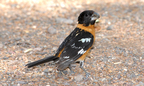
Black-headed grosbeaks have the distinctive grosbeak bill, which is large, conical, thick, and straw-colored. Both genders have yellow wing linings. Females differ in color from males, featuring brown to dark grey feathers with a striped head, back, and sides, a paler bill, white wing bar, and a tan breast. Their more colorful male counterparts have white patches on the wings, a black and white tail, and black head with bright orangish-brown underparts and red legs. They are from 15 to 20 cm in length, with wingspans from 30 to 33 cm, and weighing from 38 to 54 grams. ("What Bird: the Ultimate Bird Guide", 2004)
- Other Physical Features
- endothermic
- homoiothermic
- bilateral symmetry
- Sexual Dimorphism
- sexes colored or patterned differently
- male more colorful
-
- Range mass
- 38 to 54 g
- 1.34 to 1.90 oz
-
- Range length
- 15 to 20 cm
- 5.91 to 7.87 in
-
- Range wingspan
- 30 to 33 cm
- 11.81 to 12.99 in
Reproduction
Black-headed grosbeaks are monogamous. Males arrive in the spring about six days before the females, remaining solitary until the females arrive. Males sing to establish territory and attract mates. Older males get higher quality territories, and fighting for territory can be aggressive, as black-headed grosbeaks attack swiftly during flight. Once females arrive, males will sing from perches near females, occasionally flying up into the air while singing a courtship song. (Kroodsma, 1974; Lynes, 1998)
- Mating System
- monogamous
Black-headed grosbeak females build a nest between 4 and 25 feet above the ground over a period of 3 to 4 days, usually in deciduous trees; especially willows and coast live oaks. The nest could also be located in shrubs, bordering streams, or more rarely, gardens and parks. The nest itself is constructed thinly and loosely with twigs, rootlets, and other plant materials and placed in the dense outer foliage of a tree or shrub near an opening. (Kroodsma, 1974; Lynes, 1998)
Black-headed grosbeaks produce one brood per year in the spring and early summer, from April to July. They lay 2 to 5 eggs per season. The eggs vary in color from greenish or bluish to spotted brown. Eggs hatch in 12 to 13 days with all eggs hatching within a 24 hour period. Young fledge after about 12 days, becoming independent after another 14 days. Females reach reproductive maturity around 1 year, while males mature after 3 years. (Ehrlich, et al., 1988; Lynes, 1998)
- Key Reproductive Features
- iteroparous
- seasonal breeding
- gonochoric/gonochoristic/dioecious (sexes separate)
- sexual
- oviparous
-
- Breeding interval
- Black-headed grosbeaks produce one brood every year.
-
- Breeding season
- Copulation and nesting for Pheucticus melanocephalus occurs from April through July.
-
- Range eggs per season
- 2 to 5
-
- Average eggs per season
- 3-4
-
- Average eggs per season
- 3
- AnAge
-
- Range time to hatching
- 12 to 13 days
-
- Range fledging age
- 11 to 15 days
-
- Range time to independence
- 23 to 30 days
-
- Range age at sexual or reproductive maturity (female)
- 1 to 1 years
-
- Range age at sexual or reproductive maturity (male)
- 2 to 4 years
Both sexes invest time incubating the eggs, alternating sitting periods throughout the 12 to 13 days of incubation. Occasionally, both parents will sit on the nest and sing simultaneously. In a similar fashion, both parents feed their nestlings, and females occasionally use song to communicate with their young. Males depart for breeding grounds earlier, leaving females to feed their fledged young. (Lynes, 1998)
- Parental Investment
- altricial
-
pre-fertilization
- provisioning
-
protecting
- female
-
pre-hatching/birth
-
provisioning
- female
-
protecting
- male
- female
-
provisioning
-
pre-weaning/fledging
-
provisioning
- male
- female
-
protecting
- male
- female
-
provisioning
Lifespan/Longevity
In the wild, black-headed grosbeaks have an expected lifespan between 5 and 6 years. In captivity, however, they have lived as long as 25 years. (Lynes, 1998)
-
- Range lifespan
Status: captivity - 25 (high) years
- Range lifespan
-
- Average lifespan
Status: wild - 143 months
- Bird Banding Laboratory
- Average lifespan
Behavior
Black-headed grosbeaks are diurnal animals, active in the daytime and resting at night. Their distinctive flight pattern features short, rapid wing beats. Black-headed grosbeaks are relatively aggressive towards conspecifics during the breeding season, both males and females will fight with other grosbeaks of the same sex over territory or to protect eggs. Outside of breeding season, black-headed grosbeaks occur in small, loose flocks. These birds are migratory, moving between summer breeding ranges and wintering ranges yearly. ("NatureServe Explorer: An online encyclopedia of life", 2005; Kroodsma, 1974; Lynes, 1998; "What Bird: the Ultimate Bird Guide", 2004)
-
- Range territory size
- 7,900 to 27,000 m^2
-
- Average territory size
- unknown m^2
Home Range
The individual territories of black-headed grosbeaks range from 7,900 to 27,000 square meters. ("What Bird: the Ultimate Bird Guide", 2004)
Communication and Perception
Black-headed grosbeaks have a distinct song which resembles its close relative, rose-breasted grosbeaks (Pheucticus ludovicianus). This song is similar to that of a robin or western tanager, but richer and clearer, containing whistled notes, trills, and a back-and-forth warble. Males sing to declare territory and attract females, while females use song while foraging, to communicate or respond to other females, and to maintain contact with their offspring. Black-headed grosbeaks also use visual cues in communication, such as in assessing mates and responding to young. (Lynes, 1998; "What Bird: the Ultimate Bird Guide", 2004)
- Other Communication Modes
- choruses
- Perception Channels
- visual
- polarized light
- tactile
- acoustic
- chemical
Food Habits
Black-headed grosbeaks prey mainly on insects and other invertebrates during the breeding season, including spiders, beetles, scale insects, flies, wasps, bees, grasshoppers, codling moth caterpillars, and cankerworms. They also eat small fruits, such as cherries, blackberries, raspberries, strawberries, elderberries, and mistletoe berries; as well as buds and seeds, which they can crack open with their large and sturdy bill. Black-headed grosbeaks forage in trees and shrubs, predominantly obtaining food from gleaning. They come readily to feeding stations and campgrounds. Their winter diet is mostly unknown. ("Chipper Woods Bird Observatory", 1997; Lynes, 1998; "What Bird: the Ultimate Bird Guide", 2004)
- Primary Diet
- omnivore
- Animal Foods
- insects
- terrestrial non-insect arthropods
- Plant Foods
- seeds, grains, and nuts
- fruit
Predation
Though little is known about predators of adult black-headed grosbeaks, although domestic and feral cats (Felis silvestris) have been known to eat adult birds. Eggs and nestlings are taken by a variety of predators, ranging from other birds, such as western scrub-jays (Aphelocoma californica) and magpies (Pica), to snakes, rock squirrels (Spermophilus variegatus), deer mice (Peromyscus), chipmunks, striped skunks (Mephitis mephitis), raccoons (Procyon lotor), and weasels (Mustela). This is countered by aggressive nest defense by parent birds, who attack egg predators with their sharp, large beaks. (Lynes, 1998; Ortega and Ortega, 2002)
-
- Known Predators
-
- magpies (Pica)
- western scrub-jay (Aphelocoma californica)
- rock squirrels (Spermophilus variegatus)
- chipmunks (Tamias)
- deer mice (Peromyscus)
- garter snakes (Thamnophis)
- raccoons (Procyon lotor)
- striped skunks (Mephitis mephitis)
- weasels (Mustela)
- domestic cats (Felis silvestris)
Ecosystem Roles
Black-headed grosbeak eggs provide food for a multitude of predators, including all those mentioned in predation, above. They are also predators of insects and other terrestrial invertebrates, impacting their populations, and act to disperse seeds of the fruit they eat. Brown-headed cowbirds (Molothrus ater) infrequently form a parasitic relationship with grosbeaks in Kansas, Nebraska, Colorado, Utah, and Montana. A nest parasite, cowbirds lay eggs in black-headed grosbeak nests, which are then raised by the grosbeak "parents". (Ortega and Ortega, 2002)
- Ecosystem Impact
- disperses seeds
- Brown-headed cowbird (Molothrus ater)
Economic Importance for Humans: Positive
Black-headed grosbeaks tend to eat insects that we consider pests, such as caterpillars, moths, and flies. These are popular birds among birdwatching enthusiasts, especially when they build their large, cuplike nests, often adorned with flowers. (Kroodsma, 1974; Lynes, 1998)
- Positive Impacts
- ecotourism
- controls pest population
Economic Importance for Humans: Negative
There are no known adverse effects of Pheucticus melanocephalus on humans.
Conservation Status
Black-headed grosbeaks are under no known danger and are protected under the United States Migratory Bird Treaty Act.
-
- IUCN Red List
-
Least Concern
More information
-
- IUCN Red List
-
Least Concern
More information
-
- US Migratory Bird Act
- Protected
-
- US Federal List
- No special status
-
- CITES
- No special status
Other Comments
Black-headed grosbeaks can hybridize with their close relatives rose-breasted grosbeaks (Pheucticus ludovicianus). In ranges where the two species overlap, they cannot distinguish between their calls, sometimes leading to mixed species pairs. (Lynes, 1998)
Pheucticus melanocephalus is also known by the following names: common grosbeak; western grosbeak; and Rocky Mountain grosbeak. (Lynes, 1998)
Contributors
Tanya Dewey (editor), Animal Diversity Web.
Lenya Friesner (author), Kalamazoo College, Ann Fraser (editor, instructor), Kalamazoo College.
Glossary
- Nearctic
-
living in the Nearctic biogeographic province, the northern part of the New World. This includes Greenland, the Canadian Arctic islands, and all of the North American as far south as the highlands of central Mexico.

- Neotropical
-
living in the southern part of the New World. In other words, Central and South America.
- acoustic
-
uses sound to communicate
- altricial
-
young are born in a relatively underdeveloped state; they are unable to feed or care for themselves or locomote independently for a period of time after birth/hatching. In birds, naked and helpless after hatching.
- arboreal
-
Referring to an animal that lives in trees; tree-climbing.
- bilateral symmetry
-
having body symmetry such that the animal can be divided in one plane into two mirror-image halves. Animals with bilateral symmetry have dorsal and ventral sides, as well as anterior and posterior ends. Synapomorphy of the Bilateria.
- chemical
-
uses smells or other chemicals to communicate
- choruses
-
to jointly display, usually with sounds, at the same time as two or more other individuals of the same or different species
- diurnal
-
- active during the day, 2. lasting for one day.
- ecotourism
-
humans benefit economically by promoting tourism that focuses on the appreciation of natural areas or animals. Ecotourism implies that there are existing programs that profit from the appreciation of natural areas or animals.
- endothermic
-
animals that use metabolically generated heat to regulate body temperature independently of ambient temperature. Endothermy is a synapomorphy of the Mammalia, although it may have arisen in a (now extinct) synapsid ancestor; the fossil record does not distinguish these possibilities. Convergent in birds.
- forest
-
forest biomes are dominated by trees, otherwise forest biomes can vary widely in amount of precipitation and seasonality.
- iteroparous
-
offspring are produced in more than one group (litters, clutches, etc.) and across multiple seasons (or other periods hospitable to reproduction). Iteroparous animals must, by definition, survive over multiple seasons (or periodic condition changes).
- migratory
-
makes seasonal movements between breeding and wintering grounds
- monogamous
-
Having one mate at a time.
- motile
-
having the capacity to move from one place to another.
- native range
-
the area in which the animal is naturally found, the region in which it is endemic.
- omnivore
-
an animal that mainly eats all kinds of things, including plants and animals
- oviparous
-
reproduction in which eggs are released by the female; development of offspring occurs outside the mother's body.
- polarized light
-
light waves that are oriented in particular direction. For example, light reflected off of water has waves vibrating horizontally. Some animals, such as bees, can detect which way light is polarized and use that information. People cannot, unless they use special equipment.
- riparian
-
Referring to something living or located adjacent to a waterbody (usually, but not always, a river or stream).
- seasonal breeding
-
breeding is confined to a particular season
- sexual
-
reproduction that includes combining the genetic contribution of two individuals, a male and a female
- social
-
associates with others of its species; forms social groups.
- swamp
-
a wetland area that may be permanently or intermittently covered in water, often dominated by woody vegetation.
- tactile
-
uses touch to communicate
- temperate
-
that region of the Earth between 23.5 degrees North and 60 degrees North (between the Tropic of Cancer and the Arctic Circle) and between 23.5 degrees South and 60 degrees South (between the Tropic of Capricorn and the Antarctic Circle).
- terrestrial
-
Living on the ground.
- territorial
-
defends an area within the home range, occupied by a single animals or group of animals of the same species and held through overt defense, display, or advertisement
- visual
-
uses sight to communicate
References
1997. "Chipper Woods Bird Observatory" (On-line). Wild Birds Unlimited. Accessed October 15, 2005 at http://www.wbu.com/chipperwoods/photos/rbgrosbeak.htm.
Copyright © 2005 NatureServe, 1101 Wilson Boulevard, 15th Floor, Arlington Virginia 22209, U.S.A. All Rights Reserved. 2005. "NatureServe Explorer: An online encyclopedia of life" (On-line). NatureServe. Accessed November 21, 2005 at http://www.natureserve.org/explorer.
Mitch Waite Group. 2004. "What Bird: the Ultimate Bird Guide" (On-line). Accessed October 16, 2005 at http://identify.whatbird.com/obj/73/_/Black-headed_Grosbeak.aspx.
Ehrlich, P., D. Dobkin, D. Wheye. 1988. The Birders Handbook: A Field Guide to the Natural History of North American Birds. New York: Simon and Schuster Inc..
Kroodsma, R. 1974. Species-Recognition behavior of territorial rose-breasted and black-headed grosbeaks. The Auk, Volume 91: 54-64. Accessed November 21, 2005 at http://elibrary.unm.edu/sora/Auk/v09/n01/p0054-p0064.pdf.
Lynes, M. 1998. "Black-headed Grosbeak (Pheucticus melanocephalus). In The Riparian Bird Conservation Plan: a strategy for reversing the decline of riparian-associated birds in California" (On-line). California Partners in Flight. Accessed October 16, 2005 at http://www.prbo.org/calpif/htmldocs/riparian_v-2.html.
Ortega, C., J. Ortega. 2002. Comparison of Black-Headed Grosbeaks Nesting in Riparian and Gambel Oak Pastures in Southwestern Colorado. Southwestern Naturalist, Volume 48, Issue 3: 383--388.
Robbins, C., B. Bruun, H. Zim. 1966. Birds of North America. New York: Western Publishing Company, Inc..