Molothrus aterbrown-headed cowbird

Geographic Range
Brown-headed cowbirds (Molothrus ater) inhabit the entire United States, northern Mexico and most of Canada. Historically, their core distribution was located in the Great Plains of North America, but during the 19th and 20th centuries they expanded from the plains in all directions. Today, they are still much more abundant in the central parts of North America, especially from southern Canada to Oklahoma. The three recognized subspecies have varying ranges, Molothrus ater ater is found in the eastern United States, M. a. obscurus is found in the extreme southwest and M. a. artemisiae is found in the northwest. The subspecies may interbreed near the borders of their ranges, which has produced individuals with novel characteristics. (Ortega, 1998; Peterjohn, et al., 2000; Rothstein and Robinson, 2000)
Brown-headed cowbirds are generally migratory, but the extent of their migration depends on the individual. Some brown-headed cowbirds migrate great distances between breeding and wintering sites, while others winter within their breeding grounds. Populations of brown-headed cowbirds generally do not travel together from breeding to wintering grounds. Instead, flocks in both breeding and wintering populations disperse during each migration. While most cowbirds return to the same areas to breed each breeding season, there is far less fidelity in wintering grounds and some birds migrate between different wintering grounds. (Ortega, 1998)
Habitat
The habitat of brown-headed cowbirds includes forest edges, riparian zones, thickets, prairies, fields, cattail marshes, pastures, orchards and suburban areas. They prefer ecotonal habitats, which are close to both host nests and foraging areas. In the morning, brown-headed cowbirds are found along the edges of closed, forested habitats. In the afternoon, they are often found foraging in open habitats, such as prairies. (Lowther, 2003; Ortega, 1998; Rothstein, et al., 1986)
- Habitat Regions
- temperate
- terrestrial
- Terrestrial Biomes
- savanna or grassland
- forest
- Other Habitat Features
- urban
- suburban
- agricultural
-
- Range elevation
- 2,900 (high) m
- ft
Physical Description
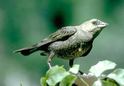
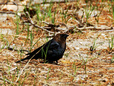
Brown-headed cowbirds are sexually dimorphic in body size and color pattern. Males are slightly larger than females, with body lengths from 19 to 22 cm, an average wingspan of 36 cm and body masses of 42 to 50 g. They have a glossy, black body and a brown head, with a pointed gray beak. Females have body lengths from 16 to 20 cm, wingspans from 32 to 38 cm and body masses of 38 to 45 g. They are dull brown and may have lightly colored streaks on their breast, with a pointed gray beak. The three subspecies including M. a. ater, M. a. artemisiae, and M. a. obscurus, are identified by beak morphology and wing cord. Male M. a. ater have a conical beak with a deeply curved upper mandible and their wing cord is between 10.4 and 11.4 cm, male M. a. artemisiae have a straight upper mandible with a wing chord greater than 11.0 cm and male M. a. obscurus have a straight upper mandible with a wing chord less than 10.5 cm. Among females, M. a. ater have a curved upper mandible and a wing chord from 9.6 to 10.1 cm, M. a. artemisiae have a straight upper mandible with a wing chord from 9.7 to 10.5 cm and female M. a. obscurus have a straight upper mandible with a wing chord less than 9.1 cm. ("Brown-headed Cowbird", 2013; Ortega, 1998; Tacutu, et al., 2013; Tekiela, 2000)
- Other Physical Features
- endothermic
- bilateral symmetry
- Sexual Dimorphism
- male larger
- sexes colored or patterned differently
- male more colorful
-
- Range mass
- 38 to 50 g
- 1.34 to 1.76 oz
-
- Range length
- 16 to 22 cm
- 6.30 to 8.66 in
-
- Range wingspan
- 32 to 38 cm
- 12.60 to 14.96 in
-
- Average basal metabolic rate
- 0.6315 cm3.O2/g/hr
-
- Average basal metabolic rate
- 0.6315 W
- AnAge
Reproduction
Mate selection is controlled by female brown-headed cowbirds. Males court females through displays and perched songs. Males give song-spread displays in which they fluff their feathers, spread their wings and bow to the female. Male selection is based on the number of displacements, song spreads and flight whistles in their repertoire, the same characteristics used to determine their social hierarchy. No single mating system describes all populations, although most studies imply a largely monogamous mating system. Almost all populations have more males than females, so females can be choosy. Males tend to be monogamous throughout the breeding season and try to maintain their pair-bond by guarding their female from other males. Females, on the other hand, tend to be promiscuous. There appears to be no reproductive advantage to mating with only one male as males do not provide food, nesting resources, protection from predation or parental care. Mating with more than one male is beneficial to a female's reproductive success, increasing the gene pool of her offspring. Males that are not in a pair-bond may mate with unguarded females, often when the female's mate is foraging. Extra-pair copulations are more frequent in populations where females have larger home ranges than males. When the female leaves her mate's home range she is no longer guarded and may therefore be more likely to copulate with another male. (Darley, 1982; Ortega, 1998)
- Mating System
- monogamous
- polygynandrous (promiscuous)
Brown-headed cowbirds are brood parasites and lay their eggs in the nest of a host species. Because their reproduction relies on hosts, their breeding season varies and is adapted to coincide with the breeding seasons of their hosts. The earliest breeding seasons begin in early to mid-April and the latest seasons end in early August, but egg laying normally occurs from May to June. The number of eggs per breeding season varies, but brown-headed cowbirds have reportedly laid up to 77 eggs in one mating season. Because they are brood parasites, the number of available host nests probably influences the number of eggs laid per breeding season. To avoid detection by the nest's host, females have developed rapid egg laying. On average, brown-headed cowbirds lay eggs in 41 seconds, compared to 20.7 to 103 minutes in other passerines. Their eggs hatch in 10 to 11.6 days. In many cases, this short incubation time allows them to hatch before host eggs and obtain food and begin growing before host hatchlings. The hatchlings of brown-headed cowbirds display exaggerated begging, which causes the host parents to feed cowbirds more than their own hatchlings. Cowbirds out-compete host hatchlings, resulting in the death of some, or all of the host's hatchlings. Fledgling brown-headed cowbirds normally leave the nest 10 to 11 days after hatching and gain independence from their foster parents at 25 to 39 days old. At this point, they find and join a flock of other brown-headed cowbirds. (Ortega, 1998; Rothstein, 2004; Tacutu, et al., 2013)
- Key Reproductive Features
- iteroparous
- seasonal breeding
- gonochoric/gonochoristic/dioecious (sexes separate)
- sexual
- oviparous
-
- Breeding interval
- Brown-headed cowbirds mate many times during the breeding season.
-
- Breeding season
- The breeding season varies with the region, but egg laying occurs most often in May and June.
-
- Range eggs per season
- 0 to 77
-
- Range time to hatching
- 10 to 11.6 days
-
- Range fledging age
- 8 to 13 days
-
- Average fledging age
- 10-11 days
-
- Range time to independence
- 25 to 39 days
-
- Average age at sexual or reproductive maturity (female)
- 1 years
-
- Average age at sexual or reproductive maturity (female)
Sex: female - 365 days
- AnAge
- Average age at sexual or reproductive maturity (female)
-
- Average age at sexual or reproductive maturity (male)
- 1 years
-
- Average age at sexual or reproductive maturity (male)
Sex: male - 365 days
- AnAge
- Average age at sexual or reproductive maturity (male)
The brood parasitic reproductive strategy of brown-headed cowbirds is believed to have evolved because early cowbirds followed bison herds and could not stay in one place long enough to care for their young. While brown-headed cowbirds have been portrayed as lazy or neglectful parents, recent evidence reveals that cowbirds take an active interest in their young. They are careful in the placement of their eggs and may continue to check on the nest. Female brown-headed cowbirds search diligently through the forest for host nests. Once a nest is found, the female inspects it and may even inspect it several times during its construction. Females also watch the host for long periods of time before laying eggs in their nest. Once eggs are laid, female cowbirds check the nest with some frequency. If a host rejects a cowbirds' egg, the female may retaliate by destroying the host's eggs or sometimes their hatchlings, this has been termed “mafia behavior”. Destroying eggs or hatchlings may discourage future rejection behavior by the host, ensuring that such behavior does not evolve. It may also stimulate the host to re-nest, allowing cowbirds another opportunity to parasitize the host. While uncommon, some brown-headed cowbirds regularly feed their hatchling in the parasitized nest, feeding only their own offspring and pecking the host's nestlings on the head when they beg for food. (Hoover and Robinson, 2007; Ortega, 1998)
- Parental Investment
- female parental care
-
pre-fertilization
- provisioning
-
protecting
- female
Lifespan/Longevity
The longest known lifespan for a wild brown-headed cowbird is 16.9 years. (Tacutu, et al., 2013)
-
- Range lifespan
Status: wild - 16.9 (high) years
- Range lifespan
-
- Average lifespan
Status: wild - 202 months
- Bird Banding Laboratory
- Average lifespan
Behavior
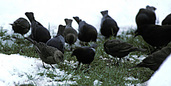
Brown-headed cowbirds are social but tend to be more solitary in the mornings. It is during this time that mating occurs, normally away from other birds and in the pair's home range. Lone females also look for host nests in the morning. In the afternoon, brown-headed cowbirds congregate in flocks to forage. During winter months, they congregate in very large flocks with other icterids and European starlings. Roosting populations may be as large as 38 million individuals. In social settings, a hierarchy is established based on the number of displacements, song spreads and flight whistles in a male's repertoire. In order to determine hierarchy, brown-headed cowbirds engage in "triangle and quadrangle ceremonies". In these activities, male cowbirds stand in a circle and give song spreads to one another to determine social status. After social status has been established, it is normally maintained by nonverbal means. In flocks, singing is performed mostly by the dominant male. This may be enforced by attacking inferior males that try to sing. (Darley, 1982; Ortega, 1998)
- Key Behaviors
- arboreal
- terricolous
- flies
- diurnal
- parasite
- motile
- migratory
- territorial
- social
- dominance hierarchies
Home Range
Brown-headed cowbirds have large home ranges because they may travel between nesting and feeding sites each day. Their home range size depends on their specific habitat, females use 4.5 ha and males use 6.6 ha in Ontario, whereas they may use 68 ha^3 in the Sierra Nevada Mountains, where they occupy an elevational gradient. Some brown-headed cowbirds reportedly travel 7 km from nesting to feeding sites each day, while others stay within the same area to nest and forage. The reproductive strategy of brown-headed cowbirds may play a role in this behavior. Due to their brood parasitic tendency, they do not need to care for their young. Freedom from parental care allows them to travel to sites with more abundant food sources. This hypothesis is supported by evidence that red-winged blackbirds, a non-parasitic species from family Icteridae, travel between nesting and foraging areas early in the breeding season, before they lay eggs. (Orians, 1961; Rothstein, et al., 1984; Orians, 1961; Ortega, 1998; Rothstein, et al., 1984)
Male brown-headed cowbirds are not known to be territorial. Rather than guard a territory, they tend to guard mates. Females, on the other hand, tend to be more territorial, although degrees of territoriality depend on their region and the density of host nests. In regions with higher densities of host nests, such as the northeastern United States, females are more territorial. Due to higher densities of nests, cowbirds are able to find many nests in a smaller home range and this is easier to defend from others. In prairie regions, such as Kansas, there is a lower density of host nests. It is not possible to obtain a home range that can be defended with the number of nests needed by females; therefore, females in these regions show little to no territoriality. (Ortega, 1998)
Communication and Perception
Brown-headed cowbirds have a variety of vocalizations, including flight whistles, single-syllable calls, perched songs, keks or chucks and chatter. These function in courtship, species and individual identification, aggression and alerts to threats. Songs are innate, at least in part. In the wild, fledglings never learn the songs of their hosts and instead learn conspecific vocalizations despite host upbringing. Males can learn perched songs even in acoustic isolation, which implies an innate component of this song. This ability is unique; the songs of most other songbirds must be learned. However, at the same time, brown-headed cowbirds are known to vary perched songs in response to the songs of other males, male aggression in response to songs and non-vocal communication of females. (Ortega, 1998; Rothstein, et al., 2000)
Flight whistles are a form of long distance communication given exclusively by males and consist of pure tones, between 3 and 9 kHz. Flight whistles vary and may include trills, they are often given before or during flight and within 5 seconds of copulation, they also function as an alarm call. Single-syllable calls are given by males and consist of a single pure tone, with a fundamental frequency between 2 and 8 kHz. Males generally have 1 or 2 in their repertoire, their functions are similar to flight whistles, but they are given more often when conspecifics are nearby. Perched songs are used exclusively by males and have a frequency range of 0.5 to 12 kHz, which is the widest frequency range of any bird song. Males have a repertoire of 1 to 8 different perched songs. When used in courtship, these songs are accompanied by a song-spread display. They also function in male to male aggression, identification and establishment of social hierarchies. Keks or chucks are short notes given by males and females. They are not detectable beyond 5 m of the bird, so relatively little is known about this vocalization. Chatter is given primarily by females and may be used in response to other vocalizations. It consists of several elements with frequencies from 2 to 6 kHz. There is little or no variation between subspecies or different populations, however, there are differences between individuals, this may imply that sounds are used in identification. (Ortega, 1998; Rothstein, et al., 2000; West, et al., 1979)
Food Habits
Brown-headed cowbirds mainly forage for food on the ground in open habitats such as grasslands. They frequently forage near herds of animals, such as cows, that stir up insects from the grass as they walk. Seventy-five percent of their diet consists of plant matter including fruits and seeds. They also feed on spiders and arthropods, such as grasshoppers, leafhoppers and beetles. During the breeding season, females eat mollusk shells to increase their calcium levels, which aids in egg production. Although both sexes eat eggs, females may do so to ingest more calcium. During the winter, their diet consists mainly of grains. ("Brown-headed Cowbird", 2013; Ortega, 1998; Reilly, Jr (ed.) and Pettingill, Jr (ed.), 1968)
- Animal Foods
- eggs
- insects
- terrestrial non-insect arthropods
- mollusks
- Plant Foods
- seeds, grains, and nuts
- fruit
Predation
Blue Jays are common egg predators, but red squirrels, northern flying squirrels and yellow-bellied sapsuckers also attack brown-headed cowbirds during incubation. Broad-winged hawks and barred owls are common predators of nestlings, as well as northern goshawks, Cooper's hawks, sharp-shinned hawks, northern saw-whet owls, blue jays and northern flying squirrels. (Cox, et al., 2012; Hannon, et al., 2009)
-
- Known Predators
-
- broad-winged Hawks (Buteo platypterus)
- barred Owls (Strix asio)
- blue jays (Cyanocitta cristata)
- red squirrels (Tamiasciurus hudsonicus)
- northern flying squirrels (Glaucomys sabrinus)
- yellow-bellied sapsucker (Sphyrapicus varius)
- northern goshawk (Accipiter gentilis)
- Cooper’s hawks (Accipiter cooperii)
- sharp-shinned hawks (Accipiter striatus)
- northern saw-whet owl (Aegolius acadicus)
Ecosystem Roles
Due to their obligate brood parasitic reproductive strategy, the reproductive activity of brown-headed cowbirds affects many populations of birds. Brown-headed cowbirds have 226 host species of all different sizes, from warblers that weigh 8 to 15 g, to blackbirds that weigh over 100 g. However, they regularly parasitize only 132 species. The most commonly utilized hosts include yellow warblers, red-eyed vireos, song sparrows, wood thrushes and common yellow throats. The reproductive success of these populations can be severely affected because parasitized nests yield reduced numbers of host offspring. This is caused by several cowbird behaviors including egg removal, egg puncturing and out-competing host hatchlings, in addition to abandonment of parasitized nests by the host. (Ortega, 1998; Rothstein, 2004; Smith, et al., 2000)
Brown-headed cowbirds pose a threat to some endangered species. This has led to the development of programs to control their populations. These programs kill thousands of cowbirds annually in an attempt to increase host populations. Control programs have been utilized to protect Kirtland's warblers, least bell's vireos, black-capped vireos and southwestern willow flycatchers. While cowbirds have some part in reducing the populations of endangered species, their actual role is probably not as large as it is portrayed. Rothstein (2004) suggests that cowbirds function as a scapegoat because endangered species populations are most affected by the disappearance of their natural habitat due to urbanization rather than by nest parasitism. (Rothstein, 2004)
- Ecosystem Impact
- disperses seeds
- parasite
- yellow warblers (Dendroica petechia)
- red-eyed vireos (Vireo olivaceus)
- song sparrows (Melospiza melodia)
- wood thrushes (Hylocichla mustelina)
- common yellow throats (Geothlypis trichas)
- Kirkland's warblers (Setophaga kirtlandii)
- least bell's vireos (Vireo bellii pusillus)
- black capped vireos (Vireo atricapilla)
- southwestern willow flycatchers (Empidonax traillii extimus)
Economic Importance for Humans: Positive
Brown-headed cowbirds help control insect populations that may be pests to humans.
- Positive Impacts
- controls pest population
Economic Importance for Humans: Negative
Control programs initiated to protect endangered bird species from brown-headed cowbirds are costly. These control programs cost taxpayers about one million dollars every year. (Rothstein, 2004)
Conservation Status
There are large numbers of brown-headed cowbirds across North America. This is due to their success in the use of a brood parasitic reproductive strategy and the expansion of their habitats through farming, deforestation and urbanization. (Ortega, 1998)
-
- IUCN Red List
-
Least Concern
More information
-
- IUCN Red List
-
Least Concern
More information
-
- US Migratory Bird Act
- No special status
-
- US Federal List
- No special status
-
- CITES
- No special status
-
- State of Michigan List
- No special status
Contributors
Brittany Byerley (author), Indiana University-Purdue University Fort Wayne, Mark Jordan (editor), Indiana University-Purdue University Fort Wayne, Leila Siciliano Martina (editor), Animal Diversity Web Staff.
Glossary
- Nearctic
-
living in the Nearctic biogeographic province, the northern part of the New World. This includes Greenland, the Canadian Arctic islands, and all of the North American as far south as the highlands of central Mexico.

- acoustic
-
uses sound to communicate
- agricultural
-
living in landscapes dominated by human agriculture.
- arboreal
-
Referring to an animal that lives in trees; tree-climbing.
- bilateral symmetry
-
having body symmetry such that the animal can be divided in one plane into two mirror-image halves. Animals with bilateral symmetry have dorsal and ventral sides, as well as anterior and posterior ends. Synapomorphy of the Bilateria.
- chemical
-
uses smells or other chemicals to communicate
- diurnal
-
- active during the day, 2. lasting for one day.
- dominance hierarchies
-
ranking system or pecking order among members of a long-term social group, where dominance status affects access to resources or mates
- endothermic
-
animals that use metabolically generated heat to regulate body temperature independently of ambient temperature. Endothermy is a synapomorphy of the Mammalia, although it may have arisen in a (now extinct) synapsid ancestor; the fossil record does not distinguish these possibilities. Convergent in birds.
- female parental care
-
parental care is carried out by females
- forest
-
forest biomes are dominated by trees, otherwise forest biomes can vary widely in amount of precipitation and seasonality.
- frugivore
-
an animal that mainly eats fruit
- granivore
-
an animal that mainly eats seeds
- herbivore
-
An animal that eats mainly plants or parts of plants.
- iteroparous
-
offspring are produced in more than one group (litters, clutches, etc.) and across multiple seasons (or other periods hospitable to reproduction). Iteroparous animals must, by definition, survive over multiple seasons (or periodic condition changes).
- migratory
-
makes seasonal movements between breeding and wintering grounds
- monogamous
-
Having one mate at a time.
- motile
-
having the capacity to move from one place to another.
- native range
-
the area in which the animal is naturally found, the region in which it is endemic.
- oviparous
-
reproduction in which eggs are released by the female; development of offspring occurs outside the mother's body.
- parasite
-
an organism that obtains nutrients from other organisms in a harmful way that doesn't cause immediate death
- polygynandrous
-
the kind of polygamy in which a female pairs with several males, each of which also pairs with several different females.
- seasonal breeding
-
breeding is confined to a particular season
- sexual
-
reproduction that includes combining the genetic contribution of two individuals, a male and a female
- social
-
associates with others of its species; forms social groups.
- suburban
-
living in residential areas on the outskirts of large cities or towns.
- tactile
-
uses touch to communicate
- temperate
-
that region of the Earth between 23.5 degrees North and 60 degrees North (between the Tropic of Cancer and the Arctic Circle) and between 23.5 degrees South and 60 degrees South (between the Tropic of Capricorn and the Antarctic Circle).
- terrestrial
-
Living on the ground.
- territorial
-
defends an area within the home range, occupied by a single animals or group of animals of the same species and held through overt defense, display, or advertisement
- tropical savanna and grassland
-
A terrestrial biome. Savannas are grasslands with scattered individual trees that do not form a closed canopy. Extensive savannas are found in parts of subtropical and tropical Africa and South America, and in Australia.
- savanna
-
A grassland with scattered trees or scattered clumps of trees, a type of community intermediate between grassland and forest. See also Tropical savanna and grassland biome.
- temperate grassland
-
A terrestrial biome found in temperate latitudes (>23.5° N or S latitude). Vegetation is made up mostly of grasses, the height and species diversity of which depend largely on the amount of moisture available. Fire and grazing are important in the long-term maintenance of grasslands.
- urban
-
living in cities and large towns, landscapes dominated by human structures and activity.
- visual
-
uses sight to communicate
References
Cornell University. 2013. "Brown-headed Cowbird" (On-line). The Cornell Lab of Ornithology: All About Birds. Accessed March 21, 2013 at http://www.allaboutbirds.org/guide/Brown-headed_Cowbird/lifehistory.
Cox, W., F. Thompson, B. Root, J. Faaborg. 2012. Declining Brown-Headed Cowbird (Molothrus ater) Populations Are Associated with Landscape-Specific Reductions in Brood Parasitism and Increases in Songbird Productivity. PLoS ONE, 7/10: e47591. Accessed May 17, 2013 at http://www.plosone.org/article/info%3Adoi%2F10.1371%2Fjournal.pone.0047591#s1.
Darley, J. 1982. Territoriality and Mating Behavior of the Male Brown-headed Cowbird. The Condor, 84/1: 15-21.
Hannon, S., S. Wilson, C. McCallum. 2009. Does cowbird parasitism increase predation risk to American redstart nests?. Oikos, 118/7: 1035-1043.
Hoover, J., S. Robinson. 2007. Retaliatory Mafia Behavior by a Parasitic Cowbird Favors Host Acceptance of Parasitic Eggs. PNAS, 104/11: 4479-4483.
Lowther, P. 2003. "Brown-headed cowbird (Molothrus ater)" (On-line). The Birds of North America Online. Accessed March 20, 2013 at http://bna.birds.cornell.edu/bna/species/047.
Orians, G. 1961. The Ecology of Blackbird (Agelaius) Social Systems. Ecological Monographs, 31/3: 285-312.
Ortega, C. 1998. Cowbirds and Other Brood Parasites. USA: The University of Arizona Press.
Peterjohn, B., J. Sauer, S. Schwarz. 2000. Temporal and Geographic Patterns in Population Trends of Brown-headed Cowbirds. Pp. 21-34 in J Smith, T Cook, S Rothstein, S Robinson, S Sealy, eds. Ecology and Management of Cowbirds and Their Hosts. Austin: University of Texas Press.
Reilly, Jr (ed.), E., O. Pettingill, Jr (ed.). 1968. The Audubon Illustrated Handbook of American Birds. USA: McGraw-Hill Book Company.
Rothstein, S. 2004. Brown-headed Cowbird: Villain or Scapegoat. Birding, 36: 374-384.
Rothstein, S., C. Farmer, J. Verner. 2000. The Structure and Function of Cowbird Vocalizations and the Use of Playbacks to Enhance Cowbird Detectability: Relations to Potential Censusing Biases. Pp. 69-80 in J Smith, T Cook, S Rothstein, S Robinson, S Sealy, eds. Ecology and Management of Cowbirds and Their Hosts. Austin: University of Texas Press.
Rothstein, S., S. Robinson. 2000. Part I Introduction: Population Trends of Cowbirds and Hosts and Relevant Methodology. Pp. 13-20 in J Smith, T Cook, S Rothstein, S Robinson, S Sealy, eds. Ecology and Management of Cowbirds and Their Hosts. Austin: University of Texas Press.
Rothstein, S., J. Verner, E. Steven. 1984. Radio-Tracking Confirms a Unique Diurnal Pattern of Spatial Occurrence in the Parasitic Brown-headed Cowbird. Ecology, 65/1: 77-88.
Rothstein, S., D. Yokel, R. Fleischer. 1986. Social Dominance, Mating and Spacing Systems, Female Fecundity, and Vocal Dialects in Captive and Free-Ranging Brown-headed Cowbirds. Current Ornithology, 3: 127-185.
Smith, J., S. Sealy, T. Cook. 2000. Part II Introduction: Cowbird Spacing Behavior, Host Selection, and Negative Consequences of Parasitism for Commonly Used Hosts. Pp. 83-86 in J Smith, T Cook, S Rothstein, S Robinson, S Sealy, eds. Ecology and Management of Cowbirds and Their Hosts. Austin: University of Texas Press.
Tacutu, R., T. Craig, A. Budovsky, D. Wuttke, G. Lehmann, D. Taranukha, J. Costa, V. Fraifeld, J. de Magalhaes. 2013. "AnAge entry for Molothrus ater" (On-line). AnAge: The Animal Ageing and Longevity Database. Accessed March 21, 2013 at http://genomics.senescence.info/species/entry.php?species=Molothrus_ater.
Tekiela, S. 2000. Birds of Indiana Field Guide. Cambridge, Minnesota: Adventure Publications.
West, M., A. King, D. Eastzer, J. Staddon. 1979. A Bioassay of Isolate Cowbird Song. Journal of Comparative and Physiological Psychology, 93/1: 124-133.