Mustelidaebadgers, otters, weasels, and relatives



Diversity
Mustelidae is the largest family within Carnivora and is comprised of 56 species in 22 genera. Members of this family include weasels, stoats, polecats, mink, marten, fishers, wolverines, otters, badgers and others. While many authors have traditionally considered skunks a subfamily within Mustelidae, recent molecular evidence indicates that skunks do not lie within the mustelid group and instead are recognized as a single family, Mephitidae, a systematic understanding which is accepted here (Dragoo and Honeycutt, 1997; Flynn et al., 2005; Marmi et. al., 2004; Sato et. al., 2003; Sato et. al., 2004). (Dragoo and Honeycutt, 1997; Flynn, et al., 2005; Marmi, et al., 2004; Nowak, 1991; Sato, et al., 2003; Sato, et al., 2004; Vaughan, et al., 2000; Whitaker and Hamilton, 1998)
Mustelids inhabit all continents except Australia and Antarctica, and do not occur on Madagascar or oceanic islands. Members of this group can be found in diverse habitats, which include both terrestrial, aquatic and marine environments. Mustelids are mainly carnivorous, with various members of the family exploiting a great diversity of both vertebrate and invertebrate prey. Mustelids are generally proficient hunters; some weasels can take prey larger than themselves. Members of this family often hunt in burrows and crevices, and some species have evolved to become adept at climbing trees (e.g., marten) or swimming (e.g., sea otters, mink) in search of prey. (Nowak, 1991; Sato, et al., 2003; Vaughan, et al., 2000; Whitaker and Hamilton, 1998)
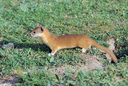
Generally, mustelids have elongate bodies with short legs and a short rostrum, as typified by weasels, ferrets, mink, and otters. Wolverines and badgers have broader bodies. An order of magnitude difference in size exists between the smallest and largest mustelid species. The smallest species is the least weasel (Mustela nivalis), weighing between 35 and 250 grams. Wolverines (Gulo gulo) and sea otters (Enhydra lutris) reach 32 kg and 45 kg, respectively. All mustelids have well developed anal scent glands, which serve various functions, including territorial marking and defense. (Hutchings and White, 2000; Nowak, 1991; Vaughan, et al., 2000)
Geographic Range
Members of the family Mustelidae inhabit all continents except Antarctica and Australia. They do not occur on Madagascar or oceanic islands, but have been introduced to New Zealand. (Dragoo and Honeycutt, 1997; Sato, et al., 2003; Vaughan, et al., 2000)
- Biogeographic Regions
- nearctic
- palearctic
- oriental
- ethiopian
- neotropical
- australian
- Other Geographic Terms
- cosmopolitan
Habitat
Mustelidae are distributed from the arctic to the tropics and occupy nearly all terrestrial habitats. Several species are semi- or nearly fully aquatic and inhabit freshwater rivers and streams, as well as coastal marine waters. (Nowak, 1991; Vaughan, et al., 2000)
- Habitat Regions
- temperate
- tropical
- polar
- terrestrial
- saltwater or marine
- freshwater
- Terrestrial Biomes
- tundra
- taiga
- desert or dune
- savanna or grassland
- chaparral
- forest
- rainforest
- scrub forest
- mountains
- Aquatic Biomes
- lakes and ponds
- rivers and streams
- coastal
- brackish water
- Other Habitat Features
- suburban
- agricultural
- riparian
- estuarine
- intertidal or littoral
Physical Description
Adult mustelids range in size from 114 mm and 25 g (least weasel) to over 1 m and 45 kg (sea otters). These animals are generally long-bodied with short legs. Most species have slender bodies, but some, like badgers (Mustelinae, Mustelinae) and wolverines have much broader bodies. The skull is elongate with a relatively short rostrum. Adult males are generally about 25 percent larger than females of the same species. The ears are short, as are the legs, each of which bears five digits. The claws do not retract and, in digging species, are especially robust. Mustelids are digitigrade or plantigrade. The dental formula varies among species: 3/3, 1/1, 2-4/2-4, 1/1-2 = 28-38. The canines are long, and the carnassials are well-developed. The upper molars are often narrow in the middle, giving them an hourglass shape. Mustelids have a powerful bite; in many species, the large postglenoid process locks the lower jaw into the upper, causing the lower jaw to only move in the vertical plane, without any rotary motion. (Nowak, 1991; Vaughan, et al., 2000; Whitaker and Hamilton, 1998)


- Other Physical Features
- endothermic
- homoiothermic
- bilateral symmetry
- Sexual Dimorphism
- male larger
Reproduction
Mating systems vary both within and among species. Many species are polygynous and/or promiscuous. Some species are social, while others are solitary. Social organization can vary within species as well. Mustelids require prolonged periods of copulation to induce ovulation of an unfertilzed egg. As a result, copulation may last for several hours before fertilization can be successful. (Amstislavsky and Ternovskaya, 2000; Johnson, et al., 2000; Vaughan, et al., 2000)
- Mating System
- polygynous
- polygynandrous (promiscuous)
Most mustelids breed seasonally, but the length of the reproductive period varies among species. Day length often dictates the onset of the breeding season, which usually lasts 3 to 4 months. Many mustelids undergo delayed implantation, with the fertilized embryo taking up to 10 months (e.g. Meles meles) to implant in the uterus in some species. Environmental conditions such as temperature and day length determine when implantation occurs. Mustelids that live in more seasonal climates are more likely to exhibit delayed implantation. Following implantation, gestation typically lasts 30 to 65 days. Females give birth to a single litter each season, the size of which varies within and among species. For example, sables have an average litter size of 2.2, but can give birth to anywhere from 1 to 7 pups. The mountain weasel averages 8.7 pups per litter, but can have between 3 and 14 young in a single bout of reproduction. Generally, mustelids are altricial, being born small and blind. They reach sexual maturity between 8 months and two years following birth. (Amstislavsky and Ternovskaya, 2000; Nowak, 1991; Thom, et al., 2004; Vaughan, et al., 2000)
- Key Reproductive Features
- iteroparous
- seasonal breeding
- gonochoric/gonochoristic/dioecious (sexes separate)
- sexual
- viviparous
- delayed implantation
Young are generally born in an alricial state, requiring extenisive care and protection from their mother. Young mustelids typically are able to care for themselves when they are about two months old. Females defend territories in order to acquire enough resources to care for their young and most often nurse and protect them in a burrow or den. (Johnson, et al., 2000; Nowak, 1991)
Lifespan/Longevity
Mustelids typically live between 5 and 20 years in the wild. (Nowak, 1991)
Behavior
Members of the family Mustelidae are either diurnal or nocturnal. Many of the long, narrow-bodied species are quick and agile, and move in a bounding, scampering fashion. The broader-bodied forms have a more lumbering gait. Some species are adept climbers, while others are excellent swimmers. Many species spend a great deal of time on the ground, searching for food in crevices, burrows, or under cover. Many species shelter in burrows. (Nowak, 1991; Vaughan, et al., 2000)
Social behavior varies both within and among species, and may vary in relation to local environmental conditions such as food availability. For example, European badgers are known to form groups with several males and females that are all reproductively active within the group. Yet in other parts of their range, European badgers may live solitarily or in pairs.Many species are territorial for at least part of the year, with individuals competing over hunting areas or access to mates (e.g., Mustela erminea). (Johnson, et al., 2000)
- Key Behaviors
- scansorial
- terricolous
- fossorial
- natatorial
- diurnal
- nocturnal
- motile
- territorial
Communication and Perception
Vision and hearing are important in Mustelidae, but olfaction is particularly well developed. In addition to using scent cues to find food, scent-marking is the main form of communication in this family. Secretions from well-developed scent glands function in territorial interactions, indicate reproductive state, and are used in other social contexts. The degree and function of scent marking varies among species, and according to social and environmental conditions within species. (Hutchings and White, 2000; Nowak, 1991; Vaughan, et al., 2000)
- Other Communication Modes
- scent marks
Food Habits
Mustelids are primarily carnivorous, but some species may at times eat plant material. A wide range of animal taxa are preyed upon by various members of this family; many mustelids are opportunistic feeders rather than specialists. However, many mustelids are especially adept at capturing small, mammalian prey. Weasels, for example, are capable of chasing and capturing rodents in their burrows. Otters are well-adapted to chasing and capturing aquatic prey, including fish, crustaceans, and other aquatic invertebrates. Mustelids hunt in a variety of terrestrial, aquatic, and arboreal habitats. Some species regularly prey on animals larger than themselves. Some species have been known to store food (e.g., Mustela, Gulo). (Nowak, 1991; Vaughan, et al., 2000)
- Primary Diet
-
carnivore
- eats terrestrial vertebrates
- piscivore
- eats eggs
- insectivore
- eats non-insect arthropods
- molluscivore
- Foraging Behavior
- stores or caches food
Predation
Mustelids are generally small carnivores, and are therefore subject to predation by larger carnivores such as canids with which they co-occur. They may also fall prey to large snakes (Serpentes), raptors (Falconiformes), and owls (Strigiformes). Some mustelids secrete noxious chemicals to discourage predators. In some of these species, aposematic color patterns can help ward off predators. (Bright, 2000; Nowak, 1991)
- Anti-predator Adaptations
- aposematic
-
- Known Predators
-
- larger carnivores Carnivora
- large snakes Serpentes
- raptors Falconiformes
- owls Strigiformes
Ecosystem Roles
Mustelids mainly impact their communities through their effects on prey populations. Many species limit rodent and bird populations. In some cases, mustelids limit rodents that are considered pests, in other cases, mustelids threaten rare bird species. Some species, such as sea otters (Enhydra lutra) are keystone predators, enhancing the diversity of their community by keeping highly competitive prey species in check. Honey badgers (or ratels, Mellivora capensis) have developed commensal relationships with both humans and honey guides (Indicator indicator), using both to aid in the location of bee colonies. (Bright, 2000; Macdonald and King, 2000; Nowak, 1991)
- Ecosystem Impact
- keystone species
Economic Importance for Humans: Positive
Many mustelids help control rodent populations that are considered to be pests. In addition, many are hunted and/or raised for their pelts, which are often considered highly valuable (e.g., the pelts of mink and sable). Some species have been domesticated and are traded as pets (e.g., ferrets). (Bright, 2000; Nowak, 1991)
- Positive Impacts
- pet trade
- body parts are source of valuable material
- controls pest population
Economic Importance for Humans: Negative
Some mustelids are considered pests, either for harming poultry livestock, for threatening other species in the wild, or for transmitting diseases. European badgers have been implicated in the transmission of bovine tuberculosis. Cattle may become infected from grazing on land where badgers have defecated. Up to 20% of badgers carry the disease in areas where bovine tuberculosis is a problem. Since 1975, badgers have been culled in the United Kingdom, but there is no conlcusive evidence that it has helped control bovine TB. As mammalian carnivores, mustelids can also be infected by, and transmit, rabies. (Bright, 2000; Gough and Rushton, 2000; Nowak, 1991)
- Negative Impacts
- causes or carries domestic animal disease
Conservation Status
Some mustelid species are considered highly threatened by the IUCN, while other species are so abundant that they are considered pests. Approximately 38% of all species of Mustelidae are considered threatened,which is a much higher proportion than mammals in general (15%). Habitat destruction is a serious risk to species with restricted habitat requirements such as otters and martens. Smaller carnivores that are restricted to small habitat fragments may also be at risk to predation by larger carnivores that can more easily move among fragments. Hunting has been a problem for some species, while others, particularly tropical mustelids, do not seem to be declining as a result. Endangered mustelids include: Colombian weasels (Mustela felipei), European mink (Mustela lutreola), Indonesian mountain weasels (Mustela lutreolina), marine otters (Lontra felina), southern river otters (Lontra provocax), sea otters (Enhydra lutris), and giant Brazilian otters (Pteronura brasiliensis). Sea mink (Neovison macrodon) became extinct in recent times. (Bright, 2000; Gough and Rushton, 2000)
Numerous re-introduction programs for various mustelid species have met with mixed success. Generally, "soft" re-introductions, those that allow the animals to acclimate to their new surroundings while in a temporary enclosure, are more successful than "hard" re-introductions, in which captive-bred animals are released directly into the wild. Black-footed ferrets (Mustela nigripes) are considered extinct in the wild, although several re-introduction programs are underway. (Bright, 2000)
-
- IUCN Red List [Link]
- Not Evaluated
Other Comments
The earliest mustelid fossils are from the Old World and have been dated to the Oligocene (33.5 – 23.8 mya) or mid-Miocene (23.8 – 5.3 mya). There is debate regarding which fossils from these epochs represent possible ancestral forms that led to Mustelidae and which fossils represent the first modern mustelids.
Contributors
Matt Wund (author), Tanya Dewey (editor), Animal Diversity Web.
Glossary
- Australian
-
Living in Australia, New Zealand, Tasmania, New Guinea and associated islands.

- Ethiopian
-
living in sub-Saharan Africa (south of 30 degrees north) and Madagascar.
- Nearctic
-
living in the Nearctic biogeographic province, the northern part of the New World. This includes Greenland, the Canadian Arctic islands, and all of the North American as far south as the highlands of central Mexico.
- Neotropical
-
living in the southern part of the New World. In other words, Central and South America.
- Palearctic
-
living in the northern part of the Old World. In otherwords, Europe and Asia and northern Africa.
- acoustic
-
uses sound to communicate
- agricultural
-
living in landscapes dominated by human agriculture.
- altricial
-
young are born in a relatively underdeveloped state; they are unable to feed or care for themselves or locomote independently for a period of time after birth/hatching. In birds, naked and helpless after hatching.
- aposematic
-
having coloration that serves a protective function for the animal, usually used to refer to animals with colors that warn predators of their toxicity. For example: animals with bright red or yellow coloration are often toxic or distasteful.
- bilateral symmetry
-
having body symmetry such that the animal can be divided in one plane into two mirror-image halves. Animals with bilateral symmetry have dorsal and ventral sides, as well as anterior and posterior ends. Synapomorphy of the Bilateria.
- bog
-
a wetland area rich in accumulated plant material and with acidic soils surrounding a body of open water. Bogs have a flora dominated by sedges, heaths, and sphagnum.
- brackish water
-
areas with salty water, usually in coastal marshes and estuaries.
- carnivore
-
an animal that mainly eats meat
- causes or carries domestic animal disease
-
either directly causes, or indirectly transmits, a disease to a domestic animal
- chaparral
-
Found in coastal areas between 30 and 40 degrees latitude, in areas with a Mediterranean climate. Vegetation is dominated by stands of dense, spiny shrubs with tough (hard or waxy) evergreen leaves. May be maintained by periodic fire. In South America it includes the scrub ecotone between forest and paramo.
- chemical
-
uses smells or other chemicals to communicate
- coastal
-
the nearshore aquatic habitats near a coast, or shoreline.
- cosmopolitan
-
having a worldwide distribution. Found on all continents (except maybe Antarctica) and in all biogeographic provinces; or in all the major oceans (Atlantic, Indian, and Pacific.
- delayed implantation
-
in mammals, a condition in which a fertilized egg reaches the uterus but delays its implantation in the uterine lining, sometimes for several months.
- desert or dunes
-
in deserts low (less than 30 cm per year) and unpredictable rainfall results in landscapes dominated by plants and animals adapted to aridity. Vegetation is typically sparse, though spectacular blooms may occur following rain. Deserts can be cold or warm and daily temperates typically fluctuate. In dune areas vegetation is also sparse and conditions are dry. This is because sand does not hold water well so little is available to plants. In dunes near seas and oceans this is compounded by the influence of salt in the air and soil. Salt limits the ability of plants to take up water through their roots.
- diurnal
-
- active during the day, 2. lasting for one day.
- endothermic
-
animals that use metabolically generated heat to regulate body temperature independently of ambient temperature. Endothermy is a synapomorphy of the Mammalia, although it may have arisen in a (now extinct) synapsid ancestor; the fossil record does not distinguish these possibilities. Convergent in birds.
- estuarine
-
an area where a freshwater river meets the ocean and tidal influences result in fluctuations in salinity.
- forest
-
forest biomes are dominated by trees, otherwise forest biomes can vary widely in amount of precipitation and seasonality.
- fossorial
-
Referring to a burrowing life-style or behavior, specialized for digging or burrowing.
- freshwater
-
mainly lives in water that is not salty.
- insectivore
-
An animal that eats mainly insects or spiders.
- intertidal or littoral
-
the area of shoreline influenced mainly by the tides, between the highest and lowest reaches of the tide. An aquatic habitat.
- introduced
-
referring to animal species that have been transported to and established populations in regions outside of their natural range, usually through human action.
- iteroparous
-
offspring are produced in more than one group (litters, clutches, etc.) and across multiple seasons (or other periods hospitable to reproduction). Iteroparous animals must, by definition, survive over multiple seasons (or periodic condition changes).
- keystone species
-
a species whose presence or absence strongly affects populations of other species in that area such that the extirpation of the keystone species in an area will result in the ultimate extirpation of many more species in that area (Example: sea otter).
- marsh
-
marshes are wetland areas often dominated by grasses and reeds.
- molluscivore
-
eats mollusks, members of Phylum Mollusca
- motile
-
having the capacity to move from one place to another.
- mountains
-
This terrestrial biome includes summits of high mountains, either without vegetation or covered by low, tundra-like vegetation.
- natatorial
-
specialized for swimming
- nocturnal
-
active during the night
- oriental
-
found in the oriental region of the world. In other words, India and southeast Asia.
- pet trade
-
the business of buying and selling animals for people to keep in their homes as pets.
- piscivore
-
an animal that mainly eats fish
- polar
-
the regions of the earth that surround the north and south poles, from the north pole to 60 degrees north and from the south pole to 60 degrees south.
- polygynandrous
-
the kind of polygamy in which a female pairs with several males, each of which also pairs with several different females.
- polygynous
-
having more than one female as a mate at one time
- rainforest
-
rainforests, both temperate and tropical, are dominated by trees often forming a closed canopy with little light reaching the ground. Epiphytes and climbing plants are also abundant. Precipitation is typically not limiting, but may be somewhat seasonal.
- riparian
-
Referring to something living or located adjacent to a waterbody (usually, but not always, a river or stream).
- saltwater or marine
-
mainly lives in oceans, seas, or other bodies of salt water.
- scent marks
-
communicates by producing scents from special gland(s) and placing them on a surface whether others can smell or taste them
- scrub forest
-
scrub forests develop in areas that experience dry seasons.
- seasonal breeding
-
breeding is confined to a particular season
- sexual
-
reproduction that includes combining the genetic contribution of two individuals, a male and a female
- stores or caches food
-
places a food item in a special place to be eaten later. Also called "hoarding"
- suburban
-
living in residential areas on the outskirts of large cities or towns.
- swamp
-
a wetland area that may be permanently or intermittently covered in water, often dominated by woody vegetation.
- tactile
-
uses touch to communicate
- taiga
-
Coniferous or boreal forest, located in a band across northern North America, Europe, and Asia. This terrestrial biome also occurs at high elevations. Long, cold winters and short, wet summers. Few species of trees are present; these are primarily conifers that grow in dense stands with little undergrowth. Some deciduous trees also may be present.
- temperate
-
that region of the Earth between 23.5 degrees North and 60 degrees North (between the Tropic of Cancer and the Arctic Circle) and between 23.5 degrees South and 60 degrees South (between the Tropic of Capricorn and the Antarctic Circle).
- terrestrial
-
Living on the ground.
- territorial
-
defends an area within the home range, occupied by a single animals or group of animals of the same species and held through overt defense, display, or advertisement
- tropical
-
the region of the earth that surrounds the equator, from 23.5 degrees north to 23.5 degrees south.
- tropical savanna and grassland
-
A terrestrial biome. Savannas are grasslands with scattered individual trees that do not form a closed canopy. Extensive savannas are found in parts of subtropical and tropical Africa and South America, and in Australia.
- savanna
-
A grassland with scattered trees or scattered clumps of trees, a type of community intermediate between grassland and forest. See also Tropical savanna and grassland biome.
- temperate grassland
-
A terrestrial biome found in temperate latitudes (>23.5° N or S latitude). Vegetation is made up mostly of grasses, the height and species diversity of which depend largely on the amount of moisture available. Fire and grazing are important in the long-term maintenance of grasslands.
- tundra
-
A terrestrial biome with low, shrubby or mat-like vegetation found at extremely high latitudes or elevations, near the limit of plant growth. Soils usually subject to permafrost. Plant diversity is typically low and the growing season is short.
- visual
-
uses sight to communicate
- viviparous
-
reproduction in which fertilization and development take place within the female body and the developing embryo derives nourishment from the female.
- young precocial
-
young are relatively well-developed when born
References
Amstislavsky, S., Y. Ternovskaya. 2000. Reproduction in Mustelids. Animal Reproduction Science, 60-61: 571-581.
Bright, P. 2000. Lessons from lean beasts: conservation biology of the mustelids. Mammal Review, 30: 217-226.
Dragoo, J., R. Honeycutt. 1997. Systematics of mustelid-like carnivores. Journal of Mammalogy, 78: 426-443.
Flynn, J., J. Finarelli, S. Zehr, J. Hsu, M. Nedbal. 2005. Molecular phylogeny of the Carnivora (Mammalia): Assessing the impact of increased sampling on resolving enigmatic relationships. Systematic Biology, 54: 317-337.
Gough, M., S. Rushton. 2000. The application of GIS-modelling to mustelid landscape ecology. Mammal Review, 30: 197-216.
Hutchings, M., P. White. 2000. Mustelid scent-marking in managed ecosystems: implications for population management. Mammal Review, 30: 157-169.
Johnson, D., D. MacDonald, A. Dickman. 2000. An analysis and review of models of the sociobiology of the Mustelidae. Mammal Review, 30: 171-196.
Koepfli, K., R. Wayne. 2003. Type I Sts markers are more informative than cytochrome b in phylogenetic reconstruction of the Mustelidae (Mammalia: Carnivora). Systematic Biology, 52: 571-593.
Macdonald, R., C. King. 2000. Biology of mustelids: reviews and future directions. Mammal Review, 30/3-4: 145.
Marmi, J., J. Lopez-Giraldez, X. Domingo-Roura. 2004. Phylogeny, evolutionary history and taxonomy of the Mustelidae based on sequences of the cytochrome b gene and a complex repetitive flanking region. Zoologica Scripta, 33: 481-499.
Nowak, R. 1991. Carnivora: family Mustelidae. Pp. 1104-1105 in Walker's Mammals of the World, Vol. 2, 5th Edition. Baltimore: Johns Hopkins University Press.
Sato, J., T. Hosada, W. Mieczyslaw, K. Tsuchiya, Y. Yamamoto, H. Suzuki. 2003. Phylogenetic relationships and divergence times among mustelids (Mammalia: Carnivora) based on nucleotide sequences of the nuclear interphotoreceptor retinoid binding protein and mitochondrial cytochrome b genes. Zoologial Science, 20: 243-264.
Sato, J., T. Hosada, M. Wolsan, H. Suzuki. 2004. Molecular phylogeny of arctoids (Mammalia: Carnivora) with emphasis on phylogenetic and taxonomic positions of the ferret-badgers and skunks. Zoologial Science, 21: 111-118.
Thom, M., D. Johnson, D. Macdonald. 2004. Evolution and delayed implantation in the Mustelidae (Mammalia: Carnivora). Evolution, 58/1: 175-183.
Vaughan, T., J. Ryan, N. Czaplewski. 2000. Mammalogy, 4th Edition. Toronto: Brooks Cole.
Whitaker, J., W. Hamilton. 1998. Mammals of the Eastern United States. Ithaca: Comstock Publishing.
Wilson, D., D. Reeder. 1993. Mammal Species of the World, A Taxonomic and Geographic Reference. Washington, D.C.: Smithsonian Institution Press. Accessed July 01, 2005 at http://nmnhgoph.si.edu/msw/.