Vulpes zerdafennec
Geographic Range
The largest populations of Vulpes zerda occur in the central Sahara, though the species can be found in mountainous and desert regions from northern Morocco (roughly 35 degrees N latitude), east along the northern tip of the Red Sea to Kuwait, and south into northern Nigeria and Chad (15 degrees N latitude). ("Fennec fox", 2004; Kingdon, 1997; Smith, 1985; Zimen, 1990)
- Biogeographic Regions
- palearctic
- ethiopian
Habitat
Fennecs are highly specialized to desert life and found almost exclusively in arid, sandy regions. The presence of desert grasses and/or light scrub vegetation is important, as fennecs use these plants to bolster, shelter, and line their dens. Fennecs are so well adapted to their Saharan climate that they need not drink. In times of need, however, nearby vegetation is a handy source of water and may be eaten. ("Fennec Fox", 2004a; Kingdon, 1997; Osborn, 1998)
- Habitat Regions
- temperate
- tropical
- terrestrial
- Terrestrial Biomes
- desert or dune
Physical Description
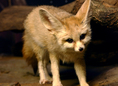
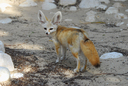
Fennecs are the smallest of the canids. They range in size from 0.8 kg in vixens to 1.5 kg in males. They are smaller than an average house cat. Tail length is between 18 and 30 cm, and accounts for nearly 60 percent of the 30 to 40 cm body length. Standing 18 to 22 cm at the shoulder, fennecs are significantly shorter than other African foxes, which average a shoulder height of 30 cm. Not enough is known about fennecs to state conclusively whether they are sexually dimorphic. The family Canidae, however, exhibits the limited sexual dimorphism common in groups of mostly monogamous species. Since V. zerda is monogamous, it is reasonable to assume this species follows the pattern of slight sexual dimorphism. ("Fennec fox", 2004; "Fennec Fox", 2004b; Estes, 1991; Kingdon, 1997; Smith, 1985; Zimen, 1990)
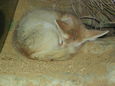
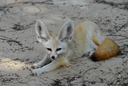
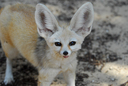
The ears of fennecs are perhaps their most distinctive feature. Massive in proportion to the skull, the large, 15 cm long pinnae are used both to dissipate heat and to locate prey moving under the sand. Enlarged auditory bullae also serve this latter purpose. Fur in adults is thick and silky, buff-colored on the dorsal surface and white along the animal’s legs, face, ear-linings and underside. In contrast, juveniles are downy and almost exclusively white. The fur over the violet gland - found in all foxes, and of unknown function - is black or dark brown. This is also the color of the fur on the tip of the tail. The feet are heavily furred, protecting the pads from the hot desert sand. The eyes, rhinal pad, and vibrissae of fennecs are all black. Dentition is weak, similar to that in bat-eared foxes. ("Fennec fox", 2004; "Fennec Fox", 2004a; "Fennec Fox", 2004b; Estes, 1991; Kingdon, 1997; Osborn, 1998; Smith, 1985; Zimen, 1990)
- Other Physical Features
- endothermic
- homoiothermic
- bilateral symmetry
- Sexual Dimorphism
- male larger
-
- Range mass
- 0.8 to 1.5 kg
- 1.76 to 3.30 lb
-
- Average mass
- 1.5 kg
- 3.30 lb
-
- Range length
- 30 to 40 cm
- 11.81 to 15.75 in
-
- Average length
- 30 cm
- 11.81 in
-
- Average basal metabolic rate
- 2.693 W
- AnAge
Reproduction
Little is known about how fennecs attract or defend their mates, though reproductive opportunity may be affected by social position. It is possible that only dominant males pair with females. The breeding season runs from January to February, but vixens remain in estrus for only a few days. Fennecs mate for life. This monogamous pairing leads to a social structure in which each breeding couple (or family- fennec parents often enlist the aid of older siblings in caring for offspring) have their own territory. This territory is bounded by urine and piles of fecal matter. Fennecs are vigorous defenders of both territory and pups. ("Fennec fox", 2004; "Fennec Fox", 2004a; "Fennec Fox", 2004b; Kingdon, 1997; Zimen, 1990)
- Mating System
- monogamous
- cooperative breeder
The breeding season of V. zerda begins in mid winter (January to February), and pups are born after a gestation period of 50 to 53 days. 50 days is the average gestation. Fennecs have a slow reproductive rate, and vixens give birth only once yearly. Their litters are relatively small, usually containing only 2 to 4 altricial pups (although 5 and even 6 are not entirely uncommon). At birth, the blind and helpless offspring weigh 50 g. Their mother attends them in the den for the first 2 weeks, until their eyes open. At 4 weeks the pups begin to play within the den. At 5 weeks play extends to the area just outside the den entrance. The pups of V. zerda suckle longer than those of most foxes, and weaning may not occur until nearly 3 months of age. Young may be licked, carried, and closely watched for up to 70 days. Sexual maturity comes with the attainment of adult size at 6 to 9 months of age. (Zimen, 1990; "Fennec fox", 2004; "Fennec Fox", 2004a; "Fennec Fox", 2004b; Kingdon, 1997; Smith, 1985; Zimen, 1990)
- Key Reproductive Features
- iteroparous
- seasonal breeding
- gonochoric/gonochoristic/dioecious (sexes separate)
- sexual
- fertilization
- viviparous
-
- Breeding interval
- Fennecs breed once yearly
-
- Breeding season
- Breeding occurs in January and February.
-
- Range number of offspring
- 1 to 6
-
- Average number of offspring
- 3
-
- Average number of offspring
- 2.2
- AnAge
-
- Range gestation period
- 50 to 53 days
-
- Average gestation period
- 50 days
-
- Range weaning age
- 30 to 90 days
-
- Range time to independence
- 6 to 9 months
-
- Average time to independence
- 6 months
-
- Range age at sexual or reproductive maturity (female)
- 6 to 9 months
-
- Average age at sexual or reproductive maturity (female)
- 6 months
-
- Range age at sexual or reproductive maturity (male)
- 6 to 9 months
-
- Average age at sexual or reproductive maturity (male)
- 6 months
The low birth rate and slow reproductive recovery of declining fennec populations means that fennec parents have a high reproductive investment in their altricial pups. Vixens give continuous care for the two weeks following birth. Father and mother work together during the prolonged rearing of the young. Males bring food to the family and watch for dangers to playing pups. Fennecs are very aggressive in the defense of their young, and added protection for the pups may be a reason to maintain community structure. Though weaned at as early as one month, fennec offspring require care and supervison for a much longer period. Full independence is not attained until roughly 6 months of age. ("Fennec fox", 2004; "Fennec Fox", 2004a; Kingdon, 1997; Zimen, 1990)
- Parental Investment
- altricial
-
pre-fertilization
- provisioning
-
protecting
- female
-
pre-hatching/birth
-
provisioning
- female
-
protecting
- female
-
provisioning
-
pre-weaning/fledging
-
provisioning
- male
- female
-
protecting
- male
- female
-
provisioning
-
pre-independence
-
provisioning
- male
- female
-
protecting
- male
- female
-
provisioning
- post-independence association with parents
- extended period of juvenile learning
Lifespan/Longevity
Fennecs can live for up to 10 years in the wild, a common lifespan among African foxes. Captive fennecs may survive for up to 12 years. ("Fennec fox", 2004; Smith, 1985)
-
- Range lifespan
Status: wild - 10 (high) years
- Range lifespan
-
- Range lifespan
Status: captivity - 12 (high) years
- Range lifespan
-
- Typical lifespan
Status: wild - 10 (high) years
- Typical lifespan
-
- Typical lifespan
Status: captivity - 12 (high) years
- Typical lifespan
Behavior
Fennecs are highly social animals, living together in family groups which may contain up to 10 individuals. These kin-based clans usually include at least one breeding pair, a litter of immature pups, and perhaps a few of the pups’ older siblings. Territory is marked by both urine and scat. Dominant males urinate more at amrking sites than their submissive fellows.
The gregarious nature of fennecs is evident in their frequent and varied vocalizations. Both adults and pups chatter, whimper, wail, growl and shriek. Howls are brief and loud, descending in pitch and repeated many times.
Fennecs often engage in play and prove remarkably agile for their small stature. A full-grown adult can jump straight up to 0.7 m, and over 1 m from the standing position. This trait helps fennecs capture prey. ("Fennec Fox", 2004a; Kingdon, 1997; Zimen, 1990)
Nocturnal hunters, fennecs need places to sleep during the day in which they will be sheltered from the hot desert sun. For this purpose they dig burrows. These dens are also used to rear pups. Often they become extensive tunnel systems and may posses several entrances from which the fennecs can flee should enemies arrive. Burrows are usually dug beneath desert bushes, allowiing the roots of the plants to provide support for tunnel walls. Leaves are used to line the vixen’s nesting chamber.
In some instances several fennec families may live together, sharing a complex den. Even when this cohabitation occurs, fennecs, like other foxes, still prefer to hunt alone. Their predatory method is the stalk-spring-pounce. Fennecs are opportunistic feeders, and cache food for future use. They remember these cache sites well from season to season. ("Fennec Fox", 2004a; Kingdon, 1997; Zimen, 1990)
- Key Behaviors
- terricolous
- nocturnal
- motile
- sedentary
- territorial
- social
- dominance hierarchies
Home Range
The size of fennec home ranges has not been reported.
Communication and Perception
Vulpes zerda perceives its environment primarily through highly developed senses of hearing and smell. The enormous ears are able to filter sound through many centimeters of sand, and can detect subtle differences between whines and whimpers in the calls of other fennecs. Night vision is enhanced by a reflective retina called a tapetum. This adaptation creates the illusion of glowing eyes and is characteristic of nocturnal animals.
Social rank among fennecs is communicated mainly through play. As social animals, they use visual and tactile communication. ("Fennec Fox", 2004a; "Fennec Fox", 2004b; Kingdon, 1997; Zimen, 1990)
- Other Communication Modes
- pheromones
- scent marks
Food Habits
Fennecs have small carnassial teeth. They obtain much of their food through digging, and, as omnivores in a desert environment, will consume almost anything that makes itself available. Small rodents, lizards, birds, eggs, and insects are all common prey. Fruit, leaves and roots are an important part of the diet of V. zerda, as they provide almost 100 percent of the animal’s hydration. Fennecs can go indefinitely without free water, and are known to cache extra food. ("Fennec fox", 2004; "Fennec Fox", 2004b; Kingdon, 1997; Osborn, 1998)
- Primary Diet
- omnivore
- Animal Foods
- birds
- mammals
- reptiles
- eggs
- carrion
- insects
- terrestrial non-insect arthropods
- Plant Foods
- leaves
- roots and tubers
- fruit
- Foraging Behavior
- stores or caches food
Predation
Little is known about what animals prey on fennecs, though it seems safe to assume that some do. Fennec dens are designed for quick escape, and the sand-colored fur which aids stalking of prey may also help them evade detection by larger, fiercer animals. Excellent hearing surely allows V. zerda to locate and avoid predators. ("Fennec Fox", 2004a; Kingdon, 1997; Osborn, 1998)
- Anti-predator Adaptations
- cryptic
Ecosystem Roles
Fennecs are predators, reducing the number of small mammals, birds, reptiles, insects, and other terrestrial invertebrates found within their home territories. They may strip the leaves off scrub vegetation, but there is no evidence that this behavior causes permanent damage to the plants. ("Fennec fox", 2004; "Fennec Fox", 2004a; "Fennec Fox", 2004b; Estes, 1991; Kingdon, 1997; Osborn, 1998)
Economic Importance for Humans: Positive
Fennecs are distributed to zoos and as personal pets. ("Fennec Fox", 2004a; "Fennec Fox", 2004b)
- Positive Impacts
- pet trade
Economic Importance for Humans: Negative
Fennecs do not have any known negative impact on humans, and why native peoples of the Sahara are hunting them into decline remains unclear. ("Fennec fox", 2004; Zimen, 1990)
Conservation Status
Fennecs once ranged broadly over northern Africa, but sport hunting and intrusion by humans are shrinking their habitat and increasing their scarcity. The IUCN Red List cites fennecs as Data deficient. CITES places fennecs in Appendix II in Austria, and Appendix III in Denmark and Tunisia. ("Fennec fox", 2004; Zimen, 1990)
-
- IUCN Red List
-
Least Concern
More information
-
- IUCN Red List
-
Least Concern
More information
-
- US Federal List
- No special status
-
- CITES
- Appendix II Appendix III
Other Comments
Interestingly, fennecs raised in the lab often dig or attempt to dig within their cages - evidence that this behavior is intuitive, rather than learned. ("Fennec Fox", 2004b)
Contributors
Nancy Shefferly (editor), Animal Diversity Web.
Rebecca Adams (author), University of Michigan-Ann Arbor, Phil Myers (editor, instructor), Museum of Zoology, University of Michigan-Ann Arbor.
Glossary
- Ethiopian
-
living in sub-Saharan Africa (south of 30 degrees north) and Madagascar.

- Palearctic
-
living in the northern part of the Old World. In otherwords, Europe and Asia and northern Africa.
- acoustic
-
uses sound to communicate
- altricial
-
young are born in a relatively underdeveloped state; they are unable to feed or care for themselves or locomote independently for a period of time after birth/hatching. In birds, naked and helpless after hatching.
- bilateral symmetry
-
having body symmetry such that the animal can be divided in one plane into two mirror-image halves. Animals with bilateral symmetry have dorsal and ventral sides, as well as anterior and posterior ends. Synapomorphy of the Bilateria.
- carrion
-
flesh of dead animals.
- chemical
-
uses smells or other chemicals to communicate
- cooperative breeder
-
helpers provide assistance in raising young that are not their own
- cryptic
-
having markings, coloration, shapes, or other features that cause an animal to be camouflaged in its natural environment; being difficult to see or otherwise detect.
- desert or dunes
-
in deserts low (less than 30 cm per year) and unpredictable rainfall results in landscapes dominated by plants and animals adapted to aridity. Vegetation is typically sparse, though spectacular blooms may occur following rain. Deserts can be cold or warm and daily temperates typically fluctuate. In dune areas vegetation is also sparse and conditions are dry. This is because sand does not hold water well so little is available to plants. In dunes near seas and oceans this is compounded by the influence of salt in the air and soil. Salt limits the ability of plants to take up water through their roots.
- dominance hierarchies
-
ranking system or pecking order among members of a long-term social group, where dominance status affects access to resources or mates
- endothermic
-
animals that use metabolically generated heat to regulate body temperature independently of ambient temperature. Endothermy is a synapomorphy of the Mammalia, although it may have arisen in a (now extinct) synapsid ancestor; the fossil record does not distinguish these possibilities. Convergent in birds.
- fertilization
-
union of egg and spermatozoan
- iteroparous
-
offspring are produced in more than one group (litters, clutches, etc.) and across multiple seasons (or other periods hospitable to reproduction). Iteroparous animals must, by definition, survive over multiple seasons (or periodic condition changes).
- monogamous
-
Having one mate at a time.
- motile
-
having the capacity to move from one place to another.
- native range
-
the area in which the animal is naturally found, the region in which it is endemic.
- nocturnal
-
active during the night
- omnivore
-
an animal that mainly eats all kinds of things, including plants and animals
- pet trade
-
the business of buying and selling animals for people to keep in their homes as pets.
- pheromones
-
chemicals released into air or water that are detected by and responded to by other animals of the same species
- scent marks
-
communicates by producing scents from special gland(s) and placing them on a surface whether others can smell or taste them
- seasonal breeding
-
breeding is confined to a particular season
- sedentary
-
remains in the same area
- sexual
-
reproduction that includes combining the genetic contribution of two individuals, a male and a female
- social
-
associates with others of its species; forms social groups.
- stores or caches food
-
places a food item in a special place to be eaten later. Also called "hoarding"
- tactile
-
uses touch to communicate
- temperate
-
that region of the Earth between 23.5 degrees North and 60 degrees North (between the Tropic of Cancer and the Arctic Circle) and between 23.5 degrees South and 60 degrees South (between the Tropic of Capricorn and the Antarctic Circle).
- terrestrial
-
Living on the ground.
- territorial
-
defends an area within the home range, occupied by a single animals or group of animals of the same species and held through overt defense, display, or advertisement
- tropical
-
the region of the earth that surrounds the equator, from 23.5 degrees north to 23.5 degrees south.
- visual
-
uses sight to communicate
- viviparous
-
reproduction in which fertilization and development take place within the female body and the developing embryo derives nourishment from the female.
References
2004. "Fennec Fox" (On-line). Mammals of the San Antonio Zoo. Accessed February 04, 2004 at http://www.sazoo-aq.org/02meet/02sublinks/fennec.html.
2004. "Fennec Fox" (On-line). The Chaffee Zoo. Accessed February 04, 2004 at http://www.chaffeezoo.org/animals/fennec.htm.
2004. "Fennec fox" (On-line). BBC Nature Facts. Accessed February 04, 2004 at http://www.bbc.co.uk/nature/wildfacts/factfiles/146.shtml.
Estes, R. 1991. The Behavior Guide to African Mammals. Berkeley & Los Angeles, CA: University of California Press.
Kingdon, J. 1997. The Kingdon Field Guide to African Mammals. San Diego, CA: Academic Press.
Osborn, D. 1998. The Mammals of Ancient Egypt. Westminster, England: Aris & Phillips Ltd.
Smith, S. 1985. The Atlas of Africa's Principal Mammals. Republic of South Africa: Natural History Books.
Zimen, E. 1990. Fennec. Pp. 131-132 in B Grzimek, ed. Fennec, Vol. 4, Second Edition. New York: McGraw-Hill.