Vombatidaewombats
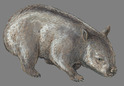
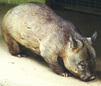

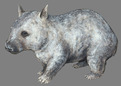

This family of marsupials contains 2 genera and 3 species, all Australian. Like other members of the Diprotodontia, they are syndactylous and diprotodont.


Wombats are medium to large size animals (19-39 kg) with a stocky body, short limbs, small ears, and a very short tail. The head is compactly built and is used in constructing tunnels. The limbs are especially powerfully, with short broad feet and strong, flat claws (except on the hallux, which is vestigial). Posture is plantigrade. Wombats are burrowers, building impressive burrow systems with many burrows. Some burrows exceed 20 m in length.

Wombats have a remarkably rodent-like skull. They have a single pair of incisors. These teeth are heavily built and rodent-like in form. Also like the incisors of rodents, the incisors of wombats have enamel on anterior and lateral surfaces only. The incisors are followed by a large diastema. The cheek teeth are hypsodont and unrooted. The molars are relatively simple; their surfaces contain two major lophs ( bilophodont). The dental formula is 1/1, 0,0, 1/1, 4/4 = 24. On the skull itself, the coronoid process of dentary reduced and the masseter is the primary muscle used in mastication. Wombats have a strongly built zygomatic arch and short rostrum.


The pouch of wombats is well developed, but it is oriented so that it opens to the rear, rather than forward as is more usual in marsupials. The embryo forms an allantoic placenta, as is true of at least some peramelids and koalas but not other marsupials.
Wombats are strictly herbivorous grazers; they have a simple stomach and a short, broad cecum.
Koalas and wombats are probably each other's closest relatives. Some of the characteristics they share include pouch opening to rear, vestigial tail, presence of a peculiar glandular patch in the stomach, formation of a placenta, loss of some premolars, and details of muscle morphology. A close relationship has also been suggested by molecular studies.
During the Pleistocene, herds of giant wombats the size of a rhinoceros roamed the plains of southern Australia.
Literature and references cited
Feldhamer, G. A., L. C. Drickamer, S. H. Vessey, and J. F. Merritt. 1999. Mammalogy. Adaptation, Diversity, and Ecology. WCB McGraw-Hill, Boston. xii+563pp.
Marshall, L. G. 1984. Monotremes and marsupials. Pp 59-115 in Anderson, S. and J. Knox Jones, eds, Orders and Families of Recent Mammals of the World. John Wiley and Sons, NY. xii+686 pp.
Strahan, R. (ed.). 1995. Mammals of Australia. Smithsonian Institution Press, Washington, D.C. 756 pp.
Vaughan, T. A. 1986. Mammalogy. Third Edition. Saunders College Publishing, Fort Worth. vi+576 pp.
Vaughan, T. A., J. M. Ryan, N. J. Czaplewski. 2000. Mammalogy. Fourth Edition. Saunders College Publishing, Philadelphia. vii+565pp.
Wilson, D. E., and D. M. Reeder. 1993. Mammal Species of the World, A Taxonomic and Geographic Reference. 2nd edition. Smithsonian Institution Press, Washington. xviii+1206 pp.
Contributors
Phil Myers (author), Museum of Zoology, University of Michigan-Ann Arbor.
Glossary
- bilateral symmetry
-
having body symmetry such that the animal can be divided in one plane into two mirror-image halves. Animals with bilateral symmetry have dorsal and ventral sides, as well as anterior and posterior ends. Synapomorphy of the Bilateria.
- chemical
-
uses smells or other chemicals to communicate
- endothermic
-
animals that use metabolically generated heat to regulate body temperature independently of ambient temperature. Endothermy is a synapomorphy of the Mammalia, although it may have arisen in a (now extinct) synapsid ancestor; the fossil record does not distinguish these possibilities. Convergent in birds.
- motile
-
having the capacity to move from one place to another.
- sexual
-
reproduction that includes combining the genetic contribution of two individuals, a male and a female
- tactile
-
uses touch to communicate