Vanessa atalanta



Geographic Range
The range of Red Admirals extends around the Northern Hemisphere, from northern Canada to Guatemala in the western hemisphere, and from Scandinavia and northern Russia south to North Africa and China in the east. It is established on Bermuda, the Azores, and the Canary Islands in the Atlantic, and the Hawaiian islands in the Pacific. It has been introduced to and breeds in New Zealand as well. (Opler, et al., 2009)
- Biogeographic Regions
- nearctic
- palearctic
- oriental
- neotropical
- oceanic islands
- Other Geographic Terms
- holarctic
Habitat
Red Admirals tend to be found in moist environments such as marshes, woods, fields, and well-watered gardens. These butterflies cannot stand extreme winter cold and are forced to migrate southward during the winter months to warmer climates. During this migration they can be found in habitats ranging from subtropics to tundras. The caterpillars of this species live on the plants they feed on (see Food Habits below). (Hubbell, 1993; Opler, et al., 2009)
- Habitat Regions
- temperate
- terrestrial
- Terrestrial Biomes
- savanna or grassland
- forest
- Wetlands
- marsh
- Other Habitat Features
- suburban
Physical Description
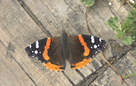
The characteristic coloration of the Red Admiral Butterfly is a black hindwing with a red-orange marginal band; the dorsal forewing is also black with white markings near the apex. The wing span of the Red Admiral ranges between 1.75 and 3 inches. These butterflies tend to have a brighter coloration and a larger body mass during the summer months than during the winter. The legs and eyes of the Red Admiral tend to be hairy and the head is moderately large.
A mature caterpillar of the larvae stage is cylindrical in shape and has branching spines arranged in rows lengthwise. (Holland, 1907; Opler, et al., 2009)
- Other Physical Features
- ectothermic
- heterothermic
- bilateral symmetry
Reproduction
Male Red Admirals are territorial butterflies that patrol their areas in order to find female mates. The males typically perch upon sunlit spots, in the mid-afternoon, to wait for females to fly by. Once fertilized, female Red Admirals will lay their eggs on the upper surface of host plant leaves. The majority of Red Admiral butterflies are double-brooded (two generations grow a year); however, in Canada and the northern part of the United States they are single-brooded (one generation a year), and in the southern United States they are triple-brooded (three generations a year).
The general life cycle of the Red Admiral butterfly goes from an egg, to a caterpillar (pupate in a chrysalis), that emerges as an adult. The adult then mates, oviposits, and starts the cycle again. (Bitzer, 2009; Hubbell, 1993)
- Key Reproductive Features
- semelparous
- seasonal breeding
- gonochoric/gonochoristic/dioecious (sexes separate)
- sexual
- fertilization
- oviparous
Behavior
Red Admirals are considered to be people-friendly butterflies that will approach and perch on human beings. In regard to other butterflies of their species, however, the male butterflies are known to be territorial in order to find a mate. Male Red Admirals generally claim an elliptically shaped area ranging between 4-13 m wide and 8-24 m long. To protect this area, the males will patrol their territorial boundaries up to thirty times an hour. If an intruder enters their area, they attempt to drive them away by out-flying and out-maneuvering the intruding butterfly.
Red Admirals tend to be fidgety and swift insects that rapidly change direction throughout the course of their flight. The species appears to be most active throughout the spring and fall months, its flight time lasts from March until November. Adult Red Admirals will hibernate throughout the winter months. (Bitzer, 2009; Opler, et al., 2009)
- Key Behaviors
- flies
- diurnal
- migratory
- hibernation
- territorial
Food Habits
Mature Red Admirals tend to feed on fermenting fruits, bird droppings, and sap from trees. Adult Red Admirals are fond of nectaring at composite flowers, such as milkweed, aster, and alfalfa. The food sources for the larva include nettles from the genus Urtica, pellitory from the genus Parietoria, and hops from the genus Humulus. (Kellogg, 1906; Opler, et al., 2009)
- Primary Diet
- herbivore
- Plant Foods
- leaves
- nectar
- flowers
- sap or other plant fluids
Economic Importance for Humans: Positive
The aesthetic beauty of the Red Admiral is one of the most underrated values of this species. Due to the Red Admirals wide-spread range throughout the Americas, Europe, and Asia, their beauty can be enjoyed by many. Red Admirals are often found nectaring at red clover, aster, and Buddleia flowers; this combination of flowers and butterflies further enhances their aesthetic value. (Opler, et al., 2009; Parenti, 1977)
Economic Importance for Humans: Negative
The adult stage of the Red Admiral is rarely harmful because mature Red Admiral butterflies feed mainly on nectar. The caterpillar stage, however, damages the plants that it feeds on, though it is not generally known to be an agricultural pest. The plants the Red Admiral caterpillars tend to eat include nettles, hops, and pellitory. (Opler, et al., 2009; Parenti, 1977)
Conservation Status
The red admiral butterfly may appear to be rare at the outer edges of its range, but it is thought to be a secure species globally. (Opler, et al., 2009)
-
- IUCN Red List
- Not Evaluated
-
- US Federal List
- No special status
-
- CITES
- No special status
-
- State of Michigan List
- No special status
Other Comments
The distinctive red-orange band across the wing of the Red Admiral makes this butterfly species easy to distinguish from other species. The common name "Red Admiral" compares this band to the chevrons on a naval uniform. (Parenti, 1977)
Contributors
Amanda Downing (author), Southwestern University, Stephanie Fabritius (editor), Southwestern University.
Glossary
- Nearctic
-
living in the Nearctic biogeographic province, the northern part of the New World. This includes Greenland, the Canadian Arctic islands, and all of the North American as far south as the highlands of central Mexico.

- Neotropical
-
living in the southern part of the New World. In other words, Central and South America.
- Palearctic
-
living in the northern part of the Old World. In otherwords, Europe and Asia and northern Africa.
- bilateral symmetry
-
having body symmetry such that the animal can be divided in one plane into two mirror-image halves. Animals with bilateral symmetry have dorsal and ventral sides, as well as anterior and posterior ends. Synapomorphy of the Bilateria.
- diurnal
-
- active during the day, 2. lasting for one day.
- ectothermic
-
animals which must use heat acquired from the environment and behavioral adaptations to regulate body temperature
- fertilization
-
union of egg and spermatozoan
- folivore
-
an animal that mainly eats leaves.
- forest
-
forest biomes are dominated by trees, otherwise forest biomes can vary widely in amount of precipitation and seasonality.
- herbivore
-
An animal that eats mainly plants or parts of plants.
- heterothermic
-
having a body temperature that fluctuates with that of the immediate environment; having no mechanism or a poorly developed mechanism for regulating internal body temperature.
- hibernation
-
the state that some animals enter during winter in which normal physiological processes are significantly reduced, thus lowering the animal's energy requirements. The act or condition of passing winter in a torpid or resting state, typically involving the abandonment of homoiothermy in mammals.
- holarctic
-
a distribution that more or less circles the Arctic, so occurring in both the Nearctic and Palearctic biogeographic regions.
Found in northern North America and northern Europe or Asia.
- internal fertilization
-
fertilization takes place within the female's body
- introduced
-
referring to animal species that have been transported to and established populations in regions outside of their natural range, usually through human action.
- marsh
-
marshes are wetland areas often dominated by grasses and reeds.
- migratory
-
makes seasonal movements between breeding and wintering grounds
- native range
-
the area in which the animal is naturally found, the region in which it is endemic.
- nectarivore
-
an animal that mainly eats nectar from flowers
- oceanic islands
-
islands that are not part of continental shelf areas, they are not, and have never been, connected to a continental land mass, most typically these are volcanic islands.
- oriental
-
found in the oriental region of the world. In other words, India and southeast Asia.
- oviparous
-
reproduction in which eggs are released by the female; development of offspring occurs outside the mother's body.
- seasonal breeding
-
breeding is confined to a particular season
- semelparous
-
offspring are all produced in a single group (litter, clutch, etc.), after which the parent usually dies. Semelparous organisms often only live through a single season/year (or other periodic change in conditions) but may live for many seasons. In both cases reproduction occurs as a single investment of energy in offspring, with no future chance for investment in reproduction.
- sexual
-
reproduction that includes combining the genetic contribution of two individuals, a male and a female
- suburban
-
living in residential areas on the outskirts of large cities or towns.
- temperate
-
that region of the Earth between 23.5 degrees North and 60 degrees North (between the Tropic of Cancer and the Arctic Circle) and between 23.5 degrees South and 60 degrees South (between the Tropic of Capricorn and the Antarctic Circle).
- terrestrial
-
Living on the ground.
- territorial
-
defends an area within the home range, occupied by a single animals or group of animals of the same species and held through overt defense, display, or advertisement
- tropical savanna and grassland
-
A terrestrial biome. Savannas are grasslands with scattered individual trees that do not form a closed canopy. Extensive savannas are found in parts of subtropical and tropical Africa and South America, and in Australia.
- savanna
-
A grassland with scattered trees or scattered clumps of trees, a type of community intermediate between grassland and forest. See also Tropical savanna and grassland biome.
- temperate grassland
-
A terrestrial biome found in temperate latitudes (>23.5° N or S latitude). Vegetation is made up mostly of grasses, the height and species diversity of which depend largely on the amount of moisture available. Fire and grazing are important in the long-term maintenance of grasslands.
References
Bitzer, R. 2009. "The Red Admiral and Painted Lady Research Site" (On-line). Accessed 04/22/09 at http://www.public.iastate.edu/~mariposa/homepage.html.
Holland, W. 1907. The Butterfly Book. New York: Doubleday, Page & Company.
Hubbell, S. 1993. Broadsides from the Other Orders. New York: Random House.
Kellogg, V. 1906. American Insects. New York: Henry Holt and Company.
Opler, P., K. Lotts, T. Naberhaus. 2009. "Red Admiral" (On-line). Butterflies and Moths of North America. Accessed 04/22/09 at http://www.butterfliesandmoths.org/species?l=1772.
Parenti, U. 1977. The World of Butterflies & Moths. New York: G.P. Putnam's Sons.