Trichosurus vulpeculasilver-gray brushtail possum
Geographic Range
Trichosurus vulpecula has the widest distribution of any Australian mammal. It can be found throughout most of Australia and Tasmania. It also thrives in New Zealand, where it was introduced in 1840.
- Biogeographic Regions
- australian
Habitat
Trichosurus vulpecula usually resides in forested or woodland areas. These habitats vary greatly throughout its range. In Tasmania, Trichosurus vulpecula can be found throughout the rainforests and dry woodlands that cover over 60% of the area. In the Australian northwest, it prefers eucalyptus forests and mangroves. In southern Australia, they also reside in wooded areas, but are sometimes found living a semi-terrestrial life where they den in rock crevasses and termite mounds (Smith et al,(49)1984). In New Zealand, Trichosurus vulpecula can be found in most forested areas.
- Terrestrial Biomes
- forest
Physical Description
Body Length: 320-580 mm
Tail Length: 240-350 mm
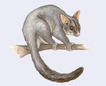
Trichosurus vulpecula has large eyes and tall rounded ears. Its fur is short but dense, and its tail is typically long and is covered in long bushy fur. In some subspecies, the fur on the tail is the same length as on the rest of the body.
Throughout its range, there is considerable variation in the coat color of Trichosurus vulpecula. Color seems to vary according to habitat, and several subspecies have been identified.
Three of the subspecies are typically grey in color: T.v. vulpecula is found throughout southern Australia; T.v. arnhemensis is found in the northern tropical regions of Australia; and T.v. eburacensis is found in Cape York. T.v. johnsoni is found in eastern Queensland, and is typically red in color. The subspecies T.v. fuliginosus, which is found in Tasmania, has black coat coloration.
In all subspecies, the underside is lighter in color. A scent gland located on the chest is used to mark territories. The reddish secretions from this gland give the fur around it a brown or reddish appearance. Like most marsupials, the females have a small, forward opening pouch that is used in reproduction.
- Other Physical Features
- endothermic
- bilateral symmetry
-
- Range mass
- 1200 to 4500 g
- 42.29 to 158.59 oz
-
- Average basal metabolic rate
- 3.8 W
- AnAge
Reproduction
There are typically two breeding seasons for Trichosurus vulpecula throughout the year. It is rare for a female to give birth twice in one year however. The highest number of births occur in the fall, with fewer occurring in the spring. Some populations of the subspecies T.v. arnhemensis are known to breed continuously throughout the year.
The females' estrous cycle lasts for about 25 days. The gestation period is around 18 days, and a single young emerges from the pouch in about 4 months. The young are typically weaned by about 6 months, and disperse anytime between 8 and 18 months. Females can reproduce by about 12 months of age, and males typically reach sexual maturity by age 2. They have an average life span of 7 years in the wild. (One Trichosurus vulpecula survived in captivity for over 14 years.)
The mortality rate for Trichosurus vulpecula is 75% in individuals around 1 year of age. That number drops considerably as the young mature and, in adult Trichosurus vulpecula, the mortality rate is only around 20%.
- Key Reproductive Features
- gonochoric/gonochoristic/dioecious (sexes separate)
- sexual
Lifespan/Longevity
-
- Average lifespan
Status: wild - 13.0 years
- Max Planck Institute for Demographic Research
- Average lifespan
-
- Average lifespan
Status: wild - 13.0 years
- Max Planck Institute for Demographic Research
- Average lifespan
-
- Average lifespan
Status: captivity - 14.7 years
- Max Planck Institute for Demographic Research
- Average lifespan
Behavior
Trichosurus vulpecula is an arboreal, nocturnal animal.
During the day is rests in hollowed out logs or trees, but in more urban areas, it finds shelter wherever it can, including in peoples' attics.
Typically a solitary species, Trichosurus vulpecula populations are so abundant that many individuals' home ranges overlap. They mark their territories using both anal secretions and secretions from the scent gland on their chests. Although they do not live in groups, clear dominance hierarchies have been observed where co-dominants of the same sex purposely avoid one another. There appears to be very little direct aggression among individuals. Trichosurus vulpecula uses deep, guttural vocalizations both to communicate territory location and to attract mates during the breeding season.
- Key Behaviors
- motile
Communication and Perception
Food Habits
Trichosurus vulpecula typically eats leaves, shoots, and flowers. Researchers have noted its great ability to adapt to a number of dietary resources including a large number of highly toxic flowers and leaves. Throughout most of its range, it prefers to feed on Eucalyptus flowers, but will eat from a number of various trees and shrubs. In addition, it eats clovers, grasses, garden fruits and turnips.
Economic Importance for Humans: Positive
Tasmania exports fur and meat of Trichosurus vulpecula to China and Taiwan every year. In New Zealand a bustling fur industry exports hundreds of thousands of pelts each year.
Economic Importance for Humans: Negative
Throughout its range, Trichosurus vulpecula is a major agricultural pest. It has caused severe damage to eucalyptus and pine forests, as well as destroying peoples' gardens. In addition, Trichosurus vulpecula is a known carrier of bovine tuberculosis which is highly contagious.
Conservation Status
Although once hunted extensively for their fur in Australia, Trichosurus vulpecula is now protected. In Tasmania, this species is partially protected, but there is an annual hunting season. In addition, landowners in Tasmania can obtain Crop Protection Permits in order to help control the damage done by these agricultural pests. Trichosurus vulpecula has thrived extensively in New Zealand, where it was introduced. There are no restrictions on hunting this species in New Zealand, and even with the thousands of animals that are killed each year, the population does not seem to be declining.
-
- IUCN Red List
-
Least Concern
More information
-
- IUCN Red List
-
Least Concern
More information
-
- CITES
- No special status
Contributors
Grace Meyer (author), University of Michigan-Ann Arbor, Phil Myers (editor), Museum of Zoology, University of Michigan-Ann Arbor.
Glossary
- Australian
-
Living in Australia, New Zealand, Tasmania, New Guinea and associated islands.

- bilateral symmetry
-
having body symmetry such that the animal can be divided in one plane into two mirror-image halves. Animals with bilateral symmetry have dorsal and ventral sides, as well as anterior and posterior ends. Synapomorphy of the Bilateria.
- chemical
-
uses smells or other chemicals to communicate
- endothermic
-
animals that use metabolically generated heat to regulate body temperature independently of ambient temperature. Endothermy is a synapomorphy of the Mammalia, although it may have arisen in a (now extinct) synapsid ancestor; the fossil record does not distinguish these possibilities. Convergent in birds.
- forest
-
forest biomes are dominated by trees, otherwise forest biomes can vary widely in amount of precipitation and seasonality.
- motile
-
having the capacity to move from one place to another.
- native range
-
the area in which the animal is naturally found, the region in which it is endemic.
- sexual
-
reproduction that includes combining the genetic contribution of two individuals, a male and a female
- tactile
-
uses touch to communicate
References
Smith, A., I. Hume. 1984. Possums and Gliders. Chipping Norton, NSW: Surrey Beatty & Sons Pty Limited in association with the Australian Mammal Society.
Strahan, R. 1995. The Mammals of Australia. Chatswood, NSW: Reed Books for the Australian Museum Trust.
Tasmanian Parks Wildlife Service, October 1996. "Management Program for the Brushtailed Possum Trichosurus vulpecula in Tasmania - Review of Background Information" (On-line). Accessed November 5, 1999 at http://www.biodiversity.environment.gov.au/plants/wildlife/possm01.htm.
Walker, 1991. Walker's Mammals of the World. Baltimore, MD: John Hopkins University Press.