Thylogale billardieriiTasmanian pademelon
Geographic Range
Red-bellied Pademelons, Thylogale billardierii, are native to Australia and Tasmania, but now are only found on Tasmania. Red-bellied Pademelons were once widespread and abundant on the mainland of Australia, but they have been extinct on the mainland since the early 1900s. Red-bellied Pademelons are still abundant on Tasmania and the larger islands of Bass Strait. (Johnson and Rose, 1995)
- Biogeographic Regions
- australian
Habitat
Thylogale billardierii inhabit areas of dense vegetation, rainforest and wet forest. Thylogale billardierii will also inhabit wet gullies in dry open eucalyptus field. However, when in a clear area, they usually stay within 100 meters of forest shelter. (PBS)
- Terrestrial Biomes
- forest
- rainforest
Physical Description
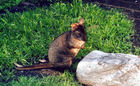
Thylogale billardierii are short stocky marsupials. Adult males weigh about 7 kg, females only about 4 kg. Pademelons have a short tail and compact body that are useful for maneuvering through dense vegetation. Thylogale billardierii have soft fine fur that is dark brown to grey brown on the dorsal side (back) of the animal, and reddish brown or lighter brown on the ventral side (stomach). The males of Thylogale billardierii have a broad chest and forearms, which are factors that contribute to males being larger than females.(Parks and Wildlife Services of Tasmania)
- Other Physical Features
- endothermic
- homoiothermic
- bilateral symmetry
- Sexual Dimorphism
- male larger
-
- Range mass
- 2.5 to 12 kg
- 5.51 to 26.43 lb
-
- Range length
- 1 to 1.5 m
- 3.28 to 4.92 ft
Reproduction
Thylogale billaridierii are polygynandrous. Occasional clicking can be heard in males chasing after females in oestrus. Immediately after birth, the female again comes into oestrus, but the blastocyst remains in embryonic diapause.
- Mating System
- polygynandrous (promiscuous)
Like other macropodids, baby Thylogale billardierii nurse in the mothers pouch after a short gestation period. In Thylogale billardierii, pouch life is six and a half months, and the young are weaned from the mothers teat around seven or eight months. Thylogale billardierii are usually sexually mature around fourteen or fifteen months. Thylogale billardierri are solitary animals that come together for mating, and will occasionally share a feeding ground.
Thylogale billardierii reproduce in captivity year round, but in the wild 70% of births are in late autumn. The gestation period is 30 days. The young makes its way into the pouch immediately after birth, and attaches itself to one of four teats. If there are other siblings, the newly born joey will choose a teat not used by a sibling.
Immediately after birth, the mother again comes into oestrus and mates. The resulting embryo develops into the blastocyst stage, and then remains in embryonic diapause. If the current joey is lost or removed, the blastocyst is developed and born 27-28 days later. If the current joey develops naturally, it will be replaced on the night he leaves the pouch by a new young resulting from the activated blastocyst(Rose et al. 1999).
- Key Reproductive Features
- year-round breeding
- gonochoric/gonochoristic/dioecious (sexes separate)
- sexual
- fertilization
- viviparous
- delayed implantation
-
- Breeding season
- autumn
-
- Average number of offspring
- 1
-
- Average number of offspring
- 1
- AnAge
-
- Average gestation period
- 30 days
-
- Average gestation period
- 29 days
- AnAge
-
- Range weaning age
- 6 to 12 months
-
- Average weaning age
- 8 months
-
- Range age at sexual or reproductive maturity (female)
- 14 to 15 months
-
- Range age at sexual or reproductive maturity (male)
- 14 to 15 months
The young of Thylogale billardierii are exclusively cared for by the mother, until they are weaned at around 7 months. (Rose et al 1999)
- Parental Investment
- altricial
- female parental care
Lifespan/Longevity
The lifespan of Thylogale billardierri is around 5-6 years in the wild. There is unsufficient data for the lifespan in captivity. (PBS)
-
- Typical lifespan
Status: wild - 5 to 6 years
- Typical lifespan
-
- Average lifespan
Status: wild - 5-6 years
- Average lifespan
-
- Average lifespan
Status: captivity - 8.8 years
- Max Planck Institute for Demographic Research
- Average lifespan
Behavior
Thylogale billardierii are mainly solitary animals that come together for mating and occasionally for feeding. There is no evidence however, that any further connection between individuals persists. Thylogale billardierii travel to a feeding spot (sometimes as far away as 2km) each evening at dusk and return to a bedding spot each morning. Daytime feeding is extremely rare. As many as ten individuals may come together for feeding; however, they scatter immediately when they sense danger. (Parks and Wildlife Services of Tasmania)
Communication and Perception
Food Habits
Thylogale billardierii mainly eat short green grasses and herbs, and they occasionally eat taller woody plants. Thylogale billardierii are nocturnal and feed at night close to the protection of the forest. (PBS)
Predation
-
- Known Predators
-
- Tasmanian wolves (Thylacinus cynocephalus)
- Tasmanian devils (Sarcophilus harrisii)
- spotted-tailed quolls (Dasyurus maculatus)
- wedge-tailed eagles (Aquila audax)
Economic Importance for Humans: Positive
Thylogale billardierii has a soft, fine fur that is valuable to humans. The meat of Thylogale billardierii has little fat, and is palatable to humans. Thylogale billardierii only inhabit Tasmania, this fact has added increased interest in tourism. (Stranham)
- Positive Impacts
- food
- ecotourism
Economic Importance for Humans: Negative
Thylogale billardierii avidly eat brush and foilage, sometimes competing with the livestock of Tasmanian farmers. This has been controlled recently by the installation of electric fences. (Statham 1994)
- Negative Impacts
- crop pest
Conservation Status
Even though Thylogale billardierii is currently very abundant and widespread in Tasmania. The species is harvested each year to ensure that the numbers remain controlled and abundant.(PBS)
-
- IUCN Red List
-
Least Concern
More information
-
- IUCN Red List
-
Least Concern
More information
-
- US Federal List
- No special status
-
- CITES
- No special status
Contributors
Adrienne Davis (author), University of Michigan-Ann Arbor, Kate Teeter (editor), University of Michigan-Ann Arbor.
Glossary
- Australian
-
Living in Australia, New Zealand, Tasmania, New Guinea and associated islands.

- altricial
-
young are born in a relatively underdeveloped state; they are unable to feed or care for themselves or locomote independently for a period of time after birth/hatching. In birds, naked and helpless after hatching.
- bilateral symmetry
-
having body symmetry such that the animal can be divided in one plane into two mirror-image halves. Animals with bilateral symmetry have dorsal and ventral sides, as well as anterior and posterior ends. Synapomorphy of the Bilateria.
- chemical
-
uses smells or other chemicals to communicate
- delayed implantation
-
in mammals, a condition in which a fertilized egg reaches the uterus but delays its implantation in the uterine lining, sometimes for several months.
- ecotourism
-
humans benefit economically by promoting tourism that focuses on the appreciation of natural areas or animals. Ecotourism implies that there are existing programs that profit from the appreciation of natural areas or animals.
- endothermic
-
animals that use metabolically generated heat to regulate body temperature independently of ambient temperature. Endothermy is a synapomorphy of the Mammalia, although it may have arisen in a (now extinct) synapsid ancestor; the fossil record does not distinguish these possibilities. Convergent in birds.
- female parental care
-
parental care is carried out by females
- fertilization
-
union of egg and spermatozoan
- folivore
-
an animal that mainly eats leaves.
- food
-
A substance that provides both nutrients and energy to a living thing.
- forest
-
forest biomes are dominated by trees, otherwise forest biomes can vary widely in amount of precipitation and seasonality.
- herbivore
-
An animal that eats mainly plants or parts of plants.
- internal fertilization
-
fertilization takes place within the female's body
- motile
-
having the capacity to move from one place to another.
- native range
-
the area in which the animal is naturally found, the region in which it is endemic.
- nocturnal
-
active during the night
- polygynandrous
-
the kind of polygamy in which a female pairs with several males, each of which also pairs with several different females.
- rainforest
-
rainforests, both temperate and tropical, are dominated by trees often forming a closed canopy with little light reaching the ground. Epiphytes and climbing plants are also abundant. Precipitation is typically not limiting, but may be somewhat seasonal.
- sexual
-
reproduction that includes combining the genetic contribution of two individuals, a male and a female
- solitary
-
lives alone
- tactile
-
uses touch to communicate
- viviparous
-
reproduction in which fertilization and development take place within the female body and the developing embryo derives nourishment from the female.
- year-round breeding
-
breeding takes place throughout the year
References
Johnson, K., R. Rose. 1995. Pademelons, Thylogale. Pp. 394-396 in R Strahan, ed. Mammals of Australia. Reed Books.
PBS, "Tasmania, Land of the Devils" (On-line). Accessed October 5, 2001 at http://www.pbs.org/edens/tasmania/featured.html.
Parks and Wildlife Services of Tasmania, "Wildlife of Tasmania" (On-line). Accessed October 2 ,2001 at http://www.parks.tas.gov.au/wildlife/mammals/padem.html.
Rose, R., J. Horak, A. Shetewi, S. Jones. 1999. Pregnancy in a marsupial, the Tasmanian Pademelon (*Thylogale billardierii*). Reproduction, Fertility, and Development, 11(3) 1999: 175-182.
Statham, M. 1994. Electric Fencing for the control of wallaby movement. Wildlife Research, 21(6) 1994: 697-707.