Thalassarche melanophrysblack-browed albatross

Geographic Range
Black-browed albatross, Thalassarche melanophrys, can be found circumpolar in the southern hemisphere anywhere in the south Atlantic, but can travel further north with cold currents. Annually during the months of September and October, they breed on south Atlantic islands including the Falkland Islands and South Georgia, South Sandwich, and Cape Horn islands. (Mullay and Association, 1989; Tuck and Heinzel, 1978; del Hoyo, et al., 1992)
- Biogeographic Regions
- ethiopian
- neotropical
- australian
- oceanic islands
- indian ocean
- atlantic ocean
- pacific ocean
Habitat
Black-browed albatross are marine, pelagic birds but commonly come inshore. It is typical for albatross to move toward shore during violent weather. They may travel thousands of kilometers off land in search of food. Their breeding grounds are often on steep slopes with tussock grass, cliff terraces, or level ground. (del Hoyo, et al., 1992)
- Habitat Regions
- temperate
- terrestrial
- saltwater or marine
Physical Description
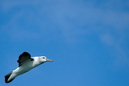
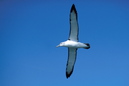
Black-browed albatross are large birds ranging anywhere from 83 to 93 cm in length and weighing from 3 to 5 kg. They have broad, blunt wings with a wingspan of 240 cm. Their back is a dark grey which blends into blackish-grey scapulars. Their blackish-colored underwing is interrupted by a white central stripe that runs the length of the wing, though the prominence of the stripe is variable. They have a yellow bill with a pink tip that curves downward at the tip. Their head is white with a black line at the base of the bill and a black eyebrow encircling and tailing off behind the eye. The iris can range from a pale whitish color to amber. The birds display no sexual dimorphism.
Juvenile black-browed albatross have similar plumage to adults, however they have a ring of gray feathers around the nape of the neck. Juveniles also have some degree of black on their beaks. (Mullay and Association, 1989; Tuck and Heinzel, 1978; del Hoyo, et al., 1992)
- Other Physical Features
- endothermic
- homoiothermic
- bilateral symmetry
- Sexual Dimorphism
- sexes alike
-
- Range mass
- 3 to 5 kg
- 6.61 to 11.01 lb
-
- Range length
- 83 to 93 cm
- 32.68 to 36.61 in
Reproduction
Black-browed albatross are monogamous and often mate for life. Pairs often engage in mutualistic feeding rituals. Black-browed albatross often engage in beak touching and allopreening between mates. In general, albatross are well-known for elaborate courtship behaviors. (del Hoyo, et al., 1992)
- Mating System
- monogamous
Black-browed albatross breed from September or October to April. They are colonial during the breeding season and make their nests out of mud, grass, guano, and seaweed. They build nests that are on a volcano-shaped dome where they incubate a single egg for 71 days. The chicks are born with grayish white down and are brooded for one to four weeks. Chicks fledge after 120 days and they reach sexual maturity after 7 to 9 years. (Falklands Conservation, 2010; National Audubon Society, et al., 1976; del Hoyo, et al., 1992)
- Key Reproductive Features
- iteroparous
- seasonal breeding
- gonochoric/gonochoristic/dioecious (sexes separate)
- sexual
- oviparous
-
- Breeding interval
- Black-browed Albatrosses breed annually.
-
- Breeding season
- Black-browed albatrosses breed from September to April.
-
- Average eggs per season
- 1
-
- Average time to hatching
- 71 days
-
- Average fledging age
- 120 days
-
- Range age at sexual or reproductive maturity (female)
- 7 to 9 years
-
- Range age at sexual or reproductive maturity (male)
- 7 to 9 years
Both parents participate in egg incubation which can last up to 71 days. Chicks are born precocial, with downy feathers and eyes open. Both parents feed the young. Parents tend the hatchling for several months, then abandon the chick before it fledges. (del Hoyo, et al., 1992)
- Parental Investment
- precocial
- male parental care
- female parental care
-
pre-fertilization
- provisioning
-
protecting
- male
- female
-
pre-hatching/birth
-
provisioning
- male
- female
-
protecting
- male
- female
-
provisioning
Lifespan/Longevity
Black-browed albatross in captivity have a maximum lifespan of 32.5 years. In the wild they generally live around 30 or more years but have been known to live as long as 70 years. (Wright, 2007)
-
- Range lifespan
Status: wild - 70 (high) years
- Range lifespan
-
- Range lifespan
Status: captivity - 35.2 (high) years
- Range lifespan
-
- Average lifespan
Status: wild - 30 years
- Average lifespan
Behavior
Black-browed albatross are typically solitary while at sea, except when a large feeding opportunity exists. During the breeding season they amass in nesting colonies that can consist of over 180,000 pairs. They are highly mobile birds and will travel between 500 and 3,000 km to forage. They use their large wings to glide for incredible distances with limited energy expenditure. They are often seen following ships hundreds of miles offshore, simply gliding behind the ship. (del Hoyo, et al., 1992)
-
- Average territory size
- 1.5 m^2
Home Range
Black-browed albatross only establish territory in the breeding season. Breeding pairs will not allow another individual within 1.5 m of the nest. (del Hoyo, et al., 1992)
Communication and Perception
Black-browed albatross are generally silent, but will make a rapid grunting noise within breeding colonies. They also make beak-clapping noises. Breeding pairs will communicate through several different courtship behaviors such as allopreening and beak touching. Like all birds, black-browed albatross perceive their environments through visual, auditory, tactile, and chemical stimuli. (del Hoyo, et al., 1992)
Food Habits
Black-browed albatross mainly feed on crustaceans and fish but also squid and carrion (i.e. penguin corpses). A large portion of their diet consists of krill that they locate using a method known as local enhancement. This is when an albatross observes another albatross or foraging species successfully feeding and they come together to take advantage of the food source. They use their webbed feet to paddle themselves around and feed by surface-seizing or surface diving. They have often been known to follow trawlers looking for any discarded catch. (Grunbaum and Veit, 2003; del Hoyo, et al., 1992)
- Animal Foods
- fish
- carrion
- mollusks
- aquatic crustaceans
Predation
Black-browed albatross’ main threat is humans but they have also been known to be fed on by tiger sharks. Accidental death by long-line fishing methods poses the greatest threat to black-browed albatross. The recent population decline is believed to be caused by increases in local long-line fishing. In the past, mariners captured albatross for their meat and raided their colonies of nests for the eggs. Albatross eggs are often eaten by rats (Rattus) and chicks are preyed upon by skuas (Stercorarius). (National Audubon Society, et al., 1976)
-
- Known Predators
-
- Tiger sharks (Galeocerdo cuvier)
- Skuas (Stercorarius)
- Rats (Rattus)
- Humans (Homo sapiens)
Ecosystem Roles
As the main dietary component, fish populations are likely impacted by black-browed albatross. Little is known regarding symbiotic relationships.
Economic Importance for Humans: Positive
There are no known positive effects of black-browed albatross on humans.
Economic Importance for Humans: Negative
There are no known adverse effects of black-browed albatross on humans.
Conservation Status
Black-browed albatross are currently listed as endangered by the IUCN Red List. The rationalization for their conservation status is the rapid decline in their populations. This decline is due to deaths attributed to long-line and trawl fisheries (net and line entanglement), disruption in prey populations, plastic ingestion, natural disasters (floods, fires, & volcanic activity), habitat destruction, pollution, and disease . (Croxall, 2006)
-
- IUCN Red List
-
No special status
More information
-
- IUCN Red List
-
No special status
More information
-
- CITES
- No special status
Contributors
Jacob Gardner (author), Florida State University, Emily DuVal (editor), Florida State University, Rachelle Sterling (editor), Special Projects.
Glossary
- Atlantic Ocean
-
the body of water between Africa, Europe, the southern ocean (above 60 degrees south latitude), and the western hemisphere. It is the second largest ocean in the world after the Pacific Ocean.

- Australian
-
Living in Australia, New Zealand, Tasmania, New Guinea and associated islands.
- Ethiopian
-
living in sub-Saharan Africa (south of 30 degrees north) and Madagascar.
- Neotropical
-
living in the southern part of the New World. In other words, Central and South America.
- Pacific Ocean
-
body of water between the southern ocean (above 60 degrees south latitude), Australia, Asia, and the western hemisphere. This is the world's largest ocean, covering about 28% of the world's surface.
- acoustic
-
uses sound to communicate
- bilateral symmetry
-
having body symmetry such that the animal can be divided in one plane into two mirror-image halves. Animals with bilateral symmetry have dorsal and ventral sides, as well as anterior and posterior ends. Synapomorphy of the Bilateria.
- carnivore
-
an animal that mainly eats meat
- carrion
-
flesh of dead animals.
- chemical
-
uses smells or other chemicals to communicate
- coastal
-
the nearshore aquatic habitats near a coast, or shoreline.
- colonial
-
used loosely to describe any group of organisms living together or in close proximity to each other - for example nesting shorebirds that live in large colonies. More specifically refers to a group of organisms in which members act as specialized subunits (a continuous, modular society) - as in clonal organisms.
- diurnal
-
- active during the day, 2. lasting for one day.
- endothermic
-
animals that use metabolically generated heat to regulate body temperature independently of ambient temperature. Endothermy is a synapomorphy of the Mammalia, although it may have arisen in a (now extinct) synapsid ancestor; the fossil record does not distinguish these possibilities. Convergent in birds.
- female parental care
-
parental care is carried out by females
- iteroparous
-
offspring are produced in more than one group (litters, clutches, etc.) and across multiple seasons (or other periods hospitable to reproduction). Iteroparous animals must, by definition, survive over multiple seasons (or periodic condition changes).
- male parental care
-
parental care is carried out by males
- monogamous
-
Having one mate at a time.
- motile
-
having the capacity to move from one place to another.
- native range
-
the area in which the animal is naturally found, the region in which it is endemic.
- nomadic
-
generally wanders from place to place, usually within a well-defined range.
- oceanic islands
-
islands that are not part of continental shelf areas, they are not, and have never been, connected to a continental land mass, most typically these are volcanic islands.
- oviparous
-
reproduction in which eggs are released by the female; development of offspring occurs outside the mother's body.
- pelagic
-
An aquatic biome consisting of the open ocean, far from land, does not include sea bottom (benthic zone).
- piscivore
-
an animal that mainly eats fish
- saltwater or marine
-
mainly lives in oceans, seas, or other bodies of salt water.
- seasonal breeding
-
breeding is confined to a particular season
- sexual
-
reproduction that includes combining the genetic contribution of two individuals, a male and a female
- solitary
-
lives alone
- tactile
-
uses touch to communicate
- temperate
-
that region of the Earth between 23.5 degrees North and 60 degrees North (between the Tropic of Cancer and the Arctic Circle) and between 23.5 degrees South and 60 degrees South (between the Tropic of Capricorn and the Antarctic Circle).
- terrestrial
-
Living on the ground.
- territorial
-
defends an area within the home range, occupied by a single animals or group of animals of the same species and held through overt defense, display, or advertisement
- visual
-
uses sight to communicate
- young precocial
-
young are relatively well-developed when born
References
2010. "The IUCN Red List of Threatened Species" (On-line). Accessed March 19, 2010 at http://www.iucnredlist.org/apps/redlist/details/144906/0.
Croxall, J. 2006. Albatross populations in peril: a population trajectory for black-browed albatrosses at South Georgia. Ecological Applications, Vol. 16 Issue 1: 419-432. Accessed March 18, 2010 at http://www.jstor.org/stable/40061809?&Search=yes&term=albatross&term=black-browed&list=hide&searchUri=%2Faction%2FdoBasicSearch%3FQuery%3Dblack-browed%2Balbatross%26x%3D0%26y%3D0%26hp%3D25%26sorigin%3Dwww.ufv.ca%26cookieSet%3D1&item=1&ttl=263&returnArticleService=showArticle.
Falklands Conservation, 2010. "Black-browed albatross" (On-line). Accessed March 19, 2010 at http://www.falklandsconservation.com/wildlife/albatross/black-browed-albatross.html.
Grunbaum, D., R. Veit. 2003. Black-browed albatrosses foraging on antarctic krill: density- dependence through local enhancement?. Ecology, Vol. 84 Issue 12: 3265-3275. Accessed March 18, 2010 at http://www.jstor.org.proxy.lib.fsu.edu/stable/3450070?&Search=yes&term=albatross&term=black browed&list=hide&searchUri=%2Faction%2FdoBasicSearch%3FQuery%3Dblack-browed%2Balbatross%26x%3D0%26y%3D0%26hp%3D25%26sorigin%3Dwww.ufv.ca%26cookieSet%3D1&item=2&ttl=263&returnArticleService=showArticle.
Mullay, M., Association. 1989. Seabirds an identification guide. London: Croom Helm LTD.
National Audubon Society, , L. Line, F. Russell. 1976. The audubon society book of wild birds. New York: Harry N. Abrams Incorporated.
Tuck, G., H. Heinzel. 1978. A Field Guide to the Seabirds of Britain and the World. St. James's Place, London: HarperCollins.
Wright, J. 2007. "Field guide to birds of North America" (On-line). Accessed March 19, 2010 at http://identify.whatbird.com/obj/1084/overview/Black-browed_Albatross.aspx.
del Hoyo, J., A. Elliot, J. Sargatal. 1992. Handbook of the birds of the world: ostrich to ducks. Barcelona: Lynx Edicions.