Taricha torosaCalifornia Newt
Geographic Range
The California Newt Taricha torosa is one of 5 members of the newt family (Salamandridae) which inhabit California. The California Newt is primarily located on the Coastal Range of California from Humbolt County to the Mexican border. Other isolated populations are also located in California, along the western slope of the Sierra Nevada mountain range (Petranka, 1998; Stebbins 1985; Dudek and Assoc., Inc. 2000).
Habitat
The California Newt of the northern population prefers the mesic forests as opposed to the southern population newts which prefer a drier climate (Petranka, 1998).
- Aquatic Biomes
- lakes and ponds
- rivers and streams
Physical Description
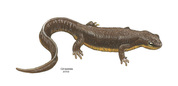
The adult California Newt is typically 12.5-20 cm (4.9-7.8 inches) in total length with males slightly larger than females. California Newts vary in color from a yellowish brown to a dark brown warty textured skin dorsally and a pale yellow to orange bottom on its ventral side. The aquatic larvae have a black stripe on either side of their dorsal fins and have gills in younger stages of development. They have large eyes that protrude beyond the edge of their head and light colored lower eyelids. (Petranka, 1998; Stebbins & Cohen, 1998).
- Other Physical Features
- ectothermic
- bilateral symmetry
Development
- Development - Life Cycle
- metamorphosis
Reproduction
Mating for the California Newt takes place from December to early May. The California Newt often migrates back to breed where they developed as larvae. Courtship of the California Newt involves a dance ritual in which the male mounts the female and rubs his chin over her nose and flutters his tail. After approximately an hour the male dismounts and leaves a spermatophore, in the form of a small mound, for the female move over and retrieve with her cloaca. The female California Newt will lay their eggs in ponds, lakes, and slow moving streams in water typically not deeper than 15 cm (5 inches). They lay from 7-30 eggs (approximately 1.9-2.8mm in diameter), attached to exposed roots or unattached on the bottom. The eggs are protected by a gel-like membrane that is toxic. The incubation period is usually 14-21 days and often longer depending on weather conditions. The size and amount of time in the larvae stage depends on the food sources and environmental conditions of their habitat (Petranka, 1998; Duellman, 1986).
- Key Reproductive Features
- gonochoric/gonochoristic/dioecious (sexes separate)
Lifespan/Longevity
-
- Average lifespan
Status: captivity - 21.8 years
- AnAge
- Average lifespan
Behavior
The California Newt has a unique way of fending off predators. First they raise their head and point their tail straight out to expose their bright under exterior color to warn off predators. If the predator attacks, the California Newt excretes a neurotoxin through its warty skin and can cause paralysis and or death to its attacker. Occasionally if it is disturbed it will make a clicking and sometimes a yelping sound. The California Newt males spend more time in the water than the females do, especially during breeding season. Taricha torosa has been observed walking through low smoldering flames and exiting with no ill effects. Apparently the secrections on their skin foam up and help dissipate the heat from the flames, perhaps giving them some safety during forest fires (Dudek and Assoc., Inc. 2000; Stebbins and Cohen, 1995).
- Key Behaviors
- motile
Food Habits
The diet of an adult California Newt consists of earthworms, snails, slugs, and sowbugs. Adult newts have also been known to cannibalize their own eggs and larvae. There is little known about the diets of the California Newt during the larvae stage.
The California Newt has an adhesive texture to its tongue and projects it out to capture its prey.(Petranka, 1998; Dudek and Assoc., Inc. 2000, Deban 1996).
Conservation Status
The California Newt is not currently listed as an endangered species but there is to be a significant problem in the Santa Monica Mountains with non-native crayfish (Procambarus clarkii) and mosquitofish (Gambusia affiinis) feeding on the eggs and larvae of the California Newt. (Petranka, 1998).
-
- IUCN Red List
-
Least Concern
More information
-
- IUCN Red List
-
Least Concern
More information
-
- US Federal List
- No special status
-
- CITES
- No special status
Other Comments
There are 2 recognized subspecies of Taricha torosa . The Coast Range Newt Taricha torosa torosa occupies the Coast range while the Sierra Newt, Taricha torosa sierrae is found in the Sierra Nevada mountain ranges (Petranka, 1998; Stebbins, 1985).
Contributors
Anthony Espinoza (author), Fresno City College, Carl Johansson (editor), Fresno City College.
Glossary
- Nearctic
-
living in the Nearctic biogeographic province, the northern part of the New World. This includes Greenland, the Canadian Arctic islands, and all of the North American as far south as the highlands of central Mexico.

- bilateral symmetry
-
having body symmetry such that the animal can be divided in one plane into two mirror-image halves. Animals with bilateral symmetry have dorsal and ventral sides, as well as anterior and posterior ends. Synapomorphy of the Bilateria.
- ectothermic
-
animals which must use heat acquired from the environment and behavioral adaptations to regulate body temperature
- metamorphosis
-
A large change in the shape or structure of an animal that happens as the animal grows. In insects, "incomplete metamorphosis" is when young animals are similar to adults and change gradually into the adult form, and "complete metamorphosis" is when there is a profound change between larval and adult forms. Butterflies have complete metamorphosis, grasshoppers have incomplete metamorphosis.
- motile
-
having the capacity to move from one place to another.
- native range
-
the area in which the animal is naturally found, the region in which it is endemic.
References
Deban, S. 1996. "Autodax: Feeding in Taricha torosa" (On-line). Accessed 31 January 2001 at http://socrates.berkeley.edu/~deban/tarichamovie.html.
Dudek and Assoc., Inc., 2000. "Western Riverside County Multiple Species Habitat Conservation Plan, California Newt Species Account" (On-line). Accessed 11September 2000 at http://ecoregion.ucr.edu/.
Duellman, W., L. Trueb. 1986. Biology of Amphibians. United States: McGraw Hill Book Company.
Fisher, R., T. Case. January 2001. "A Field Guide to the Reptiles and Amphibians of Coastal Southern California" (On-line). Accessed January 31, 2001 at http://ratbert.wr.usgs.gov/fieldguide/.
Petranka, J. 1998. Salamanders of the United States and Canada. Washington and London: Smithsonian Institution Press.
Stebbins, R. 1985. Western Reptiles and Amphibians (Peterson field guides). Boston: Houghton Mifflin.