Tapirus indicusMalayan tapir


Geographic Range
Malayan tapirs are restricted to southern Vietnam, southern Cambodia, southern Myanmar (Burma), the Tak Province of Thailand, the Malay Peninsula, and Sumatra south of the Toba Highlands. (Brooks, et al., 1997; Huffman, 2004)
Habitat
Malayan tapirs are forest dwellers that inhabit tropical terrestrial habitats. They occur in rain forests, jungles, primary forests, secondary forests, mature rubber plantations, forest edges, and sometimes open fields or cultivated areas. Tapirs may inhabit previously logged forests for browsing, but require areas of nearby primary forest as refugia and prefer late-stage successional forests to early-stage successional forests. Although Malayan tapirs have been recorded at altitudes up to 2000 m, there is a negative correlation between tapir abundance and elevation, with the highest abundance generally in lower slopes and valley bottoms. Malayan tapirs are in similar abundance both near and far from forest edges and are found close to villages and within 5 km of major cities. Although they are the least aquatic of the extant Tapiridae, Malayan tapirs seek out marshes and rivers for swimming and may wallow in mud holes to inhibit biting insects and cool off in the hot sun. Tapir tracks have been found at tributaries and tapirs are often sighted near headwaters and swamps. In Thailand, these tapirs live in dry dipterocarp and mixed deciduous forests in the rainy season. They move into evergreen forests during the dry season to avoid forest fires and food scarcity. Topography of their habitat generally varies from gentle undulation to steep hills. (Brooks, et al., 1997; Gilmore, 2001; Holden, et al., 2003; Mohamed and Traeholt, 2010; Novarino, 2005)
- Habitat Regions
- tropical
- terrestrial
- Terrestrial Biomes
- forest
- rainforest
- Wetlands
- swamp
- Other Habitat Features
- agricultural
-
- Range elevation
- 0 to 2000 m
- 0.00 to 6561.68 ft
Physical Description
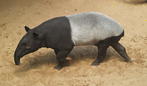
Malayan tapirs have large, stocky bodies with a prominent, prehensile proboscis formed by an extended nose and upper lip. Individuals range from 250 to 540 kg, with a length of 1.8 to 2.5 m and a height of 0.9 to 1.1 m. Females tend to be larger than males by about 25 to 100 kg. Adults have a dramatic color pattern, with a black front half of their body, white sides, and black hind legs. This pattern is often referred to as the "saddle" pattern because of its position and shape. White fur rims the ears. The eyes are small, round, and not very mobile. Malayan tapirs have four toes on their forefeet and three toes on their hind feet, each of which ends in a hoof. The fourth toe of each of the forefeet does not touch the ground, so footprints show the imprints of three digits. Newborn Malayan tapirs lack the adult coat pattern and have a coat with whitish stripes and spots which gradually fade by six months of age. (Barongi, 1993; Brooks, et al., 1997; Huffman, 2004)
- Other Physical Features
- endothermic
- homoiothermic
- bilateral symmetry
- Sexual Dimorphism
- female larger
-
- Range mass
- 250 to 540 kg
- 550.66 to 1189.43 lb
-
- Average mass
- 296 kg
- 651.98 lb
-
- Range length
- 1.8 to 2.5 m
- 5.91 to 8.20 ft
Reproduction
Malayan tapirs are monogamous during mating season and generally breed during the months of May and June. Initial introduction of mates is usually through scent signals and also sometimes visual cues. Sometimes mates will copulate in shallow water. Mates may spend a great deal of time before copulation participating in courtship rituals, such as periods of chasing, sexual investigation, or circling and sniffing of the genitalia. In addition, individuals may initiate biting of the flanks and often use vocalizations such as wheezing or whistling noises. Spraying of urine and flehmen (curling of the upper lip which facilitates the transfer of pheromones) may also occur prior to intromission. (Barongi, 1993; Gilmore, 2001; Kusuda, et al., 2008; Lilia, et al., 2010; Read, 1986)
- Mating System
- monogamous
Malayan tapirs breed during the months of May and June, producing a single offspring every other year on average, although twins have been reported. The gestation period of the female lasts between 390 and 410 days (13 to 13.5 months). Weaning of offspring usually takes place between 6 and 8 months after birth. Independence occurs when the mother gives birth to a new offspring, sometimes even later. Generally, individuals become sexually mature around the age of 30 months, although this may be earlier depending on nutrition and compatibility of the breeding pair (in captivity). Males tend to become sexually mature slightly later than females, generally by a few months. Copulation will usually take place at least once during the female's 28-32 day estrous cycle following sexual maturation. Interbirth intervals are rarely less than 18 months although cows usually return to a cyclic estrous cycle during lactation. (Barongi, 1993; Gilmore, 2001; Kusuda, et al., 2008; Lilia, et al., 2010; Read, 1986)
- Key Reproductive Features
- iteroparous
- seasonal breeding
- gonochoric/gonochoristic/dioecious (sexes separate)
- sexual
- viviparous
-
- Breeding interval
- Malayan tapirs breed every two years.
-
- Breeding season
- Malayan tapirs breed from May to June.
-
- Average number of offspring
- 1
-
- Average number of offspring
- 1
- AnAge
-
- Range gestation period
- 390 to 410 days
-
- Range weaning age
- 6 to 8 months
-
- Average time to independence
- 1.6 years
-
- Average age at sexual or reproductive maturity (female)
- 2.8 years
-
- Average age at sexual or reproductive maturity (female)
Sex: female - 1095 days
- AnAge
- Average age at sexual or reproductive maturity (female)
-
- Average age at sexual or reproductive maturity (male)
- 3 years
-
- Average age at sexual or reproductive maturity (male)
Sex: male - 1095 days
- AnAge
- Average age at sexual or reproductive maturity (male)
A healthy calf can usually stand within one or two hours of birth and first nursing occurs within two to five hours, proceeding to feedings two to three times a day. Calves eat solid food as early as two weeks old and are capable of swimming at three weeks old. All care and protection is done by the female parent until independence, although care decreases dramatically after about 3 months. Calves tend to be followers, not hiders. Often mothers and calves will rest, investigate, and swim together. Most adult males are tolerant of newborns and may even sleep with them, although violence may arise when males attempt to copulate with females too soon after birth of the calf. Newborns bear a vividly spotted and striped pattern that contrasts with the black and white adult pattern. This pattern gradually fades by six months. Malayan tapir calves grow rapidly and are weaned by 6 to 8 months after birth. They normally stay with their mother until the birth of a new offspring, sometimes longer. (Barongi, 1993; Gilmore, 2001; Read, 1986)
- Parental Investment
- precocial
- female parental care
-
pre-fertilization
- provisioning
-
protecting
- female
-
pre-hatching/birth
-
provisioning
- female
-
protecting
- female
-
provisioning
-
pre-weaning/fledging
-
provisioning
- female
-
protecting
- female
-
provisioning
-
pre-independence
-
protecting
- female
-
protecting
Lifespan/Longevity
Average lifespan of Malayan tapirs is approximately 30 years. They have been recorded living up to 36.5 years in captivity. (Barongi, 1993; de Magalhaes, et al., 2009)
-
- Range lifespan
Status: wild - 30 (high) years
- Range lifespan
-
- Range lifespan
Status: captivity - 36.5 (high) years
- Range lifespan
-
- Average lifespan
Status: wild - 25 years
- Average lifespan
-
- Average lifespan
Status: captivity - 30 years
- Average lifespan
-
- Average lifespan
Status: wild - 30.0 years
- Max Planck Institute for Demographic Research
- Average lifespan
Behavior
Although generally considered solitary, nocturnal animals, Malayan tapirs are more tolerant of conspecifics and demonstrate crepuscular rather than completely nocturnal activity in undisturbed forests. They may form groups in times of food shortage. In captivity, personalities vary from solitary to social and from tame to aggressive. They are agile, can run quickly, and are capable of climbing over small vertical barriers. Individuals maintain regular patterns of sleep during the day and activity during the evening/night. Additionally, Malayan tapirs are good swimmers, they may walk along the bottom of deep rivers, holding their breath for up to 90 seconds. (Barongi, 1993; Brooks, et al., 1997; Gilmore, 2001)
- Key Behaviors
- terricolous
- nocturnal
- crepuscular
- motile
- sedentary
- daily torpor
- solitary
-
- Range territory size
- 10 to 25 km^2
Home Range
Home ranges have been recorded between 10 and 25 square kilometers. Females tend to have larger ranges than males; one study discussed a female that had a home range of 25 square kilometers while a male from the similar study only had a home range of 12.75 square kilometers. Malayan tapirs show intraspecific tolerance and have overlapping home ranges. Densities range from 0.30 to 0.44 individuals per square kilometer in high quality habitats, but can be as low as 0.035 individuals per square kilometer in disturbed areas. On average, individuals travel about 0.32 km per day (straight line distance) and one female has been recorded traveling over 4 km in a single day (total distance). (Brooks, et al., 1997; Gilmore, 2001)
Communication and Perception
The only vocalizations of Malayan tapirs are whistles, clicks, and hiccup-like noises, often made in response to fear or pain, as an appeasement to conspecifics, as a warning call, or during mating. They have an acute sense of smell and good hearing with large, round ears. They often perform visual or scent cues during mating rituals, sometimes performing flehmen to better detect pheromones. Individuals smell and touch each other when first meeting. (Barongi, 1993; Gilmore, 2001)
- Other Communication Modes
- pheromones
Food Habits
Malayan tapirs are frugivores, folivores, and lignivores. They are selective browsers, selecting high quality food when available. The diet consists of leaves (Baccaurea parviflora and Symplocis crassipes), buds, growing twigs, bark, herbs (Curculigo latifolia and Homalomena deltoidea), low growing succulents (Homalomena species and Phyllagathis rotundifolia), shrubs (Lasianthus maingayi and Helicia attenuata), fruits (Crescentia alata and Virola oleifera), club moss (Selanginella willdenonii), grasses, tubers, and aquatic plants. Although they are selective browsers, they feed on more than 122 species of plants and do not concentrate feeding in any particular location. Instead, they move in a zigzag fashion feeding on one plant and then moving on to another, often covering great distances. Malayan tapirs are non-ruminant and hind-gut fermenters with an enlarged cecum and a simple stomach. Some seeds that they ingest are not digested and may be dispersed long distances from their origin. Fruit tends to be a large portion of the diet of the species, especially considering they are hind-gut fermenters which generally cope better with high-fiber, low-quality forage, although the relative importance varies between populations and habitats. Malayan tapirs eat between 4 and 5 percent of their body weight each day, while pregnant, lactating, or young members of the species may require a higher intake. They may also ingest large amounts of a plant containing a strong liquifying agent permitting easy passage of stools, most likely to assist the smooth functioning of its simple digestive system. The proboscis plays an important role in browsing, used to pluck leaves from branches and place them into the animal's mouth. In order to obtain desired branches or leaves, thin saplings (less than 3.8 cm) may be snapped off while thicker saplings or branches (2 to 6.5 cm) may be pushed over or walked down. Additionally, Malayan tapirs crave salt and travel upwards of 5 km to seek out salt licks. (Barongi, 1993; Clauss, et al., 2009; Gilmore, 2001; Williams and Petrides, 1980; Wilson and Wilson, 1973)
- Plant Foods
- leaves
- roots and tubers
- wood, bark, or stems
- fruit
- bryophytes
Predation
Tigers (Panthera tigris) and leopards (Panthera pardus) are the major natural predators of Malayan tapirs; however, they are not often preyed upon. The black and white pattern of the adults disrupts the body lines and makes them more difficult to recognize as potential prey. The white saddle does not suggest the form of the entire animal since the rest of the individual remains obscure in the dark. If an individual is attacked, it will run away and find the nearest source of water to escape the chase. They have thickened skin, up to 2.5 cm, on the back of the head and nape, thought to be a defensive measure against fanged animals. If a predator does attach to the neck, the tapir will attempt to bash the assailant against a tree. Humans (Homo sapiens) sometimes hunt tapirs for food. (Brooks, et al., 1997; Gilmore, 2001; Huffman, 2004)
- Anti-predator Adaptations
- cryptic
-
- Known Predators
-
- tigers (Panthera tigris)
- leopards (Panthera pardus)
- humans (Homo sapiens)
Ecosystem Roles
Fruit constitutes a large portion of the tapir diet and they help disperse the seeds of the fruit they eat. They may be the key dispersers of some communities of plants. Malayan tapirs may transport seeds both by swallowing them and defecating later and by eating fruit and spitting out the seeds. Seed dispersal may be up to a number of kilometers, generating a complex and remote seed shadow, and may disperse large numbers of seeds. Some seeds germinate faster after passing through a tapir gut. (Brooks, et al., 1997; Holden, et al., 2003)
Malayan tapirs host a number of ectoparasites, endoparasites, protozoal enteric parasites, and hemoparasites. These include protozoan blood parasites, such as Babesia, vampire moths (Calyptra eustrigata), ticks, such as Amblyomma testudinarium, mites, such as Sarcoptes tapiri, ciliate protozoans (Ciliophorma), such as g. Balantidium species, flagellated protozoans (Mastigophora), such as g. Giargia species; parasitic unicellular eukaryotes, such as trypanosomes; and parasitic flatworms, such as trematodes. (Ramsay and Zainuddin, 1993; Vroege and Zwart, 1972)
- Ecosystem Impact
- disperses seeds
- Babesia species (Babesia)
- vampire moths (Calyptra eustrigata)
- ticks (Amblyomma testudinarium)
- mites (Sarcoptes tapiri)
- ciliate protozoans (Balantidium)
- flagellated protozoans (Giargia)
- trypanosomes (Trypanosoma)
- trematodes Tremadota)
Economic Importance for Humans: Positive
Malayan tapirs has been hunted for meat by aborigines, although that is rare now. Tapirs are seed dispersers and benefit native plant communities. (Brooks, et al., 1997; Novarino, 2005)
- Positive Impacts
- food
Economic Importance for Humans: Negative
In Southwest Sumatra, Malayan tapirs are considered a problem species because they tend to strip the bark from rubber trees. In West Sumatra, they have been reported eating watermelon and cucumber crops. However, these are the only occurrences of such actions and this remains the only possible negative economic importance. Otherwise, the species has no adverse effects on humans. (Brooks, et al., 1997; Novarino, 2005)
- Negative Impacts
- crop pest
Conservation Status
Malayan tapirs are endangered on both the IUCN Red List and the United States Endangered Species Act list and an Appendix I status in the CITES appendices. The most serious threat to Malayan tapir survival is that of forest conversion for agriculture and human settlement. However, agricultural development has slowed as a result of industrial and manufacturing development in southeast Asia. Hunting of Malayan tapirs has all but ceased, except for the accidental shooting or trapping of individuals. Some aborigines occasionally consume the meat and some exporting and smuggling occurs in Thailand. In Malaysia, Malayan tapirs have been given total protection under the Wild Animals and Birds Ordinance No. 2 of 1955, and they have been protected in Indonesia since 1931. Also, the number of Malayan tapirs in captivity has increased steadily since their status as endangered. The Malayan tapir trade has been monitored in addition to the establishment of numerous wildlife management groups throughout their geographic range. The Tapir Specialist Group is a subgroup of the IUCN and is dedicated to the protection and conservation of Malayan tapirs. (Brooks, et al., 1997)
-
- IUCN Red List
-
Endangered
More information
-
- IUCN Red List
-
Endangered
More information
-
- US Federal List
- Endangered
-
- CITES
- Appendix I
-
- State of Michigan List
- No special status
Contributors
William Gearty (author), Yale University, Eric Sargis (editor), Yale University, Rachel Racicot (editor), Yale University, Tanya Dewey (editor), University of Michigan-Ann Arbor.
Glossary
- acoustic
-
uses sound to communicate
- agricultural
-
living in landscapes dominated by human agriculture.
- bilateral symmetry
-
having body symmetry such that the animal can be divided in one plane into two mirror-image halves. Animals with bilateral symmetry have dorsal and ventral sides, as well as anterior and posterior ends. Synapomorphy of the Bilateria.
- chemical
-
uses smells or other chemicals to communicate
- crepuscular
-
active at dawn and dusk
- cryptic
-
having markings, coloration, shapes, or other features that cause an animal to be camouflaged in its natural environment; being difficult to see or otherwise detect.
- endothermic
-
animals that use metabolically generated heat to regulate body temperature independently of ambient temperature. Endothermy is a synapomorphy of the Mammalia, although it may have arisen in a (now extinct) synapsid ancestor; the fossil record does not distinguish these possibilities. Convergent in birds.
- female parental care
-
parental care is carried out by females
- folivore
-
an animal that mainly eats leaves.
- food
-
A substance that provides both nutrients and energy to a living thing.
- forest
-
forest biomes are dominated by trees, otherwise forest biomes can vary widely in amount of precipitation and seasonality.
- frugivore
-
an animal that mainly eats fruit
- herbivore
-
An animal that eats mainly plants or parts of plants.
- iteroparous
-
offspring are produced in more than one group (litters, clutches, etc.) and across multiple seasons (or other periods hospitable to reproduction). Iteroparous animals must, by definition, survive over multiple seasons (or periodic condition changes).
- monogamous
-
Having one mate at a time.
- motile
-
having the capacity to move from one place to another.
- native range
-
the area in which the animal is naturally found, the region in which it is endemic.
- nocturnal
-
active during the night
- oriental
-
found in the oriental region of the world. In other words, India and southeast Asia.

- pheromones
-
chemicals released into air or water that are detected by and responded to by other animals of the same species
- rainforest
-
rainforests, both temperate and tropical, are dominated by trees often forming a closed canopy with little light reaching the ground. Epiphytes and climbing plants are also abundant. Precipitation is typically not limiting, but may be somewhat seasonal.
- seasonal breeding
-
breeding is confined to a particular season
- sedentary
-
remains in the same area
- sexual
-
reproduction that includes combining the genetic contribution of two individuals, a male and a female
- solitary
-
lives alone
- swamp
-
a wetland area that may be permanently or intermittently covered in water, often dominated by woody vegetation.
- tactile
-
uses touch to communicate
- terrestrial
-
Living on the ground.
- tropical
-
the region of the earth that surrounds the equator, from 23.5 degrees north to 23.5 degrees south.
- visual
-
uses sight to communicate
- viviparous
-
reproduction in which fertilization and development take place within the female body and the developing embryo derives nourishment from the female.
- young precocial
-
young are relatively well-developed when born
References
Barongi, R. 1993. Husbandry and conservation of tapirs Tapirus spp. International Zoo Yearbook, 32(1): 7-15.
Brooks, D., R. Bodmer, S. Matola. 1997. "Tapirs - Status Survey and Conservation Action Plan" (On-line). IUCN/SSC Tapir Specialist Group. Accessed April 06, 2012 at http://www.tapirback.com/tapirgal/iucn-ssc/tsg/action97/cover.htm.
Clauss, M., T. Wilkins, A. Hartley, J. Jatt. 2009. Diet Composition, Food Intake, Body Condition, and Fecal Consistency in Captive Tapirs (Tapirus spp.) in UK Collections. Zoo Biology, 28(4): 279-291.
Gilmore, M. 2001. Tapir Behavior- An Examination of Activity Patterns, Mother Young Interactions, Spatial Use, and Environmental Effects in Captivity on two Species (Tapirus indicus & Tapirus bairdii). Corvallis, Oregon: Oregon State University.
Holden, J., A. Yanuar, D. Martyr. 2003. The Asian Tapir in Kerinci Seblat National Park, Sumatra: evidence collected through photo-trapping. Oryx, 37(1): 34-40.
Huffman, B. 2004. "Tapirus indicus; Malayan tapir" (On-line). An ultimate ungulate fact sheet. Accessed April 07, 2012 at http://www.ultimateungulate.com/Perissodactyla/Tapirus_indicus.html.
Kusuda, S., K. Ishihara, M. Ikoma, O. Doi, K. Uetake, T. Tanaka. 2008. Male and female behaviors related with estrus and copulation in the captive Malayan tapir, Tapirus indicus. Japanese Journal of Zoo and Wildlife Medicine, 13: 45-50.
Lilia, K., Y. Rosnina, H. Abd Wahid, Z. Zahari, M. Abraham. 2010. Gross Anatomy and Ultrasonographic Images of the Reproductive System of the Malayan Tapir (Tapirus indicus). Anatomia Histologia Embryologia, 39(6): 569-575.
Mohamed, N., C. Traeholt. 2010. A Preliminary Study of Habitat Selection by Malayan Tapir, Tapirus indicus, in Krau Wildlife Reserve, Malaysia. Tapir Conservation: The Newsletter of the IUCN/SSC Tapir Specialist Group, 19(2): 32-35.
Mohd, A. 2002. Recent Observations of Melanistic Tapirs in Peninsular Malaysia. Tapir Conservation: Newsletter of the IUCN/SSC Tapir Specialist Group, 11(1): 27-28.
Novarino, W. 2005. Population Monitoring and Study of Daily Activities of Malayan Tapir (Tapirus indicus). West Sumatra, Indonesia: Andalas University.
Ramsay, E., Z. Zainuddin. 1993. "Infectious Diseases of the Rhinoceros and Tapir," in Zoo and Wild Animal Medicine. Philadelphia and London: Saunders.
Read, B. 1986. Breeding and management of the Malayan tapir, Tapirus indicus, at St. Louis Zoo. International Zoo Yearbook, 24/25: 294-297.
Vroege, C., P. Zwart. 1972. Babesiasis in a Malayan Tapir (Tapirus indicus Desmarest, 1819). Z. Parasitenk, 40: 177-179.
Williams, K., G. Petrides. 1980. Browse Use, Feeding Behavior, and Management of the Malayan Tapir. The Journal of Wildlife Management, 44(2): 489-494.
Wilson, R., S. Wilson. 1973. Diet of captive tapirs Tapirus spp. International Zoo Yearbook, 13(1): 213-217.
de Magalhaes, J., J. Curado, G. Church. 2009. A database of vertebrate longevity records and their relation to other life-history traits. Journal of Evolutionary Biology, 22(8): 1770-1774. Accessed April 07, 2012 at http://genomics.senescence.info/species/entry.php?species=Tapirus_indicus.