Sylvilagus aquaticusswamp rabbit

Geographic Range
Sylvilagus aquaticus can be found in most of the south-central United States and the Gulf coast. It is abundant in Alabama, Mississippi and Louisiana. Sylvilagus aquaticus can also be found in parts of South Carolina, Tennessee, Texas, Oklahoma, Missouri, Kansas, Illinois, Indiana, and Georgia. (Chapman and Feldhamer, 1981; Nowak, 1999)
Habitat
Sylvilagus aquaticus prefers to live in swampy lowlands, marshy areas, floodplains, tributaries of larger rivers, and cypress swamps. It is typically found close to water. Swamp rabbits spend the day in self-made depressions in tall grass, leaves, or anything that provides cover until their nocturnal foraging bouts. (Chapman and Feldhamer, 1981; Nowak, 1999)
- Habitat Regions
- temperate
- terrestrial
- Terrestrial Biomes
- forest
- scrub forest
Physical Description
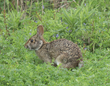
Sylvilagus aquaticus is the largest member of its genus, the cottontails. However, its ears are smaller relative to other cottontails. The head and back are usually a mix of dark brown, rusty brown, or black. The throat, ventral surface and tail are white. A clear cinnamon-colored ring is visible around the eye. Males are slightly larger than females. Males weigh from 1816 to 2554 grams, with an average of 2235 g. Females are from 1646 to 2668 grams, averaging 2161 g.
Altricial young are born with fur up to 5 mm long with a weight of approximately 61.4 g. At birth, their fur color is dark (either brown or black) on their back, sides and throat. The tail, chin and abdomen are white. The head is a mix of tan and black. Their eyes are closed when born and open in 4 to 7 days. (Chapman and Feldhamer, 1981; Nowak, 1999; Scheibe and Henson, 2003)
- Other Physical Features
- endothermic
- homoiothermic
- bilateral symmetry
- Sexual Dimorphism
- male larger
-
- Range mass
- 1646 to 2668 g
- 58.01 to 94.03 oz
-
- Range length
- 452 to 552 mm
- 17.80 to 21.73 in
-
- Average length
- 501 mm
- 19.72 in
Reproduction
Swamp rabbits are synchronous breeders; all the members of a population breed at or around the same time. Prior to breeding a predictable sequence of behaviors occurs. First, females chase and/or threaten the males. Consequently, the males dash away. A jumping sequence follows. Finally, copulation occurs, and females begin chasing the males again. (Chapman and Feldhamer, 1981; Bond, et al., 2006)
- Mating System
- polygynandrous (promiscuous)
Swamp rabbits usually begin breeding in mid- to late-February until August. Few exceptions are noted: in Texas, breeding occurs year round, in Louisiana, breeding can occur in every month except October.
Estrous behavior in unbred females follows a 12-day cycle, and estrus itself lasts about an hour in S. aquaticus. The gestation period lasts from 35 to 40 days (average of 36 to 37 days). They give birth to 1 to 6 offspring with an average of 3 offspring per litter.
Females make nests out of grass, dead twigs, and leaf litter above ground. These nests are typically 5.5 cm deep, 15 cm wide, and 18 cm high, and have side entrances. Sometimes, they use holes in large stumps or logs, Females also tend to build dummy nests before they build a real nest, which differs in that it is lined with fur before females give birth.
Young become sexually mature between 23 and 30 weeks old. Although juveniles are capable of breeding in their first year, most do not. Females have between 1 to 6 litters a year but 2 to 3 is most common. (Chapman and Feldhamer, 1981; Bond, et al., 2006)
- Key Reproductive Features
- iteroparous
- seasonal breeding
- year-round breeding
- gonochoric/gonochoristic/dioecious (sexes separate)
- sexual
- fertilization
- viviparous
-
- Breeding interval
- Females typically have 2 to 3 litters per year.
-
- Breeding season
- Breeding occurs from mid- to late-February in most places, but can occur year-round.
-
- Range number of offspring
- 1 to 6
-
- Average number of offspring
- 3
-
- Range gestation period
- 35 to 40 days
-
- Average gestation period
- 36.5 days
-
- Range time to independence
- 12 to 15 days
-
- Range age at sexual or reproductive maturity (female)
- 23 to 30 weeks
-
- Range age at sexual or reproductive maturity (male)
- 23 to 30 weeks
Mothers stay with their young until they leave the nest at 12 to 15 days old. She nurses them usually around dusk and dawn. The mother continues to feed the young after they leave the nest. Once the young are weaned there is no further parental care. Males do not care for young. (Chapman and Feldhamer, 1981; Fowler and Kissell, 2007)
- Parental Investment
- altricial
-
pre-fertilization
- provisioning
-
protecting
- female
-
pre-hatching/birth
-
provisioning
- female
-
protecting
- female
-
provisioning
-
pre-weaning/fledging
-
provisioning
- female
-
provisioning
Lifespan/Longevity
There is not much known about the wild or captive lifespans of Sylvilagus aquaticus because there have been very few studies examining this topic. Other Sylvilagus species live from 7 to 9 years maximum. ("Swamp Rabbit Ecology", 2000; Chapman and Feldhamer, 1981; Chapman, 2007; Bond, et al., 2006; Fowler and Kissell, 2007; Nowak, 1999)
-
- Range lifespan
Status: wild - 10 (high) years
- Range lifespan
-
- Average lifespan
Status: wild - 1.8 years
- Average lifespan
-
- Average lifespan
Status: wild - 1.8 years
- Average lifespan
Behavior
Sylvilagus aquaticus is most active at dawn, dusk, and at night. During the day they remain hidden and motionless, usually in a large hollow log or dense grass. They only move when a predator is too close to them. When a predator get too close they flee in a zig-zag pattern. They will jump into water and stay perfectly still, with only their nose above the water's surface.
Within a population of swamp rabbits, there is a linear dominance hierarchy among males, which helps limit fighting, once established. Only during breeding season do aggressive encounters occur between males, as they pursue a female. Females in the population have a mutual tolerance of one another. ("Swamp Rabbit Ecology", 2000; Chapman and Feldhamer, 1981; Nowak, 1999)
- Key Behaviors
- terricolous
- saltatorial
- nocturnal
- crepuscular
- motile
- sedentary
- solitary
- territorial
- dominance hierarchies
-
- Range territory size
- 0.01 to 0.08 km^2
Home Range
Swamp rabbits are territorial, and males practice "chinning" which is a pheromone-marking activity. These territories range in size from 0.01 to 0.08 square km (2.1 to 18.9 acres). ("Swamp Rabbit Ecology", 2000; Chapman and Feldhamer, 1981)
Communication and Perception
Swamp rabbits are normally not vocal except when they feel threatened. Males also leave scent marks to establish territories. Other Sylvilagus species also drum the ground with their rear feet to indicate aggression. ("Swamp Rabbit Ecology", 2000; Chapman and Feldhamer, 1981; Chapman, 2007)
- Other Communication Modes
- scent marks
Food Habits
Swamp rabbits are herbivores, foraging on a variety of plant materials, including grasses, sedges, shrubs, tree bark, tree seedlings, and twigs. Helm and Chabreck (2006) found that their preferred foods include savannah panicgrass (Phanopyrun gymnocarpon), false nettle (Boehmeria cylindrica), dewberry (Rubus sieboldii) and greenbrier (Smilax bona-nox). Swamp rabbits practice coprophagy. They have two kinds of fecal matter. The first is soft and green and still had nutrients in it--this is the kind that they eat because it gives them a chance to get more nutrients out of the food. The second kind of fecal matter are dark brown/black hard pellets--they do not eat these. (Chapman and Feldhamer, 1981; Choate, et al., 1994; Fowler and Kissell, 2007; Helm and Chabreck, 2006; Nowak, 1999)
- Primary Diet
- herbivore
- coprophage
- Plant Foods
- leaves
- roots and tubers
- wood, bark, or stems
- Other Foods
- dung
Predation
There are few known predators of Sylvilagus aquaticus, but known predators include domestic dogs (Canis lupus familiaris), American alligators (Alligator mississippiensis), and humans (Homo sapiens). This species is the 2nd most hunted rabbit in the United States. They use a combination of cryptic coloration and "freezing" to avoid being detected and a rapid, irregular jumping pattern when fleeting to avoid capture. (Chapman and Feldhamer, 1981)
- Anti-predator Adaptations
- cryptic
-
- Known Predators
-
- American alligators (Alligator mississippiensis)
- domestic dogs (Canis lupus familiaris)
- humans (Homo sapiens)
Ecosystem Roles
Swamp rabbits are important prey in their native ecosystems and their herbivory influences plant communities.
Swamp rabbits are affected by several parasites which include the trematodes Hasstilesia texensis and Hasstilesia tricolor, the cestodes Cittotaenia ctenoides, Cittotaenia variabilis, Multiceps serialis, and Raillietina stilesiellacestodes, the nematodes Graphidium strigosum, Nematodirus leporis, Obeliscoides cuniculi, Parasalurus ambiguous, Trichostrongylus calcaratus, and Trichuris leporis, fleas, ticks, and mites Haemaphysalis leporis-palustris. ("Swamp Rabbit Ecology", 2000; Chapman and Feldhamer, 1981)
- trematodes Hasstilesia texensis
- trematodes Hasstilesia tricolor
- nematodes Graphidium strigosum
- nematodes Nematodirus leporis
- nematodes Obeliscoides cuniculi
- nematodes Parasalurus ambiguous
- nematodes Trichostrongylus calcaratus
- nematodes Trichuris leporis
- cestode Cittotaenia ctenoides
- cestodes Cittotaenia variabilis
- cestodes Multiceps serialis
- cestodes Raillietina stilesiellacestodes
- mites Haemaphysalis leporis-palustris
- fleas Siphonaptera)
- ticks Acari
Economic Importance for Humans: Positive
Swamp rabbits are hunted for fur, meat, and for sport in the southeastern United States. ("Swamp Rabbit Ecology", 2000)
- Positive Impacts
- food
- body parts are source of valuable material
Economic Importance for Humans: Negative
Swamp rabbits are usually harmless, but may occasionally damage crops and other vegetation. ("Swamp Rabbit Ecology", 2000)
- Negative Impacts
- crop pest
Conservation Status
The IUCN rank of this species is Lower Risk/Least Concern. Sylvilagus aquaticus has a global rank of "Secure" from NatureServe2007. In Alabama, Georgia, Mississippi, Texas, and Louisiana populations are considered secure. Swamp rabbits are vulnerable in Kentucky and Arkansas and imperiled in Oklahoma and South Carolina. (Chapman, 2007)
-
- IUCN Red List
-
Least Concern
More information
-
- IUCN Red List
-
Least Concern
More information
-
- US Federal List
- No special status
-
- CITES
- No special status
-
- State of Michigan List
- No special status
Contributors
Tanya Dewey (editor), Animal Diversity Web.
Annamarie Roszko (author), Radford University, Karen Powers (editor, instructor), Radford University.
Glossary
- Nearctic
-
living in the Nearctic biogeographic province, the northern part of the New World. This includes Greenland, the Canadian Arctic islands, and all of the North American as far south as the highlands of central Mexico.

- acoustic
-
uses sound to communicate
- altricial
-
young are born in a relatively underdeveloped state; they are unable to feed or care for themselves or locomote independently for a period of time after birth/hatching. In birds, naked and helpless after hatching.
- bilateral symmetry
-
having body symmetry such that the animal can be divided in one plane into two mirror-image halves. Animals with bilateral symmetry have dorsal and ventral sides, as well as anterior and posterior ends. Synapomorphy of the Bilateria.
- chemical
-
uses smells or other chemicals to communicate
- coprophage
-
an animal that mainly eats the dung of other animals
- crepuscular
-
active at dawn and dusk
- cryptic
-
having markings, coloration, shapes, or other features that cause an animal to be camouflaged in its natural environment; being difficult to see or otherwise detect.
- dominance hierarchies
-
ranking system or pecking order among members of a long-term social group, where dominance status affects access to resources or mates
- endothermic
-
animals that use metabolically generated heat to regulate body temperature independently of ambient temperature. Endothermy is a synapomorphy of the Mammalia, although it may have arisen in a (now extinct) synapsid ancestor; the fossil record does not distinguish these possibilities. Convergent in birds.
- fertilization
-
union of egg and spermatozoan
- folivore
-
an animal that mainly eats leaves.
- food
-
A substance that provides both nutrients and energy to a living thing.
- forest
-
forest biomes are dominated by trees, otherwise forest biomes can vary widely in amount of precipitation and seasonality.
- granivore
-
an animal that mainly eats seeds
- herbivore
-
An animal that eats mainly plants or parts of plants.
- iteroparous
-
offspring are produced in more than one group (litters, clutches, etc.) and across multiple seasons (or other periods hospitable to reproduction). Iteroparous animals must, by definition, survive over multiple seasons (or periodic condition changes).
- marsh
-
marshes are wetland areas often dominated by grasses and reeds.
- motile
-
having the capacity to move from one place to another.
- native range
-
the area in which the animal is naturally found, the region in which it is endemic.
- nocturnal
-
active during the night
- polygynandrous
-
the kind of polygamy in which a female pairs with several males, each of which also pairs with several different females.
- saltatorial
-
specialized for leaping or bounding locomotion; jumps or hops.
- scent marks
-
communicates by producing scents from special gland(s) and placing them on a surface whether others can smell or taste them
- scrub forest
-
scrub forests develop in areas that experience dry seasons.
- seasonal breeding
-
breeding is confined to a particular season
- sedentary
-
remains in the same area
- sexual
-
reproduction that includes combining the genetic contribution of two individuals, a male and a female
- solitary
-
lives alone
- swamp
-
a wetland area that may be permanently or intermittently covered in water, often dominated by woody vegetation.
- tactile
-
uses touch to communicate
- temperate
-
that region of the Earth between 23.5 degrees North and 60 degrees North (between the Tropic of Cancer and the Arctic Circle) and between 23.5 degrees South and 60 degrees South (between the Tropic of Capricorn and the Antarctic Circle).
- terrestrial
-
Living on the ground.
- territorial
-
defends an area within the home range, occupied by a single animals or group of animals of the same species and held through overt defense, display, or advertisement
- visual
-
uses sight to communicate
- viviparous
-
reproduction in which fertilization and development take place within the female body and the developing embryo derives nourishment from the female.
- year-round breeding
-
breeding takes place throughout the year
References
Smithsonian Institution. "Smithsonian National Museum of Natural History" (On-line). North American Mammals. Accessed September 21, 2007 at http://www.mnh.si.edu/mna/image_info.cfm?species_id=366.
2000. "Swamp Rabbit Ecology" (On-line). Swamp Rabbit Ecology. Accessed November 09, 2007 at http://www.geocities.com/sylvilagus4/ecology.html.
Bond, B., J. Bowman, B. Leopold, L. Wes Burger, k. Godwin, C. Class. 2006. Swamp Rabbit Demographics, Morphometrics, and Reproductive Characteristics in Mississippi. Mississipps Academy of Science, Volume 51, issue 2: 123-128.
Chapman, B. 2007. The Land Manager's Guide to Mammals of the South. Durhan, NC: USDA Forest Service and Nature Conservancy.
Chapman, J., G. Feldhamer. 1981. Sylvilagus aquaticus. Mammalian Species, 151: 1-4. Accessed September 18, 2007 at http://www.science.smith.edu/departments/Biology/VHAYSSEN/msi/default.html.
Choate, J., J. Knock Jones, C. Jones. 1994. Handbook of Mammals of the Aouth-Central States. baton Rouge and London: Lousiana State University Press.
Forsyth, N., F. Elder, J. Shay, W. Wright. 2005. Lagomorphs (rabbits, pikas and hares) do not use telomere-directed replicative aging in vitro. Mechanisms of ageing and development, 126: 685-691.
Fowler, A., R. Kissell. 2007. Winter Relative Abundance and Habitat Associations of Swamp Rabbits in Eastern Arkansas. Southeatern Naturalist, Volume 6, issue 2: 247-258. Accessed September 21, 2007 at http://gw5kw3uf8g.search.serialssolutions.com/?&url_ver=Z39.88-2004&url_ctx_fmt=info:ofi/fmt:kev:mtx:ctx&rft_val_fmt=info:ofi/fmt:kev:mtx:journal&rft.atitle=Winter+relative+abundance+and+habitat+associations+of+swamp+rabbits+in+eastern+Arkansas&rft.auinit=A&rft.aulast=Fowler&rft.date=2007&rft.epage=258&rft.genre=article&rft.issn=1528-7092&rft.issue=2&rft.spage=247&rft.stitle=SOUTHEAST+NAT&rft.title=SOUTHEASTERN+NATURALIST&rft.volume=6&rfr_id=info:sid/www.isinet.com:WoK:WOS&rft.au=Kissel,+RE.
Helm, S., R. Chabreck. 2006. Notes on Food Habits of Swamp Rabbits in the Atchafalaya Basin, Louisiana. Mississippi Academy of Science: 129-133.
Nowak, R. 1999. Walker's Mammals of the World sixth Edition Volume 2. Baltimore and London: The Johns Hopkins University Press.
Platt, S., T. Rainwater. Notes on nesting and little size of wild swamp rabbits in Louisiana..
Scheibe, J., R. Henson. 2003. THE DISTRIBUTION OF SWAMP RABBITS IN SOUTHEAST MISSOURI. Southeastern Naturalist, Volume 3, Issue 3: 327–334.
Zollner, P., W. Smith, L. BRENNAN. 2000. Home Range Use by Swamp Rabbits (Sylvilagus aquaticus) in a Frequently Inundated Bottomland Forest. The American Midland Naturalist, Volume 143, Issue 1: 64-69.