Squalus acanthiasGrayfish(Also: Pacific dogfish; Spiny Dogfish)
Geographic Range
The spiny dogfish inhabits the temperate and subarctic latitudes of the North Atlantic and North Pacific oceans. Specimens have been found in the Black and Mediterranean seas.
- Biogeographic Regions
- arctic ocean
- atlantic ocean
- pacific ocean
Habitat
Spiny dogfish exist in an oceanic environment of depths from the surface to 400 fathoms or more. They prefer a temperature range of 6-11 degrees centregade.
Physical Description
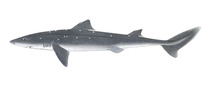
The spiny dogfish can be recognized by its two dorsal fins, each with a spine; second dorsal is smaller than the first. Pectoral fins posses curved margins and rounded free rear tips. These sharks have narrow anterior nasal flaps. The teeth are oblique and smooth with a notch on the outer margin. Color is slate grey to brown above (often with scattered small white spots) and light grey to pure white on the belly. An albino was reported in Norwegian waters.
- Other Physical Features
- bilateral symmetry
-
- Range mass
- 3.1 to 9.1 kg
- 6.83 to 20.04 lb
Reproduction
This shark is ovoviviparous. Males reach maturity between 80-100cm in length or at around 11 years of age; females mature at100-124 cm or in 18-21 years. Mating takes place during the winter months. As soon as the eggs are fertilized, the female secretes a thin, horny, transparent shell around them. The shells suround several eggs at once and are called candles. Gestation lasts between 22-24 months. Litters range between 2-11 pups and are between 20-30 cm at birth. They live for as long as 25-30 years.
Lifespan/Longevity
-
- Average lifespan
Status: wild - 60.0 years
- Max Planck Institute for Demographic Research
- Average lifespan
Behavior
Spiny dogfish are gregarious fish that form large schools of hundreds to thousands of sharks, often composed entirely of the same size or sex. The schools have north-south coastal and on-shore off-shore movements that are not completely understood. The name "dogfish" was adapted by fishermen who referred to the schools of them chasing schools of smaller fish as "packs".
- Key Behaviors
- natatorial
- motile
Food Habits
Spiny dogfish prey on bony fishes, smaller sharks, octopuses, squid, crabs, and eggcases of sharks and chimaeras.
Economic Importance for Humans: Positive
This species is used for its oil and as fish meal. It is also a popular labratory animal. In some areas (Europe more than the U.S.), it is a popular food fish.
Economic Importance for Humans: Negative
This fish causes tremendous damage when packs of them become entangled in commercial fishing nets.
Conservation Status
No special status.
-
- IUCN Red List
-
Endangered
More information
-
- IUCN Red List
-
Endangered
More information
-
- US Federal List
- No special status
-
- CITES
- No special status
Contributors
Robin Street (author), University of Michigan-Ann Arbor.
Glossary
- Arctic Ocean
-
the body of water between Europe, Asia, and North America which occurs mostly north of the Arctic circle.
- Atlantic Ocean
-
the body of water between Africa, Europe, the southern ocean (above 60 degrees south latitude), and the western hemisphere. It is the second largest ocean in the world after the Pacific Ocean.

- Pacific Ocean
-
body of water between the southern ocean (above 60 degrees south latitude), Australia, Asia, and the western hemisphere. This is the world's largest ocean, covering about 28% of the world's surface.
- benthic
-
Referring to an animal that lives on or near the bottom of a body of water. Also an aquatic biome consisting of the ocean bottom below the pelagic and coastal zones. Bottom habitats in the very deepest oceans (below 9000 m) are sometimes referred to as the abyssal zone. see also oceanic vent.
- bilateral symmetry
-
having body symmetry such that the animal can be divided in one plane into two mirror-image halves. Animals with bilateral symmetry have dorsal and ventral sides, as well as anterior and posterior ends. Synapomorphy of the Bilateria.
- coastal
-
the nearshore aquatic habitats near a coast, or shoreline.
- motile
-
having the capacity to move from one place to another.
- natatorial
-
specialized for swimming
- native range
-
the area in which the animal is naturally found, the region in which it is endemic.
References
The Sharks of North America;Castro:1983.
Sharks;Stevens, John;Merehurst Press:1987.