Spheniscus mendiculusGalapagos penguin


Geographic Range
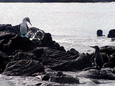
Spheniscus mendiculus is found on the Galapagos Islands, off the western coast of Ecuador. Spheniscus mendiculus is a year-round resident of the majority of the 19 islands in the Galapagos chain. Most individuals are found on the two larger islands of Fernandina and Isabela. ("Galapagos Islands", 2005; Harris, 1974; Sibley and Monroe Jr, 1990)
- Biogeographic Regions
- neotropical
- Other Geographic Terms
- island endemic
Habitat
Galapagos penguins occupy coastal areas and offshore waters where the cold Cromwell Current brings food and other population-sustaining necessities into the vicinity. These birds rest on sandy shores and rocky beaches and nest on areas of sheltered coast. Galapagos penguins primarily breed on the larger islands of Fernandina and Isabela where they lay eggs in caves or holes found in the volcanic rock of the islands. When feeding, they will hunt for small fish and crustaceans in the coastal waters, diving to a depth of approximately 30 m. (Davis and Darby, 1990; Gorman, 1990; Lynch, 1997; "Penguins, The Galapagos Penguin", 1990)
- Habitat Regions
- tropical
- terrestrial
- saltwater or marine
- Terrestrial Biomes
- desert or dune
- Aquatic Biomes
- coastal
- Other Habitat Features
- caves
-
- Range elevation
- 10 (high) m
- 32.81 (high) ft
-
- Range depth
- 30 (high) m
- 98.43 (high) ft
Physical Description
Galapagos penguins are fairly small penguins, averaging only 53 cm in height and ranging in weight from 1.7 to 2.6 kg. Sexual dimorphism exists, in that males are slightly larger than females. Galapagos penguins are the smallest members of the Spheniscus or "banded" penguins. Members of this species are mainly black in color with white accenting colors on various locations of the body and a large white frontal area. As in all banded penguins, the head is black with a white mark that begins above both eyes and circles back, down, and forward to the neck. They have the narrowest head-stripe of the banded penguins, a factor that distinguishes them from the similar Spheniscus magellanicus. Below the head stripe, S. mendiculus has a small black collar that merges into the back. Below the black collar there is another white stripe that runs the length of both sides of the body, followed by a black stripe that also runs the length of the body. (Lynch, 1997; Simpson, 1976)
- Other Physical Features
- endothermic
- homoiothermic
- bilateral symmetry
- Sexual Dimorphism
- male larger
-
- Range mass
- 1700 to 2600 g
- 59.91 to 91.63 oz
-
- Average length
- 53 cm
- 20.87 in
Reproduction
Breeding in Galapagos penguins involves a fairly complex set of courtship rituals before copulation occurs. First, male Galapagos penguins must locate a mate if they do not already have one. Since these penguins generally copulate with the same mate throughout their lifespan, each year only a handful of adult penguins need to attract a new mate. Those that are searching for a new mate exhibit various courtship rituals that attract a mate and strengthen the bond between the two partners. Paired individuals also participate in courtship rituals that enhance the pair bond. Such courtship rituals include displays of mutual preening, flipper patting, and bill dueling. After finding a mate, but before copulation, each penguin pair builds a nest that is continuously renovated until the eggs are laid. When the complex courtship and initial nest building are complete, the penguins begin mating. In Galapagos penguins, as in all other penguins, mating involves a balancing act in which the male climbs upon the back of the female that is sprawled upon the ground on her stomach. Once on top, sometimes after several tries, the male and female copulate--the process usually only takes about one minute. Steady copulation usually begins to occur early before the first egg is laid. As egg laying draws closer the penguins may copulate more frequently, mounting up to 14 times a day. Once the eggs are laid, both male and female S. mendiculus care for the young, including incubating the egg, fasting, and foraging for food. This reproductive process occurs every time a pair of Galapagos penguins mate, up to two or three times a year. (Gorman, 1990; Lynch, 1997; Muller-Schwarze, 1984)
- Mating System
- monogamous
Galapagos penguins breed two to three times a year, producing two eggs per clutch. As the breeding season lasts year round, most breeding occurs whenever coastal waters are cold enough and abundant with food supplies. These factors, necessary for breeding, occur most often between May and July, thus prompting most of the breeding of Galapagos penguins to occur during these months. However, as climatic changes are unpredictable, breeding can occur at any time of the year when conditions are favorable. Galapagos penguins construct nests in caves or volcanic-formed cavities before copulation takes place. At egg-laying Galapagos penguins incubate their eggs, which lasts from 38 to 42 days. After hatching, the same process of caring for the chick and foraging for food continues. Chicks fledge at approximately 60 days and are fully independent within 3 to 6 months. Female Galapagos penguins must wait another 3 to 4 years to reach sexual maturity while males must wait another 4 to 6 years. (Lynch, 1997; Muller-Schwarze, 1984; Richdale, 1951; Stonehouse, 1975)
Their nesting behavior is unique. Galapagos penguins will make their nests out of any resources that are available and often steal pebbles, sticks, and other components from a neighboring nest when the inhabitants are not present. (Lynch, 1997)
- Key Reproductive Features
- iteroparous
- year-round breeding
- gonochoric/gonochoristic/dioecious (sexes separate)
- sexual
- oviparous
-
- Breeding interval
- Galapagos penguins generally breed two to three times a year, breeding when food supplies are plentiful in the surrounding coastal waters.
-
- Breeding season
- The breeding season of Galapagos penguins lasts throughout the year; however, most breeding takes place between May and July.
-
- Range eggs per season
- 4 to 6
-
- Range time to hatching
- 38 to 42 days
-
- Average fledging age
- 60 days
-
- Range time to independence
- 3 to 6 months
-
- Range age at sexual or reproductive maturity (female)
- 3 to 4 years
-
- Range age at sexual or reproductive maturity (male)
- 4 to 6 years
Parental investment of Galapagos penguins is divided between both males and females. Incubation duties are shared and, when one incubates, the other ventures to coastal waters to forage for food. Similarly, at hatching, one parent broods and guards the newly-hatched chick while the other forages for food to nourish itself and the chick. The foraging parent returns with food to regurgitate for the chick. This intense guarding and feeding process occurs for about 30 to 40 days, at which point the chick has grown substantially and can then be left alone for periods of time while the parents forage. This post-guarding period generally lasts about one month, at its completion the chick will have completed its growth into an adult penguin. (Gorman, 1990; Lynch, 1997; Muller-Schwarze, 1984)
- Parental Investment
- altricial
-
pre-fertilization
- provisioning
-
protecting
- female
-
pre-hatching/birth
-
provisioning
- male
- female
-
protecting
- male
- female
-
provisioning
-
pre-weaning/fledging
-
provisioning
- male
- female
-
protecting
- male
- female
-
provisioning
-
pre-independence
-
provisioning
- male
- female
-
protecting
- male
- female
-
provisioning
Lifespan/Longevity
Galapagos penguins can live for 15 to 20 years. Because of high mortality rates due to predation, starvation, climatic events, and human disturbance, most Galapagos penguins do not live to such ages.
-
- Typical lifespan
Status: wild - 15 to 20 years
- Typical lifespan
-
- Average lifespan
Status: wild - 15-20 years
- Average lifespan
Behavior
Galapagos penguins are social animals that live in large colonies. By living in large colonies, these penguins can take advantage of group hunting and deterring predators. These penguins are awkward on land as a result of their short legs and small wings that provide little balance. When walking, Galapagos penguins waddle with outstretched wings. They are agile swimmers. (Gorman, 1990; Lynch, 1997; Simpson, 1976)
- Key Behaviors
- terricolous
- natatorial
- diurnal
- motile
- sedentary
- territorial
- social
- colonial
Home Range
Spheniscus mendiculus is endemic to the Galapagos archipelago. Galapagos penguins roam for food within the coastal waters of these islands, but specific home ranges are not reported. Galapagos penguins live in colonies and are territorial, protecting their nesting area from neighbors. Territory size depends on population density. (Lynch, 1997; Stonehouse, 1975)
Communication and Perception
Galapagos penguins rely on a series of vocal calls and sounds as well as a complex array of body movements for varying communication purposes. Vocalizations are crucial in helping to identify mates and chicks. These calls, along with body movements such as wing-flapping, help to deter egg-snatching predators. In courtship rituals, S. mendiculus relies heavily on displays and postures that advertise sexual status (paired or not paired), help to attract a mate, and reinforce the bond between the pair. Spheniscus mendiculus also uses vocalizations and body movements for general communication, such as greetings and displays of emotion. (Sparks and Soper, 1987; Lynch, 1997; Sparks and Soper, 1987; Lynch, 1997; Sparks and Soper, 1987; Lynch, 1997; Sparks and Soper, 1987; Stonehouse, 1975)
- Other Communication Modes
- duets
Food Habits
Galapagos penguins are carnivorous and eat all types of small fish (no longer than 15 mm in length) and other small marine invertebrates. Prey species include anchovies (Engraulidae), sardines and pilchards (Cleupidae), and mullets (Mulgilidae). Galapagos penguins use their short wings to swim through the water and their small, stout beaks to capture small fish and other small marine organisms. Galapagos penguins usually hunt in groups and capture small prey by seizing them from below. The position of their eyes in relation to the beak means that they see prey best from a position below the prey. (Davis and Darby, 1990; Lynch, 1997; Muller-Schwarze, 1984)
- Animal Foods
- fish
- mollusks
- aquatic crustaceans
- other marine invertebrates
- zooplankton
Predation
Galapagos penguins lay their eggs in caves or holes in the volcanic rock, reducing predation on their eggs. They also vocalize, attack, and use body movements (wing-flapping, vocal calls, etc.) to frighten away predators. This is most effective when a group of penguins confronts a predator. Predators on young penguins include rats, crabs, and snakes. As adults, Galapagos penguins are preyed on by hawks and owls, as well as feral cats and dogs. When foraging for food in the water, Galapagos penguins are preyed on by sharks and other large, marine animals. The pattern of black and white countershading on their body makes them difficult to see underwater. A predator looking from above will see a black-colored backside of the penguin that blends in with the darker, deeper water. A predator seeing the penguin from below will see a white underside that blends with the lighter-colored, shallow water. (Davis and Darby, 1990; Muller-Schwarze, 1984; Simpson, 1976; Sparks and Soper, 1987)
- Anti-predator Adaptations
- cryptic
-
- Known Predators
-
- Galapagos rice rats (Oryzomys galapagoensis)
- Sally lighfoot crabs (Grapsus grapsus)
- Galapagos snakes (Dromicus slevini and Dromicus dorsalis)
- Galapagos hawks (Buteo galapagoensis)
- short-eared owls (Asio flammeus)
- barn owls (Tyto alba)
- domestic cats (Felis silvestris)
- domestic dogs (Canis lupus familiaris)
Ecosystem Roles
Galapagos penguins are major predators of small fish and other marine invertebrates in the coastal waters of the Galapagos. They also act as prey for marine and avian predators in the Galapagos. (Davis and Darby, 1990; Simpson, 1976)
Economic Importance for Humans: Positive
Galapagos penguins provide economic value to humans who use this species and its coastal habitat to promote ecotourism. Many tourists and avid birdwatchers will pay to travel and visit the habitats of the Galapagos penguins. (Harris, 1974)
- Positive Impacts
- ecotourism
Economic Importance for Humans: Negative
Galapagos penguins may cause minor economic harm to the seafood industry for humans. As S. mendiculus relies heavily on a diet of small fish, such as anchovies and sardines, collectively the species can have an effect on the number of small fish available to catch for human consumption in their range. It has been shown that a penguin population can eat upwards of 6,000 to 7,000 tons of food locally, approximately 3,000 tons of that total has some economic value to humans. (Simpson, 1976)
Conservation Status
According to the IUCN Red List and the United States Endangered Species Act, Galapagos penguins are currently listed as endangered. Due to climatic changes brought about by El Niño and La Niña cycles, the food supply available to the Galapagos penguins varies greatly. These unpredictable shifts in food supply often lead to starvation and deaths and a substantial decline in the already dwindling penguin population. Furthermore, human disturbances and predation are major factors contributing to the decline of S. mendiculus. Human disturbance is the main cause for ecosystem harm that affects the nesting grounds of Galapagos penguins. Few efforts are underway to protect S. mendiculus. However, recently the Galapagos Conservation Trust launched the Sylvia Harcourt-Carrasco Bird Life Fund for Galapagos that will aim much of its efforts at conserving the population of Galapagos penguins. This fund provides a push for the conservation of S. mendiculus that may lead to other conservation actions, and eventually to a restored, healthy population. (Benthall, 2006; Bingham, 2006)
-
- IUCN Red List
-
Endangered
More information
-
- IUCN Red List
-
Endangered
More information
-
- US Migratory Bird Act
- No special status
-
- US Federal List
- Endangered
-
- CITES
- No special status
-
- State of Michigan List
- No special status
Contributors
Tanya Dewey (editor), Animal Diversity Web.
Joshua Wahlstrom (author), Kalamazoo College, Ann Fraser (editor, instructor), Kalamazoo College.
Glossary
- Neotropical
-
living in the southern part of the New World. In other words, Central and South America.

- acoustic
-
uses sound to communicate
- altricial
-
young are born in a relatively underdeveloped state; they are unable to feed or care for themselves or locomote independently for a period of time after birth/hatching. In birds, naked and helpless after hatching.
- bilateral symmetry
-
having body symmetry such that the animal can be divided in one plane into two mirror-image halves. Animals with bilateral symmetry have dorsal and ventral sides, as well as anterior and posterior ends. Synapomorphy of the Bilateria.
- carnivore
-
an animal that mainly eats meat
- chemical
-
uses smells or other chemicals to communicate
- coastal
-
the nearshore aquatic habitats near a coast, or shoreline.
- colonial
-
used loosely to describe any group of organisms living together or in close proximity to each other - for example nesting shorebirds that live in large colonies. More specifically refers to a group of organisms in which members act as specialized subunits (a continuous, modular society) - as in clonal organisms.
- cryptic
-
having markings, coloration, shapes, or other features that cause an animal to be camouflaged in its natural environment; being difficult to see or otherwise detect.
- desert or dunes
-
in deserts low (less than 30 cm per year) and unpredictable rainfall results in landscapes dominated by plants and animals adapted to aridity. Vegetation is typically sparse, though spectacular blooms may occur following rain. Deserts can be cold or warm and daily temperates typically fluctuate. In dune areas vegetation is also sparse and conditions are dry. This is because sand does not hold water well so little is available to plants. In dunes near seas and oceans this is compounded by the influence of salt in the air and soil. Salt limits the ability of plants to take up water through their roots.
- diurnal
-
- active during the day, 2. lasting for one day.
- duets
-
to jointly display, usually with sounds in a highly coordinated fashion, at the same time as one other individual of the same species, often a mate
- ecotourism
-
humans benefit economically by promoting tourism that focuses on the appreciation of natural areas or animals. Ecotourism implies that there are existing programs that profit from the appreciation of natural areas or animals.
- endothermic
-
animals that use metabolically generated heat to regulate body temperature independently of ambient temperature. Endothermy is a synapomorphy of the Mammalia, although it may have arisen in a (now extinct) synapsid ancestor; the fossil record does not distinguish these possibilities. Convergent in birds.
- island endemic
-
animals that live only on an island or set of islands.
- iteroparous
-
offspring are produced in more than one group (litters, clutches, etc.) and across multiple seasons (or other periods hospitable to reproduction). Iteroparous animals must, by definition, survive over multiple seasons (or periodic condition changes).
- monogamous
-
Having one mate at a time.
- motile
-
having the capacity to move from one place to another.
- natatorial
-
specialized for swimming
- native range
-
the area in which the animal is naturally found, the region in which it is endemic.
- oviparous
-
reproduction in which eggs are released by the female; development of offspring occurs outside the mother's body.
- piscivore
-
an animal that mainly eats fish
- saltwater or marine
-
mainly lives in oceans, seas, or other bodies of salt water.
- sedentary
-
remains in the same area
- sexual
-
reproduction that includes combining the genetic contribution of two individuals, a male and a female
- social
-
associates with others of its species; forms social groups.
- tactile
-
uses touch to communicate
- terrestrial
-
Living on the ground.
- territorial
-
defends an area within the home range, occupied by a single animals or group of animals of the same species and held through overt defense, display, or advertisement
- tropical
-
the region of the earth that surrounds the equator, from 23.5 degrees north to 23.5 degrees south.
- visual
-
uses sight to communicate
- year-round breeding
-
breeding takes place throughout the year
- zooplankton
-
animal constituent of plankton; mainly small crustaceans and fish larvae. (Compare to phytoplankton.)
References
Encyclopaedia Britannica, Inc. 2005. Galapagos Islands. Pp. 80 in The New Encyclopaedia Britannica, Micropaedia, Vol. Volume 5, 15th Edition Edition. Chicago: Encyclopaedia Britannica, Inc..
2002. "Longevity and Causes of Death" (On-line). Seaworld and Busch Gardens. Accessed November 11, 2006 at http://www.seaworld.org/infobooks/Penguins/longevity.html.
Marshall Editions Developments Limited. 1990. Penguins, The Galapagos Penguin. Pp. 49 in J Elphick, ed. The Illustrated Encyclopedia of Birds: The Definitive Reference to Birds of the World, Vol. 1, 1st Edition. New York, NY: Prentice Hall Press.
Benthall, S. 2006. "Current Programmes" (On-line). Galapagos Conservation Trust. Accessed November 14, 2006 at http://www.gct.org/funded.html.
Bingham, M. 2006. "Galapagos Penguin" (On-line). Accessed November 14, 2006 at http://www.penguins.cl/galapagos-penguins.htm.
Boersma, P. 1998. Population trends of the Galapagos penguin: impacts of El Nino and La Nina. The Condor, 100: 245-253.
Davis, L., J. Darby. 1990. Penguin Biology. San Diego, CA: Academic Press, Inc.
Davis, L., M. Renner. 2003. Penguins. New Haven, CT: Yale University Press.
Gorman, J. 1990. The Total Penguin. New York, NY: Prentice Hall Press.
Harris, M. 1974. A Field Guide To The Birds of Galapagos. Glasgow: William Collins Sons & Co Ltd.
Lynch, W. 1997. Penguins of the World. Buffalo, NY: Firefly Books (U.S.) Inc.
Muller-Schwarze, D. 1984. The Behavior of Penguins: Adapted to Ice and Tropics. Albany, NY: State University of New York Press.
Richdale, L. 1951. Sexual Behavior in Penguins. Lawrence, KS: University of Kansas Press.
Sibley, C., B. Monroe Jr. 1990. Distribution and Taxonomy of Birds of the World. New Haven, CT: Yale University Press.
Simpson, G. 1976. Penguins: Past and Present, Here and There. New Haven, CT: Yale University Press.
Sparks, J., T. Soper. 1987. Penguins. New York, NY: Facts on File, Inc.
Stonehouse, B. 1975. The Biology of Penguins. Baltimore, MD: University Park Press.