Spheniscus demersusjackass penguin



Geographic Range
Spheniscus demersus, commonly known as African, black-footed, or jackass penguin, is the only penguin species found on the African continent. This species inhabits the Benguela and western Agulhas ecosystems of southern Africa. African penguins form colonies near a chain of islands between Hollamsbird Island, Namibia, and Bird Island in Algoa Bay, South Africa. (Crawford, et al., 2001; Frost, et al., 1976)
Habitat
African penguins live in large colonies on rocky coastlines of southwest Africa. They can swim up to 20 kph and can travel 30 to 70 km during each trip. They spend the night gathered together on shore and much of the day feeding in the water. (Crawford, et al., 2006; Heath and Randall, 1989)
- Habitat Regions
- temperate
- terrestrial
- Aquatic Biomes
- coastal
-
- Range depth
- 130 (high) m
- 426.51 (high) ft
-
- Average depth
- 30-60 m
- ft
Physical Description
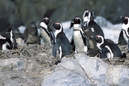
Adults stand around 45 cm tall and weigh an average of 3.1 kg. African penguins have black plumage on the back and white feathers with black markings on the chest and belly. The white and black plumage serves as camouflage to predators, with the white appearing to aquatic predators from below and the black appearing to aerial predators from above. They also have a horseshoe-shaped white band that goes around the eye from the chin towards the beak. Additionally, a horseshoe-shaped band of black goes across their chest. Juveniles have gray-blue feathers that darken to black with age. The change from juvenile plumage to adult plumage takes around 3 years. (Cooper, 1977; Stefoff, 2005)
African penguins resemble their close relatives, other species in the genus Spheniscus, including Galapagos penguins of the Pacific Ocean and Humboldt penguins and Magellanic penguins of South America. The 4 Spheniscus species share size and plumage characteristics. (Cooper, 1977; Stefoff, 2005)
- Other Physical Features
- endothermic
- homoiothermic
- bilateral symmetry
- Sexual Dimorphism
- sexes alike
-
- Average mass
- 3.1 kg
- 6.83 lb
-
- Average length
- 45 cm
- 17.72 in
Reproduction
African penguins are monogamous. During breeding, male and female penguins are most distinguishable from one another due to the pattern of colors. African penguins dig shallow burrows under rocks, in sand or under sparse vegetation. They gather in breeding areas called 'rookeries' from September to February, where they lay two eggs. African penguin courtship rituals typically begin with the male projecting visual and auditory displays to attract a mate. Head-swinging motions usually refer to ownership of nest site, attracting females, and/or used as a warning for other males. The next stage is used to ensure a mutual bond is formed; which involves a harsh vocal call released while extending the neck and head upward. The final stage includes bowing, where one or both penguins duck the head while the bill points at the nest or at the other bird's feet. (Shannon and Crawford, 1999)
- Mating System
- monogamous
African penguin pairs return to the same breeding sites year after year. Although breeding takes place throughout the year, nesting peaks in Namibia from November to December and in South Africa from March until May. Females typically lay two eggs, which are then incubated by both parents for about 40 days. All penguins have a patch of bare skin at the base of their bellies, called a "brood patch”, that helps the parent provide direct heat to incubate the eggs. (Cooper, 1977; Crawford, et al., 2006; Crawford, et al., 2008; Shannon and Crawford, 1999)
- Key Reproductive Features
- iteroparous
- seasonal breeding
- gonochoric/gonochoristic/dioecious (sexes separate)
- sexual
- oviparous
-
- Breeding interval
- African penguins breed once yearly.
-
- Breeding season
- Breeding occurs in Namibia from November to December and in South Africa from March until May.
-
- Average eggs per season
- 2
-
- Average time to hatching
- 40 days
-
- Range fledging age
- 60 to 130 days
-
- Average time to independence
- 80 days
-
- Average age at sexual or reproductive maturity (female)
- 4 years
-
- Average age at sexual or reproductive maturity (male)
- 5 years
After the eggs hatch, the pair feeds their young for about one month by regurgitating food into the hatchling's mouth. Hatchlings are then left alone in crèches, or groups, a characteristic common to bird species that breed in large colonies, while their parents forage for food. Young leave the colony once they develop their juvenile plumage in 2 to 4 months. (Cooper, 1977; Crawford, et al., 2006; Crawford, et al., 2008; Shannon and Crawford, 1999)
- Parental Investment
- altricial
- male parental care
- female parental care
-
pre-fertilization
- provisioning
-
protecting
- male
- female
-
pre-hatching/birth
-
provisioning
- female
-
protecting
- male
- female
-
provisioning
-
pre-weaning/fledging
-
provisioning
- male
- female
-
protecting
- male
- female
-
provisioning
Lifespan/Longevity
The average lifespan of Spheniscus demersus is 10 to 27 years in the wild, whereas an African penguin living in captivity generally has a longer lifespan. Other penguin species live for 15 to 20 years. Limits to aging are predation, human impact, and storm systems. (Crawford, et al., 2001; Shannon and Crawford, 1999; Whittington, et al., 2000)
-
- Range lifespan
Status: wild - 27 (high) years
- Range lifespan
-
- Range lifespan
Status: captivity - 25 (high) years
- Range lifespan
-
- Typical lifespan
Status: wild - 10 to 15 years
- Typical lifespan
Behavior
Allopreening (preening each other) can commonly be observed in Spheniscus demersus. This is practical, because penguins cannot easily preen their own heads and necks. If they are by themselves, they have to use their feet to preen their heads. Allopreening allows for cleaning and rearranging of feathers and aids in the removal of parasites such as ticks. African penguins often bathe within a few meters of the shoreline. They shake their bodies around wildly and preen themselves with their beak and feet. On warmer days, African penguins may dive into the water to keep cool. Fighting occurs occasionally and involves the beating of wings and biting. African penguins have been observed chasing through colonies clutching an opposing penguin’s back with their beaks while beating the penguin with its wings. (Crawford, et al., 2001; Crawford, et al., 2006; Crawford, et al., 2008; Frost, et al., 2009; Frost, et al., 1976)
- Key Behaviors
- terricolous
- natatorial
- diurnal
- motile
- sedentary
- territorial
- social
- colonial
Home Range
The distance that African penguins have to travel to find food varies, both temporally and spatially. On the west coast a typical foraging trip could range from 30 to 70 km for a single trip. On the south coast, foraging birds cover an average of 110 km per trip. (Crawford, et al., 2008)
Communication and Perception
African penguins are also called jackass penguins because they emit a loud, braying, donkey-like call to communicate. There are three types of calls used: bray, yell, and haw. The yell, or contact call, is used to defend a territory from another colony member. The bray, or display call, is used to attract mates and is used between partners in a colony. Penguins also perform displays that are used to establish nesting areas, help with partner/hatchling recognition and defense against intruders. The haw is used by partners when one is on land and the other is in the water. (Cunningham, et al., 2008; Frost, et al., 2009; Thumser and Ficken, 1998)
Food Habits
African penguins feed primarily on shoaling pelagic fish such as anchovies (Engraulis encrasicolus), pilchards (Sardinops sagax), horse mackerel (Trachurus capensis), and round herrings (Etrumeus teres), supplemented by squid and crustaceans. When on the hunt for prey, African genguins can reach a top speed of close to 20 km/h. The distance that African penguins have to travel to find food varies regionally. (Crawford, et al., 2006; Randall and Randall, 1990)
- Animal Foods
- fish
- mollusks
- aquatic crustaceans
Predation
African penguins are on the endangered species list. Initially, their decline was due to the exploitation of eggs for food. Also, habitat alteration and disturbance associated with guano collection at breeding colonies contributed to their decline. These factors have now largely ceased, and the major current threats include competition with commercial fisheries for pelagic fish prey and oil pollution. Natural threats include competition with Cape Fur seals (Arctocephalus pusillus) for space at breeding colonies and for food resources, as well as predation by seals on penguins. Feral cats are also present and pose a problem at some colonies. African penguins also face predation of eggs and chicks by avian predators such as kelp gulls (Larus dominicanus) and sacred ibises (Threskiornis aethiopicus), while natural terrestrial predators, such as mongooses (Cynictis penicillata), genets (Genetta tigrina), and leopards (Panthera pardus) are also present at mainland colonies. ("The IUCN Red List of Threatened Species", 2009; Crawford, et al., 2001; Randall and Randall, 1990; Stefoff, 2005)
- Anti-predator Adaptations
- cryptic
-
- Known Predators
-
- Cape fur seals (Arctocephalus pusillus)
- kelp gulls (Larus dominicanus)
- sacred ibises (Threskiornis aethiopicus)
- yellow mongooses (Cynictis penicillata)
- large-spotted genets (Genetta tigrina)
- leopards (Panthera pardus)
Ecosystem Roles
African penguins are predators of small shoaling fish, including anchovies (Engraulis capensis) and sardines (Sardinops sagax). Up to 18 species of crustaceans are also prey to the African penguin.
Additionally, four types of blood parasites, Plasmodium relictum, P. elongatum, P. cathemerium, and Leucocytozoon tawaki have been recorded in Spheniscus demersus. (Crawford, et al., 2001; Crawford, et al., 2006; Crawford, et al., 2008; Cunningham, et al., 2008; Jones and Shellam, 1999; Randall and Randall, 1990)
- Plasmodium relictum
- Plasmodium elongatum
- Plasmodium cathemerium
- Leucocytozoon tawaki
Economic Importance for Humans: Positive
African penguins provide a substantial source of guano. Guano was excavated from rookeries, processed, and made into fertilizer, which was then sold around the world. Penguin skins have been used as gloves. Guano is now forbidden in fertilizer, which has reduced the economic importance for humans. African penguins also benefit humans by ecotourism. They are a species that humans can get up close to and watch how they interact with their environment. The primary viewing site of African penguins is the colony at False Bay in Simons Town, South Africa. This colony has over 2000 penguins. African penguins are the most common penguin found in zoos due to their size and temperature requirements, which are easy to maintain. (Crawford, et al., 2006; Shannon and Crawford, 1999; Stefoff, 2005)
- Positive Impacts
- ecotourism
Economic Importance for Humans: Negative
There are no real negative economic effects of the African penguin. They do not eat enough fish to be detrimental to the local fishing industry. (Stefoff, 2005)
Conservation Status
African penguins are classified as vulnerable. Since the early 1900s, the African penguin population has been in decline. The initial decline was due to commercial sales of eggs and disturbance of nesting birds. Presently, the species is threatened by oil pollution. ("The IUCN Red List of Threatened Species", 2009; Frost, et al., 1976)
-
- IUCN Red List
-
Endangered
More information
-
- IUCN Red List
-
Endangered
More information
-
- US Migratory Bird Act
- No special status
-
- US Federal List
- Endangered
-
- CITES
- Appendix II
-
- State of Michigan List
- No special status
Contributors
Will Pearce (author), Radford University, Karen Powers (editor), Radford University, Tanya Dewey (editor), University of Michigan-Ann Arbor.
Glossary
- Ethiopian
-
living in sub-Saharan Africa (south of 30 degrees north) and Madagascar.

- acoustic
-
uses sound to communicate
- altricial
-
young are born in a relatively underdeveloped state; they are unable to feed or care for themselves or locomote independently for a period of time after birth/hatching. In birds, naked and helpless after hatching.
- bilateral symmetry
-
having body symmetry such that the animal can be divided in one plane into two mirror-image halves. Animals with bilateral symmetry have dorsal and ventral sides, as well as anterior and posterior ends. Synapomorphy of the Bilateria.
- carnivore
-
an animal that mainly eats meat
- chemical
-
uses smells or other chemicals to communicate
- coastal
-
the nearshore aquatic habitats near a coast, or shoreline.
- colonial
-
used loosely to describe any group of organisms living together or in close proximity to each other - for example nesting shorebirds that live in large colonies. More specifically refers to a group of organisms in which members act as specialized subunits (a continuous, modular society) - as in clonal organisms.
- cryptic
-
having markings, coloration, shapes, or other features that cause an animal to be camouflaged in its natural environment; being difficult to see or otherwise detect.
- diurnal
-
- active during the day, 2. lasting for one day.
- ecotourism
-
humans benefit economically by promoting tourism that focuses on the appreciation of natural areas or animals. Ecotourism implies that there are existing programs that profit from the appreciation of natural areas or animals.
- endothermic
-
animals that use metabolically generated heat to regulate body temperature independently of ambient temperature. Endothermy is a synapomorphy of the Mammalia, although it may have arisen in a (now extinct) synapsid ancestor; the fossil record does not distinguish these possibilities. Convergent in birds.
- female parental care
-
parental care is carried out by females
- iteroparous
-
offspring are produced in more than one group (litters, clutches, etc.) and across multiple seasons (or other periods hospitable to reproduction). Iteroparous animals must, by definition, survive over multiple seasons (or periodic condition changes).
- male parental care
-
parental care is carried out by males
- monogamous
-
Having one mate at a time.
- motile
-
having the capacity to move from one place to another.
- natatorial
-
specialized for swimming
- native range
-
the area in which the animal is naturally found, the region in which it is endemic.
- oviparous
-
reproduction in which eggs are released by the female; development of offspring occurs outside the mother's body.
- piscivore
-
an animal that mainly eats fish
- seasonal breeding
-
breeding is confined to a particular season
- sedentary
-
remains in the same area
- sexual
-
reproduction that includes combining the genetic contribution of two individuals, a male and a female
- social
-
associates with others of its species; forms social groups.
- tactile
-
uses touch to communicate
- temperate
-
that region of the Earth between 23.5 degrees North and 60 degrees North (between the Tropic of Cancer and the Arctic Circle) and between 23.5 degrees South and 60 degrees South (between the Tropic of Capricorn and the Antarctic Circle).
- terrestrial
-
Living on the ground.
- territorial
-
defends an area within the home range, occupied by a single animals or group of animals of the same species and held through overt defense, display, or advertisement
- visual
-
uses sight to communicate
References
2009. "The IUCN Red List of Threatened Species" (On-line). Accessed February 01, 2010 at http://www.iucnredlist.org/apps/redlist/details/144810/0.
Cooper, J. 1977. Moult of the black-footed penguin. International Zoo Yearbook, 18: 22-27.
Crawford, R., P. Barham, L. Underhill, L. Shannon, J. Coetzee, B. Dyer, T. Leshoro, L. Upfold. 2006. The influence of food availability on breeding success of african penguins Spheniscus demersus at Robben Island, South Africa. Biological Conservation, 132/1: 119-125.
Crawford, R., J. David, L. Shannon, J. Kemper, N. Klages, J. Roux, L. Underhill, V. Ward, A. Williams, A. Wolfaardt. 2001. African penguins as predators and prey-coping (or not) with change. African Journal of Marine Science, 23: 435-447.
Crawford, R., L. Underhill, J. Coetzee, T. Fairweather, L. Shannon, A. Wolfaardt. 2008. Influences of the abundance and distribution of prey on african penguins Spheniscus demersus off western South Africa. African Journal of Marine Science, 30: 167-175.
Cunningham, G., V. Strauss, P. Ryan. 2008. African penguins (Spheniscus demersus) can detect dimethyl sulphide, a prey-related odour. The Journal of Experimental Biology, 221: 3123-3127.
Frost, P., W. Siegfried, A. Burger. 2009. Behavioural adaptations of the jackass penguin, Spheniscus demersus to a hot, arid environment. Journal of Zoology, 179: 165-187.
Frost, P., W. Slegfried, J. Cooper. 1976. Conservation of the jackass penguin (Spheniscus demersus). Biological Conservation, 9/2: 79-99.
Heath, R., R. Randall. 1989. Foraging ranges and movements of jackass penguins (Spheniscus demersus) established through radio telemetry. Journal of Zoology, 217: 367-379.
Jones, H., G. Shellam. 1999. Blood parasites in penguins, and their potential impact on conservation. Marine Ornithology, 27: 181-184.
Randall, R., B. Randall. 1990. Cetaceans as predators of jackass penguins Spheniscus demersus: deductions based on behaviour. Marine Ornithology, 18: 9-12.
Shannon, L., R. Crawford. 1999. Management of the african penguin Spheniscus demersus-insights from modeling. Marine Ornithology, 27: 119-128.
Stefoff, R. 2005. Penguins. 99 White Planes Road Tarrytown, NY: Marshall Cavendish Benchmark.
Thumser, N., M. Ficken. 1998. A Comparison of the Vocal Repertoires of Captive Spheniscus Penguins. Marine Ornithology, 26: 41-48.
Whittington, P., B. Dyer, N. Klages. 2000. Maximum Longevities of African Penguins Spheniscus Demersus Based on Banding Records. Marine Ornithology, 28: 81-82.
Wilson, R., G. La Cock, M. Wilson, F. Mollagee. 1985. Differential digestion of fish and squid in jackass penguins Spheniscus demersus. Ornis Scandinavica, 16: 77-79.