Sitta carolinensiswhite-breasted nuthatch


Geographic Range
White-breasted nuthatches reside throughout most of North America, including the continental United States, southern regions of Canada, and central Mexico. (Pravosudov and Grubb, 1993)
Habitat
White-breasted nuthatches live in deciduous woodlands and mixed deciduous and coniferous forests. They prefer, older, more mature hardwood forests and may require the presence of oak trees. White-breasted nuthatches are also common visitors to backyard birdfeeders. (Pravosudov and Grubb, 1993)
- Habitat Regions
- temperate
- terrestrial
- Terrestrial Biomes
- forest
- Other Habitat Features
- suburban
Physical Description
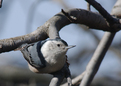
The long bills of white-breasted nuthatches distinguish them from other nuthatches. Their bills are nearly as long as their heads and are slightly upturned. White-breasted nuthatches have black crowns on their heads, with white cheeks and white undersides. Their undersides have a slightly rosy region towards the tail. A nuthatch's back is a bluish-gray. Their wings and tails are a mixture of white, black, and bluish-gray. Males tend to be slightly more vivdly colored than females, with the dark parts of their plumage being very dark and contrasting with their light plumage. Females tend to be somewhat more gray overall. Very little research has been done on these birds but it is known that they weigh on average 20 g and are about 15 cm long. (Pravosudov and Grubb, 1993)
- Other Physical Features
- endothermic
- bilateral symmetry
- Sexual Dimorphism
- male more colorful
-
- Average mass
- 20 g
- 0.70 oz
-
- Average mass
- 20.5 g
- 0.72 oz
- AnAge
-
- Average length
- 15 cm
- 5.91 in
Reproduction
White-breasted nuthatches form monogamous pairs that remain together year-round from the time of courtship and establishment of a territory until one of the pair dies or disappears. Courtship in white-breasted nuthatches is composed of a breeding song sung by the males, distinctive call notes and courtship feeding. (Pravosudov and Grubb, 1993)
- Mating System
- monogamous
The dates of nest-building, egg-laying, hatching, and young leaving the nest vary from region to region. Most breeding is done between early May and early June, but some populations show a range starting as early as April and even possibly going into July. White-breasted nuthatches raise one brood per year. Female white-breasted nuthatches build their nests alone. White-breasted nuthatches nest in cavities from 3 to 18 meters from the ground. The female lays 3 to 10 (typically 6 to 8) pinkish-white eggs. She then incubates the eggs for 12 to 14 days, and the male brings food to her in the nest cavity. The nestlings stay in the nest for 26 days before fledging. After fledging, the chicks remain with their parents for several weeks before they disperse. Both parents feed and protect them during this time. These young nuthatches leave their parent's territory to establish their own territories, usually in pairs, and breed the next spring. (Pravosudov and Grubb, 1993)
- Key Reproductive Features
- iteroparous
- seasonal breeding
- gonochoric/gonochoristic/dioecious (sexes separate)
- sexual
- oviparous
-
- Breeding interval
- White-breasted nuthatches breed once per year.
-
- Breeding season
- The dates of nest-building, egg-laying, hatching, and young leaving the nest vary from region to region. Most breeding is done between early May and early June.
-
- Range eggs per season
- 3 to 10
-
- Average eggs per season
- 7
-
- Average eggs per season
- 8
- AnAge
-
- Range time to hatching
- 12 to 14 days
-
- Average fledging age
- 26 days
-
- Range age at sexual or reproductive maturity (female)
- 1 to 1 years
-
- Range age at sexual or reproductive maturity (male)
- 1 to 1 years
The female builds the nest and incubates the eggs. Once the eggs have hatched, both parents feed and protect the young. Males tend to do most of the parental care in the first few days after hatching, but as the young become more independent, both parents share the job equally. (Pravosudov and Grubb, 1993)
- Parental Investment
-
pre-fertilization
- provisioning
-
protecting
- male
- female
-
pre-hatching/birth
-
protecting
- female
-
protecting
-
pre-weaning/fledging
-
provisioning
- male
- female
-
protecting
- male
- female
-
provisioning
-
pre-independence
-
provisioning
- male
- female
-
protecting
- male
- female
-
provisioning
Lifespan/Longevity
The estimated average lifespan of a white-breasted nuthatch is 2 years. The oldest known white-breasted nuthatch lived almost 10 years. (Pravosudov and Grubb, 1993)
-
- Average lifespan
Status: wild - 10 years
- Average lifespan
-
- Average lifespan
Status: wild - 2 years
- Average lifespan
-
- Average lifespan
Status: wild - 118 months
- Bird Banding Laboratory
- Average lifespan
Behavior
White-breasted nuthatches are excellent at climbing up and down the sides of trees, and are easily identified by their habit of creeping up and down tree trunks. They forage this way, searching out insects hidden in crevices along the trunks and limbs of trees. They also sometimes feed on the ground, hopping rather than walking.
Nuthatches do not migrate. They defend a territory year-round which varies in size depending on if it is in a wooded (smaller) or non-wooded (larger) area. The territory is dominated by the male, but both sexes live together within the territory. Nuthatch pairs may leave their territory in winter when food becomes scarce. They often head for bird feeders or join flocks with chickadees and titmice. White-breasted nuthatches are diurnal. (Pravosudov and Grubb, 1993)
-
- Range territory size
- 0.1 to 0.2 km^2
Home Range
In this species, the home range is the same as the territory. Typical territories in wooded habitats are 0.10 to 0.15 square kilometers. Territories in semi-wooded areas are about 0.2 square kilometers. (Pravosudov and Grubb, 1993)
Communication and Perception
White-breasted nuthatches communicate using vocalizations and visual cues. They are generally quiet during the summer and their breeding season. They vocalize most during the very early spring and the winter. White-breasted nuthatches sing several different songs, each consisting of several notes. Most of their songs are used for territorial defense and assertion. There are 13 different calls known at this time: Hit and tuck, Tchup, Quank, Quank quank, rapid quank, rough quank, Chrr, Phee-oo, Squeal, Brr-a and Whine. Each call has a different purpose. White-breasted Nuthatches also have very good vision. (Pravosudov and Grubb, 1993)
Food Habits
Nuthatches get their name from their habit of placing large seeds and nuts in crevices of trees and then prying them open with their bills. Nuthatches also probe crevices along tree trunks and limbs for smaller seeds and insects. They store seeds in loose bark or crevices. The percentage of seed and insect food varies with the season. One study found the diet included 68% seed in winter, 48% seed in spring, no seed in summer (100% insects), and 29% seed in fall. The insect foods eaten by white-breasted nuthatches include such species as weevils, tent caterpillars, ants, scale insects, psyllids, wood borers, and leaf beetles. (Pravosudov and Grubb, 1993)
- Primary Diet
- omnivore
- Animal Foods
- insects
- Plant Foods
- seeds, grains, and nuts
- Foraging Behavior
- stores or caches food
Predation
Predators of adults are most likely hawks and owls. Nestlings and eggs are eaten by woodpeckers, small squirrels, and climbing snakes, such as smooth green snakes. White-breasted nuthatches respond to predators near their nest by pecking and flicking their wings while making "hn-hn" noises. They also use a piece of fur or vegetation to wipe around their nest opening when they leave the nest. This covers up their scent and keeps squirrels and other predators from using smell to find their nests. (Pravosudov and Grubb, 1993)
-
- Known Predators
-
- hawks (Accipitridae)
- owls (Strigiformes)
- woodpeckers (Piciformes)
- squirrels (Sciuridae)
- climbing snakes (Serpentes)
Ecosystem Roles
White-breasted nuthatches help to control insect populations in the summer. They also disperse the seeds of many plants. (Pravosudov and Grubb, 1993)
- Ecosystem Impact
- disperses seeds
Economic Importance for Humans: Positive
White-breasted nuthatches eat insects that some humans consider to be pests. (Pravosudov and Grubb, 1993)
- Positive Impacts
- controls pest population
Economic Importance for Humans: Negative
We do not know of any way that white-breasted nuthatches negatively affect humans.
Conservation Status
White-breasted nuthatches are common throughout most of North America. There are an estimated 10,000,000 individuals throughout their range, and the overall population appears to be slowly increasing. This species is protected under the U.S. Migratory Bird Act.
The removal of dead trees from forests may cause some problems for this species because they require cavity sites for nesting. (Pravosudov and Grubb, 1993)
-
- IUCN Red List
-
Least Concern
More information
-
- IUCN Red List
-
Least Concern
More information
-
- US Migratory Bird Act
- Protected
-
- US Federal List
- No special status
-
- CITES
- No special status
-
- State of Michigan List
- No special status
Other Comments
Although the white-breasted nuthatches are a common bird, there is little documentation of their life history and biology. This is because they prefer to breed in natural holes in large, dead trees, where it is difficult to examine them. (Pravosudov and Grubb, 1993)
Contributors
Tanya Dewey (author), Animal Diversity Web.
Kari Kirschbaum (editor), Animal Diversity Web.
Jennifer Roof (author), University of Michigan-Ann Arbor.
Glossary
- Nearctic
-
living in the Nearctic biogeographic province, the northern part of the New World. This includes Greenland, the Canadian Arctic islands, and all of the North American as far south as the highlands of central Mexico.

- acoustic
-
uses sound to communicate
- arboreal
-
Referring to an animal that lives in trees; tree-climbing.
- bilateral symmetry
-
having body symmetry such that the animal can be divided in one plane into two mirror-image halves. Animals with bilateral symmetry have dorsal and ventral sides, as well as anterior and posterior ends. Synapomorphy of the Bilateria.
- chemical
-
uses smells or other chemicals to communicate
- diurnal
-
- active during the day, 2. lasting for one day.
- endothermic
-
animals that use metabolically generated heat to regulate body temperature independently of ambient temperature. Endothermy is a synapomorphy of the Mammalia, although it may have arisen in a (now extinct) synapsid ancestor; the fossil record does not distinguish these possibilities. Convergent in birds.
- forest
-
forest biomes are dominated by trees, otherwise forest biomes can vary widely in amount of precipitation and seasonality.
- iteroparous
-
offspring are produced in more than one group (litters, clutches, etc.) and across multiple seasons (or other periods hospitable to reproduction). Iteroparous animals must, by definition, survive over multiple seasons (or periodic condition changes).
- monogamous
-
Having one mate at a time.
- motile
-
having the capacity to move from one place to another.
- native range
-
the area in which the animal is naturally found, the region in which it is endemic.
- omnivore
-
an animal that mainly eats all kinds of things, including plants and animals
- oviparous
-
reproduction in which eggs are released by the female; development of offspring occurs outside the mother's body.
- seasonal breeding
-
breeding is confined to a particular season
- sedentary
-
remains in the same area
- sexual
-
reproduction that includes combining the genetic contribution of two individuals, a male and a female
- solitary
-
lives alone
- stores or caches food
-
places a food item in a special place to be eaten later. Also called "hoarding"
- suburban
-
living in residential areas on the outskirts of large cities or towns.
- tactile
-
uses touch to communicate
- temperate
-
that region of the Earth between 23.5 degrees North and 60 degrees North (between the Tropic of Cancer and the Arctic Circle) and between 23.5 degrees South and 60 degrees South (between the Tropic of Capricorn and the Antarctic Circle).
- terrestrial
-
Living on the ground.
- territorial
-
defends an area within the home range, occupied by a single animals or group of animals of the same species and held through overt defense, display, or advertisement
- visual
-
uses sight to communicate
References
Pravosudov, V., T. Grubb. 1993. White-breasted nuthatch (Sitta carolinensis). Pp. 1-16 in A Poole, F Gill, eds. The Birds of North America, Vol. 54. Philadelphia: The Academy of Natural Sciences; Washington, D.C.: The American Ornithologists' Union.