Sebastes caurinusRockfish
Geographic Range
Copper rockfish are found in waters along the Pacific coast ranging from Baja, California up to Kehui, Alaska. They are common in the waters of British Columbia and in Puget Sound. (Albin, et al., 1995)
- Biogeographic Regions
- pacific ocean
Habitat
Copper rockfish are demersal, preferring the ocean bottom near low-profile rocks and reefs. The range of water depths they inhabit is relatively broad, from 10 to 183 meters, and the fish are found in shallower water during upwelling. Most often, these fish are in close contact with reefs, maintaining an even closer contact during the winter and spring than in the summer months. Tagging experiments have suggested that mature fish do not move far from their home location. ("Species profiles: life histories and environmental requirements of coastal fishes and invertabrates (Pacific Southwest) - brown rockfish, copper rockfish, and black rockfish", 1989; Boschung, Jr., 1983)
- Habitat Regions
- saltwater or marine
-
- Range depth
- 10 to 183 m
- 32.81 to 600.39 ft
Physical Description
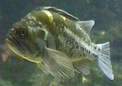
Their overall color is variable but a copper-brown color with darker fins is generally observed. Patches of yellow or copper are also present, usually near the gill coverings. They are distinguished from other rockfish species by the clear areas along the posterior two thirds of the lateral lines, and in having a whitish underside. They have 13 dorsal and 3 anal spines that are mildly venomous. (; Boschung, Jr., 1983; Froese, 2004)
- Other Physical Features
- bilateral symmetry
-
- Range mass
- 2.6 (high) kg
- 5.73 (high) lb
-
- Range length
- 57 (high) cm
- 22.44 (high) in
Development
Copper rockfish are live-bearers and in California waters, the larvae are released in the spring when they are 5-6 mm in length. Generally among rockfish, the larvae drift in offshore waters and survive in the upper 80 m of the water column for 1-2 months before they transform into juveniles. Because of identification problems with other species of rockfish, the distribution of copper rockfish larvae and juveniles are often debated. In central California, these juveniles are closely associated with the surface and mid-depth kelp beds and do not become benthic until they have reached 40-50 mm. ("Species profiles: life histories and environmental requirements of coastal fishes and invertabrates (Pacific Southwest) - brown rockfish, copper rockfish, and black rockfish", 1989)
Growth rates are fastest in fish less than 3 years old and are highest in the summer months, coinciding with high feeding rates and upwelling. Sexual maturity has been shown to vary slightly between different regions along the Pacific coast. Off central California, males become sexually mature between the ages of 3 and 7 years. Females are fully mature by 8 years. These fish often reach 20 years of age. ("Species profiles: life histories and environmental requirements of coastal fishes and invertabrates (Pacific Southwest) - brown rockfish, copper rockfish, and black rockfish", 1989; Coad, 1995)
- Development - Life Cycle
- metamorphosis
Reproduction
No information could be obtained describing the mating behaviors of copper rockfish or any of the various rockfish species.
Spawning in copper rockfish occurs once a year in the spring at a time that varies geographically. Fertilization occurs internally, and little is known about the specific courtship or mating behaviors. Females move inshore to release their young and are capable of regulating where and when larvae are released. This is thought to be dependant on environmental conditions. As is true of other rockfish species, fecundity is related to length. (; "Species profiles: life histories and environmental requirements of coastal fishes and invertabrates (Pacific Southwest) - brown rockfish, copper rockfish, and black rockfish", 1989; Albin, et al., 1995)
- Key Reproductive Features
- seasonal breeding
- gonochoric/gonochoristic/dioecious (sexes separate)
- sexual
- fertilization
- ovoviviparous
-
- Breeding interval
- Spawning occurs once a year.
-
- Breeding season
- Spawning occurs most often during early spring but varies among different geographies.
-
- Range number of offspring
- 100,000 larvae to 300,000 larvae
-
- Range age at sexual or reproductive maturity (female)
- 8 (high) years
-
- Range age at sexual or reproductive maturity (male)
- 3 to 7 years
Copper rockfish larvae are independent once they are released inshore. The female provides internal nourishment to the embryos until they are released. ("Species profiles: life histories and environmental requirements of coastal fishes and invertabrates (Pacific Southwest) - brown rockfish, copper rockfish, and black rockfish", 1989)
- Parental Investment
-
pre-hatching/birth
-
provisioning
- female
-
provisioning
Lifespan/Longevity
Copper rockfish can live to be decades old and take several years to become sexually mature. Once mature, females generally produce a higher number of eggs each year. These traits are important for the survival of the species since a relatively low percentage of young survive each year. Few if any efforts have been made to breed copper rockfish in captivity. (Coad, 1995; Froese, 2004)
-
- Range lifespan
Status: wild - 55 (high) years
- Range lifespan
-
- Typical lifespan
Status: wild - 40 (high) years
- Typical lifespan
-
- Average lifespan
Status: captivity - 55 years
- AnAge
- Average lifespan
Behavior
Adult copper rockfish are highly residential and remain near their home site. Although they are a solitary species and usually seen alone, they are sometimes present in mixed aggregates with other species. Individual fish display agnostic behavior to show "protective territoriality". ("Species profiles: life histories and environmental requirements of coastal fishes and invertabrates (Pacific Southwest) - brown rockfish, copper rockfish, and black rockfish", 1989; ; Johnson, et al., 2003)
- Key Behaviors
- natatorial
- motile
- sedentary
- solitary
Home Range
Sebastes caurinus inhabit the pacific ocean coast from Baja, Californis to Kehui, Alaska and usually do not swim more than a mile from their home. ()
Communication and Perception
No information was available on communication in this species.
Food Habits
Copper rockfish are opportunistic carnivores that feed mainly on organisms present near the ocean floor, usually crabs, mollusks and other fish. They feed during the day as well as at night. Often the prey varies with the season with crabs eaten more often in winter and early spring. Large copper rockfish tend to be aggressive feeders and sometimes prey on Squalus acanthias, a small shark species. ("Species profiles: life histories and environmental requirements of coastal fishes and invertabrates (Pacific Southwest) - brown rockfish, copper rockfish, and black rockfish", 1989)
- Animal Foods
- fish
- mollusks
- aquatic or marine worms
- aquatic crustaceans
Predation
Juvenile rockfish that reside in kelp beds are often eaten by many fishes and other marine animals. Adults are eaten by lingcod Ophiodon elongatus and also other large predators. ("Species profiles: life histories and environmental requirements of coastal fishes and invertabrates (Pacific Southwest) - brown rockfish, copper rockfish, and black rockfish", 1989)
-
- Known Predators
-
- lingcod (Ophiodon elongates)
Ecosystem Roles
At all life stages, copper rockfish are eaten by other fish. They also eat different types of fish and marine invertebrates. ("Species profiles: life histories and environmental requirements of coastal fishes and invertabrates (Pacific Southwest) - brown rockfish, copper rockfish, and black rockfish", 1989)
Economic Importance for Humans: Positive
The copper rockfish, as well as other rockfish species that live in the California coastal waters, are very important to commercial and sport fisheries. The 60 species of rockfish caught account for 34% by weight of all sportfish landed in California. ("Species profiles: life histories and environmental requirements of coastal fishes and invertabrates (Pacific Southwest) - brown rockfish, copper rockfish, and black rockfish", 1989)
- Positive Impacts
- food
Economic Importance for Humans: Negative
Copper rockfish have no known negative impacts on humans.
Conservation Status
Copper rockfish are not yet theatened, however other rockfish species are endangered. Rockfish are a valuable game fish and it is important for precautions to be implemented to prevent overfishing. This is especially important with rockfish populations since the fish have long lifespans with their reproductive capacity increasing as they age.
-
- IUCN Red List
- No special status
-
- US Federal List
- No special status
-
- CITES
- No special status
Contributors
Jessica Gumerson (author), University of Michigan-Ann Arbor, William Fink (editor, instructor), University of Michigan-Ann Arbor.
Matthew Wund (editor), University of Michigan-Ann Arbor.
Glossary
- Pacific Ocean
-
body of water between the southern ocean (above 60 degrees south latitude), Australia, Asia, and the western hemisphere. This is the world's largest ocean, covering about 28% of the world's surface.

- benthic
-
Referring to an animal that lives on or near the bottom of a body of water. Also an aquatic biome consisting of the ocean bottom below the pelagic and coastal zones. Bottom habitats in the very deepest oceans (below 9000 m) are sometimes referred to as the abyssal zone. see also oceanic vent.
- bilateral symmetry
-
having body symmetry such that the animal can be divided in one plane into two mirror-image halves. Animals with bilateral symmetry have dorsal and ventral sides, as well as anterior and posterior ends. Synapomorphy of the Bilateria.
- carnivore
-
an animal that mainly eats meat
- chemical
-
uses smells or other chemicals to communicate
- fertilization
-
union of egg and spermatozoan
- food
-
A substance that provides both nutrients and energy to a living thing.
- internal fertilization
-
fertilization takes place within the female's body
- metamorphosis
-
A large change in the shape or structure of an animal that happens as the animal grows. In insects, "incomplete metamorphosis" is when young animals are similar to adults and change gradually into the adult form, and "complete metamorphosis" is when there is a profound change between larval and adult forms. Butterflies have complete metamorphosis, grasshoppers have incomplete metamorphosis.
- motile
-
having the capacity to move from one place to another.
- natatorial
-
specialized for swimming
- native range
-
the area in which the animal is naturally found, the region in which it is endemic.
- ovoviviparous
-
reproduction in which eggs develop within the maternal body without additional nourishment from the parent and hatch within the parent or immediately after laying.
- piscivore
-
an animal that mainly eats fish
- reef
-
structure produced by the calcium carbonate skeletons of coral polyps (Class Anthozoa). Coral reefs are found in warm, shallow oceans with low nutrient availability. They form the basis for rich communities of other invertebrates, plants, fish, and protists. The polyps live only on the reef surface. Because they depend on symbiotic photosynthetic algae, zooxanthellae, they cannot live where light does not penetrate.
- saltwater or marine
-
mainly lives in oceans, seas, or other bodies of salt water.
- seasonal breeding
-
breeding is confined to a particular season
- sedentary
-
remains in the same area
- sexual
-
reproduction that includes combining the genetic contribution of two individuals, a male and a female
- solitary
-
lives alone
- tactile
-
uses touch to communicate
- visual
-
uses sight to communicate
References
U.S. Fish and Wildlife Service. Species profiles: life histories and environmental requirements of coastal fishes and invertabrates (Pacific Southwest) - brown rockfish, copper rockfish, and black rockfish. 82(11.113). Washington, DC: U.S. Army Corps of Engineers. 1989.
Albin, D., K. Karpov, W. Van Buskirk. 1995. "Endangered and Threatened Species: Puget Sound Populations of Copper Rockfish, Quillback Rockfish, Brown Rockfish, and Pacific Herring" (On-line). Accessed December 08, 2004 at http://www.psmfc.org/~wvanbusk/pub/kelp/no3/index.htm#contents.
Black, H. 2002. Fishing for Answers to Questions about the Aging Process. BioScience, Vol. 52 No. 1: 15-18.
Boschung, Jr., H. 1983. The Audubon Society field guide to North American fishes, whales, and dolphins. New York: Knopf: Distributed by Random House.
Coad, B. 1995. Encyclopedia of Canadian fishes. Waterdown, Ont.: Canadian Sportfishing Productions.
Froese, R. 2004. "FishBase" (On-line). Accessed October 25, 2004 at http://www.fishbase.org.
Hart, J. 1973. Pacific fishes of Canada. Ottawa: Fisheries Research Board of Canada.
Johnson, S., M. Murphy, D. Csepp. 2003. Distribution, habitat, and behavior of rockfishes, Sebastes spp., in nearshore waters of southeastern Alaska: observations from a remotely operated vehicle. Environmental Biology of Fishes, 66: 259-270.