Sciurus carolinensiseastern gray squirrel


Geographic Range
Sciurus carolinensis ranges over the eastern United States to just west of the Mississippi River and north to Canada. Introductions have occurred in the western states and some of Canada that was not previously inhabited, as well as in Italy, Scotland, England and Ireland.
- Biogeographic Regions
- nearctic
- palearctic
Habitat
Sciurus carolinensis prefers habitats of mature continuous woodlands of greater than 40 hectares with diverse understory vegetation. Densities are highest in forests with trees that produce foods that last through winter storage such as oaks (Quercus) and walnuts (Juglans).
- Habitat Regions
- temperate
- Terrestrial Biomes
- forest
Physical Description
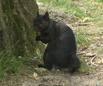
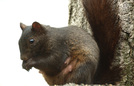
Sciurus carolinensis is a medium sized tree squirrel with no sexual dimorphism in size or coloration. The dorsal surface ranges from grizzled dark to pale grey and may have cinnamon tones. The ears are pale grey to white and its tail is white to pale grey. Underparts are grey to buff. Melanism is common in the northern portions of the range and albinism is rare in all areas. There are a total of 22 teeth in the adults with a dental formula of i (1/1), c (0/0), p (2/1/), m (3/3). The total length of these squirrels ranges from 380 to 525 mm, tail length ranges from 150 to 250 mm, ear length ranges from 25 to 33mm, and hind foot length ranges from 54 to 76mm. (Ruff and Wilson, 1999)
- Other Physical Features
- endothermic
- homoiothermic
- bilateral symmetry
- Sexual Dimorphism
- sexes alike
-
- Range mass
- 338 to 750 g
- 11.91 to 26.43 oz
-
- Average mass
- 540.33 g
- 19.04 oz
-
- Range length
- 380.0 to 525.0 mm
- 14.96 to 20.67 in
-
- Average basal metabolic rate
- 2.062 W
- AnAge
Reproduction
Males compete among themselves for the ability to mate with female eastern grey squirrels. Females may mate with more than one male as well.
- Mating System
- polygynandrous (promiscuous)
Males start following females 5 days before estrus and may come from as far away as 500 meters. Estrus in the female is indicated by an enlarged pink vulva, a condition which usually lasts less than 8 hours. The vagina is closed in prepubescent and anestrous females. Copulation lasts less than thirty seconds. After ejaculation, a gelatinous white vaginal plug forms, preventing further sperm entry.
Breeding occurs in December-February and May-June and is slightly delayed in more northern latitudes. Gestation lasts 44 days. Most females begin their reproductive life at 1.25 years but can bear young as early as 5.5 months. Females may bear young twice a year for more than 8 years. Males usually are sexually mature by 11 months but maturity can be delayed by as much as two years if the young males are housed with a dominant adult male. Inactive testes weigh 1g, whereas active testes weight 6-7g. This cycle of testicular recrudescence and regression occurs twice a year.
Newborns are naked with the exception of their vibrissae and they weigh from 13-18g. Young are altricial. Weaning begins in the seventh week and is completed by the tenth. At this point, the juvenile pelage is lost. Adult size and mass are reached at 9 months. Two litters are born each year in late winter and midsummer with generally 2-4 young per litter (up to 8 young are possible).
- Key Reproductive Features
- iteroparous
- seasonal breeding
- gonochoric/gonochoristic/dioecious (sexes separate)
- sexual
- fertilization
- viviparous
-
- Breeding interval
- Eastern grey squirrels breed twice in a year, typically.
-
- Breeding season
- Breeding occurs in December-February and May-June and is slightly delayed in more northern latitudes.
-
- Range number of offspring
- 2.0 to 8.0
-
- Average number of offspring
- 3.0
-
- Average number of offspring
- 4
- AnAge
-
- Average gestation period
- 44.0 days
-
- Average gestation period
- 44 days
- AnAge
-
- Average weaning age
- 3.0 weeks
-
- Range age at sexual or reproductive maturity (female)
- 5.5 (low) months
-
- Average age at sexual or reproductive maturity (female)
- 15 months
-
- Range age at sexual or reproductive maturity (male)
- 5.5 (low) months
-
- Average age at sexual or reproductive maturity (male)
- 15 months
Newborns are naked with the exception of their vibrissae. Vibrissae are small hairs around the nose and mouth that are used for touch, much like the whiskers of a cat. The newborns weigh from 13g to 18g. Young are altricial. They are cared for in the nest by their mother until they reach independence. Weaning begins in the seventh week and is completed by the tenth. At this point, the juvenile hair is lost. Adult size and mass are reached at 9 months old.
- Parental Investment
- no parental involvement
- altricial
-
pre-fertilization
-
protecting
- female
-
protecting
-
pre-hatching/birth
-
provisioning
- female
-
protecting
- female
-
provisioning
-
pre-weaning/fledging
-
provisioning
- female
-
protecting
- female
-
provisioning
-
pre-independence
-
provisioning
- female
-
protecting
- female
-
provisioning
Lifespan/Longevity
The maximum longevity is 12.5 years in the wild but a captive female lived to be more than 20 years of age.
-
- Range lifespan
Status: wild - 12.5 (high) years
- Range lifespan
-
- Average lifespan
Status: wild - 12.5 years
- Max Planck Institute for Demographic Research
- Average lifespan
-
- Average lifespan
Status: captivity - 23.5 years
- Max Planck Institute for Demographic Research
- Average lifespan
-
- Average lifespan
Status: wild - 23.5 years
- Max Planck Institute for Demographic Research
- Average lifespan
-
- Average lifespan
Status: wild - 23.6 years
- Max Planck Institute for Demographic Research
- Average lifespan
-
- Average lifespan
Status: captivity - 12.0 years
- Max Planck Institute for Demographic Research
- Average lifespan
Behavior
During the spring, summer and autumn, squirrels have their peak activity times about 2 hours after sunrise and 2-5 hours before sunset. This allows them to avoid the heat of the day. During the winter, they are unimodally diurnal with a peak just 2-4 hours before sunset. Generally, females are more active in the summer months and males are more active in the winter months. A dominance hierarchy forms in males during breeding times; females mate with several males. Related individuals may defend a territory (Taylor 1969). Squirrels occupy two types of homes, including a permanent tree den as well as a nest of leaves and twigs on a tree crotch 30-45 feet above the ground. Females nest alone when pregnant, and lactating females are especially aggressive and avoided by others. (Ruff and Wilson, 1999)
- Key Behaviors
- arboreal
- scansorial
- diurnal
- motile
- sedentary
- territorial
- social
- dominance hierarchies
Home Range
Home ranges are generally larger in the summer. Home range sizes are negatively correlated with squirrel density. Lactating females may decrease their home ranges by as much as 50%. Home ranges are used in the same sequence each day.
Communication and Perception
Eastern grey squirrels communicate among themselves with a variety of vocalizations and postures, such as tail flicking. They also have a keen sense of smell and can determine much about their neighbors in this way, including levels of stress and reproductive condition.
Eastern grey squirrels communicate among themselves with a variety of vocalizations and postures, such as tail flicking. They also have a keen sense of smell. They use their sense of smell to determine many things about their neighbors. Some of the things they can determine are levels of stress and reproductive condition.
Food Habits
Sciurus carolinensis feeds mostly on nuts, flowers and buds of more than 24 species of oaks, 10 species of hickory, pecan, walnut and beech tree species. Maple, mulberry, hackberry, elm, bucky and horse chestnut fruits, seeds, bulbs or flowers are also eaten along with wild cherry, dogwood, hawthorn, black gum, hazelnut, hop hornbeam and gingko tree fruits, seeds, bulbs and/or flowers. The seeds and catkins of gymnosperms such as cedar, hemlock, pine, and spruce are another food source along with a variety of herbaceous plants and fungi. Crops, such as corn and wheat, are eaten, especially in the winter. Insects are eaten in the summer and are probably especially important for juveniles. Cannibalism has been reported, and squirrels may also eat bones, bird eggs and nestlings, and frogs. They bury food in winter caches using a method called scatter hoarding and locate these caches using both memory and smell.
- Primary Diet
- omnivore
- Animal Foods
- birds
- mammals
- amphibians
- eggs
- carrion
- insects
- Plant Foods
- leaves
- seeds, grains, and nuts
- fruit
- Other Foods
- fungus
- Foraging Behavior
- stores or caches food
Predation
Eastern grey squirrels are preyed on by many predators, including American mink, other weasels, red foxes, bobcats, grey wolves, coyotes, lynx, and birds of prey, such as red-tailed hawks. They emit warning calls to warn neighboring squirrels of the presence of predators. Their extreme agility in the trees makes them difficult to capture. (Ruff and Wilson, 1999)
-
- Known Predators
-
- American minks (Neovison vison)
- weasels (Mustela)
- red foxes (Vulpes vulpes)
- bobcats (Lynx rufus)
- grey wolves (Canis lupus)
- Canada lynx (Lynx canadensis)
- coyotes (Canis latrans)
- birds of prey (Falconiformes)
- red-tailed hawks (Buteo jamaicensis)
Ecosystem Roles
Eastern grey squirrels are important predators of seeds and other animals in the ecosystems in which they live. Their seed-caching activities may help disperse tree seeds. They may help to distribute truffle fungal spores when they eat truffles. Eastern grey squirrels are also prey animals themselves and are hosts for parasites such as ticks, fleas, lice, and roundworms. They are important and ubiquitous members of the forest ecosystems in which they live.
Eastern grey squirrels are important members of the forest ecosystems in which they live. They eat a lot of seeds. Their seed-caching activities may help disperse tree seeds. They may help to distribute truffle fungal spores when they eat truffles. They also prey on other animals in the ecosystem where they live. And of course eastern grey squirrels are also prey animals themselves! They are hosts for parasites such as ticks, fleas, lice, and roundworms.
Economic Importance for Humans: Positive
Eastern grey squirrels provided food for Native Americans and colonists and are still eaten by some people today. They have economic importance in some states, such as Mississippi where 2.5 million are harvested each year with an economic impact of 12.5 million dollars.
Squirrels are ranked second to birds in value to nature watchers.
- Positive Impacts
- food
- ecotourism
Economic Importance for Humans: Negative
In Great Britain, Sciurus carolinensis is considered very destructive to property and is ranked second in negative impact only to the Norway rat (Rattus norvegicus).
- Negative Impacts
- crop pest
- household pest
Conservation Status
Sciurus carolinensis is not threatened.
-
- IUCN Red List
-
Least Concern
More information
-
- IUCN Red List
-
Least Concern
More information
-
- US Federal List
- No special status
-
- CITES
- No special status
-
- State of Michigan List
- No special status
Other Comments
Some interesting clines occur in both skull size and coat color. There is a decreasing cline southward in skull size, though toothrows and mandible sizes remain the same (possibly due to stabilizing selection on those characters involved in mastication). Also, more black-coated squirrels occur in the north. Studies have shown that black animals have 18% lower heat loss in temperatures below -10 degrees Celcius, along wth a 20% lower basal metabolic rate, and a nonshivering thermogenesis capacity 11% higher than grey morphs.
Contributors
Mara Katharine Lawniczak (author), University of Michigan-Ann Arbor.
Glossary
- Nearctic
-
living in the Nearctic biogeographic province, the northern part of the New World. This includes Greenland, the Canadian Arctic islands, and all of the North American as far south as the highlands of central Mexico.

- Palearctic
-
living in the northern part of the Old World. In otherwords, Europe and Asia and northern Africa.
- acoustic
-
uses sound to communicate
- altricial
-
young are born in a relatively underdeveloped state; they are unable to feed or care for themselves or locomote independently for a period of time after birth/hatching. In birds, naked and helpless after hatching.
- arboreal
-
Referring to an animal that lives in trees; tree-climbing.
- bilateral symmetry
-
having body symmetry such that the animal can be divided in one plane into two mirror-image halves. Animals with bilateral symmetry have dorsal and ventral sides, as well as anterior and posterior ends. Synapomorphy of the Bilateria.
- carrion
-
flesh of dead animals.
- chemical
-
uses smells or other chemicals to communicate
- diurnal
-
- active during the day, 2. lasting for one day.
- dominance hierarchies
-
ranking system or pecking order among members of a long-term social group, where dominance status affects access to resources or mates
- ecotourism
-
humans benefit economically by promoting tourism that focuses on the appreciation of natural areas or animals. Ecotourism implies that there are existing programs that profit from the appreciation of natural areas or animals.
- endothermic
-
animals that use metabolically generated heat to regulate body temperature independently of ambient temperature. Endothermy is a synapomorphy of the Mammalia, although it may have arisen in a (now extinct) synapsid ancestor; the fossil record does not distinguish these possibilities. Convergent in birds.
- fertilization
-
union of egg and spermatozoan
- food
-
A substance that provides both nutrients and energy to a living thing.
- forest
-
forest biomes are dominated by trees, otherwise forest biomes can vary widely in amount of precipitation and seasonality.
- introduced
-
referring to animal species that have been transported to and established populations in regions outside of their natural range, usually through human action.
- iteroparous
-
offspring are produced in more than one group (litters, clutches, etc.) and across multiple seasons (or other periods hospitable to reproduction). Iteroparous animals must, by definition, survive over multiple seasons (or periodic condition changes).
- motile
-
having the capacity to move from one place to another.
- native range
-
the area in which the animal is naturally found, the region in which it is endemic.
- omnivore
-
an animal that mainly eats all kinds of things, including plants and animals
- polygynandrous
-
the kind of polygamy in which a female pairs with several males, each of which also pairs with several different females.
- seasonal breeding
-
breeding is confined to a particular season
- sedentary
-
remains in the same area
- sexual
-
reproduction that includes combining the genetic contribution of two individuals, a male and a female
- social
-
associates with others of its species; forms social groups.
- stores or caches food
-
places a food item in a special place to be eaten later. Also called "hoarding"
- suburban
-
living in residential areas on the outskirts of large cities or towns.
- tactile
-
uses touch to communicate
- temperate
-
that region of the Earth between 23.5 degrees North and 60 degrees North (between the Tropic of Cancer and the Arctic Circle) and between 23.5 degrees South and 60 degrees South (between the Tropic of Capricorn and the Antarctic Circle).
- territorial
-
defends an area within the home range, occupied by a single animals or group of animals of the same species and held through overt defense, display, or advertisement
- urban
-
living in cities and large towns, landscapes dominated by human structures and activity.
- visual
-
uses sight to communicate
- viviparous
-
reproduction in which fertilization and development take place within the female body and the developing embryo derives nourishment from the female.
References
Banfield, A.W.F. 1981. The Mammals of Canada. University of Toronto Press, Toronto. pp. 132-134.
Jones, Jr., J.K. and E. C. Birney. 1988. Handbook of Mammals of the North-Central States. Univeristy of Minnesota Press, Minneapolis. p.166.
Koprowski, J.L. 2 Dec 94. Mammalian Species No. 480 Sciurus carolinensis. pp.1-9.
"Animal Life History Database" (On-line).
Ruff, S., D. Wilson. 1999. The Smithsonian Book of North American Mammals. Washington [D.C.]: Smithsonian Institution Press in association with the American Society of Mammalogists.