Recurvirostra americanaAmerican avocet


Geographic Range
American avocets are found in western North America from March through October and in coastal California, southern Texas, Florida, Louisiana and south to Guatemala in winter. (Gill, 1995; Soothill and Soothill, 1982)
- Biogeographic Regions
- nearctic
- neotropical
Habitat
American avocets are numerous in mudflats, ponds, wetlands, and freshwater marshes and swamps. They are also common in lakes, rocky/sandy seashores, bay/coastal islands, and tidal flats. (Ehrlich, et al., 1988; Hayman, et al., 1986; Soothill and Soothill, 1982)
- Habitat Regions
- temperate
- tropical
- terrestrial
- Aquatic Biomes
- lakes and ponds
- coastal
- brackish water
- Other Habitat Features
- estuarine
Physical Description
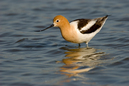
Graceful and sleek, these long-legged waders have a black bill and light blue legs. Avocets are the tallest and longest-legged birds in their family. They are 400 to 500 mm in length and have a wingspan of 213 to 242 mm. They are often confused with black-necked stilts (Himantopus mexicanus), but are distinguishable by the bold black and white pattern on their back and wings and a strongly upcurved black bill. Females are similar in appearance to males but with a shorter and more upwardly-curved bill, male bills are longer and straighter. They are the only avocet with distinct breeding and non-breeding plumages. Breeding plumage is obtained in the first year and is a beautiful rusty cinnamon along the head and neck. Basic plumage is a gray head. Adult breeding plumage appears from January to March and is lost in July to September. (Hayman, et al., 1986; Kaufman, 2000; Soothill and Soothill, 1982)
- Other Physical Features
- endothermic
- bilateral symmetry
- Sexual Dimorphism
- sexes shaped differently
-
- Average mass
- 340 g
- 11.98 oz
- AnAge
-
- Average length
- 400-500 mm
- in
-
- Average wingspan
- 213-242 mm
- in
Development
1 brood per year, usually 3-5 eggs laid which are a pale ashy-yellow or olive-brown covered evenly with dark brown spots and blotches. Eggs are laid at intervals of 1-2 days, with a full clutch in 5 days (Hayman et al., 1986; Soothill & Soothill, 1982; Nethersole-Thompson, 1986).
Reproduction
American avocets are monogamous and loosely colonial. Pairs perform elaborate courtship displays that involve various crouching and bowing postures in and out of water, dancing with outspread wings and swaying from side to side. (Ehrlich, et al., 1988; Hayman, et al., 1986; Soothill and Soothill, 1982)
- Mating System
- monogamous
Breeding occurs between April and June. Nests are built on shore and are usually scrapes in the ground; they are sometimes lined with dry grass or mud chips. The female lays 3 to 5 eggs (4 on average); eggs are olive colored with brown and black spots. Incubation lasts 22 to 29 days and the eggs hatch synchronously. Fledging occurs after 28 to 35 days. (Ehrlich, et al., 1988; Hayman, et al., 1986; Soothill and Soothill, 1982)
- Key Reproductive Features
- iteroparous
- seasonal breeding
- gonochoric/gonochoristic/dioecious (sexes separate)
- sexual
- fertilization
- oviparous
-
- Breeding season
- April to June
-
- Range eggs per season
- 3 to 5
-
- Average eggs per season
- 4
- AnAge
-
- Range time to hatching
- 22 to 29 days
-
- Range fledging age
- 28 to 35 days
Both male and female American avocets incubate the eggs. Incubation lasts 22 to 29 days. The precocial young are cared for by both sexes but the young feed themselves. Fledging occurs after 28 to 35 days. (Ehrlich, et al., 1988; Nethersole-Thompson, 1986)
- Parental Investment
- no parental involvement
- precocial
- pre-fertilization
-
pre-hatching/birth
-
protecting
- male
- female
-
protecting
-
pre-weaning/fledging
-
protecting
- male
- female
-
protecting
Lifespan/Longevity
Banded American avocets have been recorded to live up to 9 years in the wild.
No records are available about life span in captivity, but presumably they live for 9 plus years! (Klimkiewicz, 2002)
-
- Range lifespan
Status: wild - 9 (high) years
- Range lifespan
-
- Average lifespan
Status: wild - 168 months
- Bird Banding Laboratory
- Average lifespan
Behavior
American avocets are migratory birds that form social groups and are colonial nesters. Outside of breeding season they may gather in flocks of several hundred and feed in dense groups. They show crepuscular activity patterns. (Ehrlich, et al., 1988; Hayman, et al., 1986; Nethersole-Thompson, 1986)
- Key Behaviors
- flies
- crepuscular
- motile
- migratory
- social
- colonial
Home Range
We do not have information on home range for this species at this time.
Communication and Perception
American avocets make loud "wheet" or "pleeet" and shrill "kleeap" sounds that are often repeated. They are very noisy when intruders approach active nests. They also communicate using complex displays that include dancing, bowing and crouching. (Ehrlich, et al., 1988; Kaufman, 2000; Soothill and Soothill, 1982)
Food Habits
American avocets swoop their open bills back and forth in shallow water to catch aquatic insects. They may feed in flocks of up to 100 plus birds, in deep water they will "tip up" like dabbling ducks and are reportedly good swimmers.
Foods eaten include: Insects and other invertebrates, shrimp and other crustaceans, aquatic vegetation and seeds. (Alden, 1999; Ehrlich, et al., 1988; Soothill and Soothill, 1982)
- Primary Diet
- omnivore
- Animal Foods
- insects
- terrestrial non-insect arthropods
- aquatic crustaceans
- Plant Foods
- leaves
- seeds, grains, and nuts
Predation
American avocets are mostly quiet and uncaring but become extremely aggressive on breeding and nesting grounds and protest loudly and dive bomb when intruders approach. They have few non-human predators, some known nest predators include skunks (subfamily Mephitinae) and foxes (family Canidae). (Kaufman, 2000; Soothill and Soothill, 1982)
-
- Known Predators
-
- skunks (Mephitinae)
- foxes (Canidae)
Ecosystem Roles
American avocets are important members of their ecosystem; because of their food habits they likely have a regulatory influence on insect and crustacean populations, and they are an important food source for their predators. They also have an influence on the plants and seeds they eat. (Brown, 1999; Brown, 1999)
Economic Importance for Humans: Positive
American avocets are enjoyable to watch and are sought out by many birders.
- Positive Impacts
- ecotourism
Economic Importance for Humans: Negative
There are no known adverse affects of American avocets on humans.
Conservation Status
Currently protected by the US Migratory Bird Act, American avocets are making a comeback after over-hunting in the 19th and early 20th centuries. The main threats to American avocets today are habitat loss and degredation. (Brown, 1999)
-
- IUCN Red List
-
Least Concern
More information
-
- IUCN Red List
-
Least Concern
More information
-
- US Migratory Bird Act
- Protected
-
- US Federal List
- No special status
-
- CITES
- No special status
-
- State of Michigan List
- No special status
Other Comments
American avocets are very beautiful birds with personality! I worked near them at wetland and they are very vocal and protective of nests. It is interesting to watch them wade and feed in shallows.
Contributors
Alaine Camfield (editor), Animal Diversity Web.
Patina Thompson (author), University of Arizona, Todd McWhorter (editor), University of Arizona.
Glossary
- Nearctic
-
living in the Nearctic biogeographic province, the northern part of the New World. This includes Greenland, the Canadian Arctic islands, and all of the North American as far south as the highlands of central Mexico.

- Neotropical
-
living in the southern part of the New World. In other words, Central and South America.
- acoustic
-
uses sound to communicate
- bilateral symmetry
-
having body symmetry such that the animal can be divided in one plane into two mirror-image halves. Animals with bilateral symmetry have dorsal and ventral sides, as well as anterior and posterior ends. Synapomorphy of the Bilateria.
- brackish water
-
areas with salty water, usually in coastal marshes and estuaries.
- chemical
-
uses smells or other chemicals to communicate
- coastal
-
the nearshore aquatic habitats near a coast, or shoreline.
- colonial
-
used loosely to describe any group of organisms living together or in close proximity to each other - for example nesting shorebirds that live in large colonies. More specifically refers to a group of organisms in which members act as specialized subunits (a continuous, modular society) - as in clonal organisms.
- crepuscular
-
active at dawn and dusk
- ecotourism
-
humans benefit economically by promoting tourism that focuses on the appreciation of natural areas or animals. Ecotourism implies that there are existing programs that profit from the appreciation of natural areas or animals.
- endothermic
-
animals that use metabolically generated heat to regulate body temperature independently of ambient temperature. Endothermy is a synapomorphy of the Mammalia, although it may have arisen in a (now extinct) synapsid ancestor; the fossil record does not distinguish these possibilities. Convergent in birds.
- estuarine
-
an area where a freshwater river meets the ocean and tidal influences result in fluctuations in salinity.
- fertilization
-
union of egg and spermatozoan
- iteroparous
-
offspring are produced in more than one group (litters, clutches, etc.) and across multiple seasons (or other periods hospitable to reproduction). Iteroparous animals must, by definition, survive over multiple seasons (or periodic condition changes).
- marsh
-
marshes are wetland areas often dominated by grasses and reeds.
- migratory
-
makes seasonal movements between breeding and wintering grounds
- monogamous
-
Having one mate at a time.
- motile
-
having the capacity to move from one place to another.
- native range
-
the area in which the animal is naturally found, the region in which it is endemic.
- omnivore
-
an animal that mainly eats all kinds of things, including plants and animals
- oviparous
-
reproduction in which eggs are released by the female; development of offspring occurs outside the mother's body.
- seasonal breeding
-
breeding is confined to a particular season
- sexual
-
reproduction that includes combining the genetic contribution of two individuals, a male and a female
- social
-
associates with others of its species; forms social groups.
- swamp
-
a wetland area that may be permanently or intermittently covered in water, often dominated by woody vegetation.
- tactile
-
uses touch to communicate
- temperate
-
that region of the Earth between 23.5 degrees North and 60 degrees North (between the Tropic of Cancer and the Arctic Circle) and between 23.5 degrees South and 60 degrees South (between the Tropic of Capricorn and the Antarctic Circle).
- terrestrial
-
Living on the ground.
- tropical
-
the region of the earth that surrounds the equator, from 23.5 degrees north to 23.5 degrees south.
- visual
-
uses sight to communicate
- young precocial
-
young are relatively well-developed when born
References
Alden, P. 1999. National Audubon Society, Field Guide to the Southwestern States 1st Edition. New York: Random House.
Brown, S. 1999. "American Avocet" (On-line). Great Salt Lake Playa Foodweb Project. Accessed February 24, 2004 at http://people.westminstercollege.edu/faculty/tharrison/gslplaya99/avocet.htm.
Ehrlich, P., D. Dobkin, D. Wheye. 1988. The Birder's Handbook: a field guide to the natural history of North American birds. New York: Simon & Schuster Inc.
Gill, F. 1995. Ornithology, Second Edition. New York: W.H. Freeman and Company.
Hayman, P., J. Marchant, T. Prater. 1986. Shorebirds: an indentification guide to the waders of the world. London: Croom Helm, Ltd.
Kaufman, K. 2000. Birds of North America. New York, New York: Houghton Mifflin Company.
Klimkiewicz, M. 2002. "Longevity Records of North American Birds. Version 2002.1. Patuxent Wildlife Research Center. Bird Banding Laboratory. Laurel MD." (On-line). Accessed 02/19/04 at http://www.pwrc.usgs.gov/bbl/.
Nethersole-Thompson, D. 1986. Waders, their breeding, haunts and watchers. Staffordshire, England: T & AD Poyser, Ltd.
Soothill, E., R. Soothill. 1982. Wading birds of the world. Poole, Dorset: Blandford Press.