Pteroglossus torquatuscollared aracari
Geographic Range
Pteroglossus torquatus, commonly known as "collared aracari", is found from southern Mexico to Colombia and some parts of Venezuela. (Skutch, 1985a)
- Biogeographic Regions
- neotropical
Habitat
Collared aracari preferred habitat is generally woody lowland forest or humid rainforest with secondary growth. These birds are found from sea level up to 1500 meters. They are fairly common throughout their range. (Sibley and Monroe, 1990; Skutch, 1985a; Stiles and Skutch, 1989)
- Habitat Regions
- tropical
- terrestrial
- Terrestrial Biomes
- forest
- rainforest
-
- Range elevation
- 0 to 1500 m
- 0.00 to 4921.26 ft
Physical Description
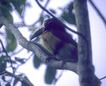
Collared aracaris have a mostly black back with a green tinge to the feathers. The plumage of the neck and throat is blackish while the upper tail and rump are bright red. The undertail and belly plumage is mostly yellow with black and red stripes across the abdomen. The upper portion of the beak is whitish-gray or sometimes whitish. The lower beak and lower ridge of the upper beak are black. The lower edge of the upper beak has widely-spaced tooth-like protrusions. The beak is light weight because of a crisscross of rods made out of bone. The skin that surrounds the beak and eyes is bright red. The eyes are yellow. In this species the female is similar to the male except that her beak is smaller. Juvenile collared aracaris have a duller appearance than adults. Average weight is about 230 g and body length is 41 cm on average. ("Animals: Collared Aracari", 2001; Skutch, 1985a; Skutch, 1985b)
- Other Physical Features
- endothermic
- homoiothermic
- bilateral symmetry
- Sexual Dimorphism
- sexes alike
-
- Average mass
- 230 g
- 8.11 oz
-
- Average length
- 41 cm
- 16.14 in
Reproduction
Collared aracaris are monogamous and may mate for life. Courtship behaviors are not well known. Collared aracaris are cooperative breeders. Offspring from the previous clutch or clutches will help parents take care of their siblings. Approximately five to six adults will attend nestlings at a time, bringing food and guarding them. It is not known whether cooperative breeding is common in other toucan species. (Skutch, 1985b; Stiles and Skutch, 1989)
- Mating System
- monogamous
- cooperative breeder
Collared aracaris breed once a year from January to May. They lay three eggs in a cluth. (Stiles and Skutch, 1989)
Collared aracaris roost and make nests in large woodpecker holes or natural cavities about 6 to 30 m (20 to 100 ft) off the ground. These birds do not use materials for nesting. During the incubation period only one bird stays in the nest, usually one of the mating pair, to keep the eggs warm. Both of the parents take turns incubating the egg from 15 up to 18 days, with an average of 16 days. It takes another six weeks for the young to be able to leave the nest, at fledgling. The exact age at which collared aracaris are reproductively mature is unknown. However, related toco toucans become sexually mature between the ages of 3 and 4 years old. ("Toco Toucan", 2002; Skutch, 1985b; Stiles and Skutch, 1989)
- Key Reproductive Features
- iteroparous
- seasonal breeding
- gonochoric/gonochoristic/dioecious (sexes separate)
- sexual
- oviparous
-
- Breeding interval
- Collared aracaris breed once a year.
-
- Breeding season
- The breeding season for collared aracaris is January through May.
-
- Average eggs per season
- 3
-
- Range time to hatching
- 15 to 18 days
-
- Average time to hatching
- 16 days
-
- Average fledging age
- 6 weeks
Collared aracaris live in groups and five adults may roost in the nest cavity after the eggs hatch. Up to six adult birds will bring food to the nestlings. Some of the other adult birds that attend the nest are siblings to the new hatchlings, probably from the previous brood.
Collared aracaris, like other toucans, are born blind and naked and with very short beaks. On their heels they have special pads that protect them from the bottom of their nest. After six weeks they are ready to leave the nest but continue to be fed by adults for a few more weeks. ("Animals: Collared Aracari", 2001; Skutch, 1985a; Stiles and Skutch, 1989)
- Parental Investment
- altricial
-
pre-fertilization
- provisioning
-
protecting
- female
-
pre-hatching/birth
-
provisioning
- female
-
protecting
- male
- female
-
provisioning
-
pre-weaning/fledging
-
provisioning
- male
- female
-
protecting
- male
- female
-
provisioning
-
pre-independence
-
provisioning
- male
- female
-
protecting
- male
- female
-
provisioning
- post-independence association with parents
Lifespan/Longevity
Longevity of collared aracaris in captivity and in the wild is unknown. Toco toucans (Ramphastos toco) live up to 20 years in captivity. ("Toco Toucan", 2002)
-
- Average lifespan
Status: captivity - 20 years
- Average lifespan
Behavior
Collared aracaris live in small flocks of 6 to 15 birds, some of which are related. Throughout the year collared aracaris sleep together with their tails folded over their backs; up to six adults and fledglings will sleep in this way in woodpecker holes. The flock may have several woodpecker holes and natural cavities that they use to roost in.
Pteroglossus torquatus fly using rapid beats of their wings. They use short glides to get to a perch and springy “jay-like” jumps to move along a branch. ("Animals: Collared Aracari", 2001; Skutch, 1985b; Stiles and Skutch, 1989)
Home Range
It does not appear that P. torquatus is territorial.
Communication and Perception
Collared aracaris use different vocalizations for various purposes. The general call is a loud peeseek, pink, or a harsh pseek. They emit a grahhrr sound when aggravated. The alarm call is a shrill eeeyeeek. When collared aracaris are excited they emit a pitit sound. (Stiles and Skutch, 1989)
Food Habits
Collared aracaris are omnivorous, eating fledgling birds, insects, eggs and dry fruits of Protium, palms, Cecropia and Ficus species. ("Animals: Collared Aracari", 2001; Henderson, 2002)
In captivity collared aracaris are fed a diet that consists of dog food and fresh fruit. They are given plenty of water to bathe in and drink. They are also given a weak tea to drink every other month so that it will bind to the iron in their diet and help expel the iron. Iron damages their liver and is deadly. It is believed that the tannins in the tea resemble those found in water that these birds would drink in the rainforest. (Foley, 2006)
As with all toucans, the bill of collared aracaris is specially designed to be durable for eating fruit, but also lightweight for flight. Though it looks heavy, the beak is thin. The inside is reinforced with a crisscross of lightweight rods made of bone. The “tooth-like” protrusions help toucans catch and grasp food in the bill. (Skutch, 1985b)
- Primary Diet
- omnivore
- Animal Foods
- birds
- reptiles
- eggs
- insects
- Plant Foods
- seeds, grains, and nuts
- fruit
Predation
Young collared aracaris are preyed upon by white hawks and forest falcons. Predation is most common on fledglings. (Skutch, 1985b; Stiles and Skutch, 1989)
-
- Known Predators
-
- white hawks (Leucopternis albicollis)
- forest falcons (Micrastur)
Ecosystem Roles
Collared aracaris are agents of seed dispersal in the tropical forests where they live. Seeds pass through their digestive tract unharmed and are deposited away from the parent plant.
- Ecosystem Impact
- disperses seeds
Economic Importance for Humans: Positive
Aside from their important ecosystem roles, the main positive benefit to humans of P. torquatus is ecotourism. These birds are common throughout their range. Bird watchers see a great number of these birds when they go on hikes. (Sibley and Monroe, 1990)
Collared aracaris are also traded in the pet industry. If raised from chicks and hand fed, they become quite tame. (Foley, 2006)
- Positive Impacts
- pet trade
- ecotourism
- research and education
Economic Importance for Humans: Negative
There are no known adverse effects of Pteroglossus torquatus on humans.
Conservation Status
Collared aracaris, as of 2004, were classified as Least Concern (LC) by the IUCN red list of threatened species, they have no special status according to CITES.
-
- IUCN Red List
-
Least Concern
More information
-
- IUCN Red List
-
Least Concern
More information
-
- US Migratory Bird Act
- No special status
-
- US Federal List
- No special status
-
- CITES
- No special status
Other Comments
Among native peoples, toucans are linked to evil spirits and are thought to be manifestation of demons. Medicine men will also use toucans as a way to fly to the world of the spirits. ("Toco Toucan", 2002)
Contributors
Tanya Dewey (editor), Animal Diversity Web.
Kendra Garchow (author), Kalamazoo College, Ann Fraser (editor, instructor), Kalamazoo College.
Glossary
- Neotropical
-
living in the southern part of the New World. In other words, Central and South America.

- acoustic
-
uses sound to communicate
- altricial
-
young are born in a relatively underdeveloped state; they are unable to feed or care for themselves or locomote independently for a period of time after birth/hatching. In birds, naked and helpless after hatching.
- arboreal
-
Referring to an animal that lives in trees; tree-climbing.
- bilateral symmetry
-
having body symmetry such that the animal can be divided in one plane into two mirror-image halves. Animals with bilateral symmetry have dorsal and ventral sides, as well as anterior and posterior ends. Synapomorphy of the Bilateria.
- chemical
-
uses smells or other chemicals to communicate
- cooperative breeder
-
helpers provide assistance in raising young that are not their own
- diurnal
-
- active during the day, 2. lasting for one day.
- ecotourism
-
humans benefit economically by promoting tourism that focuses on the appreciation of natural areas or animals. Ecotourism implies that there are existing programs that profit from the appreciation of natural areas or animals.
- endothermic
-
animals that use metabolically generated heat to regulate body temperature independently of ambient temperature. Endothermy is a synapomorphy of the Mammalia, although it may have arisen in a (now extinct) synapsid ancestor; the fossil record does not distinguish these possibilities. Convergent in birds.
- forest
-
forest biomes are dominated by trees, otherwise forest biomes can vary widely in amount of precipitation and seasonality.
- iteroparous
-
offspring are produced in more than one group (litters, clutches, etc.) and across multiple seasons (or other periods hospitable to reproduction). Iteroparous animals must, by definition, survive over multiple seasons (or periodic condition changes).
- monogamous
-
Having one mate at a time.
- motile
-
having the capacity to move from one place to another.
- native range
-
the area in which the animal is naturally found, the region in which it is endemic.
- omnivore
-
an animal that mainly eats all kinds of things, including plants and animals
- oviparous
-
reproduction in which eggs are released by the female; development of offspring occurs outside the mother's body.
- pet trade
-
the business of buying and selling animals for people to keep in their homes as pets.
- rainforest
-
rainforests, both temperate and tropical, are dominated by trees often forming a closed canopy with little light reaching the ground. Epiphytes and climbing plants are also abundant. Precipitation is typically not limiting, but may be somewhat seasonal.
- seasonal breeding
-
breeding is confined to a particular season
- sedentary
-
remains in the same area
- sexual
-
reproduction that includes combining the genetic contribution of two individuals, a male and a female
- social
-
associates with others of its species; forms social groups.
- tactile
-
uses touch to communicate
- terrestrial
-
Living on the ground.
- tropical
-
the region of the earth that surrounds the equator, from 23.5 degrees north to 23.5 degrees south.
- visual
-
uses sight to communicate
References
Central Florida Zoological Park. 2001. "Animals: Collared Aracari" (On-line). Central Florida Zoological Park: Your connection to the Natural world. Accessed October 12, 2006 at http://www.centralfloridazoo.org/animals/Collared_aracari.htm.
Busch Entertainment Corporation. 2002. "Toco Toucan" (On-line). Animal Bytes. Accessed November 12, 2006 at http://www.seaworld.org/animal-info/animal-bytes/animalia/eumetazoa/coelomates/deuterostomes/chordata/craniata/aves/piciformes/toco-toucan.htm.
Foley, D. 2006. "El Jardin Diostede Collared Aracari Pteroglossus torquatus" (On-line). El Jardin Diostede. Accessed October 15, 2006 at http://diostede.com/collared_aracari_toucan/b_humboldt_diostede.html.
Henderson, C. 2002. Field Guide to the Wildlife of Costa Rica. Austin: University of Texas Press.
Sibley, C., B. Monroe. 1990. Pteroglossus [torquatus] torquatus (Gmelin). Pp. 69 in Distribution and Taxonomy of Birds of the World, Vol. 1, 1st Edition. New Haven: Yale University Press.
Skutch, A. 1985. Toucan. Pp. 602-604 in B Campbell, E Lack, eds. A Dictionary of Birds, Vol. 1, 1 Edition. Vermillion: Buteo.
Skutch, A. 1985. Toucans, Honeyguides and Barbets. Pp. 286-290 in D Perrins, D Middleton, eds. The Encyclopedia of Birds, Vol. 1, 1 Edition. New York: Facts On File Publications.
Stiles, F., A. Skutch. 1989. A Guide to the Birds of Costa Rica. Ithaca, New York: Comstock Publishing Associates.