Psammobates pardalisLeopard Tortoise
Geographic Range
Leopard tortoises (Psammobates pardalis) are endemic to Africa, and their geographic range extends from Sudan to Ethiopia and from Natal in eastern Africa to southern Angola and South Africa. They are also diffusely distributed throughout portion of southwestern Africa. (Bartlett, et al., 2006; Douglas and Rall, 2006; McMaster and Downs, 2009)
Habitat
Leopard tortoises occupy a variety of xeric and mesic habitats throughout their geographic range, ranging from dry arid plains to temperate grassland ecosystems. They are intolerant of damp or cold habitats. They have also been reported in mountainous terrain. These tortoises spend most of their time in shrub habitat with low lying vegetation, which serves as their primary food source. In the summer, they seek shelter under various low lying plants. (Bartlett, et al., 2006; Douglas and Rall, 2006)
- Habitat Regions
- temperate
- terrestrial
- Terrestrial Biomes
- desert or dune
- savanna or grassland
- forest
- mountains
Physical Description
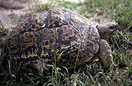
Leopard tortoises are the fourth largest tortoise species in the world. They exhibit indeterminate growth and adults range in mass from 15 to 54 kg, with an average of 18 kg. Carapace length ranges from 30 to 70 cm, with an average carapace length of 45 cm. Females are often larger than males. It also is common for leopard tortoises to have moderate carapacial pyramiding, a shell deformity in which scutes exhibit pyramidal growth. Leopard tortoises differ from other members of the genus Geochelone due to their distinct shell markings. Base color of the carapace may be tan, yellow, or sometimes shades of dusty brown. The intensity of shell patterning varies. Blotches on the shell are most often black and are typically only present on juveniles. The head, feet, and tail vary in color but are usually tan to brown. Despite differences in appearance, the diet and habitat of tortoises in the genus Geochelone are usually similar. (Bartlett, et al., 2006; Leuteritz and Ekbia, 2008; Schmidt, 2006; Simang, et al., 2010)
- Other Physical Features
- ectothermic
- heterothermic
- bilateral symmetry
- Sexual Dimorphism
- female larger
-
- Range mass
- 15 to 54 kg
- 33.04 to 118.94 lb
-
- Average mass
- 18 kg
- 39.65 lb
-
- Range length
- 30 to 70 cm
- 11.81 to 27.56 in
-
- Average length
- 45 cm
- 17.72 in
Development
Leopard tortoises are oviparous, and their eggs are initially leather-like but dry to become hard and brittle. The egg contains a large, nutrient-rich yolk, which the embryo feeds on during development. Sex determination is temperature dependent; females develop under average temperatures of 30 C or more and males develop under average temperatures of less than 30 C. Temperature-dependent sex determination suggests that the mother has some control over the sex ratio of her offspring. If she lays her eggs in a warm environment the sex ratio favors females, whereas a cool environment favors males. Eggs are roughly spherical and about 57.5 mm in diameter. Clutch size ranges from 7 to 20 eggs, and most eggs hatch within 47 to 180 days. After hatching, young tortoises grow very rapidly during the first few months of life. In general, hatchlings in this genus weigh around 100 grams and grow between 300 and 400 grams during their first year of life. (Bowman, 1966; Deeming and Ferguson, 1991; Spotila, et al., 1994; Stanford, 2010)
- Development - Life Cycle
- temperature sex determination
Reproduction
Leopard tortoises are monogamous, and both males and females become increasingly aggressive when searching for a mate. They fight for mates by butting and ramming rivals. During courtship, males follow their potential mate and repeatedly run into them until the females become immobilized. Males sometimes lift their mate off the ground by ramming them. Females become defensive and in some cases try to escape. During copulation, males mount the female and extend their necks and grunt during mating. (Ernst and Barbour, 1989; Leuteritz and Ravolanaivo, 2005)
- Mating System
- monogamous
Leopard tortoises breed from May to October. Males become reproductively mature by five years of age, and although the specific age of maturation is unknown, females are thought to become reproductively mature later than males. After mating, females dig a hole in the ground, ranging from 100 to 300 mm deep, in which to lay her eggs. The frail eggs are white and spherical. Gestation ranges from 9 to 12 months and varies according to location, temperature, and precipitation. Females lay 5 to 7 clutches during a single breeding season, with each clutch separated from the previous by about 3 to 4 weeks. Clutches range from 5 to 30 eggs, with larger female having larger clutches. (Ernst and Barbour, 1989; Leuteritz and Ravolanaivo, 2005)
- Key Reproductive Features
- iteroparous
- seasonal breeding
- gonochoric/gonochoristic/dioecious (sexes separate)
- sexual
- fertilization
- oviparous
-
- Breeding interval
- Leopard tortoises breed once yearly.
-
- Breeding season
- Leopard tortoises breed from May to October.
-
- Range number of offspring
- 5 to 30
-
- Range gestation period
- 9 to 14 months
-
- Average gestation period
- 12 months
-
- Range age at sexual or reproductive maturity (male)
- 5 to 6 years
-
- Average age at sexual or reproductive maturity (male)
- 5 years
Paternal care in leopard tortoises is non-existent, as males leave directly after copulation. Females dig a hole in which to lay their eggs, which ranges in depth from 100 to 300 mm. After the eggs are laid, she covers them and leaves. Hatchlings are immediately independent upon emerging. (Bartlett, et al., 2006; Ernst and Barbour, 1989)
- Parental Investment
- no parental involvement
Lifespan/Longevity
In the wild, adult leopard tortoises may live for up to 100 years. No records are available regarding captive individuals. However, typical lifespan for other species of Geochelone tortoises in captivity is approximately 50 years. Factors that may limit the lifespan of leopard tortoises include human impacts through the pet trade and male aggression during courtship and mating. (Bartlett, et al., 2006; Ernst and Barbour, 1989; Wimberger, et al., 2009)
-
- Range lifespan
Status: wild - 100 (high) years
- Range lifespan
-
- Average lifespan
Status: captivity - 50 hours
- Average lifespan
Behavior
Auditory perception is important to leopard tortoise mating behavior, as males vocalize species-specific calls in an attempt to attract females. Males also vocalize during competition for mates. Male vocalizations include a variety of grunts and groans. Although tortoises do not audibly respond to vocalizations, most are visually responsive. Like most other tortoises, leopard tortoises are known for their hissing noises. When feeling threatened, tortoises quickly pull the head and feet into the shell, resulting in air being forced from the lungs and thus the distinctive hissing noise is produced. Males possess neck glands, which inform conspecifics of their willingness to mate or battle another male. Evidence suggests that, during mating season, male tortoises follow females for days or even weeks at a time before initiating courtship. In order to initiate contact, males bite the female on the head or feet. Social hierarchies are established via aggression, as dominance is established through a series of competitions. Social networks among the tortoises are fairly weak, with little intraspecific communication occurring. (Auffenberg, 1977)
Home Range
There is no information available regarding the average home range size of leopard tortoises. (Ernst and Barbour, 1989)
Communication and Perception
Communication and perception within leopard tortoises is primarily visual, however, there is little evidence to suggest that tortoises are able to distinguish between different colors. A recent study proposed juvenile leopard tortoises most often approach colors such as red and different shades of green. In general, tortoises are particularly sensitive to sounds under 1,000 Hz. (Auffenberg, 1977; Simang, et al., 2010)
Food Habits
Leopard tortoises are primarily herbivorous, with plant material making up approximately 98% of their diet. They consume berries and other fruits when available. Bone fragments and ash may be consumed during times of decreased resource abundance. Although most tortoises consume mostly grasses, leopard tortoises primarily consume forbs. They feed primarily from the ground, particularly from areas within their habitat that produce low-lying forbs. (McMaster and Downs, 2008; Schmidt, 2006)
- Plant Foods
- leaves
- seeds, grains, and nuts
- flowers
Predation
Leopard tortoises are well camouflaged and are difficult to capture given their thick, heavy shells. Tortoises suffer the highest predation rates prior to hatching due to predation on eggs. Nearly 80% of hatchlings may eaten by predators such as foxes, coyotes, and mongooses. Adult tortoises are preyed upon by humans and are usedful in creating medicine, tools, and are often used as a source of food. (Stanford, 2010)
-
- Known Predators
-
- humans (Homo sapiens)
- foxes (Vulpes vulpes)
- coyotes (Canis latrans)
- mongooses (Herpestidae)
Ecosystem Roles
Leopard tortoises are important seed predators and disperse seeds throughout their environment. They commonly forage on plants that are close to the ground and ingest a large number of seeds, which are redistributed throughout their geographic range via defecation. They also consume the seeds of berries and other fruits, which are redistributed after consumption as well. Leopard tortoises are vulnerable to tortoise ticks. There is no other information available regarding parasites of this species. (Horak, et al., 2006; Leuteritz and Ekbia, 2008; Schmidt, 2006)
- Ecosystem Impact
- disperses seeds
- tortoise ticks (Amblyomma marmoreum)
Economic Importance for Humans: Positive
Leopard tortoises are sometimes hunted for their meat and for the pet trade and are used to create traditional medicine. As an indigenous food source, they are cooked in their shells, however, this does not occur frequently and does not seem to significantly affect population abundance. According to Schedule 2 of the Western Cape Nature Conservation Laws Amendment Act of 2000, leopard tortoises are classified as "protected wildlife", which restricts trade of whole animals, dead or alive, and by-products of this species. (Leuteritz and Ekbia, 2008)
- Positive Impacts
- pet trade
- food
- source of medicine or drug
Economic Importance for Humans: Negative
Psammobates pardalis is regarded as an agricultural pest (pumpkins, beans, and cowpeas) throughout its geographic range. (Kabigumila, 1998)
- Negative Impacts
- crop pest
Conservation Status
Although many species of tortoise are becoming increasingly threatened, leopard tortoises have not been evaluated by the International Union for the Conservation of Nature (IUCN). They are endemic to Africa and are currently listed under CITES' Appendix II. Although Tanzania has the largest recorded leopard tortoise population, with an estimated 5,990 individuals, it also has the highest mortality rate of any country containing leopard tortoises. Ethiopia is second, with only 500 individuals. Leopard tortoises are regarded as agricultural pests throughout their geographic range, and as a result, retaliatory killings are not uncommon. (Kabigumila, 1998; Leuteritz and Ekbia, 2008)
-
- IUCN Red List
- Not Evaluated No special status
-
- US Federal List
- No special status
-
- CITES
- Appendix II
-
- State of Michigan List
- No special status
Contributors
Hillary H. Baker (author), Radford University, Jordan N. Grubb (author), Radford University, Christine Small (editor), Radford University, John Berini (editor), Animal Diversity Web Staff.
Glossary
- Ethiopian
-
living in sub-Saharan Africa (south of 30 degrees north) and Madagascar.

- acoustic
-
uses sound to communicate
- bilateral symmetry
-
having body symmetry such that the animal can be divided in one plane into two mirror-image halves. Animals with bilateral symmetry have dorsal and ventral sides, as well as anterior and posterior ends. Synapomorphy of the Bilateria.
- chemical
-
uses smells or other chemicals to communicate
- desert or dunes
-
in deserts low (less than 30 cm per year) and unpredictable rainfall results in landscapes dominated by plants and animals adapted to aridity. Vegetation is typically sparse, though spectacular blooms may occur following rain. Deserts can be cold or warm and daily temperates typically fluctuate. In dune areas vegetation is also sparse and conditions are dry. This is because sand does not hold water well so little is available to plants. In dunes near seas and oceans this is compounded by the influence of salt in the air and soil. Salt limits the ability of plants to take up water through their roots.
- drug
-
a substance used for the diagnosis, cure, mitigation, treatment, or prevention of disease
- ectothermic
-
animals which must use heat acquired from the environment and behavioral adaptations to regulate body temperature
- fertilization
-
union of egg and spermatozoan
- folivore
-
an animal that mainly eats leaves.
- food
-
A substance that provides both nutrients and energy to a living thing.
- forest
-
forest biomes are dominated by trees, otherwise forest biomes can vary widely in amount of precipitation and seasonality.
- herbivore
-
An animal that eats mainly plants or parts of plants.
- heterothermic
-
having a body temperature that fluctuates with that of the immediate environment; having no mechanism or a poorly developed mechanism for regulating internal body temperature.
- iteroparous
-
offspring are produced in more than one group (litters, clutches, etc.) and across multiple seasons (or other periods hospitable to reproduction). Iteroparous animals must, by definition, survive over multiple seasons (or periodic condition changes).
- monogamous
-
Having one mate at a time.
- motile
-
having the capacity to move from one place to another.
- mountains
-
This terrestrial biome includes summits of high mountains, either without vegetation or covered by low, tundra-like vegetation.
- native range
-
the area in which the animal is naturally found, the region in which it is endemic.
- oviparous
-
reproduction in which eggs are released by the female; development of offspring occurs outside the mother's body.
- pet trade
-
the business of buying and selling animals for people to keep in their homes as pets.
- seasonal breeding
-
breeding is confined to a particular season
- sexual
-
reproduction that includes combining the genetic contribution of two individuals, a male and a female
- social
-
associates with others of its species; forms social groups.
- tactile
-
uses touch to communicate
- temperate
-
that region of the Earth between 23.5 degrees North and 60 degrees North (between the Tropic of Cancer and the Arctic Circle) and between 23.5 degrees South and 60 degrees South (between the Tropic of Capricorn and the Antarctic Circle).
- terrestrial
-
Living on the ground.
- tropical savanna and grassland
-
A terrestrial biome. Savannas are grasslands with scattered individual trees that do not form a closed canopy. Extensive savannas are found in parts of subtropical and tropical Africa and South America, and in Australia.
- savanna
-
A grassland with scattered trees or scattered clumps of trees, a type of community intermediate between grassland and forest. See also Tropical savanna and grassland biome.
- temperate grassland
-
A terrestrial biome found in temperate latitudes (>23.5° N or S latitude). Vegetation is made up mostly of grasses, the height and species diversity of which depend largely on the amount of moisture available. Fire and grazing are important in the long-term maintenance of grasslands.
- visual
-
uses sight to communicate
References
Auffenberg, W. 1977. Display Behavior in Tortoises. Oxford, United Kingdom: Oxford University Press.
Bartlett, R., P. Bartlett, M. Earle-Bridges. 2006. Turtles and Tortoises. Hauppauge, New York: Barron's Educational Series, Inc.
Bowman, R. 1966. The Galapagos. London, England: Cambridge University Press.
Deeming, D., M. Ferguson. 1991. Egg Incubation: Its Effects on Embryonic Development in Birds and Reptiles. Cambridge, United Kingdom: Cambridge University Press.
Douglas, R., M. Rall. 2006. Seasonal shelter selection by leopard tortoises Geochelone pardalis in the Franklin Nature Reserve, Free State, South Africa. Chelonian Conservation & Biology, 5/1: 121-129.
Edqvist, U. 2008. "Tortoise Trust" (On-line). Accessed March 15, 2011 at http://www.tortoisetrust.org/articles/elegans.html.
Ernst, C., R. Barbour. 1989. Turtles of the World. Washington, D.C., and London: Smithsonian Institution Press.
Fergus, C. 2007. Turtles. Mechanicsburg, PA: Stackpole Books.
Fledelius, B., G. Jørgensen, H. Jensen, L. Brimer. 2005. Influence of the calcium content of the diet offered to leopard tortoises Geochelone pardalis. Veterinary Record: Journal of the British Veterinary Association, 156/26: 831-835.
Guzmán, A., P. Stevenson. 2008. Seed dispersal, habitat selection and movement patterns in the Amazonian tortoise, Geochelone denticulata. Amphibia-Reptilia, 29/4: 463-472.
Horak, I., I. McKay, H. Heyne, A. Spickett. 2006. Hosts, seasonality and geographic distribution of the South African tortoise tick, Amblyomma marmoreum. Onderstepoort Journal of Veterinary Research, 73/1: 1-3.
Kabigumila, J. 2000. Growth and carapacial colour variation of the leopard tortoise, Geochelone pardalis babcocki , in northern Tanzania. African Journal of Ecology, 38/3: 217-223.
Kabigumila, J. 2001. Sighting frequency and food habits of the leopard tortoise, Geochelone pardalis, in northern Tanzania. African Journal of Ecology, 39/3: 276-285.
Kabigumila, J. 2001. Size composition and sex ration of the leopard tortoise Geochelone pardalis in northern Tanzania. African Journal of Ecology, 39/4: 393.
Kabigumila, J. 1998. Community attitudes to tortoises Geochelone pardalis babcocki and their conservation in Northern Tanzania. African Study Monographs, 19/4: 201-216.
Leuteritz, T., R. Ravolanaivo. 2005. Reproductive ecology and egg production of the radiated tortoise Geochelone radiata in southern Madagascar. African Zoology, 40/2: 233-242.
Leuteritz, T., H. Ekbia. 2008. Not all roads lead to resilience: a complex systems approach to the comparative analysis of tortoises in arid ecosystems. Ecology and Society, 13/1: 1-14.
McMaster, M., C. Downs. 2008. Digestive parameters and water turnover of the leopard tortoise. Comparative Biochemistry & Physiology Part A: Molecular & Integrative Physiology, 151/1: 114-125.
McMaster, M., C. Downs. 2009. Home range and daily movement of leopard tortoises Stigmochelys pardalis in the Nama-Karoo, South Africa. Journal of Herpetology, 43/4: 561-569.
McMaster, M., C. Downs. 2006. Population structure and density of leopard tortoises Geochelone pardalis on farmland in the Nama-Karoo. Journal of Herpetology, 40/4: 495-502.
Schmidt, W. 2006. Reptiles & Amphibians of Southern Africa. Cape Town: Struik Publishers.
Simang, A., P. Cunningham, B. Henen. 2010. Color selection by juvenile leopard tortoises Stigmochelys pardalis in Namibia. Journal of Herpetology, 44/2: 327-331.
Spotila, J., L. Zimmerman, C. Binckley, J. Grumbles, D. Rostal, A. List, E. Beyer, K. Phillips, S. Kemp. 1994. Effects of incubation conditions on sex determination, hatching success, and growth of hatchling desert tortoises Gopherus agassizii. Herpetological Monographs, 8/17: 103-116.
Stanford, C. 2010. The Last Tortoise: A Tale of Extinction in Our Lifetime. United States: Harvard University Press.
Tuberville, T., T. Norton, B. Waffa, C. Hagen, T. Glenn. 2011. Mating system in a gopher tortoise population established through multiple translocations: apparent advantage of prior residence. Biological Conservation, 144/1: 175-183.
Wilkinson, A., Hui-Minn Chan, G. Hall. 2007. Spatial learning and memory in the tortoise Geochelone carbonaria. Journal of Comparative Psychology, 121/4: 412-418.
Wimberger, K., A. Armstrong, C. Downs. 2009. Can rehabilitated leopard tortoises, Stigmochelys pardalis, be successfully released into the wild. Chelonian Conservation & Biology, 8/2: 173-184.