Proteles cristataaardwolf
Geographic Range
Aardwolves (Proteles cristata, Sparrman 1783) are found in two, disjunct populations in Africa. Aardwolves are found in southern Zambia, Angola, and Mozambique, as well as northeastern Uganda and Somalia. The northeastern population, the subspecies Proteles cristata septentrionalis, also extends into central Tanzania, Ethiopia, Sudan, and Egypt. Southern populations are considered the subspecies Proteles cristata cristata. (Gingerich, 1974; Koehler and Richardson, 1990; Sliwa, 1996)
Habitat
Aardwolves inhabit dry, open savannas and grasslands, where annual rainfall averages below 80 cm. They avoid deserts or heavily wooded areas. Northeastern and southern populations are separated entirely by wet woodlands. Aardwolves are shy, solitary foragers who require up to 4 square kilometers of territory for optimal survival. This area is typically only shared with a mating partner and/or young from the current or previous year. During daylight hours, times of whelping, and extreme environmental conditions, aardwolves retreat to subterranean dens, usually previously dug by aardvarks or springhare species. (Anderson and Richardson, 2005; Gingerich, 1974; Koehler and Richardson, 1990)
- Habitat Regions
- temperate
- tropical
- terrestrial
- Terrestrial Biomes
- savanna or grassland
Physical Description
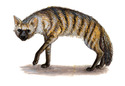
Aardwolves have dark stripes on buff-yellow or dark brown fur, as well as a thick mane running from the back of the head to the tail. Intermittent spots or stripes on a pale gray-white neck may be seen. Feet are usually dark solid black with irregular horizontal stripes on the legs. Total length ranges from 850 to 1050 mm and the tail alone makes up 200 to 300 mm of this total length. Weight ranges from 8 to 14 kg. Males and females exhibit no sexual dimorphism in color or size. All aardwolves have large, pointed ears, slender skulls, and reduced molars due to a diet exclusively of termites. Like all members of Hyaenidae, they have forelegs longer than hind legs, creating a sloped stature.
Aardwolves bear a striking resemblance to striped hyenas (Hyaena hyaena), which are sympatric in the northeastern portion of their range. Both have similar fur texture and color, though aardwolves tend to have more regular stripes and are only a quarter the body mass of striped hyenas. Questions have been raised about this similarity as a rare form of Batesian mimicry among mammals, but no conclusive evidence is recognized. (Gingerich, 1974; Goodhart, 1975; Koehler and Richardson, 1990; Sliwa, 1996)
- Other Physical Features
- endothermic
- homoiothermic
- bilateral symmetry
- Sexual Dimorphism
- sexes alike
-
- Range mass
- 8 to 14 kg
- 17.62 to 30.84 lb
-
- Range length
- 850 to 1050 mm
- 33.46 to 41.34 in
-
- Range basal metabolic rate
- 59 to 70 cm3.O2/g/hr
Reproduction
Mating occurs during the last two weeks of June and the first two weeks of July. Scent "pasting" with anal gland secretions by both males and females is used to attract partners. Males are extremely territorial over both land and mates, in and out of mating season. They will not necessarily remain monogamous; aggressive males are known to copulate with neighboring females already with weaker mates, and litters may be fathered by more than one male. (Koehler and Richardson, 1990)
- Mating System
- polygynous
Aardwolves copulate and produce offspring during summer. Females gestate for approximately 90 days after fertilization, giving birth to 2 to 5 cubs. These cubs remain solely underground in a den for the first month and continue to increase their foraging distance from the den every couple of months (with parental supervision). Weaning is usually completed by four months of age, yet complete independence may not be established until almost one year of age. (Koehler and Richardson, 1990; Sliwa, 1996)
- Key Reproductive Features
- iteroparous
- seasonal breeding
- gonochoric/gonochoristic/dioecious (sexes separate)
- sexual
- viviparous
-
- Breeding interval
- Breeding occurs once yearly.
-
- Breeding season
- Breeding occurs from mid-June to mid-July.
-
- Range number of offspring
- 2 to 5
-
- Average gestation period
- 90 days
-
- Range weaning age
- 3 to 4 months
-
- Average time to independence
- 1 years
Males and females care for their young through the first, juvenile year. Aardwolf pups remain under parental supervision up to one year old, with solitary foraging beginning around 7 months old. While pups are still small, male aardwolves invest most of their energy in guarding the den, while females leave to forage. (Koehler and Richardson, 1990)
- Parental Investment
- altricial
- male parental care
- female parental care
-
pre-fertilization
- provisioning
-
protecting
- female
-
pre-hatching/birth
-
provisioning
- female
-
protecting
- female
-
provisioning
-
pre-weaning/fledging
-
provisioning
- female
-
protecting
- male
- female
-
provisioning
-
pre-independence
-
provisioning
- male
- female
-
protecting
- male
- female
-
provisioning
Lifespan/Longevity
No data on the average lifespan of aardwolves in the wild has been recorded. However, closely related spotted hyenas (Crocuta crocuta) and many other species in the Family Hyaenidae may exceed 18 years in the wild. The maximum lifespan documented for aardwolves was a 20 year-old captive female. (Holekamp and Smale, 1998; Koehler and Richardson, 1990; de Magalhaes, et al., 2009)
-
- Range lifespan
Status: captivity - 20 (high) years
- Range lifespan
Behavior
Aardwolves are mainly nocturnal mammals that remain solitary or in pairs for the majority of their lifespan. During the day aardwolves retreat to subterranean dens to rest and escape extreme heat, although during winter months they may resurface during late afternoons to forage. Small groups in the same territory may forage together during winter, but only within a distance of approximately 100 meters of another aardwolf. Females spend both days and nights in dens while supervising cubs, relying on the male partner for protection. Dens are occupied no longer than 8 weeks at a time before aardwolves relocate. (Anderson and Richardson, 2005; Koehler and Richardson, 1990; Nel and Bothma, 1983; Sliwa and Richardson, 1998; Sliwa, 1996; Walker, 1996)
- Key Behaviors
- terricolous
- nocturnal
- motile
- sedentary
- solitary
- territorial
-
- Range territory size
- 1 to 4 km^2
Home Range
Home range size is from 1 to 4 square kilometers per individual or pair. (Koehler and Richardson, 1990)
Communication and Perception
Aardwolves communicate primarily through anal gland scent marking. These smear marks are rubbed on foliage to establish territories and attract potential mates. Males tend to mark more often than females. Scent marks from a foreign P. cristata may cause a male or female to relocate dens, but marks from a mate are continuously over-marked until the scent is covered. Vocal communication is rare, only being used when startled, fighting, or stressed. These distress calls range from clucking to roaring. Keen sight and sound perception are used when searching for termites at night. (Apps, 2008; Koehler and Richardson, 1990; Mills, et al., 1984; Nel and Bothma, 1983; Sliwa and Richardson, 1998)
Abundant scent marking by both genders is used to communicate. Within a home range, aardwolves bury their feces in common middens that are marked by anal gland secretions. If intruders are discovered on any marked territory, they show aggressive behavior and warn by erecting a tall mane of hair down the backside that makes them seem much larger than they are. Pups begin to exhibit fluffing of the tail while learning to play with siblings. This defensive stance may initially be used between two familiar aardwolves in the same territory, but will be suppressed upon successful recognition. Though molars and canine teeth are reduced, powerful jaws and claws have been retained for combat. If startled, a foul secretion from the anal glands may be released. (Apps, 2008; Koehler and Richardson, 1990; Mills, et al., 1984; Nel and Bothma, 1983; Sliwa and Richardson, 1998)
- Other Communication Modes
- scent marks
Food Habits
The diet of aardwolves consists solely of termites belonging to the groups Trinervitermes and Hodotermes. Consumption of these termites depends on their abundance and seasons; Trinervitermes species remain active only during warmer months and Hodotermes species remain active into cooler months. Harvester termites from the Trinervitermes group release a terpene toxin that deters many of their predators, however, aardwolves shows no aversion to this secretion. Aardwolves consume their prey by licking termites off surfaces using a flat, sticky tongue. With this method, they may consume up to 300,000 termites every night. Very little water is required, as termites usually supplement needed fluid intake. (Koehler and Richardson, 1990; Matsebula, et al., 2009; Richardson and Levitan, 1994)
- Primary Diet
- carnivore
- Animal Foods
- insects
Predation
Adult aardwolves have no significant predators. Pups are vulnerable to black-backed jackals (Canis mesomelas) unless well-protected by males in dens. Humans (Homo sapiens) may affect populations; African farmers mistake these passive hyaenids as threats to livestock and kill aardwolves discovered on their land. Motor vehicle collisions contribute to mortality as well, although aardwolves usually avoid roadways. Domestic dogs (Canis lupus familiaris) trained to hunt foxes and jackals will also mistakenly attack aardwolves in the wild. (Anderson, 2005; Koehler and Richardson, 1990)
- Anti-predator Adaptations
- cryptic
-
- Known Predators
-
- humans (Homo sapiens)
- black-backed jackals (Canis mesomelas)
- domestic dogs (Canis lupus familiaris)
Ecosystem Roles
Aardwolves significantly limit termite populations throughout their range, preventing extensive wood damage for both humans and natural habitats. Aardwolf density and foraging techniques have noninvasive impacts on the ecosystem. Aardwolves and brown hyenas (Hyaena brunnea) are the only known hosts of two subspecies of mallophagous louse, Felicola intermedius intermedius and F. i. hyaenae. Aardwolves may also carry the parasite Haemaphysalis zumpti, a tick that favors small burrowing mammals. (Hoogstraal and El Kammah, 1974; Koehler and Richardson, 1990)
- Felicola intermedius intermedius
- Felicola intermedius hyaenae
- Haemaphysalis zumpti
Economic Importance for Humans: Positive
Aardwolves play a key role in pest control, consuming up to 105,000,000 termites per individual a year. The grasslands where these termites feed are the main food source for domestic livestock, and aardwolves may prevent significant crop damage for African farmers. (Koehler and Richardson, 1990)
- Positive Impacts
- controls pest population
Economic Importance for Humans: Negative
There are no known adverse effects of P. cristata on humans.
Conservation Status
Aardwolf populations remain stable across the majority of their African habitat and are not considered threatened. However, sightings are rare due to their timid and nocturnal behavior; aardwolf densities usually do not exceed 1 adult per square km. (Koehler and Richardson, 1990; Skinner and van Aarde, 1983)
-
- IUCN Red List
-
Least Concern
More information
-
- IUCN Red List
-
Least Concern
More information
-
- US Federal List
- No special status
-
- CITES
- No special status
-
- State of Michigan List
- No special status
Other Comments
Despite numerous similarities to other hyaenid species, aardwolves were once classified in their own family, Protelidae. (Koehler and Richardson, 1990)
Contributors
Meghan Stump (author), Radford University, Karen Powers (editor), Radford University, Tanya Dewey (editor), University of Michigan-Ann Arbor.
Glossary
- Ethiopian
-
living in sub-Saharan Africa (south of 30 degrees north) and Madagascar.

- acoustic
-
uses sound to communicate
- altricial
-
young are born in a relatively underdeveloped state; they are unable to feed or care for themselves or locomote independently for a period of time after birth/hatching. In birds, naked and helpless after hatching.
- bilateral symmetry
-
having body symmetry such that the animal can be divided in one plane into two mirror-image halves. Animals with bilateral symmetry have dorsal and ventral sides, as well as anterior and posterior ends. Synapomorphy of the Bilateria.
- carnivore
-
an animal that mainly eats meat
- chemical
-
uses smells or other chemicals to communicate
- cryptic
-
having markings, coloration, shapes, or other features that cause an animal to be camouflaged in its natural environment; being difficult to see or otherwise detect.
- endothermic
-
animals that use metabolically generated heat to regulate body temperature independently of ambient temperature. Endothermy is a synapomorphy of the Mammalia, although it may have arisen in a (now extinct) synapsid ancestor; the fossil record does not distinguish these possibilities. Convergent in birds.
- female parental care
-
parental care is carried out by females
- insectivore
-
An animal that eats mainly insects or spiders.
- iteroparous
-
offspring are produced in more than one group (litters, clutches, etc.) and across multiple seasons (or other periods hospitable to reproduction). Iteroparous animals must, by definition, survive over multiple seasons (or periodic condition changes).
- male parental care
-
parental care is carried out by males
- motile
-
having the capacity to move from one place to another.
- native range
-
the area in which the animal is naturally found, the region in which it is endemic.
- nocturnal
-
active during the night
- polygynous
-
having more than one female as a mate at one time
- scent marks
-
communicates by producing scents from special gland(s) and placing them on a surface whether others can smell or taste them
- seasonal breeding
-
breeding is confined to a particular season
- sedentary
-
remains in the same area
- sexual
-
reproduction that includes combining the genetic contribution of two individuals, a male and a female
- solitary
-
lives alone
- tactile
-
uses touch to communicate
- temperate
-
that region of the Earth between 23.5 degrees North and 60 degrees North (between the Tropic of Cancer and the Arctic Circle) and between 23.5 degrees South and 60 degrees South (between the Tropic of Capricorn and the Antarctic Circle).
- terrestrial
-
Living on the ground.
- territorial
-
defends an area within the home range, occupied by a single animals or group of animals of the same species and held through overt defense, display, or advertisement
- tropical
-
the region of the earth that surrounds the equator, from 23.5 degrees north to 23.5 degrees south.
- tropical savanna and grassland
-
A terrestrial biome. Savannas are grasslands with scattered individual trees that do not form a closed canopy. Extensive savannas are found in parts of subtropical and tropical Africa and South America, and in Australia.
- savanna
-
A grassland with scattered trees or scattered clumps of trees, a type of community intermediate between grassland and forest. See also Tropical savanna and grassland biome.
- temperate grassland
-
A terrestrial biome found in temperate latitudes (>23.5° N or S latitude). Vegetation is made up mostly of grasses, the height and species diversity of which depend largely on the amount of moisture available. Fire and grazing are important in the long-term maintenance of grasslands.
- visual
-
uses sight to communicate
- viviparous
-
reproduction in which fertilization and development take place within the female body and the developing embryo derives nourishment from the female.
References
Anderson, M. 2005. Aardwolf adaptations: a review. Department of Tourism, Environment & Conservation, 59: 73-78. Accessed March 16, 2010 at http://www.andersonafrica.co.za/publications/aardwolfadaptations.pdf.
Anderson, M., P. Richardson. 2005. The physical and thermal characteristics of aardwolf dens. South African Journal of Wildlife Research, 35/2: 147-153. Accessed February 03, 2010 at http://www.andersonafrica.co.za/publications/Aardwolfdenning.pdf.
Apps, P. 2008. Smither's Mammals of Southern Africa: A Field Guide. South Africa: Struik Publishers.
Gingerich, P. 1974. Proteles cristatus Sparrman from the pleistocene of South Africa, with a note on tooth replacement in the aardwolf (Mammalia: Hyaenidae). Annals of the Transvaal Museum, 29/4: 49-55. Accessed February 02, 2010 at http://www-personal.umich.edu/~gingeric/PDFfiles/PDG018_SAfProteles.pdf.
Goodhart, C. 1975. Does the aardwolf mimic a hyena?. Zoological Journal of the Linnean Society, 57: 349-356. Accessed February 12, 2010 at http://www3.interscience.wiley.com/cgi-bin/fulltext/119862784/PDFSTART.
Holekamp, K., L. Smale. 1998. Behavioral Development in the Spotted Hyena. BioScience, 48/12: 997-1005. Accessed April 09, 2010 at http://www.jstor.org/pss/1313456.
Hoogstraal, H., K. El Kammah. 1974. Notes on African Haemaphysalis Ticks. XII. H. (Rhipistoma) zumpti sp. n., a Parasite of Small Carnivores and Squirrels in Southern Africa (Ixodoidea: Ixodidae). The Journal of Parasitology, 60/1: 188-197.
Koehler, C., P. Richardson. 1990. Proteles cristatus. Mammalian Species, 363: 1-6. Accessed February 02, 2010 at http://www.science.smith.edu/departments/Biology/VHAYSSEN/msi/default.html.
Matsebula, S., A. Monadjem, K. Roques, D. Garcelon. 2009. The diet of the aardwolf, Proteles cristatus at Malolotja Nature Reserve, western Swaziland. African Journal of Ecology, 47: 448-451. Accessed February 06, 2010 at http://www.naturalhistorysociety.org.sz/attachments/Aardwolf%20diet%20publication.pdf.
Mills, M., J. Nel, J. Bothma. 1984. Notes on some smaller carnivores from the Kalahari Gemsbok National Park. Koedoe, 1: 221-227. Accessed February 06, 2010 at http://www.koedoe.co.za/index.php/koedoe/article/viewFile/581/610.
Nel, J., J. Bothma. 1983. Scent marking and midden used by aardwolves (Proteles cristatus) in the Namib Desert. African Journal of Ecology, 21: 25-39.
Richardson, P., C. Levitan. 1994. Tolerance of Aardwolves to Defense Secretions of Trinervitermes trinervoides. Journal of Mammalogy, 75/1: 84-91. Accessed March 12, 2010 at http://www.jstor.org/pss/1382238.
Skinner, J., R. van Aarde. 1983. The use of space by the Aardwolf Proteles cristatus. Notes From The Mammal Society, 52: 299-301. Accessed February 12, 2010 at http://www.ceru.up.ac.za/downloads/use_space_Aardwolf.pdf.
Sliwa, A. 1996. A functional analysis of scent marking and mating behaviour in the aardwolf, Proteles cristatus (Sparrman, 1783). Faculty of Biological and Agricultural Sciences, University of Pretoria, 1: 1-172. Accessed April 21, 2010 at http://www.carnivoreconservation.org/files/thesis/sliwa_1996_phd.pdf.
Sliwa, A., P. Richardson. 1998. Responses of aardwolves, Proteles cristatus, Sparrman 1783, to translocated scent marks. Animal Behaviour, 56: 137-146. Accessed February 03, 2010 at http://agonline.tamu.edu/WFSC622/materials/pdf/sliwa98.pdf.
Taylor, W., J. Skinner. 2000. Associative feeding between Aardwolves (Proteles cristatus) and Aardvarks (Orycteropus afer). Mammal Review, 30/2: 141-143. Accessed February 06, 2010 at http://www3.interscience.wiley.com/cgi-bin/fulltext/119184697/PDFSTART.
Walker, C. 1996. Signs of the Wild. South Africa: Struik Publishers.
Williams, J., M. Anderson, P. Richardson. 1997. Seasonal differences in field metabolism, water requirements, and foraging behavior of free-living aardwolves. Ecology, 78/8: 2588-2602. Accessed February 06, 2010 at http://gw5kw3uf8g.scholar.serialssolutions.com/?sid=google&auinit=JB&aulast=Williams&atitle=Seasonal+differences+in+field+metabolism,+water+requirements,+and+foraging+behavior+of+free-living+aardwolves&id=doi:10.1890/0012-9658(1997)078[2588:SDIFMW]2.0.CO;2&title=Ecology+(Durham)&volume=78&issue=8&date=1997&spage=2588&issn=0012-9658.
de Magalhaes, J., A. Budovsky, G. Lehmann, J. Costa, Y. Li, V. Fraifeld, G. Church. 2009. The Human Ageing Genomic Resources: online databases and tools for biogerontologists. Aging Cell, 8/1: 65-72. Accessed April 22, 2010 at http://genomics.senescence.info/species/entry.php?species=Proteles_cristata.
van Jaarsveld, A., P. Richardson, M. Anderson. 1995. Post-natal growth and sustained lactational effort in the Aardwolf: life-history implications. Functional Ecology, 9/3: 492-497. Accessed February 06, 2010 at http://gw5kw3uf8g.scholar.serialssolutions.com/?sid=google&auinit=AS&aulast=Van+Jaarsveld&atitle=Post-natal+growth+and+sustained+lactational+effort+in+the+Aardwolf:+life-history+implications&id=doi:10.2307/2390014&title=Functional+ecology&volume=9&issue=3&date=1995&spage=492&issn=0269-8463.