Procavia capensisrock hyrax

Geographic Range
Procavia capensis occurs throughout most of Africa and the Arabian Peninsula with the exception of the Congo basin and Madagascar. It is the most arid-adapted of hyrax species, and its range includes dry mountainous regions in the Namib, Sahara, and Arabian deserts. (Bartholomew and Rainy, 1971; Estes, 1991; Hoeck, 1975; Olds and Shoshani, 1982)
Habitat
Procavia capensis is commonly found in arid land habitat including deserts, savannas and scrub forests. It lives in rocky areas with moderate vegetative cover and many rock crevices and cavities, the latter of which are used as shelter. Although it does not burrow, it does inhabit abandoned burrows, including those of aardvarks and meerkats. Even when traveling between suitable habitats, rock hyraxes do not normally stray from areas with some form of cover or refuge. (Estes, 1991; Hoeck, 1975; Olds and Shoshani, 1982)
- Habitat Regions
- tropical
- terrestrial
- Terrestrial Biomes
- desert or dune
- savanna or grassland
- scrub forest
- Other Habitat Features
- agricultural
Physical Description
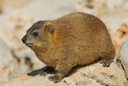
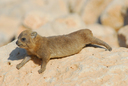
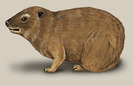
Hyraxes are the smallest of the subungulate mammals and are similar in appearance to woodchucks. Members of this species have a single pair of long, strong, tusk-like incisors, and their molars are similar to the cheek teeth of rhinoceroses. Total length for adults ranges from 305 to 550 mm, and tail length ranges from 11 to 24 mm. Hindfoot length ranges from 65 to 76mm, and ear length ranges from 27 to 38 mm. These hyraxes are heavily built for their size, weighing as much as 4.3 kg. Males (4 kg) are slightly larger than females (3.6 kg) and have blunter features and thinner bodies with thicker necks than females. The tusks of males are larger and sharper than those of females. Males also have a larger larynx and larger guttural pouches, which help to amplify their territorial calls. Hyrax eyes contain a special membrane called the umbraculum that is thought to shield the eye from the sun. (Estes, 1991; Olds and Shoshani, 1982; Skinner and Chimimba, 2005)

The forefeet of Procavia capensis have four toes and are plantigrade, while the hindfeet have three toes and are semi-digitigrade. All of the toes have rounded nails resembling hooves, except the inside rear toe, which is equipped with a claw that is used in grooming. Procavia capensis has mesaxonic feet in which the plane of symmetry passes through the third digit. The soles of the feet have large, black pads that are moistened by sweat glands, increasing their cohesion to rocky substrates. (Bartholomew and Rainy, 1971; Estes, 1991; Olds and Shoshani, 1982)


The coat of Procavia capensis is dense and rough, with a thick undercoat and long guard hairs scattered throughout. Long, black vibrissae, used as haptic receptors, are found on the back and around the mouth. Pelage color is highly variable among subspecies, ranging from gray, to yellow-brown, to dark brown. The dorsum is usually darker than the flanks, and the venter tends to be a paler cream-color. In the cape region of Africa, pelage color corresponds with environmental moisture; animals living in wetter areas have darker coats, and those living in more arid regions have paler coats. A patch on the dorsum is surrounded by longer hairs in a contrasting color that may be black, yellow, or orange. Underneath this patch is a bare spot containing a dorsal gland specific to hyraxes that secretes pheromones, which are likely used to mark rocks and help young imprint on their mother. Pheromone production is most pronounced during mating season. (Estes, 1991; Olds and Shoshani, 1982)
- Other Physical Features
- endothermic
- homoiothermic
- bilateral symmetry
- Sexual Dimorphism
- male larger
- sexes shaped differently
- ornamentation
-
- Range mass
- 4.3 (high) kg
- 9.47 (high) lb
-
- Average mass
- 3.8 kg
- 8.37 lb
-
- Range length
- 305 to 550 mm
- 12.01 to 21.65 in
-
- Average basal metabolic rate
- 4.954 W
- AnAge
Reproduction
Rock hyraxes are polygynous, and a single territorial male can control a harem of 3 to 7 females in a territory of less than 4000 square meters. Prior to copulation, the male usually calls and then approaches a receptive female with his penis and dorsal spot erected while weaving his head. Although there are no visible signs of estrous, the quantity or quality of dorsal-gland secretions may change as a function of estrous. Mating females may attack their mates when they approaching if females are not willing to copulate. A willing female backs into the male and presses her anogenital region against his flank and breast. The male then grasps her with his forelegs for a moment while copulation occurs. Territorial males preferentially mate with mature females. Peripheral males are usually only successful in mating with subadult or young adult females that are under 28 months of age. The structure of the male penis differs between the different genera of hyraxes, thus contributing to reproductive isolation where sympatry occurs. (Estes, 1991; Olds and Shoshani, 1982)
- Mating System
- polygynous
Procavia capensis breeds seasonally (e.g., August to November in Kenya) with births synchronized to occur during the rainy season. During the breeding season, there is a significant increase in territoriality evident through dramatically higher rates of calling and aggression in males; these behaviors correspond with an increase in testicle size. Testicles can become more than 20 times larger than their normal size during breeding season. Outside of the breeding season, spermatogenesis does not occur. Gestation lasts from 6 to 8 months, which is unusually long for a mammal of such small size. Extended gestation in P. capensis is thought to reflect the fact that its ancestors were much larger in body size. Females become increasingly aggressive as parturition approaches and temporarily form isolated nursing groups with other pregnant females. Birth takes place in the dark and females make hoarse squeaking noises in time with their contractions. Litter size ranges from 1 to 6, with an average of 2.4, which represents 10.8% of the mother’s weight. Newborns are large and well-developed at birth. They have both eyes fully opened, a complete coat of hair, and weigh 170 to 240 grams. Young can jump by two days old, and by the third or fourth day, they begin to eat food. Newborns are capable of eating solid food by two weeks of age. Weaning is usually complete by three months after birth. Reproductive maturity is achieved at 16 months of age, but young do not reach adult size and weight until three years of age. (Estes, 1991; Millar and Glover, 1970; Olds and Shoshani, 1982)
- Key Reproductive Features
- iteroparous
- seasonal breeding
- gonochoric/gonochoristic/dioecious (sexes separate)
- sexual
- viviparous
-
- Breeding interval
- Rock hyraxes breed once yearly
-
- Breeding season
- In Kenya, rock hyraxes breed from August to November.
-
- Range number of offspring
- 1 to 4
-
- Average number of offspring
- 2.4
-
- Average number of offspring
- 3
- AnAge
-
- Range gestation period
- 6 to 8 months
-
- Average weaning age
- 3 months
-
- Average age at sexual or reproductive maturity (female)
- 16 months
-
- Average age at sexual or reproductive maturity (female)
Sex: female - 500 days
- AnAge
- Average age at sexual or reproductive maturity (female)
-
- Average age at sexual or reproductive maturity (male)
- 16 months
-
- Average age at sexual or reproductive maturity (male)
Sex: male - 500 days
- AnAge
- Average age at sexual or reproductive maturity (male)
After birth, neonates are licked clean before they climb onto the back of the mother where they rest on her dorsal gland. This is thought to promote imprinting and keeps young warm and out of the way of other adults. Females have three pairs of mammae, one pectoral and two inguinal, all of which are used in nursing. Nursing may occur inside a burrow or outside on the rocks and occurs at roughly 1.5 h intervals during the first couple of days after birth. There is no information available regarding paternal care in this species. (Estes, 1991; Olds and Shoshani, 1982)
- Parental Investment
- precocial
- female parental care
-
pre-fertilization
- provisioning
-
protecting
- female
-
pre-hatching/birth
-
provisioning
- female
-
protecting
- female
-
provisioning
-
pre-weaning/fledging
-
provisioning
- female
-
protecting
- female
-
provisioning
-
pre-independence
-
provisioning
- female
-
protecting
- female
-
provisioning
Lifespan/Longevity
Little information is available regarding the average lifespan of Procavia capensis, however, evidence suggests it can live for up to 12 years in the wild. (Estes, 1991)
-
- Range lifespan
Status: wild - 12 (high) years
- Range lifespan
-
- Average lifespan
Status: wild - 8.5 years
- Max Planck Institute for Demographic Research
- Average lifespan
-
- Average lifespan
Status: captivity - 11.0 years
- Max Planck Institute for Demographic Research
- Average lifespan
-
- Average lifespan
Status: wild - 14.0 years
- Max Planck Institute for Demographic Research
- Average lifespan
Behavior
Procavia capensis is gregarious and lives in colonies with as many as 80 individuals, depending on home range size and resource abundance. Colonies are typically composed of a territorial male that controls a harem of several related females and their offspring, but may consist of multiple families, each headed by an adult male. Females are usually philopatric and may associate with each other indefinitely. Female emigration is rare, but dispersing females have been accepted into other colonies after an initial period of hostility from resident females. There is no defined dominance hierarchy among females, but older individuals tend to be more dominant and vigilant than younger individuals. (Estes, 1991; Hoeck, 1975; Olds and Shoshani, 1982)
Within individual rock hyrax colonies, territorial males dominate other colony members and remain on alert for predators and conspecific rivals. Male offspring are forced to disperse by 30 months of age, but usually disperse earlier, by 17 to 24 months. Territorial males are relatively tolerant of their own male offspring but very aggressive towards dispersing males, which may travel more than 2 km in search of undefended habitat. In most cases, there is no acceptable habitat nearby and young males are forced to defend sleeping holes on the periphery of the colony's territory. When the territorial male dies or becomes weakened, the top peripheral male replaces him. (Estes, 1991; Hoeck, 1975; Hoeck, 1989)
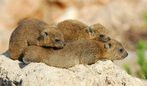
Despite being basically endothermic, rock hyraxes have a widely fluctuating body temperature and cannot exist without shelter from temperature extremes. They employ many of the same behavioral adaptations as reptiles to avoid extreme temperatures. Unless the weather is very warm, they do not leave their burrows until morning when they typically spend an hour or so sunbathing. Foraging occurs after sunbathing and during the afternoon, with most feeding occurring in the evening. They often avoid the warmest part of the day by resting in shade. Rain is also avoided, and hyraxes may not leave their dens at all during cold, rainy days. They are sometimes active during moonlit nights. Adult hyraxes spend 95% of their time resting. Resting often involves heaping, which usually takes place inside their den as animals lay on top of one another. Evidence suggests that resting behavior is correlated with ambient temperature. As temperatures become increasingly warm, resting behavior changes from heaping to huddling to solitary resting. (Bartholomew and Rainy, 1971; Estes, 1991; Olds and Shoshani, 1982)
- Key Behaviors
- terricolous
- diurnal
- motile
- sedentary
- territorial
- social
- colonial
- dominance hierarchies
Home Range
There is no information available regarding the average home range size of rock hyraxes.
Communication and Perception
All of the senses of rock hyraxes are well-developed, although their near-vision is thought to be relatively poor. Hyraxes have a variety of vocal calls. Territorial calls are distinct and genus-specific. In rock hyraxes, territorial calls are loud and repetitious and increase in volume and duration towards the end of the sequence before ending in a series of guttural noises. Adults also emit twittering or whinnying calls and striking alarm calls, which are made when a potential predator is identified. When threatened, they may growl or grind their molars. Infants make only five of the twenty-one sounds used by adults; three of these are vocal, including mewing calls given when they are lost or begging, and two are non-vocal. Between 2 to 15 months of age, young develop all vocal sounds except five; four of which are exclusive to adult females and one is characteristic of adult males. (Estes, 1991; Olds and Shoshani, 1982)
Rock hyraxes urinate on the sides of rocks near colony sites. Crystallized calcium carbonate present in the excretion makes a white stain used in visual communication. Hyraxes also deposit their droppings and urine in a common latrine, but it is unknown whether this serves any role in olfactory communication. The dorsal gland and hair surrounding it are important for communication among conspecifics. Pheromone production from the dorsal gland increases with increased stimuli. In an aggressive context, pheromone production is accompanied by a slight curling of the upper lip and piloerection of the neck hairs. During territorial calls, males crouch and raise their head with their jaws slightly agape. Hyraxes show submission by presenting their hindquarters, backing away, closing their dorsal gland, and/or flattening their ears. Submissive behaviors are very important, as simple interactions such as approaching or directly staring at another adult might be seen as a threat and the tusks can inflict fatal wounds. To avoid antagonizing other individuals, feeding or huddling individuals usually face away from each other. (Estes, 1991; Olds and Shoshani, 1982)
- Other Communication Modes
- pheromones
- scent marks
Food Habits
Rock hyraxes are primarily grazers and forage on many different plant species per foraging bought; however, regional preferences have been documented. For example, giant lobelia and certain daisy species are preferred on the west slope of Mt. Kenya, swampy vegetation is eaten close to the bottoms of valleys, and lowland forage includes new shoots, fruits, berries, and figs. Grasses make up 78% of the diet during the wet season, but only 57% during the dry season. When conditions are moist, either during the wet season or after a rainfall, rock hyraxes show a preference for new shoots, buds, and leaves. During drought, they may eat coarse material such as bark, lichens, and liverworts. Daily food consumption varies with body weight, and plant water content has a significant influence on the amount of food that is ingested. Rock hyraxes may travel up to 60 m from their burrows to forage but may travel further during a drought. When grazing, individuals maintain their spacing and remaining vigilant for potential predators. (Estes, 1991; Hoeck, 1975; Hoeck, 1989; Olds and Shoshani, 1982; Sale, 1966)
The feeding habits of rock hyraxes are comparable to those of ungulates. Giraffes and elephants are their most likley competitors for food. Hyraxes can feed very rapidly and entire colonies may spend less than one hour per day feeding. Most feeding is concentrated in two feeding periods of about twenty minutes: one about three hours after sunrise and the other about two hours before sunset. Rock hyraxes do not manipulate or carry their food, and they use their feet only to reach or hold twigs. While foraging, they often hold their head at a 90˚ angle to best utilize their wide gape, and they bite off large amounts of vegetation. By eating large amounts of food quickly, and spending most of their time resting, rock hyraxes are able to survive on resources too sparse or nutrient-poor to support more active mammals of a comparable size. (Estes, 1991; Olds and Shoshani, 1982; Sale, 1966)
- Plant Foods
- leaves
- wood, bark, or stems
- fruit
- bryophytes
Predation
Except in high mountainous areas, leopards are the main predator of Procavia capensis. Hyraxes may also be preyed upon by snakes (e.g., Egyptian cobras and puff adders), eagles (e.g., Verreaux’s eagles and martial eagles), owls, jackals, African wild dogs, and various cat species (e.g., servals, caracals and lions). Neonates are sometimes preyed upon by mongooses. Procavia capensis evades predators by staying alert and remaining close to cover while foraging. Individuals immediately respond to the alarm calls of territorial males and to the calls of other species such as bush hyraxes and some birds. Hyraxes also avoid predators by using burrows that are smaller in diameter than most predators in their habitat. They have been known to escape predation by playing dead, or by working together to scare off smaller predators from the safety of a burrow. (Estes, 1991; Olds and Shoshani, 1982)
-
- Known Predators
-
- Egyptian cobra (Naja haje)
- puff adder (Bitis arietans)
- Verreaux's eagle (Aquila verreauxii)
- martial eagle (Polemaetus bellicosus)
- owls (Strigiformes)
- jackals (Canis)
- African wild dogs (Lycaon pictus)
- serval (Leptailurus serval)
- caracal (Caracal caracal)
- lion (Panthera leo)
- mongooses (Herpestidae)
Ecosystem Roles
Rock hyraxes are the dominant herbivores in rocky areas throughout their geographic range. They are preyed upon by a number of different vertebrate species and are known to host up to 25 species of lice. (Estes, 1991; Olds and Shoshani, 1982)
- lice (Pthiraptira)
Economic Importance for Humans: Positive
Members of Procavia capensis colonies urinate and defecate in designated areas called latrines. As time goes on and more material accumulates, this matter eventually congeals into a large, sticky solid. This substance has been used in a number of applications, including a medicine called hyraceum that has been used to treat epilepsy, convulsions, and a number of female-specific diseases. Procavia capensis is hunted for its meat throughout its geographic range. (Olds and Shoshani, 1982)
- Positive Impacts
- food
- source of medicine or drug
Economic Importance for Humans: Negative
In areas where humans are prevalent, especially South Africa, rock hyraxes are sometimes considered pests, as they inhabit road culverts and/or crevices in stone walls. Agricultural plots that have been recently cleared are often bordered by rocks that were removed during clearing, thus providing prime habitat for rock hyraxes. Fields such as these are often used for cultivating fruit trees, upon which hyraxes browse and cause considerable damage. In addition, rock hyraxes are a known reservoir for Leishmania tropica, a flagellate parasite that infects rodents and humans. (Estes, 1991; Jacobson, et al., 2003; Moran, et al., 1987; Olds and Shoshani, 1982; Svobodová, et al., 2006)
- Negative Impacts
-
injures humans
- carries human disease
- crop pest
Conservation Status
Although Procavia capensis is classified as a species of least concern on the IUCN's Red List of Threatened Species, current population trends are unknown. While it is hunted for its meat throughout its geographic range and has experienced local extirpations, there are no major threats to the long-term persistence of this species. (Barry, et al., 2008)
-
- IUCN Red List
-
Least Concern
More information
-
- IUCN Red List
-
Least Concern
More information
Other Comments
The word “hyrax” means “shrewmouse” in Greek. The Hebrew word for Procavia capensis, “Shaphan”, roughly translates into “the hidden one.” In Biblical times, hyraxes were known as “conies”. They are also referred to as dassies or rock dassies in Southern Africa. (Estes, 1991; Olds and Shoshani, 1982)
Contributors
Erin Linderman (author), Michigan State University, Barbara Lundrigan (editor), Michigan State University, John Berini (editor), Animal Diversity Web Staff.
Glossary
- Ethiopian
-
living in sub-Saharan Africa (south of 30 degrees north) and Madagascar.

- acoustic
-
uses sound to communicate
- agricultural
-
living in landscapes dominated by human agriculture.
- bilateral symmetry
-
having body symmetry such that the animal can be divided in one plane into two mirror-image halves. Animals with bilateral symmetry have dorsal and ventral sides, as well as anterior and posterior ends. Synapomorphy of the Bilateria.
- chemical
-
uses smells or other chemicals to communicate
- colonial
-
used loosely to describe any group of organisms living together or in close proximity to each other - for example nesting shorebirds that live in large colonies. More specifically refers to a group of organisms in which members act as specialized subunits (a continuous, modular society) - as in clonal organisms.
- desert or dunes
-
in deserts low (less than 30 cm per year) and unpredictable rainfall results in landscapes dominated by plants and animals adapted to aridity. Vegetation is typically sparse, though spectacular blooms may occur following rain. Deserts can be cold or warm and daily temperates typically fluctuate. In dune areas vegetation is also sparse and conditions are dry. This is because sand does not hold water well so little is available to plants. In dunes near seas and oceans this is compounded by the influence of salt in the air and soil. Salt limits the ability of plants to take up water through their roots.
- diurnal
-
- active during the day, 2. lasting for one day.
- dominance hierarchies
-
ranking system or pecking order among members of a long-term social group, where dominance status affects access to resources or mates
- drug
-
a substance used for the diagnosis, cure, mitigation, treatment, or prevention of disease
- endothermic
-
animals that use metabolically generated heat to regulate body temperature independently of ambient temperature. Endothermy is a synapomorphy of the Mammalia, although it may have arisen in a (now extinct) synapsid ancestor; the fossil record does not distinguish these possibilities. Convergent in birds.
- female parental care
-
parental care is carried out by females
- folivore
-
an animal that mainly eats leaves.
- food
-
A substance that provides both nutrients and energy to a living thing.
- herbivore
-
An animal that eats mainly plants or parts of plants.
- iteroparous
-
offspring are produced in more than one group (litters, clutches, etc.) and across multiple seasons (or other periods hospitable to reproduction). Iteroparous animals must, by definition, survive over multiple seasons (or periodic condition changes).
- motile
-
having the capacity to move from one place to another.
- native range
-
the area in which the animal is naturally found, the region in which it is endemic.
- pheromones
-
chemicals released into air or water that are detected by and responded to by other animals of the same species
- polygynous
-
having more than one female as a mate at one time
- scent marks
-
communicates by producing scents from special gland(s) and placing them on a surface whether others can smell or taste them
- scrub forest
-
scrub forests develop in areas that experience dry seasons.
- seasonal breeding
-
breeding is confined to a particular season
- sedentary
-
remains in the same area
- sexual
-
reproduction that includes combining the genetic contribution of two individuals, a male and a female
- sexual ornamentation
-
one of the sexes (usually males) has special physical structures used in courting the other sex or fighting the same sex. For example: antlers, elongated tails, special spurs.
- social
-
associates with others of its species; forms social groups.
- tactile
-
uses touch to communicate
- terrestrial
-
Living on the ground.
- territorial
-
defends an area within the home range, occupied by a single animals or group of animals of the same species and held through overt defense, display, or advertisement
- tropical
-
the region of the earth that surrounds the equator, from 23.5 degrees north to 23.5 degrees south.
- tropical savanna and grassland
-
A terrestrial biome. Savannas are grasslands with scattered individual trees that do not form a closed canopy. Extensive savannas are found in parts of subtropical and tropical Africa and South America, and in Australia.
- savanna
-
A grassland with scattered trees or scattered clumps of trees, a type of community intermediate between grassland and forest. See also Tropical savanna and grassland biome.
- temperate grassland
-
A terrestrial biome found in temperate latitudes (>23.5° N or S latitude). Vegetation is made up mostly of grasses, the height and species diversity of which depend largely on the amount of moisture available. Fire and grazing are important in the long-term maintenance of grasslands.
- visual
-
uses sight to communicate
- viviparous
-
reproduction in which fertilization and development take place within the female body and the developing embryo derives nourishment from the female.
- young precocial
-
young are relatively well-developed when born
References
Barry, R., P. Bloomer, H. Hoeck, H. Shoshani. 2008. "IUCN 2010 Red List of Threatened Species: Procavia capensis" (On-line). Accessed March 17, 2011 at http://www.iucnredlist.org/.
Bartholomew, G., M. Rainy. 1971. Regulation of Body Temperature in the Rock Hyrax, Heterohyrax brucei. Journal of Mammalogy, 52: 81-95.
Estes, R. 1991. The Behavior Guide to African Mammals. Berkeley: The University of California Press.
Hoeck, H. 1989. Demography and Competition in Hyrax. A 17 Years Study. Oecologia, 79: 353-360.
Hoeck, H. 1975. Differential Feeding Behaviour of the Sympatric Hyrax Procavia johnstoni and Heterohyrax brucei. Oecologia, 22: 15-47.
Jacobson, R., C. Eisenberger, M. Svobodova, G. Baneth, J. Sztern, J. Carvalho, A. Nasereddin, M. Fari, U. Shalom, P. Volf, J. Votypka, J. Dedet, F. Pratlong, G. Schonian, L. Schnur, C. Jaffe, A. Warburg. 2003. Outbreak of Cutaenous Leishmaniasis in Northern Israel. Journal of Infectious Diseases, 188: 1065-73.
Millar, R., T. Glover. 1970. Seasonal changes in the reproductive tract of the male rock hyrax, Procavia capensis. Journal of Reproduction and Fertility, 23: 497-499.
Moran, S., S. Sofer, M. Cohen. 1987. Control of the rock hyrax, Procavia capensis, in fruit orchards by fluoroacetamide baits. Crop Protection, 6: 265-270.
Olds, N., J. Shoshani. 1982. Mammalian Species Procavia capensis. American Society of Mammalogists, 171: 1-7.
Sale, J. 1966. Daily food consumption and mode of ingestion in the hyrax. J. E. Afr. Nat. Hist. Soc., 25: 215-224.
Skinner, J., C. Chimimba. 2005. The Mammals of the Southern African Sub-region. Cambridge: Cambridge University Press.
Svobodová, M., P. Volf, J. Votýpka. 2006. Experimental transmission of Leishmania tropica to hyraxes (Procavia capensis) by the bite of Phlebotomus arabicus. Microbes and Infection, 8: 1691-1694.