Platysternon megacephalumBig-headed Turtle
Geographic Range
This species is distributed throughout southeastern Asia. It occurs in southern China (including Hainan Island), southwest through northern Vietnam, Laos, Kampuchea, and northern Thailand to southern Burma. (Barbour and Ernst, 1989; Kirkpatrick, 1995)
Habitat
Platysternon megacephalum lives in rocky, mountain streams and brooks. The water of these streams is usually fast moving and has a temperature of 12° - 17°C which is favored by this species. (Barbour and Ernst, 1989; Kirkpatrick, 1995)
- Habitat Regions
- freshwater
- Terrestrial Biomes
- mountains
- Aquatic Biomes
- rivers and streams
- Other Habitat Features
- riparian
Physical Description
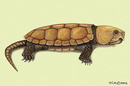
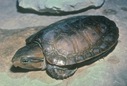
Platysternon megacephalum is a very odd-shaped turtle with a huge head and a long tail that are almost the same size as its body. Total body length reachs up to 40 cm. Compared to most turtle species, the head of Platysternon megacephalum is oversized for its body. It's triangular and cannot be withdrawn into its shell. The turtle's skull is solid bone and, unlike most turtles, has no openings in the upper surface. Adults usually have a shell about 15-18 cm in length and it is more flattened than many other freshwater turtles. The carapace is yellow to brown, rectangular with a squared-off front and a more rounded back end, while the plastron is usually yellow. The toes are slightly webbed with strong claws. This species is noted to have legs covered with large scales and a tail that is very long and muscular. If needed, the tail can support the entire weight of the turtle.
There is no marked difference between the male and female, except the plastron of the male has a tendency to be more concave than the female.
The young are more brightly marked than the adults and have more pronounced serrations at the rear of the carapace. Also, the tail is often longer than that of an adult. (Inger and Schmidt, 1957; Kirkpatrick, 1995; McCarthy, 1991)
- Other Physical Features
- ectothermic
- bilateral symmetry
- Sexual Dimorphism
- sexes alike
-
- Range length
- 40 (high) cm
- 15.75 (high) in
Reproduction
The reproductive habits of Platysternon megacephalum are almost completely unknown except for a few details. This species has been reported to lay 1-2 white eggs at a time that measure about 37 mm by 22 mm. The eggs resemble bird eggs. (Kirkpatrick, 1995)
- Key Reproductive Features
- gonochoric/gonochoristic/dioecious (sexes separate)
- oviparous
Lifespan/Longevity
-
- Average lifespan
Sex: male
Status: captivity - 15.0 years
- Max Planck Institute for Demographic Research
- Average lifespan
Behavior
Platysternon megacephalum is nocturnal. It usually spends the day under a rock or under water. At night, it surfaces to search for food along the stream's bottom, or out of the water along the stream's edge. It is not a good swimmer but is well adapted for walking and climbing on rocks.
If aggravated, it will bite and retain its grip for a long period of time. The use of this animal's strong, hooked jaws can produce very serious injuries. This animal is not known to be aggressive toward other turtles confined with it. (Barbour and Ernst, 1989; Kirkpatrick, 1995)
Food Habits
Platysternon megacephalum is carnivorous. Using its strong beak and jaws, it consumes small marine and terrestrial animals such as fish, mollusks, and worms. It often searchs for food at night along stream bottoms and among low shrubs. (Barbour and Ernst, 1989; Kirkpatrick, 1995)
- Primary Diet
-
carnivore
- piscivore
- molluscivore
- vermivore
Economic Importance for Humans: Positive
Platysternon megacephalum is a turtle that has been very common in food markets of southern China. This species is marketed by pet traders and is bought as souvenirs by tourists. (Kirkpatrick, 1995)
Economic Importance for Humans: Negative
Platysternon megacephalum has no negative economic importance to humans.
Conservation Status
Platysternon megacephalum is one of several species of Asian turtles that have recently become heavily consumed in China and other Asian countries. Because of this, Platysternon megacephalum is now a rare find and the IUCN classifies it as an endangered species. (Higgins, Tuesday, October 3, 2000)
-
- IUCN Red List
-
Endangered
More information
-
- IUCN Red List
-
Endangered
More information
-
- US Federal List
- No special status
-
- CITES
- Appendix II
Contributors
Marion Vereecke (author), Milford High School, George Campbell (editor), Milford High School.
Glossary
- bilateral symmetry
-
having body symmetry such that the animal can be divided in one plane into two mirror-image halves. Animals with bilateral symmetry have dorsal and ventral sides, as well as anterior and posterior ends. Synapomorphy of the Bilateria.
- carnivore
-
an animal that mainly eats meat
- ectothermic
-
animals which must use heat acquired from the environment and behavioral adaptations to regulate body temperature
- food
-
A substance that provides both nutrients and energy to a living thing.
- freshwater
-
mainly lives in water that is not salty.
- molluscivore
-
eats mollusks, members of Phylum Mollusca
- motile
-
having the capacity to move from one place to another.
- mountains
-
This terrestrial biome includes summits of high mountains, either without vegetation or covered by low, tundra-like vegetation.
- native range
-
the area in which the animal is naturally found, the region in which it is endemic.
- nocturnal
-
active during the night
- oriental
-
found in the oriental region of the world. In other words, India and southeast Asia.

- oviparous
-
reproduction in which eggs are released by the female; development of offspring occurs outside the mother's body.
- pet trade
-
the business of buying and selling animals for people to keep in their homes as pets.
- piscivore
-
an animal that mainly eats fish
- riparian
-
Referring to something living or located adjacent to a waterbody (usually, but not always, a river or stream).
References
Barbour, R., C. Ernst. 1989. Turtles of the World. Washington, D.C., and London: Smithsonian Institution Press.
Higgins, M. Tuesday, October 3, 2000. "Endangered Turtle Count Doubles in Four Years" (On-line). Accessed 01/07/04 at http://www.enn.com/.
Inger, R., K. Schmidt. 1957. Living Reptiles of the World. Garden City, New York: Doubleday & Company, Inc..
Kirkpatrick, D. 1996. "The Big-headed Turtle, Platysternon megacephalum" (On-line). Accessed 01/07/04 at http://www.unc.edu/~dtkirkpa/stuff/bigheads.html.
Kirkpatrick, D. 1995. The Big-headed Turtle, Platysternon megacephalum. Reptile & Amphibian Magazine, November/December: 40-47.
McCarthy, C. 1991. Reptile. New York: Alfred A. Knopf.
Pope, C. 1955. The Reptile World. New York: Alfred A. Knopf.
Pritchard, D. 1979. Encyclopedia of Turtles. New Jersey: T.F.H. Publications, Inc. Ltd..