Phocarctos hookeriNew Zealand sea lion
Geographic Range
New Zealand sea lions, also known as Hooker’s sea lions, inhabit the southern stretches of New Zealand’s territory in the Pacific with colonies reaching as far north as the Foveaux Straight and as far south as Macquarie Island. However, the vast majority of breeding occurs among the Auckland Islands, with a scattering of breeding colonies inhabiting the Campbell Islands. The population is estimated to be between 10,000 and 13,000 total individuals. Although New Zealand sea lions were thought to have disappeared from the mainland 200 years ago due to human hunting, in 1993 it was reported that a single sea lion had breed on the mainland peninsula. ("New Zealand Sea Lion", 2010; Louise Chilvers, et al., 2007)
- Biogeographic Regions
- oceanic islands
Habitat
New Zealand sea lions are comfortable in a wide range of habitats, from 400 m above sea level through the hills, forests, and fields of the local islands to dives of up to 600 m below sea level. Yet, the majority of individuals prefer to remain on sandy beaches and hunt primarily at depths no greater than 200 m below sea level. When breeding females will seek shelter in the inland vegetation and, when necessary, they will hunt mainland birds and their nests. ("New Zealand Sea Lion", 2010; Charteris, et al., 2008; Maloney, et al., 2009)
- Habitat Regions
- polar
- saltwater or marine
- Aquatic Biomes
- coastal
-
- Range elevation
- 400 (high) m
- 1312.34 (high) ft
-
- Range depth
- 600 (high) m
- 1968.50 (high) ft
Physical Description
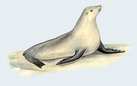
New Zealand sea lion males have a defined mane around their shoulders and a dark brown or black color. Males reach between 2.4 and 3.5 m in length and weigh between 200 and 400 kg. Conversely, females are a much lighter grey and some are even yellow with some darker shades around the flippers. Females are also significantly smaller reaching only between 1.6 and 2 m in length and weighing between 100 and 160 kg. Pups are typically brown in appearance with young males resembling females until full maturation. This species also features a very short, blunt head with a length to width ratio of 2:1, compared to an average ratio for fur seals and sea lions of 3:1. ("New Zealand Sea Lion", 2010; Clark, 1873)
New Zealand sea lions are similar to Australian sea lions in appearance, but many differences have surfaced which are used to distinguish New Zealand sea lions, not only from Australian sea lions, but also from most other species of sea lion. It is typical for New Zealand sea lions to have a deep concave palate (22 mm in males and 14.5 mm in females), a dental formula of I: 3/2 C: 1/1 Cheek teeth: 6/5, and a smooth cylindrical projection of the tympanic bulla. (King, 1960)
- Other Physical Features
- endothermic
- bilateral symmetry
- Sexual Dimorphism
- male larger
- sexes colored or patterned differently
-
- Range mass
- 100 to 400 kg
- 220.26 to 881.06 lb
-
- Range length
- 1.6 to 3.5 m
- 5.25 to 11.48 ft
Reproduction
New Zealand sea lions are polygynous and males are territorial. One dominant male will occupy a beach in late November and harems of up to 25 females will gather in December. Other bulls will remain on the perimeter of the territory occasionally challenging the dominant male. By late January, the harems will break up and the bulls will disperse. ("New Zealand Sea Lion", 2010)
- Mating System
- polygynous
Breeding occurs in New Zealand's summer months and is followed by a gestation period of about 11 months. Females move to a breeding beach about 2 days before giving birth. They usually have only one pup at a time and give birth every one to two years. During their first year, the pups are completely dependent on the mother for food and protection. ("New Zealand Sea Lion", 2010; Louise Chilvers, et al., 2007)
At birth males are larger than females, with males weighing in at about 10.6 kg and females 9.7 kg. (Louise Chilvers, et al., 2007)
- Key Reproductive Features
- iteroparous
- seasonal breeding
- gonochoric/gonochoristic/dioecious (sexes separate)
- sexual
- viviparous
-
- Breeding interval
- New Zealand sea lions breed once every one to two years.
-
- Breeding season
- Mating occurs between ecember to early January.
-
- Range number of offspring
- 1 (high)
-
- Average number of offspring
- 1
- AnAge
-
- Average gestation period
- 11 months
-
- Average gestation period
- 365 days
- AnAge
-
- Average time to independence
- 12 months
-
- Range age at sexual or reproductive maturity (female)
- 3 (low) years
-
- Range age at sexual or reproductive maturity (male)
- 8 to 9 years
Body reserves for pups are relatively low at birth. Suckling occurs for eight to nine days before the mother's first foraging trip, which tends to last for only two days. A direct influence on pup mortality is male harassment; females move pups to inland vegetation six weeks after birth, presumably to protect them from adult males. ("New Zealand Sea Lion", 2010; Louise Chilvers, et al., 2007)
- Parental Investment
- precocial
- female parental care
Lifespan/Longevity
New Zealand sea lions are not formally kept in captivity and little is known about their lifespan. However, it is estimated that the maximum lifespan for both males and females is about 23 years. ("New Zealand Sea Lion", 2010)
-
- Range lifespan
Status: wild - 23 (high) years
- Range lifespan
Behavior
New Zealand sea lions are a social species, but not migratory. Tracking of females has shown that they do not travel between the breeding sites in the Auckland Islands and the Campbell Islands. Their only movement is between the beaches under the control of the bulls with whom they breed and the birthing beaches. ("New Zealand Sea Lion", 2010; Maloney, et al., 2009)
Male New Zealand sea lions have social hierarchies. The dominant territorial male has breeding rights leaving juvenile and bachelor males mostly excluded from mating. ("New Zealand Sea Lion", 2010)
- Key Behaviors
- natatorial
- motile
- sedentary
- territorial
- social
- dominance hierarchies
Home Range
In order to feed, New Zealand sea lions might travel up to 175 km from its local coast. ("New Zealand Sea Lion", 2010)
Communication and Perception
New Zealand sea lion communications have not been described, but is widely studied in their popular relatives, California sea lions. For California sea lions, the most common form of communication is vocal. Males, in particular, use vocal communication to indicate territorial ownership, sexual readiness, and readiness to fight. Females use vocal cues to communicate alarm and readiness to suckle to their pups. Pups have an alarm vocalization as well as a vocalization to indicate hunger. (Peterson and Bartholomew, 1969)
- Communication Channels
- acoustic
Food Habits
New Zealand sea lions are carnivorous. They predominately eat arrow squids, but other common prey include red cods, opalfishes, other small local fishes, octopuses, rays and sharks. Most dives are to less than 200 m and last for four to five minutes; maximum dives reach 600 m. Immature sea lions feed on the same type and size of prey as adults. There have been reports of New Zealand sea lions traveling on land and hunting Southern Royal Albatross,. A number of studies have concluded that New Zealand sea lions often forages and functions to its physiologic limits; this is thought to limit reproductive output. ("New Zealand Sea Lion", 2010; Charteris, et al., 2008; Louise Chilvers, et al., 2007; Meynier, et al., 2009)
- Primary Diet
- carnivore
- Animal Foods
- birds
- fish
- mollusks
- other marine invertebrates
- Foraging Behavior
- stores or caches food
Predation
The only known predators on New Zealand seal lions are sharks and dogs on the mainland. Humans also hunted New Zealand sea lions, but today New Zealand laws protect the species. ("New Zealand Sea Lion", 2010)
-
- Known Predators
-
- sharks (Carcharhiniformes)
- domesticated dogs (Canis lupus familiaris)
Ecosystem Roles
New Zealand seal lions are dominant predators. They hunt similarly endangered species, including the Southern Royal Albatross, which worries local scientists and poses an interesting conundrum. (Charteris, et al., 2008)
New Zealand seal lions have a mutualist relationship with the red-billed gull. This bird will perch on the back of New Zealand seal lions picking the blowflies and other insects from the lion’s back and head. This behavior is similar to that of birds and cattle. (Bell, 2008)
- red-billed gull (Larus novaehollandiae)
Economic Importance for Humans: Positive
There are no known positive effects of New Zealand seal lions on humans.
Economic Importance for Humans: Negative
There are no known adverse effects of New Zealand seal lions on humans.
Conservation Status
According to the New Zealand Department of Conservation, New Zealand seal lions are listed as critical, while IUCN lists the species as vulnerable. New Zealand is highly concerned about New Zealand seal lions, because of interactions with local fishing vessels. They rely on arrow squid for food, but humans fish for this squid, as well. Similar to dolphin interactions with tuna fishing, New Zealand seal lions tend to be a common incidental catch of squid fishermen. The New Zealand Government has put limits on the numbers of New Zealand seal lions that can be caught in fishing nets. Once this limit is reached, the fishery must close operations for the remainder of the season. ("New Zealand Sea Lion", 2010; Kahui, 2011)
Another cause for conservation concern for New Zealand seal lions are bacterial epidemics. Each epidemic takes out hundreds of adults and pups. Scientists must take this into consideration when contemplating further management plans for this species, because the population is already limited and has a restricted range. ("New Zealand Sea Lion", 2010; Louise Chilvers, et al., 2007)
-
- IUCN Red List
-
Vulnerable
More information
-
- IUCN Red List
-
Vulnerable
More information
Contributors
David Ferland (author), Michigan State University, Barbara Lundrigan (editor), Michigan State University.
Glossary
- acoustic
-
uses sound to communicate
- bilateral symmetry
-
having body symmetry such that the animal can be divided in one plane into two mirror-image halves. Animals with bilateral symmetry have dorsal and ventral sides, as well as anterior and posterior ends. Synapomorphy of the Bilateria.
- carnivore
-
an animal that mainly eats meat
- chemical
-
uses smells or other chemicals to communicate
- coastal
-
the nearshore aquatic habitats near a coast, or shoreline.
- dominance hierarchies
-
ranking system or pecking order among members of a long-term social group, where dominance status affects access to resources or mates
- endothermic
-
animals that use metabolically generated heat to regulate body temperature independently of ambient temperature. Endothermy is a synapomorphy of the Mammalia, although it may have arisen in a (now extinct) synapsid ancestor; the fossil record does not distinguish these possibilities. Convergent in birds.
- female parental care
-
parental care is carried out by females
- iteroparous
-
offspring are produced in more than one group (litters, clutches, etc.) and across multiple seasons (or other periods hospitable to reproduction). Iteroparous animals must, by definition, survive over multiple seasons (or periodic condition changes).
- molluscivore
-
eats mollusks, members of Phylum Mollusca
- motile
-
having the capacity to move from one place to another.
- natatorial
-
specialized for swimming
- native range
-
the area in which the animal is naturally found, the region in which it is endemic.
- oceanic islands
-
islands that are not part of continental shelf areas, they are not, and have never been, connected to a continental land mass, most typically these are volcanic islands.
- piscivore
-
an animal that mainly eats fish
- polar
-
the regions of the earth that surround the north and south poles, from the north pole to 60 degrees north and from the south pole to 60 degrees south.
- polygynous
-
having more than one female as a mate at one time
- saltwater or marine
-
mainly lives in oceans, seas, or other bodies of salt water.
- seasonal breeding
-
breeding is confined to a particular season
- sedentary
-
remains in the same area
- sexual
-
reproduction that includes combining the genetic contribution of two individuals, a male and a female
- social
-
associates with others of its species; forms social groups.
- stores or caches food
-
places a food item in a special place to be eaten later. Also called "hoarding"
- tactile
-
uses touch to communicate
- territorial
-
defends an area within the home range, occupied by a single animals or group of animals of the same species and held through overt defense, display, or advertisement
- viviparous
-
reproduction in which fertilization and development take place within the female body and the developing embryo derives nourishment from the female.
- young precocial
-
young are relatively well-developed when born
References
2010. "New Zealand Sea Lion" (On-line). New Zealand Department of Conservation. Accessed March 12, 2012 at http://www.doc.govt.nz/conservation/native-animals/marine-mammals/seals/new-zealand-sea-lion-rapoka-whakahao/.
Bell, B. 2008. Mutualistic and opportunistic foraging by red-billed gull (Larus novaehollandiae) around Hooker's sea lion (Phocarctos hookeri). Notornis, 55: 224-225.
Charteris, M., P. Moore, E. Larsen. 2008. Notes on New Zealand mammals 8. Predation on nesting southern royal albatrosses Diomedea epomophora by New Zealand sea lion Phocarctos hookeri. New Zealand Journal of Zoology, 35: 201-204.
Clark, J. 1873. On the eared seals of the Auckland Islands. Proceedings of the Zoological Society of London, 1873: 750-760.
Kahui, V. 2011. A bioeconomic model for Hooker’s sea lion bycatch in New Zealand. The Australian Journal of Agricultural and Resource Economics, 56: 22-41.
King, J. 1960. Sea-lions of the genera Neophoca and Phocarctos. Mammalia, 24: 445-456.
Louise Chilvers, B., B. Robertson, I. Wilkinson, P. Duignan. 2007. Growth and survival of New Zealand sea lions, Phocarctos hookeri: birth to 3 months. Polar Biol, 30: 459-469.
Maloney, A., B. Louise Chilvers, M. Haley, C. Muller, W. Roe, I. Debski. 2009. Distribution, pup production and mortality of New Zealand sea lion (Phocarctos hookeri) on Campbell Island/Motu Ihupuku, 2008. New Zealand Journal of Ecology, 33/2: 97-103.
Meynier, L., D. Mackenzie, P. Duignan, B. Louise Chilvers, P. Morel. 2009. Variability in the diet of New Zealand sea lion (Phocarctos hookeri) at the Auckland Islands, New Zealand. Marine Mammal Science, 25/2: 302-326.
Peterson, R., G. Bartholomew. 1969. Airborne vocal communication in the California sea lion, Zalophus californianus. Animal Behavior, 17: 17-24.