Phacochoerus africanuscommon warthog(Also: warthog)




Geographic Range
Warthogs (Phacochoerus africanus) are found outside forested areas in Africa, from Mauritania to Ethiopia and south to Namibia and eastern South Africa. ("Grzimek's Encyclopedia of Mammals", 1989; "Walker's Mammals of the World", 1991; Grubb, 1993)
Habitat
Common warthogs are found in open and wooded savannas, grass-steppes, and semi-deserts in Africa. Common warthogs prefer open areas and avoid rainforest and severe desert. They are found on Kilimanjaro up to an elevation of 3000 m and along coastal regions of Africa. Common warthogs often utlilize formerly wooded areas that have been cleared for pastures.
The distribution of common warthogs is limited by cover, human disturbance, and suitable foraging. Warthogs require areas to cool-off in order to cope with high temperatures. These include wallows. They also require areas in which to stay warm in the evening, such as burrows. ("African Wildlife Foundation", 2005; "Sea World/Busch Gardens", 2005; "Walker's Mammals of the World", 1991; Vercammen and Mason, 1993)
- Habitat Regions
- tropical
- terrestrial
- Terrestrial Biomes
- savanna or grassland
- Other Habitat Features
- agricultural
-
- Range elevation
- 0 to 3000 m
- 0.00 to 9842.52 ft
Physical Description
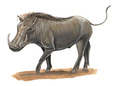
Common warthogs weigh 50 to 150 kg with females being 15 to 20 percent lighter than males. Head and body length is 900 to 1500 mm. Shoulder height ranges from 635 to 850 mm. Common warthogs have large upper tusks that are 255 to 635 mm long in males and 152 to 255 mm long in females. As their name suggests, warthogs have three pairs of facial warts, comprised of cartilaginous connective tissue. The three types of warts are: 1) the suborbital warts, which may grow as long as 15 cm in males; 2) the preorbital warts, which do not develop as much in females; and 3) the submaxillary warts, which have white bristles.
The head is large with a mane that goes down the spine to the middle of the back. There is sparse hair covering the body. Color is usually black or brown. Tails are long and end with a tuft of hair. Common warthogs do not have subcutaneous fat and the coat is sparse, making them suceptible to extreme environmental temperatures.
Common warthogs can be distinguised from Cape warthogs by the number of incisors. Common warthogs have two upper and four to six lower incisors, in contrast to Cape warthogs, which lack incisors. ("African Wildlife Foundation", 2005; "Grzimek's Encyclopedia of Mammals", 1989; "Sea World/Busch Gardens", 2005; "Walker's Mammals of the World", 1991; Randi, et al., 2002)
- Other Physical Features
- endothermic
- bilateral symmetry
- Sexual Dimorphism
- male larger
- ornamentation
-
- Range mass
- 50 to 150 kg
- 110.13 to 330.40 lb
-
- Range length
- 900 to 1500 mm
- 35.43 to 59.06 in
Reproduction
Common warthogs have a polygynandrous mating system. Both males and females have many mates. Males do not defend territories, but when females are in estrus ritualized fighting between males does occur. Fighting involves pushing and striking with the head and blunt upper tusks. The more dangerous lower tusks are rarely used, and injuries or fatalities are rare. Adult males are usually solitary and join female groups briefly for mating. Females attract boars by sight and smell by urinating in a hunched position. ("African Wildlife Foundation", 2005; "Grzimek's Encyclopedia of Mammals", 1989; "Sea World/Busch Gardens", 2005; "Walker's Mammals of the World", 1991; Cumming, 1970; Vercammen and Mason, 1993)
- Mating System
- polygynandrous (promiscuous)
Mating in common warthogs is seasonally dependent. Females usually become fertile 4 to 5 months after the rainy season has ended and give birth during the dry season. Common warthogs are sexually mature at 18 to 20 months, although males do not typically mate until 4 years of age. Common warthogs are recorded to have the longest gestation of all pigs, ranging from 170 to 175 days. Litters range in size from 1 to 7 piglets, with an average of 3 piglets per litter. Piglets are weaned at about 21 weeks of age.
Female P. africanus spend most of their lives in groups called soundings, but prior to giving birth they become solitary. Females give birth in a burrow, which is important in regulating the body temperature of the piglets, since young warthogs can not maintain their own body temperature the first few days of life. Young warthogs spend six to seven weeks in the burrow before venturing out with the mother. Male warthogs do not leave their mother until they are 2 years of age. Female warthogs leave their mother when they are sexually mature, but may return to the sounding later in life. ("African Wildlife Foundation", 2005; "Grzimek's Encyclopedia of Mammals", 1989; "Sea World/Busch Gardens", 2005; "Walker's Mammals of the World", 1991; Cumming, 1970; Vercammen and Mason, 1993)
- Key Reproductive Features
- iteroparous
- seasonal breeding
- gonochoric/gonochoristic/dioecious (sexes separate)
- sexual
- viviparous
-
- Breeding interval
- Common warthogs breed once yearly.
-
- Breeding season
- Common warthogs breed under seasonal climatic conditions associated with rainfall. Mating peaks occur 4 to 5 months after the end of the rains.
-
- Range number of offspring
- 1 to 7
-
- Average number of offspring
- 3
-
- Average number of offspring
- 3
- AnAge
-
- Range gestation period
- 170 to 175 days
-
- Average gestation period
- 172 days
-
- Average weaning age
- 21 weeks
-
- Range time to independence
- 18 to 24 months
-
- Range age at sexual or reproductive maturity (female)
- 18 to 20 months
-
- Range age at sexual or reproductive maturity (male)
- 18 to 20 months
Common warthog sows isolate themselves in burrows to give birth, then stay undergroud with the altricial piglets for the first week. Piglets remain in the den for the first 6 to 7 weeks, and the sow returns often to nurse them. Piglets accompany the mother everywhere after the 6 to 7 weeks in the den. They are weened at about six months. Other sows in the sounding may nurse the young if they are closely related. Offspring may stay within the sounding for up to two years. Males do not play a role in parental care. ("African Wildlife Foundation", 2005; "Grzimek's Encyclopedia of Mammals", 1989; "Sea World/Busch Gardens", 2005; "Walker's Mammals of the World", 1991; Cumming, 1970; Vercammen and Mason, 1993)
- Parental Investment
- altricial
-
pre-fertilization
- provisioning
-
protecting
- female
-
pre-hatching/birth
-
provisioning
- female
-
protecting
- female
-
provisioning
-
pre-weaning/fledging
-
provisioning
- female
-
protecting
- female
-
provisioning
-
pre-independence
-
provisioning
- female
-
protecting
- female
-
provisioning
- post-independence association with parents
- extended period of juvenile learning
Lifespan/Longevity
Researchers in the eastern Selous Game Reserve, Tanzania found the average lifespan of a warthog was 7 to 11 years. Other literature indicates that warthogs may live as long as 18 years.
Infant warthogs are suceptible to both extreme temperatures and predation, which is why the juvenile survival rate is less than 50% in the first year of life. Other common causes of mortality in adult warthogs are predation, human disturbance, hunting, and disease. ("African Wildlife Foundation", 2005; "Sea World/Busch Gardens", 2005; Boshe, 1984)
-
- Range lifespan
Status: wild - 15 to 18 years
- Range lifespan
-
- Typical lifespan
Status: wild - 7 to 11 years
- Typical lifespan
-
- Average lifespan
Status: captivity - 20.9 years
- AnAge
- Average lifespan
Behavior
Common warthogs live in family groups called soundings. A sounding usually consists of females and their young. Males usually disperse after 2 years of age and become solitary or form bachelor groups. Females stay in a sounding except when they are pregnant. Soundings can consist of up to 18 members. Common warthogs are primarily diurnal and take refuge at night in burrows. Warthogs commonly utilize aardvark holes for sleeping at night. They cope with high temperatures by wallowing in mud or water and cope with low temperatures by sheltering in burrows and huddling together. They are primarily diurnal when there is not human disturbance. ("African Wildlife Foundation", 2005; "Grzimek's Encyclopedia of Mammals", 1989; "Walker's Mammals of the World", 1991; Vercammen and Mason, 1993)
-
- Range territory size
- 0.62 to 3.3 km^2
Home Range
Common warthogs do not exhibit territorial behavior. Different groups of warthogs have extensive overlap of home ranges. Warthogs share resting, feeding, drinking, and wallowing sites. Occassionaly warthogs shift their home ranges in response to seasonal water shortages. Home range size of common warthogs can vary from 0.62 km^2 to 3.3 km^2. (Cumming, 1970)
Communication and Perception
Common warthogs have poor eyesight, but their senses of hearing and smell are keen. A common warthogs, when alarmed, run with its tail upright as an alarm for conspecifics. During friendly encounters, common warthogs rub their preorbital glands against each other. Female warthogs use frequent urination to demonstrate their readiness for mating to boars. During fights among conspecifics, the loser typically squeaks and flees and the victor usually leaves the losing individual alone. During fights and mating, warthogs grunt and grind their teeth. ("Grzimek's Encyclopedia of Mammals", 1989; "Walker's Mammals of the World", 1991)
Food Habits
Common warthogs are primarily grazers but also feed on roots, berries, bark of young trees, and occassionaly carrion. They are specialized for grazing short grasses by being able to lower themselves close to the ground on their wrist joints, which are calloused and padded. Common warthogs use their snouts and tusks to excavate rhizomes and bulbs. Rhizomes and bulbs may also provide water for common warthogs during periods of drought. Common warthogs eat their own dung and the dung of rhinoceroses, African buffalos, waterbucks, and francolins. ("African Wildlife Foundation", 2005; "Grzimek's Encyclopedia of Mammals", 1989; "Sea World/Busch Gardens", 2005; "Walker's Mammals of the World", 1991; Cumming, 1970)
- Primary Diet
- omnivore
- Animal Foods
- carrion
- Plant Foods
- leaves
- roots and tubers
- wood, bark, or stems
- seeds, grains, and nuts
- fruit
- Other Foods
- dung
Predation
The predominant predators of common warthogs are lions. Common warthogs avoid nocturnal predators by being active during the day and sheltering in burrows at night. They also use the warning calls of red-billed and yellow-billed oxpeckers to avoid predators. They are fast runners and usually avoid attack by fleeing. Common warthogs change their activity patterns to avoid humans. In areas with human disturbance, warthogs often become more active nocturnaly. ("Grzimek's Encyclopedia of Mammals", 1989; Vercammen and Mason, 1993)
-
- Known Predators
-
- lions (Panthera leo)
- leopards (Panthera pardus)
- cheetah (Acinonyx jubatus)
Ecosystem Roles
Common warthogs have a mutualistic relationship with birds, such as red-billed and yellow-billed oxpeckers. The birds are able to feed on the parasites carried by common warthogs while the warthogs are able to rid themselves of these pests. It is thought that the rooting of the common warthog aids in plant growth by aerating the soil. They are also prey to lions and leopards. ("Sea World/Busch Gardens", 2005; Anderson, et al., 1998; Vercammen and Mason, 1993)
- Ecosystem Impact
- soil aeration
- N/A
- Red-billed oxpeckers, Yellow-billed oxpeckers
- tsetse fly and ticks
Economic Importance for Humans: Positive
Common warthogs are valued for their meat, both for local consumption and trade in cities. Common warthogs are easy to hunt and have a potential of increasing population size by 39% annually, which makes them popular on game ranches. Rooting by common warthogs may also help to churn up soil and aerate the land, which in turn aids in plant growth. They are also a source of food for birds, such as red-billed and yellow-billed oxpeckers, that eat parasites off of their bodies. ("Sea World/Busch Gardens", 2005; Vercammen and Mason, 1993)
- Positive Impacts
- food
- body parts are source of valuable material
Economic Importance for Humans: Negative
Common warthogs are known to cause damage to various crops, such as rice-fields and peanut crops. Cattle ranchers also see common warthogs as competitors for grazing in southern Africa. Common warthogs are suceptible to diseases which may be transmitted to domestic pigs, such as the tick-borne African swine fever virus. They also are a host of the tsetse fly, which can cause African sleeping sickness in humans. (Anderson, et al., 1998; Vercammen and Mason, 1993)
- Negative Impacts
-
injures humans
- carries human disease
- crop pest
- causes or carries domestic animal disease
Conservation Status
Currently common warthogs are not a protected species, but many populations are in serious decline due to overhunting in unprotected areas. Wildlife reserves are trying to protect warthogs, but outside of these areas there are no regulations on hunting. Several zoos have tried captive breeding with very little success. (Vercammen and Mason, 1993)
-
- IUCN Red List
-
Least Concern
More information
-
- IUCN Red List
-
Least Concern
More information
-
- US Federal List
- No special status
-
- CITES
- No special status
Contributors
Eileen Creel (author), Humboldt State University, Brian Arbogast (editor, instructor), Humboldt State University.
Nancy Shefferly (editor), Animal Diversity Web.
Glossary
- Ethiopian
-
living in sub-Saharan Africa (south of 30 degrees north) and Madagascar.

- acoustic
-
uses sound to communicate
- agricultural
-
living in landscapes dominated by human agriculture.
- altricial
-
young are born in a relatively underdeveloped state; they are unable to feed or care for themselves or locomote independently for a period of time after birth/hatching. In birds, naked and helpless after hatching.
- bilateral symmetry
-
having body symmetry such that the animal can be divided in one plane into two mirror-image halves. Animals with bilateral symmetry have dorsal and ventral sides, as well as anterior and posterior ends. Synapomorphy of the Bilateria.
- carrion
-
flesh of dead animals.
- causes or carries domestic animal disease
-
either directly causes, or indirectly transmits, a disease to a domestic animal
- chemical
-
uses smells or other chemicals to communicate
- diurnal
-
- active during the day, 2. lasting for one day.
- endothermic
-
animals that use metabolically generated heat to regulate body temperature independently of ambient temperature. Endothermy is a synapomorphy of the Mammalia, although it may have arisen in a (now extinct) synapsid ancestor; the fossil record does not distinguish these possibilities. Convergent in birds.
- food
-
A substance that provides both nutrients and energy to a living thing.
- iteroparous
-
offspring are produced in more than one group (litters, clutches, etc.) and across multiple seasons (or other periods hospitable to reproduction). Iteroparous animals must, by definition, survive over multiple seasons (or periodic condition changes).
- migratory
-
makes seasonal movements between breeding and wintering grounds
- motile
-
having the capacity to move from one place to another.
- native range
-
the area in which the animal is naturally found, the region in which it is endemic.
- omnivore
-
an animal that mainly eats all kinds of things, including plants and animals
- polygynandrous
-
the kind of polygamy in which a female pairs with several males, each of which also pairs with several different females.
- seasonal breeding
-
breeding is confined to a particular season
- sexual
-
reproduction that includes combining the genetic contribution of two individuals, a male and a female
- sexual ornamentation
-
one of the sexes (usually males) has special physical structures used in courting the other sex or fighting the same sex. For example: antlers, elongated tails, special spurs.
- social
-
associates with others of its species; forms social groups.
- soil aeration
-
digs and breaks up soil so air and water can get in
- tactile
-
uses touch to communicate
- terrestrial
-
Living on the ground.
- tropical
-
the region of the earth that surrounds the equator, from 23.5 degrees north to 23.5 degrees south.
- tropical savanna and grassland
-
A terrestrial biome. Savannas are grasslands with scattered individual trees that do not form a closed canopy. Extensive savannas are found in parts of subtropical and tropical Africa and South America, and in Australia.
- savanna
-
A grassland with scattered trees or scattered clumps of trees, a type of community intermediate between grassland and forest. See also Tropical savanna and grassland biome.
- temperate grassland
-
A terrestrial biome found in temperate latitudes (>23.5° N or S latitude). Vegetation is made up mostly of grasses, the height and species diversity of which depend largely on the amount of moisture available. Fire and grazing are important in the long-term maintenance of grasslands.
- visual
-
uses sight to communicate
- viviparous
-
reproduction in which fertilization and development take place within the female body and the developing embryo derives nourishment from the female.
References
2005. "African Wildlife Foundation" (On-line). Accessed March 11, 2005 at http://www.awf.org/wildlives/153.
1989. Grzimek's Encyclopedia of Mammals. Pp. 40-44 in S Parker, ed. Grzimek's Encyclopedia of Mammals, Vol. 5, 1 Edition. New York: McGraw-Hill.
2005. "Sea World/Busch Gardens" (On-line). Animal Bytes. Accessed March 11, 2005 at http://www.seaworld.org/AnimalBytes/warthogab.html.
1991. Walker's Mammals of the World. Pp. 1060-1062 in R Nowak, ed. Walker's Mammals of the World, Vol. 2, 1 Edition. Baltimore: John Hopkins University Press.
Anderson, E., G. Hutchings, N. Mukarati, P. Wilkinson. 1998. African swine fever virus infection of the bushpig (Potamochoerus porcus) and its significance in the epidemiology of the disease. Veterinary Microbiology, 62: 1-15.
Boshe, J. 1984. Demographic characteristics of the warthog population of the eastern Selous Game Reserve, Tanzania. African Journal of Ecology, 22: 43-47.
Cumming, D. 1970. A contribution to the biology of warthog (Phacochoerus africanus) in the Sengwa region of Rhodesia. Grahamstown: Rhodes University.
Grubb, P. 1993. Wart hog. Pp. 377 in D Wilson, D Reeder, eds. Mammal Species of the World, Vol. 1, 2 Edition. Washington and London: Smithsonian Institution Press.
Randi, E., J. D'Huart, V. Lucchini, R. Aman. 2002. Evidence of two genetically deeply divergent species of warthog, Phacochoerus africanus and Phacochoerus aethiopicus in East Africa. Mammalian Biology, 67: 91-96.
Somers, M. 1997. The sustainability of harvesting a warthog population: assessment of management options using simulation modelling. South African Journal of Wildlife Research, 27/2: 37-44.
Vercammen, P., D. Mason. 1993. The warthogs. Status Survey and Conservation Action Plan, 1: 1-11.