Petrogale concinnapygmy rock wallaby
Geographic Range
Petrogale concinna is found in two, disjunct areas of Australia: the Northern Territory of Australia, including the neighboring islands of Borda, Augustus, Long, and Hidden, and northwestern Kimberly area in western Australia. These populations have generally been considered subspecies: Petrogale concinna canescens and Petrogale concinna monastria. (Churchill, 1997; Woinarski, et al., 2008)
- Biogeographic Regions
- australian
Habitat
Petrogale concinna is restricted to the sandstone or granite rocky hills, cliffs and gorges of northern Australia. (Churchill, 1997; "Elevations", 2004; Menkhorst and Knight, 2004)
- Habitat Regions
- tropical
- Terrestrial Biomes
- savanna or grassland
-
- Range elevation
- 300 to 600 m
- 984.25 to 1968.50 ft
Physical Description
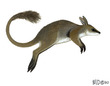
Petrogale concinna has dull, reddish colored fur with light grey and black marbling. The belly is greyish-white. The tip of tail is black and bushy. The fur is short with a soft, silky texture. The soles of the feet are thickly padded and granulated in order to grip rock; these animals use skin friction rather than large claws to climb. Body size varies among individuals. Head and body length can range from 310-365 mm; the tail can range 260-335mm; hind feet can be 95-105 mm; ear length can be 41-45 mm; and weight can range from 1200-1600g g. (Menkhorst and Knight, 2004; Nowak, 1991; Taylor, 1984)
The teeth of Petrogale concinna are unique among marsupials. Throughout life, the molars of P. concinna continually erupt. The old molars are pushed forward until they eventually fall out in the front of the mouth. The actual number of molars is unknown. As many as nine molars can successively erupt, but there are seldom more than five molars in place at any time. Researchers believe this phenomenon could be an adaptation to the ferns that they eat, because fern tissue is extremely abrasive. (Nowak, 1991; Taylor, 1984)
As Petrogale concinna runs, it carries its body horizontally with its tail arched high over its back.
- Other Physical Features
- endothermic
- homoiothermic
- bilateral symmetry
- Sexual Dimorphism
- sexes alike
-
- Range mass
- 1200 to 1600 g
- 42.29 to 56.39 oz
-
- Range length
- 310 to 365 mm
- 12.20 to 14.37 in
Reproduction
Little is known about this species in the wild. Captive Petrogale concinna females are known to attack males after mating by kicking and bites to the back of head and neck. If the male was not removed, he would be killed. (Nelson and Goldstone, 1986)
Captive Petrogale concinna breed throughout the year, and post-partum estrus and embryonic diapause occur. The estrous cycle lasts from an average of 31-36 days. Dominant females posess a shorter estrous cycle than subordinant females. Females have one offspring per litter and gestation lasts roughly thirty days. The time to weaning in P. concinna is much shorter than that of the other species in its genus. After 160 days outside of the pouch, the joey is completely weaned and, in 175 days, it is independent. (Nelson and Goldstone, 1986)
- Key Reproductive Features
- iteroparous
- year-round breeding
- gonochoric/gonochoristic/dioecious (sexes separate)
- sexual
- viviparous
- embryonic diapause
- post-partum estrous
-
- Breeding season
- Breeding occurs continually throughout the year.
-
- Average number of offspring
- 1
-
- Average number of offspring
- 1
- AnAge
-
- Average gestation period
- 30 days
-
- Average gestation period
- 30 days
- AnAge
-
- Average weaning age
- 160 days
-
- Average time to independence
- 175 days
-
- Average age at sexual or reproductive maturity (female)
- 2 years
-
- Average age at sexual or reproductive maturity (female)
Sex: female - 430 days
- AnAge
- Average age at sexual or reproductive maturity (female)
-
- Average age at sexual or reproductive maturity (male)
- 2 years
Females nurse and care for their young until they reach independence. Once the young are weaned, mothers do not tolerate their continued presence. Females drive off young when they attempts to suckle. They may bite at the tail of the young, occasionally causing the tail to become lost due to irritation caused by bites. (Nelson and Goldstone, 1986)
- Parental Investment
- altricial
-
pre-fertilization
- provisioning
-
protecting
- female
-
pre-hatching/birth
-
provisioning
- female
-
protecting
- female
-
provisioning
-
pre-weaning/fledging
-
provisioning
- female
-
protecting
- female
-
provisioning
Lifespan/Longevity
The maximum known lifespan of Petrogale concinna is 17 years. ("Sheet 1", 2006)
-
- Average lifespan
Status: captivity - 11.7 years
- AnAge
- Average lifespan
Behavior
Petrogale concinna is mostly nocturnal and timid. Members of this species occasionally like to bask in the morning. They are also gregarious, living in groups. (Nowak, 1991; Taylor, 1984)
- Key Behaviors
- terricolous
- saltatorial
- nocturnal
- motile
- sedentary
- territorial
Home Range
The home range is not known, however a territory is occassionally shared with Petrogale brachyotis (a rock wallaby similar to Petrogale concinna). (Menkhorst and Knight, 2004)
Communication and Perception
Marsupials are rarely vocal. When they are used, vocalizations play a role primarily in mating, territorial, and mother to young encounters. Captive Petrogale concinna displayed vocalization during adult female encounters. Using vocalization establishes dominance among females. Vocalization was nearly always given by the defending animal, with each call appearing to have different functional significances. Threat calls are screams, given in response to an attack; sneezes are given at intermediate distances in response to movements of the opponent; coughs are threat calls given in response to an approach; barks are hesitant calls that are generally given at long distances. (Aitkin, 1998; Goldstone and Nelson, 1986)
Food Habits
Petrogale concinna does not stray far from the safety of its rock shelter, except that at night it may travel far distances to feed on grasses, sedges and ferns. During the dry season this species relies on a fern Marsilea crenata, feeding primarily on grasses during the wet season. (Hume, 1999; Menkhorst and Knight, 2004; Nowak, 1991)
Unlike most macropodids, adult P. concinna lack a specialized structure called a gastric sulcus. This structure is found in most herbivores that have modified stomachs for microbial fermentation of food, and facilitates movement of liquid digesta. Captive P. concinna were seen frequently regurgitating food. According to Goldstone and Nelson “this behavior is not analogous to rumination in ruminants and has been termed mercyism”. (Goldstone and Nelson, 1986; Hume, 1999)
- Plant Foods
- leaves
- roots and tubers
Predation
Current threats to P. concinna include habitat change by altered fire regimes and possible attacks by feral cats. (Maxwell, et al., 1996)
-
- Known Predators
-
- humans (Homo sapiens)
- dingos (Canis lupus dingo)
Ecosystem Roles
Members of this species are herbivores. They may play a role in determining the structure of plant communities.
- Ecosystem Impact
- disperses seeds
Economic Importance for Humans: Positive
Little is known about Petrogale concinna.
- Positive Impacts
- research and education
Economic Importance for Humans: Negative
No known negative economic importance.
Conservation Status
Although Petrogale concinna is not listed as being threatened it is found on two of Australia's conservation reserves; Kakadu and Litchfield National Parks. (Churchill, 1997)
-
- IUCN Red List
-
Data Deficient
More information
-
- IUCN Red List
-
Data Deficient
More information
-
- US Federal List
- No special status
-
- CITES
- No special status
-
- State of Michigan List
- No special status
Other Comments
There are fifteen known species of rock wallabies including P. concinna. Petrogale concinna has a variety of names such as the Nabarlek and little pigmy rock wallaby. It was discovered in 1842 by a gentleman by the name of Gould. (Menkhorst and Knight, 2004; Nowak, 1991)
Contributors
Tanya Dewey (editor), Animal Diversity Web.
Cassandra Dunham (author), University of Michigan-Ann Arbor, Phil Myers (editor, instructor), Museum of Zoology, University of Michigan-Ann Arbor.
Glossary
- Australian
-
Living in Australia, New Zealand, Tasmania, New Guinea and associated islands.

- acoustic
-
uses sound to communicate
- altricial
-
young are born in a relatively underdeveloped state; they are unable to feed or care for themselves or locomote independently for a period of time after birth/hatching. In birds, naked and helpless after hatching.
- bilateral symmetry
-
having body symmetry such that the animal can be divided in one plane into two mirror-image halves. Animals with bilateral symmetry have dorsal and ventral sides, as well as anterior and posterior ends. Synapomorphy of the Bilateria.
- chemical
-
uses smells or other chemicals to communicate
- embryonic diapause
-
At about the time a female gives birth (e.g. in most kangaroo species), she also becomes receptive and mates. Embryos produced at this mating develop only as far as a hollow ball of cells (the blastocyst) and then become quiescent, entering a state of suspended animation or embryonic diapause. The hormonal signal (prolactin) which blocks further development of the blastocyst is produced in response to the sucking stimulus from the young in the pouch. When sucking decreases as the young begins to eat other food and to leave the pouch, or if the young is lost from the pouch, the quiescent blastocyst resumes development, the embryo is born, and the cycle begins again. (Macdonald 1984)
- endothermic
-
animals that use metabolically generated heat to regulate body temperature independently of ambient temperature. Endothermy is a synapomorphy of the Mammalia, although it may have arisen in a (now extinct) synapsid ancestor; the fossil record does not distinguish these possibilities. Convergent in birds.
- folivore
-
an animal that mainly eats leaves.
- herbivore
-
An animal that eats mainly plants or parts of plants.
- iteroparous
-
offspring are produced in more than one group (litters, clutches, etc.) and across multiple seasons (or other periods hospitable to reproduction). Iteroparous animals must, by definition, survive over multiple seasons (or periodic condition changes).
- motile
-
having the capacity to move from one place to another.
- native range
-
the area in which the animal is naturally found, the region in which it is endemic.
- nocturnal
-
active during the night
- saltatorial
-
specialized for leaping or bounding locomotion; jumps or hops.
- sedentary
-
remains in the same area
- sexual
-
reproduction that includes combining the genetic contribution of two individuals, a male and a female
- tactile
-
uses touch to communicate
- territorial
-
defends an area within the home range, occupied by a single animals or group of animals of the same species and held through overt defense, display, or advertisement
- tropical
-
the region of the earth that surrounds the equator, from 23.5 degrees north to 23.5 degrees south.
- tropical savanna and grassland
-
A terrestrial biome. Savannas are grasslands with scattered individual trees that do not form a closed canopy. Extensive savannas are found in parts of subtropical and tropical Africa and South America, and in Australia.
- savanna
-
A grassland with scattered trees or scattered clumps of trees, a type of community intermediate between grassland and forest. See also Tropical savanna and grassland biome.
- temperate grassland
-
A terrestrial biome found in temperate latitudes (>23.5° N or S latitude). Vegetation is made up mostly of grasses, the height and species diversity of which depend largely on the amount of moisture available. Fire and grazing are important in the long-term maintenance of grasslands.
- visual
-
uses sight to communicate
- viviparous
-
reproduction in which fertilization and development take place within the female body and the developing embryo derives nourishment from the female.
- year-round breeding
-
breeding takes place throughout the year
References
Commonwealth of Australia. 2004. "Elevations" (On-line). Australian Government. Accessed April 17, 2006 at http://www.ga.gov.au/education/facts/landforms/elevatio.htm#Elevation%20Map.
Ohio University. 2006. "Sheet 1" (On-line). Accessed April 17, 2006 at http://oak.cats.ohiou.edu/~milesd/marsupial_lh.xls.
Aitkin, L. 1998. Hearing- The Brain and Auditory Communication in Marsupials. New York: Springer.
Churchill, 1997. Habitat use, distribution and conservation status of the Nabarlek Petrogale concinna, and sympatric rock-dwelling mammals in the Northern Territory. Australian Mammalogy, 19: 297-308.
Goldstone, A., J. Nelson. 1986. Aggressive Behaviour in Two Female Peradorcas concinna (Macropodidae) and its relation to Ostrus. Australian Wildlife Res., 13: 375-85.
Hume, I. 1999. Marsupial Nutrition. United Kingdom: Cambridge University Press.
Maxwell, S., A. Burbidge, K. Morris. 1996. "Action Plan for Australian Marsupials and Monotremes" (On-line). Australian Government; Department of the Environment and Heritage. Accessed April 18, 2006 at http://www.deh.gov.au/biodiversity/threatened/action/marsupials/27.html.
Menkhorst, P., F. Knight. 2004. A Field Guide to the Mammals of Australia. Melbourne: Oxford University Press.
Nelson, J., A. Goldstone. 1986. Reproduction in Peradorcas concinna Marsupialia: Macropodidae. Austrailian Wildlife Research, 13: 501-505.
Nowak, R. 1991. Walker's Mammals of the World. Baltimore & London: The John Hopkins University Press.
Taylor, M. 1984. Mammals of Australia. Melbourne: Oxford University Press.
Woinarski, J., A. Burbidge, W. Telfer, N. McKenzie, T. Start. 2008. "Petrogale concinna" (On-line).
IUCN Red List of Threatened Species. Version 2013.2. Accessed December 05, 2013 at http://www.iucnredlist.org/details/16761/0.