Petauroides volansgreater glider
Geographic Range
Greater gliders are found along the eastern coast of the Australian mainland, from eastern Queensland to southern Victoria (Nowak, 1999; Troughton, 1966).
- Biogeographic Regions
- australian
Habitat
Greater gliders are generally restricted to fairly expansive tall eucalyptus forests, and are never found in the rainforest (Grzimek, 1990). Patches of old growth must be at least 20 ha to sustain a population (Possingham, et al. 1994). Greater gliders are associated with high basal areas of over-story, and they need large patch sizes of old-growth forest. They are most often found in sites containing many trees with hollows. A single glider may use 4-18 den sites (Incoll et al., 2001; Lindenmayer et al., 1993).
- Habitat Regions
- temperate
- Terrestrial Biomes
- forest
Physical Description
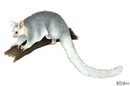
Greater gliders are the largest of the gliding possums. Females have a well-developed pouch and two mammae. P. volans are about the size of a domestic cat, weighing 1-1.5 kg as adults. The head and body length is 300-480 mm and the tail is 450-550 mm long (Nowak, 1999). These marsupials have a short snout and large round ears covered by thick fur (Strahan, 1995). The patagium, which is also covered with fur, extends from the knee to the elbow, (unlike the Petauridae, in which it extends from the ankle to the wrist), giving the glider a triangular shape when in the air (Berra, 1998). The long, furred tail, which is not prehensile, is used as a rudder (Grzimek, 1972). Color varies more than that of any other marsupial. The very long, dense fur is typically brownish-black, but can range from pure black with a creamy underside, to dusky browns and grays, cinnamon, red, yellow, and completely white (Grzimek, 1972; Troughton,1966).
- Other Physical Features
- endothermic
- bilateral symmetry
-
- Range mass
- 1 to 1.5 kg
- 2.20 to 3.30 lb
-
- Range length
- 300 to 480 mm
- 11.81 to 18.90 in
-
- Average basal metabolic rate
- 3.191 W
- AnAge
Reproduction
Males and females will normally share a den from the onset of breeding until the young emerge from the pouch (Strahan, 1995). Some males are monogamous while others are bigamous, although there is no paternal care given to the young (Nowak, 1999).
- Mating System
- monogamous
- polygynous
Breeding season begins in March, and a single young is born between April and June. The offspring rides in the mother’s pouch until September, suckling on one of the two teats, then rides on the mother’s back until November or December. In January it reaches the age of independence. Sexually maturity is reached at two years of age. Until weaning, approximately half of the offspring produced are male. After the weaning period, the proportion of the population that is male drops precipitously to 39% (Hand, 1990; Tyndale-Biscoe and Smith, 1969).
- Key Reproductive Features
- iteroparous
- seasonal breeding
- gonochoric/gonochoristic/dioecious (sexes separate)
- sexual
- fertilization
- viviparous
-
- Breeding season
- Breeding begins in March, and the young is born between April and June.
-
- Range number of offspring
- 1 (high)
-
- Average number of offspring
- 1
- AnAge
-
- Average age at sexual or reproductive maturity (female)
- 2 years
-
- Average age at sexual or reproductive maturity (female)
Sex: female - 639 days
- AnAge
- Average age at sexual or reproductive maturity (female)
-
- Average age at sexual or reproductive maturity (male)
- 2 years
-
- Average age at sexual or reproductive maturity (male)
Sex: male - 639 days
- AnAge
- Average age at sexual or reproductive maturity (male)
As in all marsupials, the young are born highly altricial in most respects. Development must be completed in the mother's pouch, rather than in the uterus, as it is in placental mammals. The single offspring is nursed in the pouch until September, when the young glider emerges at 150 g to ride on its mother’s back. In November-December, when about 300 g, the young leaves its mother’s back and becomes more independent. In January, at about 600 g, the young is able to live independently. (Tyndale-Biscoe and Smith, 1969).
- Parental Investment
- altricial
- female parental care
Lifespan/Longevity
Longevity may be up to 15 years in the wild (Nowak, 1999).
-
- Range lifespan
Status: wild - 15 (high) years
- Range lifespan
-
- Average lifespan
Status: captivity - 15.0 years
- Max Planck Institute for Demographic Research
- Average lifespan
-
- Average lifespan
Status: wild - 6.0 years
- Max Planck Institute for Demographic Research
- Average lifespan
Behavior
Gliders are solitary arboreal animals, with a home range of 1-2.2 ha. Home ranges of females overlap, whereas males maintain separate territories (Incoll et al., 2001). They nest in hollows high up in both living and dead trees. The hollows are occasionally lined with strips of bark or layers of leaves (Troughton, 1966). P. volans may transport nesting material rolled-up in their tails (Nowak, 1999).
Greater gliders are clumsy and slow on the ground, but they are at home in the trees and in the air. During gliding, they bend their forearms, with the hands almost meeting in front of the chest (Grzimek, 1972; Nowak, 1999). They use their long, furred tail as a rudder (Troughton, 1966).
Greater gliders use their patagium as a blanket to reduce heat loss by wrapping it around themselves. On hot days, they will lick their fur to lose heat through evaporation (Grzimek, 1990).
- Key Behaviors
- nocturnal
- motile
- sedentary
- solitary
- territorial
Communication and Perception
Food Habits
Greater gliders are folivores, feeding almost entirely on eucalyptus leaves that they break down with bacterial fermentation in an enlarged cecum (Berra, 1998; Lindenmayer et al., 1999; Possingham et al., 1994). This specialized diet means they are very difficult to keep in zoos (Grzimek, 1990). Greater gliders rarely need to drink (Strahan, 1995).
- Plant Foods
- leaves
Predation
Owls may represent the largest threat to gliders. Powerful owls and sooty owls both prey upon them. Dingos and introduced foxes also take P. volans. Because they are gliders, it is likely that they can escape predators by "flying" away.
-
- Known Predators
-
- powerful owls (Ninox strenua)
- sooty owls (Tyto tenebricosa)
- dingos (Canis lupus dingo)
- red foxes (Vulpes vulpes)
Ecosystem Roles
The role of these gliders in the ecosystem has not been evaluated. However, they do eat eucalyptus leaves, maing the energy stored in those leaves available to their predators.
Economic Importance for Humans: Positive
Although the fur is long and thick, it is rather loose and soft which makes it difficult to work with. Luckily for greater gliders, fur traders rarely wanted their skins (Strahan,1995).
Economic Importance for Humans: Negative
Since greater gliders require large patches of old growth habitat (Possingham et al., 1994), their needs can conflict with those of humans who wish to cut the trees for timber.
Conservation Status
Although widespread and abundant in some areas, greater gliders are very sensitive to clear-cuts and fragmentation of their old-growth habitat. Their conservation is entirely dependent upon the responsible management of the old growth forests in which they live (Kavanaugh and Bamkin, 1995; Strahan, 1995). Tyndale-Biscoe and Smith (1969) showed that over 90% of gliders displaced by a clear-cut die rather than establish a new territory in suitable habitat nearby. Greater gliders may have difficulty migrating through unfavorable habitat for several reasons. They are specialist feeders, and only eat the leaves of some eucalyptus trees. They only carry limited quantities of body fat, and are likely to undergo rapid changes in body condition under adverse conditions, such as with dispersal. They are also very clumsy on the ground, and so have difficulty in crossing open tree-less areas (Lindenmayer et al., 1999).
-
- IUCN Red List
-
Least Concern
More information
-
- IUCN Red List
-
Least Concern
More information
-
- CITES
- No special status
Other Comments
Greater gliders were previously classified as Schoinobates volans until 1982, when the generic name was changed to Petauroides (Nowak,1999).
Contributors
Juliet Nagel (author), University of Wisconsin-Stevens Point, Chris Yahnke (editor), University of Wisconsin-Stevens Point.
Glossary
- Australian
-
Living in Australia, New Zealand, Tasmania, New Guinea and associated islands.

- altricial
-
young are born in a relatively underdeveloped state; they are unable to feed or care for themselves or locomote independently for a period of time after birth/hatching. In birds, naked and helpless after hatching.
- bilateral symmetry
-
having body symmetry such that the animal can be divided in one plane into two mirror-image halves. Animals with bilateral symmetry have dorsal and ventral sides, as well as anterior and posterior ends. Synapomorphy of the Bilateria.
- chemical
-
uses smells or other chemicals to communicate
- endothermic
-
animals that use metabolically generated heat to regulate body temperature independently of ambient temperature. Endothermy is a synapomorphy of the Mammalia, although it may have arisen in a (now extinct) synapsid ancestor; the fossil record does not distinguish these possibilities. Convergent in birds.
- female parental care
-
parental care is carried out by females
- fertilization
-
union of egg and spermatozoan
- folivore
-
an animal that mainly eats leaves.
- forest
-
forest biomes are dominated by trees, otherwise forest biomes can vary widely in amount of precipitation and seasonality.
- herbivore
-
An animal that eats mainly plants or parts of plants.
- internal fertilization
-
fertilization takes place within the female's body
- iteroparous
-
offspring are produced in more than one group (litters, clutches, etc.) and across multiple seasons (or other periods hospitable to reproduction). Iteroparous animals must, by definition, survive over multiple seasons (or periodic condition changes).
- monogamous
-
Having one mate at a time.
- motile
-
having the capacity to move from one place to another.
- native range
-
the area in which the animal is naturally found, the region in which it is endemic.
- nocturnal
-
active during the night
- polygynous
-
having more than one female as a mate at one time
- seasonal breeding
-
breeding is confined to a particular season
- sedentary
-
remains in the same area
- sexual
-
reproduction that includes combining the genetic contribution of two individuals, a male and a female
- solitary
-
lives alone
- tactile
-
uses touch to communicate
- temperate
-
that region of the Earth between 23.5 degrees North and 60 degrees North (between the Tropic of Cancer and the Arctic Circle) and between 23.5 degrees South and 60 degrees South (between the Tropic of Capricorn and the Antarctic Circle).
- territorial
-
defends an area within the home range, occupied by a single animals or group of animals of the same species and held through overt defense, display, or advertisement
- viviparous
-
reproduction in which fertilization and development take place within the female body and the developing embryo derives nourishment from the female.
References
Berra, T. 1998. A natural history of Australia. San Diego, CA: Academic Press.
Grzimek, B. 1990. Grzimek’s Encyclopedia of Mammals: Volume 1. New York: McGraw-Hill Publishing Company.
Hand, S. 1990. Care and handling of Australian Native Animals: Emergency care and captive management. Chipping Norton, New South Wales: Surrey Beatty and Sons Pty Unlimited.
Incoll, R., R. Loyn, S. Ward, R. Cunningham, C. Donnelly. 2001. The occurrence of gliding possums in old-growth forest patches of mountain ash (*Eucalyptus regnans*) in the Central Highlands of Victoria. Biological Conservation, 98(1): 77-88.
Kavanaugh, R., K. Bamkin. 1995. Distribution of nocturnal forest birds and mammals in relation to the logging mosaic in southeastern New South Wales, Australia. Biological Conservation, 71(1): 41-53.
Lindenmayer, D., R. Cunningham, C. Donnelly. 1993. The conservation of arboreal marsupials in the Montane Ash forests of the Central Highlands of Victoria, southeast Australia, IV. The presences and abundance of arboreal marsupials in retained linear habitats (wildlife corridors) within logged forest. Biological Conservation, 66(3): 207-221.
Lindenmayer, D., R. Cunningham, M. Pope, C. Donnelly. 1999. The response of arboreal marsupials to landscape context: a large-scale fragmentation study. Ecological Applications, 9(2): 594-611.
Nowak, R. 1999. Walker’s Mammals of the World, Sixth edition. Volume 1. Baltimore and London: The Johns Hopkins University Press.
Possingham, H., D. Lindenmayer, T. Norton, I. Davis. 1994. Metapopulation viability analysis of the greater glider *Petauroides volans* in a wood production area. Biological Conservation, 70(3): 227-236.
Strahan, R. 1995. Mammals of Australia. Washington, D. C.: Smithsonian Institution Press.
Troughton, E. 1966. Furred animals of Australia. Narbeth, Pennsylvania: Livingston Publishing Company.
Tyndale Biscoe, , R. Smith. 1969. Studies on the marsupial glider, Schoinobates volans (Kerr). Journal of Animal Ecology, 38: 637-649.