Petauridaegliders, Leadbeater's possum, and striped possums

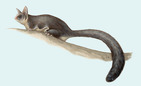
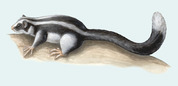


The petaurids include the striped possum, Leadbeater's possum, and wrist-winged gliders. All told there are 10 species currently recognized, placed in 3 genera. Petaurids are found in forested areas of Australia and New Guinea.
These small to medium-sized marsupials all have a dark dorsal stripe that runs from the rump to the head. Their tail is long, very furry, and prehensile. Many species have a well-developed gliding membrane that extends from the wrists to the ankles. Other species, however, lack this membrane or have only a vestige of it. Like other members of the order Diprotodontia, petuarids are syndactylous and diprotodont. Digits 1 and 2 on the forefeet are opposable to digits 3-5, and the hindfoot has a well-developed hallux.


Petaurids have long, sharp, and procumbent (outwardly projecting) lower incisors. Their molars are low-crowned ( bunodont) and have smooth cusps. The dental formula is 3/2, 1/0, 3/3, 4/4 = 40. The cranium has strongly developed zygomatic arches.


Members of this family have a well-developed pouch, which opens anteriorly.
Petaurids feed on insects and on the sap and gum of eucalypts and acacias. They obtain sap by making wounds in tree bark with incisors. One group, the dactylopsilines, have a remarkably long fourth digit on their forefeet. They forage by thumping on branches with their hands, then listening for the movement of insects inside. They open a hole with their rodent-like incisors and extract their prey with their elongated fourth finger and long tongue -- a manner of foraging very much like the primates, aye-ayes.
Literature and references cited
Feldhamer, G. A., L. C. Drickamer, S. H. Vessey, and J. F. Merritt. 1999. Mammalogy. Adaptation, Diversity, and Ecology. WCB McGraw-Hill, Boston. xii+563pp.
Marshall, L. G. 1984. Monotremes and marsupials. Pp 59-115 in Anderson, S. and J. Knox Jones, eds, Orders and Families of Recent Mammals of the World. John Wiley and Sons, NY. xii+686 pp.
Strahan, R. (ed.). 1995. Mammals of Australia. Smithsonian Institution Press, Washington, D.C. 756 pp.
Vaughan, T. A. 1986. Mammalogy. Third Edition. Saunders College Publishing, Fort Worth. vi+576 pp.
Vaughan, T. A., J. M. Ryan, N. J. Czaplewski. 2000. Mammalogy. Fourth Edition. Saunders College Publishing, Philadelphia. vii+565pp
Wilson, D. E., and D. M. Reeder. 1993. Mammal Species of the World, A Taxonomic and Geographic Reference. 2nd edition. Smithsonian Institution Press, Washington. xviii+1206 pp.
Contributors
Phil Myers (author), Museum of Zoology, University of Michigan-Ann Arbor.
Glossary
- bilateral symmetry
-
having body symmetry such that the animal can be divided in one plane into two mirror-image halves. Animals with bilateral symmetry have dorsal and ventral sides, as well as anterior and posterior ends. Synapomorphy of the Bilateria.
- chemical
-
uses smells or other chemicals to communicate
- endothermic
-
animals that use metabolically generated heat to regulate body temperature independently of ambient temperature. Endothermy is a synapomorphy of the Mammalia, although it may have arisen in a (now extinct) synapsid ancestor; the fossil record does not distinguish these possibilities. Convergent in birds.
- motile
-
having the capacity to move from one place to another.
- sexual
-
reproduction that includes combining the genetic contribution of two individuals, a male and a female
- tactile
-
uses touch to communicate