Pecari tajacucollared peccary

Geographic Range
Collared peccaries (Pecari tacaju) are native to Nearctic and Neotropical regions, in North, Central, and South America. In North America, they are found as far north as the southern parts of Arizona, New Mexico, and Texas. They are absent from central Mexico, between the border with the United States and the Mexican state of Guanajuato. However, they are found along both coasts of Mexico and throughout the entirety of southern Mexico, south of the state of the Guanajuato. Their range extends south throughout all of Central America. In South America, they are found east of the Andes Mountains, up to the Atlantic coast, and as far south as northern Argentina and the southern border of Brazil. Collared peccaries can also be found in the country of Trinidad and Tobago and have been introduced to the Caribbean. (Bissonette, 1982; Gongora, et al., 2011; Marinho, et al., 2019; Oliver, 1993)
- Biogeographic Regions
- nearctic
- neotropical
Habitat
Collared peccaries live in a variety of subtropical and tropical areas such as rainforests and woodlands, as well as arid or semi-arid areas, such as deserts and grasslands. Collared peccaries can be found at elevations of 0 to 3,000 m above sea level.
In the United States, collared peccaries live in areas where an abundance of food sources, such as prickly pears (genus g.Opuntia). Collared peccaries can be found in semi-arid deserts, pasturelands, plantations, and rocky canyons around caverns. They often gather in small groups to sleep in cool locations such as burrows, caves, bases of large trees, and under houses. (Oliver, 1993; Schmidly and Bradley, 2016)
- Habitat Regions
- tropical
- Terrestrial Biomes
- desert or dune
- savanna or grassland
- forest
- Other Habitat Features
- suburban
- agricultural
- caves
-
- Range elevation
- 0 to 3,000 m
- 0.00 to ft
Physical Description
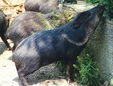
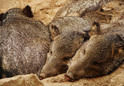
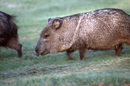
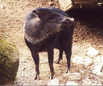
Collared peccaries are quadrupeds that, as adults, are 30 to 50 cm tall at the shoulders and have body lengths between 84 and 106 cm. Their ears range in length from 3 to 10 cm and their tails are around 1.2 cm long, on average. Adult collared peccaries weigh 15 to 28 kg, but individuals in Arizona and Peru have been recorded to reach weights of 40 to 42 kg. Adults have rough, grey coats with a whitish collar that wraps around their necks, just anterior to their shoulders. Their upper bodies are usually greyish-black, but in desert habitats their pelage can be dark yellowish brown in color. Collared peccaries tend to have darker coats in tropical areas.
Collared peccaries have 38 teeth in total. Their upper canines are straight, and their lower canines are longer and stick out as tusks. Males have visibly larger tusks than females. Their dental formula is 2133/3133.
Juvenile collared peccaries are reddish-brown, with a dark dorsal stripe. They develop adult coloration at around 3 months old and reach their adult height at about 10 months old. Juveniles measure 80 cm in length and weigh around 10 kg, on average. Newborns only weigh around 0.5 kg; they have 4 temporary canine teeth and 2 lower incisors. (Manaster, 2006; Marinho, et al., 2019; Oliver, 1993; Reyno-Hurtado, et al., 2014; Schmidly and Bradley, 2016)
- Other Physical Features
- endothermic
- bilateral symmetry
- Sexual Dimorphism
- sexes alike
- sexes shaped differently
-
- Range mass
- 15 to 42 kg
- 33.04 to 92.51 lb
-
- Range length
- 84 to 106 cm
- 33.07 to 41.73 in
-
- Average basal metabolic rate
- 33.165 W
- AnAge
Reproduction
Collared peccaries are sexually active throughout the year. Males reproduce year-round, as long as they can find mates, and females will reproduce provided they are not already gestating or weaning young. Collared peccaries are polygynous. They typically live in small herds with a dominant male that mates with multiple females in the group. Males initiate mating by smelling, nuzzling, or biting females. Sexually receptive females then allow males to mount them and copulate. Prior to mounting, males will push their snouts between the back legs of their mate. (Cooper, et al., 2010; da Silva, et al., 2016; de Kort, et al., 2018)
- Mating System
- polygynous
Collared peccaries breed year-round, with peak breeding times varying based on geographic location. In Arizona, peak breeding activity occurs in the rainy season, between July and August. Conversely, in parts of the Amazon Rainforest, collared peccaries breed most frequently from mid-February to June. Females usually give birth to two litters per year.
Female collared peccaries become sexually mature at 33 to 34 weeks old, while males reach maturity at 46 to 47 weeks old. Females enter periods of estrous that last for 21 to 36 days. After copulation, females gestate their young for 142 to 151 days. There are typically 2 young in a litter, although litter size ranges from 1 to 4 young. Young are around 0.5 kg at birth, and are weaned at about 6 weeks old. However, juveniles associate with their mothers for up to 9 months after they are born. Juvenile collared peccaries reach maturity at about 11 months old, at which point they are fully independent and sexually active. (Byers and Bekoff, 1981; Medri and Mourao, 2016; Reyno-Hurtado, et al., 2014)
- Key Reproductive Features
- iteroparous
- seasonal breeding
- year-round breeding
- gonochoric/gonochoristic/dioecious (sexes separate)
- sexual
- fertilization
- viviparous
-
- Breeding interval
- Collared peccary females breed twice a year. Males breed year-round.
-
- Breeding season
- Breeding season lasts all year, with peaks in the rainy season, which varies depending on geographic location.
-
- Range number of offspring
- 1 to 4
-
- Average number of offspring
- 2
-
- Average number of offspring
- 2
- AnAge
-
- Range gestation period
- 142 to 148 days
-
- Average weaning age
- 6 weeks
-
- Average time to independence
- 9 months
-
- Average age at sexual or reproductive maturity (female)
- 11 months
-
- Average age at sexual or reproductive maturity (female)
Sex: female - 329 days
- AnAge
- Average age at sexual or reproductive maturity (female)
-
- Average age at sexual or reproductive maturity (male)
- 11 months
-
- Average age at sexual or reproductive maturity (male)
Sex: male - 358 days
- AnAge
- Average age at sexual or reproductive maturity (male)
Juvenile collared peccaries are precocial at birth. Females nurse their young for around 6 weeks. During this time, mothers and their young communicate using grunting and purring vocalizations. After juveniles are weaned, they remain with their mothers for up to 9 months before becoming fully independent. Males do not play explicit roles in caring for their young. However, collared peccaries live in small herds, typically with a dominant male that mates with females and protects the herd against perceived threats. In doing so, male collared peccaries likely provide protection for offspring that are still a part of their herds. In some cases, collared peccaries remain in the same herd after they reach independence. (Schweinsburg, 1969)
- Parental Investment
- precocial
- female parental care
-
pre-hatching/birth
-
provisioning
- female
-
protecting
- male
- female
-
provisioning
-
pre-weaning/fledging
-
provisioning
- female
-
protecting
- male
- female
-
provisioning
-
pre-independence
-
provisioning
- female
-
protecting
- male
- female
-
provisioning
- post-independence association with parents
Lifespan/Longevity
Collared peccaries have been reported to live up to 31 years in captivity. In the wild, they typically have a lifespan of 7 years, although one female in Arizona was reported to live up to 15 years.
Juvenile collared peccaries have high mortality rates and are at high risk of predation. A study from 2006 found that juvenile mortality is affected partly from factors other than predators. This study estimated that around 22% of juvenile mortality is the attributed to maternal abandonment and 14% is attributed to intraspecific aggression. Adult collared peccaries also face mortality risk, as they serve as prey for large predators. Wild collared peccaries are also hunted by humans (Homo sapiens). (Mayor, et al., 2007; Planck-Gesellschaft, 2002; Reyno-Hurtado, et al., 2014; Weigl, 2005)
-
- Range lifespan
Status: wild - 15 (high) years
- Range lifespan
-
- Range lifespan
Status: captivity - 31 (high) years
- Range lifespan
-
- Average lifespan
Status: wild - 7 years
- Average lifespan
-
- Average lifespan
Status: captivity - 31.5 years
- AnAge
- Average lifespan
Behavior
Collared peccaries are nocturnal in the summer and diurnal in the winter. In non-forested habitats they are crepuscular, moving as a herd around dawn and dusk. Herds may spread out dramatically at this time, traveling and foraging more than 30 m apart at times.
In semi-arid areas such as Arizona, New Mexico, and Texas, collared peccaries live in herds of about 5 to 15 individuals, while in forested regions like Brazil they live in groups of 5 to 10. Small herds usually consist of 1 to 2 males and 1 to 3 females of different ages. Collared peccaries of both sexes exhibit a dominance hierarchy, with one dominant male in every herd. Male hierarchy is based on age, body size, and tusk size, whereas female hierarchy is based on age, body size, and reproductive status. Dominant males protect their herd from predators and regulate group behavior, whereas subdominant males help guide their herd to foraging sites. Old, weak, or sick collared peccaries are reported to separate from their herd and come together to join a new herd in their home territory. When their health improves, collared peccaries return to their original herds.
In New Mexico, during droughts and harsh winters, collared peccaries travel north in search of food and shelter. In extreme heat, they seek shelter under trees and in caves. Collared peccaries exhibit social behaviors such as playing, mutual rubbing, and sniffing other individuals on their fur and around their genitals.
Collared peccaries have large dorsal scent glands anterior to the bases of their tails, which secrete a liquid they use to mark territories. Collared peccaries mark trees, rocks, and other objects in their home range to communicate territorial boundaries with different herds. (Albert, et al., 2004; Byers and Bekoff, 1981; Cooper, et al., 2010; da Silva, et al., 2016; Hannon, et al., 1991; Keuroghlian, et al., 2004; Reyno-Hurtado, et al., 2014; Schweinsburg, 1969)
- Key Behaviors
- terricolous
- troglophilic
- diurnal
- nocturnal
- crepuscular
- motile
- migratory
- solitary
- territorial
- social
- dominance hierarchies
Home Range
The home range sizes of collared peccaries vary geographically. In Texas, their range can be 72 to 225 ha, while in the Amazon Rainforest in Brazil, they can have a range of 50 to 700 ha. A reintroduced population in Argentina had variable ranges of 890 ha. They inhabit a variety of vegetative associations, including grasslands and forests, and will move seasonally depending on changes in food availability. Each herd has a home range consisting of a central area used exclusively by that herd and outer areas shared with neighboring herds. Males mark their territories by marking objects with scent gland secretions. Territory size has not been quantified or distinguished from home ranges. (Cooper, et al., 2010; Hurtado, et al., 2020; Keuroghlian, et al., 2004; Schweinsburg, 1969)
Communication and Perception
Collared peccaries have poor eyesight, unable to detect and distinguish objects farther than 3 m away. They rely more heavily on their hearing to communicate and perceive their environment. Collared peccaries communicate using behaviors and calls that can be aggressive, submissive, or used to communicate alarm. Aggression is notable during feeding bouts; collared peccaries produce repetitive grunts to maintain group vigilance while foraging. When provoked, they clack their teeth together in rapid up-and-down motions. Juveniles also communicate using this behavior. Submissive individuals produce "yip" sounds, similar to a whimper, and longer submissive "yip-ow" calls. Juveniles are reported to make these noises most often. Juveniles can also produce loud, high-pitched squeals when they are separated from the group. Adults produce similar cries, but at a lower pitch. When alarmed by predators, collared peccaries produce repetitive huffs and grunts while stomping their feet. Collared peccaries have large skin glands that contain secretory tissue, which produce odors that signal danger and ward off predators. (Bissonette, 1982; Oliver, 1993; Waterhouse, et al., 1996)
Food Habits
Collared peccaries are omnivores, though the majority of their diet is vegetation, such as grasses (family Poaceae), forbs, woody plants, an succulents. A 1981 diet composition study on collared peccaries in Texas found that their diets consist of 74.7% of cacti, 15.3% woody plants, 5.1% forbs, 2.3% grasses, and 2.3% unknown plants.
Collared peccaries in semi-arid areas are mainly herbivorous, eating roots, herbs, and cacti such as prickly pears (Opuntia), which are also a source of water. In addition to prickly pears, collared peccaries consume mesquite beans (Prosopis pubescens), sotol (genus Dasylirion), and lechuguilla (Agave lechuguilla). However, collared peccaries also eat insects, including grasshoppers and crickets (order Orthoptera), beetles (order Coleoptera), and their larvae.
In tropical forests, collared peccaries are primarily frugivorous; they consume fruits from over 128 species and seeds from 79 species. Diet composition does not differ between sexes. Collared peccaries exhibit seasonal differences in diet and feeding behavior. During the summer, they rest in shady areas during the day and start foraging in the evening, around dusk. During the fall and spring, collared peccaries forage from early in the morning until late afternoon. Juveniles are fed by their mothers and weaned after 6 weeks, but are introduced to solid food shortly after being born. (Bissonette, 1982; Everitt, et al., 1981; Reyno-Hurtado, et al., 2014; Robinson and Eisenberg, 1985; Schmidly and Bradley, 2016)
- Animal Foods
- insects
- Plant Foods
- roots and tubers
- wood, bark, or stems
- seeds, grains, and nuts
- fruit
- flowers
Predation
Primary predators of collared peccaries include jaguars (Panthera onca), pumas (Puma concolor), coyotes (Canis latrans), and humans (Homo sapiens). It is likely that ocelots (Leopardus pardalis) and American crocodiles (Crocodylus acutus) eat collared peccaries too.
Collared peccaries typically react to potential predators by fleeing, but they have been observed to stand their ground as a herd or make bluff-charges. Adults occasionally leave juveniles behind when they flee. In these cases, young collared peccaries play dead or hide in nearby foliage. Juveniles also hide to mitigate risk of predation while their parents are foraging. (Lundgren and Moeller, 2017; Reyno-Hurtado, et al., 2014)
- Anti-predator Adaptations
- cryptic
-
- Known Predators
-
- Jaguars (Panthera onca)
- Pumas (Puma concolor)
- Coyotes (Canis latrans)
- Humans (Homo sapiens)
- Ocelots (Leopardus pardalis)
- American crocodiles (Crocodylus acutus)
Ecosystem Roles
Collared peccaries are omnivores, eating a variety of plants and insects in their habitats. They browse vegetation and also consume fruit, thus serving as seed dispersers for native plants. Collared peccaries also serve as prey for jaguars (Panthera onca), mountain lions (Puma concolor), coyotes (Canis latrans), ocelots (Leopardus pardalis), and American crocodiles (Crocodylus acutus). Collared peccaries create and maintain water and mud wallows, which benefit other species that use the wallows as water holes and breeding places.
In the United States, collared peccaries are hosts for species of lice (Pecaroecus javalii), psoroptic ear mites (Otodectes cynotis), spinose ear ticks (Otobius megnini), winter ticks (Dermacentor albipictus), and spirurid nematodes (Physocephalus sexalatus). In Brazil, they are recorded as hosts for nine species of nematodes: Eucyathostomum dentatum, Cruzia brasiliensis, Monodontus semicircularis, Monodontus aguiari, Spiculopteragia tayassui, Texicospirura turki, Parabronema pecariae, Physocephalus sexalatus, and Coopria punctata. In Trinidad, they are also known hosts for the trematode species Stichorchis giganteus and the nematode species Strongyloides agouti. (Meleney, 1975; Pereira Junior, et al., 2016; Samuel and Low, 1970)
- Ecosystem Impact
- creates habitat
- Lice (Pecaroecus javalii)
- Spinose ear ticks (Otobius megnini)
- Psoroptic ear mites (Otodectes cynotis)
- Winter ticks (Dermacentor albipictus)
- Nematodes (Physocephalus sexalatus)
- Nematodes (Eucyathostomum dentatum)
- Nematodes (Cruzia brasiliensis)
- Nematodes (Monodontus semicircularis)
- Nematodes (Monodontus aguiari)
- Nematodes (Spiculopteragia tayassui)
- Nematodes (Texicospirura turki)
- Nematodes (Parabronema pecariae)
- Nematodes (Physocephalus sexalatus)
- Nematodes (Cooperia punctata)
- Nematodes (Strongyloides agouti)
- Trematodes (Stichorchis giganteus)
Economic Importance for Humans: Positive
Collared peccaries are a source of meat for indigenous and rural communities in Central and South America. They are also hunted for their pelts, which are used to make materials such as leather. In rural communities, peccary meat is sold for an average of 23 USD per individual and their skins are valued at 5 USD. Collared peccaries are important for the economies of South American countries such as Peru, which sells collared peccary skins to European leather companies, which use the skins to make gloves, shoes, and wallets. In the United States, collared peccaries are hunted for sport, though under a tightly-controlled bag limit system that varies by state. (Gongora, et al., 2011)
- Positive Impacts
- food
- body parts are source of valuable material
Economic Importance for Humans: Negative
Collared peccaries are capable of tolerating some levels of human disturbance and can establish populations in urban and suburban areas, where they eat garbage and may act aggressive towards people or pets. Furthermore, collared peccaries are hosts for diseases and parasites that can affect humans and domestic animals. Collared peccaries have a flexible diet, and may consume or trample crop plants. In rural areas of South America, collared peccaries consume crops such as cassava (Manihot esculenta) and corn (Zea mays). It is estimated that collared peccaries consume an average of 8% of crops from South American farms each year. A report from 2015 found that a farming family in Mato Grosso do Sul, Brazil lost 10% of their crops due to collared peccaries, equating to about $100,000 in lost profits. (Borrell, 2015; EarthTouch News, 2018; Pereira Junior, et al., 2016)
- Negative Impacts
- injures humans
- crop pest
Conservation Status
Collared peccaries are listed as a species of "Least Concern" on the IUCN Red List and are listed under Appendix II of CITES, which regulates national and international trade without proper permits. However, populations in the U.S. and Mexico are exempt from the Appendix II status. They have no special status on the Status of Michigan List or the U.S. Federal List.
Conservation threats to collared peccaries include habitat loss, habitat fragmentation, and overhunting for meat or hides. In Peru, around 56,000 collared peccaries are hunted legally each year. These numbers are considered to be sustainable, but it is important for local governments to monitor population sizes going forward.
There are several conservation actions or recommendations in place for collared peccaries. Conservation actions include proper management of hunting for meat and pelts through hunting licenses and bag limits. In Colombia and Venezuela, it is permitted to hunt collared peccaries for subsistence, but it is illegal to make and sell collared peccary products. In Peru, both subsistence hunting and the sale of collared peccary products are permitted under management laws. Research on collared peccary populations can also inform proper conservation management. For example, by identifying core areas of peccary activity, land managers can define safe areas where hunting is prohibited and collared peccaries can maintain healthy population sizes. Furthermore, the geographic range of collared peccaries includes multiple national parks and reserves that are protected against hunting and poaching. (Reyno-Hurtado, et al., 2014; Taber, et al., 2011)
-
- IUCN Red List
-
Least Concern
More information
-
- IUCN Red List
-
Least Concern
More information
-
- US Federal List
- No special status
-
- CITES
- Appendix II No special status
-
- State of Michigan List
- No special status
Contributors
Aaliyah Benson (author), Radford University, Sierra Felty (editor), Radford University, Karen Powers (editor), Radford University, Galen Burrell (editor), Special Projects.
Glossary
- Nearctic
-
living in the Nearctic biogeographic province, the northern part of the New World. This includes Greenland, the Canadian Arctic islands, and all of the North American as far south as the highlands of central Mexico.

- Neotropical
-
living in the southern part of the New World. In other words, Central and South America.
- acoustic
-
uses sound to communicate
- agricultural
-
living in landscapes dominated by human agriculture.
- bilateral symmetry
-
having body symmetry such that the animal can be divided in one plane into two mirror-image halves. Animals with bilateral symmetry have dorsal and ventral sides, as well as anterior and posterior ends. Synapomorphy of the Bilateria.
- carnivore
-
an animal that mainly eats meat
- causes disease in humans
-
an animal which directly causes disease in humans. For example, diseases caused by infection of filarial nematodes (elephantiasis and river blindness).
- chemical
-
uses smells or other chemicals to communicate
- crepuscular
-
active at dawn and dusk
- cryptic
-
having markings, coloration, shapes, or other features that cause an animal to be camouflaged in its natural environment; being difficult to see or otherwise detect.
- desert or dunes
-
in deserts low (less than 30 cm per year) and unpredictable rainfall results in landscapes dominated by plants and animals adapted to aridity. Vegetation is typically sparse, though spectacular blooms may occur following rain. Deserts can be cold or warm and daily temperates typically fluctuate. In dune areas vegetation is also sparse and conditions are dry. This is because sand does not hold water well so little is available to plants. In dunes near seas and oceans this is compounded by the influence of salt in the air and soil. Salt limits the ability of plants to take up water through their roots.
- diurnal
-
- active during the day, 2. lasting for one day.
- dominance hierarchies
-
ranking system or pecking order among members of a long-term social group, where dominance status affects access to resources or mates
- endothermic
-
animals that use metabolically generated heat to regulate body temperature independently of ambient temperature. Endothermy is a synapomorphy of the Mammalia, although it may have arisen in a (now extinct) synapsid ancestor; the fossil record does not distinguish these possibilities. Convergent in birds.
- female parental care
-
parental care is carried out by females
- fertilization
-
union of egg and spermatozoan
- folivore
-
an animal that mainly eats leaves.
- food
-
A substance that provides both nutrients and energy to a living thing.
- forest
-
forest biomes are dominated by trees, otherwise forest biomes can vary widely in amount of precipitation and seasonality.
- frugivore
-
an animal that mainly eats fruit
- granivore
-
an animal that mainly eats seeds
- herbivore
-
An animal that eats mainly plants or parts of plants.
- insectivore
-
An animal that eats mainly insects or spiders.
- introduced
-
referring to animal species that have been transported to and established populations in regions outside of their natural range, usually through human action.
- iteroparous
-
offspring are produced in more than one group (litters, clutches, etc.) and across multiple seasons (or other periods hospitable to reproduction). Iteroparous animals must, by definition, survive over multiple seasons (or periodic condition changes).
- migratory
-
makes seasonal movements between breeding and wintering grounds
- motile
-
having the capacity to move from one place to another.
- native range
-
the area in which the animal is naturally found, the region in which it is endemic.
- nocturnal
-
active during the night
- polygynous
-
having more than one female as a mate at one time
- seasonal breeding
-
breeding is confined to a particular season
- sexual
-
reproduction that includes combining the genetic contribution of two individuals, a male and a female
- social
-
associates with others of its species; forms social groups.
- solitary
-
lives alone
- suburban
-
living in residential areas on the outskirts of large cities or towns.
- tactile
-
uses touch to communicate
- territorial
-
defends an area within the home range, occupied by a single animals or group of animals of the same species and held through overt defense, display, or advertisement
- tropical
-
the region of the earth that surrounds the equator, from 23.5 degrees north to 23.5 degrees south.
- tropical savanna and grassland
-
A terrestrial biome. Savannas are grasslands with scattered individual trees that do not form a closed canopy. Extensive savannas are found in parts of subtropical and tropical Africa and South America, and in Australia.
- savanna
-
A grassland with scattered trees or scattered clumps of trees, a type of community intermediate between grassland and forest. See also Tropical savanna and grassland biome.
- temperate grassland
-
A terrestrial biome found in temperate latitudes (>23.5° N or S latitude). Vegetation is made up mostly of grasses, the height and species diversity of which depend largely on the amount of moisture available. Fire and grazing are important in the long-term maintenance of grasslands.
- visual
-
uses sight to communicate
- viviparous
-
reproduction in which fertilization and development take place within the female body and the developing embryo derives nourishment from the female.
- year-round breeding
-
breeding takes place throughout the year
- young precocial
-
young are relatively well-developed when born
References
Albert, S., R. Cynthia, S. C. Gregory. 2004. Collared peccary range expansion in northwestern New Mexico. The Southwestern Naturalist, 49/4: 524-528.
Bissonette, J. 1982. Ecology and Social Behavior of the Collared Peccary on Big Bend National Park. U.S. Department of the Inferior National Park Service. Washington, D.C.: Scientific Monograph Series No. 16.
Borrell, B. 2015. "Brazilian farmers urge return of big cats to Cerrado to protect crops from rampaging peccaries" (On-line). Accessed November 02, 2022 at https://news.mongabay.com/2015/04/brazilian-farmers-urge-return-of-big-cats-to-cerrado-to-protect-crops-from-rampaging-peccaries/#.
Byers, J., M. Bekoff. 1981. Social, spacing, and cooperative behavior of the collared peccary, Tayassu tajacu. Journal of Mammalogy, 62/4: 767-785.
Cooper, J., P. Waser, E. Hellgren, T. Gabor. 2010. Is sexual monomorphism a predictor of polygynandry? Evidence from a social mammal, the collared peccary. Behavioral Ecology and Sociobiology, 65/4: 775-785.
EarthTouch News, 2018. "We spent a year photographing the animal crop raiders of the Amazon – here are the results" (On-line). EarthTouch News. Accessed November 02, 2022 at https://www.earthtouchnews.com/conservation/conservation/we-spent-a-year-photographing-the-animal-crop-raiders-of-the-amazon-here-are-the-results/.
Everitt, H., C. Gonzalez, M. Alaniz, G. Latigo. 1981. Food habits of the collared peccary on south Texas rangelands. Journal of Range Management, 34/2: 141-144.
Gines Mayor, P., R. Bodmer, M. Lopez Bejar. 2010. Reproductive performance of the wild peccary (Tayassu tajacu) female in the Peruvian Amazon. European Journal of Wildfire Research, 56/4: 681-684.
Gongora, J., R. Reyna-Hurtado, H. Beck, A. Taber, M. Altrichter, A. Keuroghlian. 2011. "Pecari tajacu" (On-line). The IUCN Red List of Threatened Species 2011: e.T41777A10562361. Accessed November 17, 2022 at https://dx.doi.org/10.2305/IUCN.UK.2011-2.RLTS.T41777A10562361.en.
Guimaraes, D., S. Gracia de Gracia, M. Auxiliadora, P. Ferreira, S. do Soccorro Bastos da Silva. 2012. Ovarian folliculogenesis in collared peccary, Pecari tajacu (Artiodactyla: Tayassuidae). Revista de Biologia Tropical, 60/1: 437-455.
Hannon, P., D. Dowdell, R. Lochmiller, W. Grant. 1991. Dorsal-gland activity in peccaries at various physiological states. Journal of Mammalogy, 72/4: 825-827.
Hurtado, C., H. Beck, P. Thebpanya, M. Altrichter. 2020. Spatial patterns of the first groups of collared peccaries (Pecari tajacu) reintroduced in South America. Tropical Ecology, 61: 400-411.
Jones, K., K. Lall, G. Garcia. 2019. Endoparasites of selected native non-domesticated mammals in the Neotropics (New World tropics). Veterinary Sciences, 6/4: Article 87. Accessed November 20, 2022 at doi: 10.3390/vetsci6040087.
Keuroghlian, A., D. Eaton, W. Longland. 2004. Area use by white-lipped and collared peccaries (Tayassu pecari and Tayassu tajacu) in a tropical forest fragment. Biological Conservation, 120/3: 411-425.
Lundgren, E., K. Moeller. 2017. Anti-predator strategies of, and possible thanatosis in, juvenile collared peccaries (Pecari tajacu). The Southwestern Naturalist, 62/3: 235-237.
Manaster, J. 2006. Javelinas. Lubbock, Texas: Texas Tech University Press.
Marinho, P., M. da Silva, C. Lisboa. 2019. Presence of the collared peccary Pecari tajacu (Artiodactyla. Tayassuidae) in the far northeast of its Brazilian distribution. Neotropical Biology and Conservation, 14/4: 499-509.
Mayor, P., D. Guimaraes, Y. Le Pendu, J. Da Silva, J. Ferran, M. Lopez-Bejar. 2007. Reproductive performance of captive collared peccaries (Tayassu tajacu) in the eastern Amazon. Animal Reproductive Science, 102/1-2: 88-97. Accessed November 02, 2022 at doi: 10.1016/j.anireprosci.2006.10.015.
Mayor, P., G. Pereira Da Silva, R. Santos de Andrade, F. Ozanan Barros Monteiro. 2019. Embryonic and fetal development of the collared peccary (Pecari tajacu). Animal Reproduction Science, Volume 208: 106-123. Accessed August 30, 2022 at https://doi.org/10.1016/j.anireprosci.2019.106123.
Medri, Í., G. Mourao. 2016. Male-male aggression in free-ranging collared peccaries, Pecari tajacu (Artiodactyla, Tayassuidae), from Brazilian Pantanal. Current Ethology, 15/2: 24-29.
Meleney, W. 1975. Arthropod parasites of the collared peccary, Tayassu tajacu (Artiodactyla: Tayassuidae), from New Mexico. The Journal of Parasitology, 61/3: 530-534.
Oliver, W. 1993. Pigs, Peccaries, and Hippos. Gland, Switzerland: IUCN.
Pereira Junior, R., S. Sousa, M. Oliveira, A. Valadares, E. Hoppe, K. Almeida. 2016. Helminthic parasites of the collared peccaries (Tayassu tajacu Linnaeus, 1758) of the Brazilian Amazon. Pesquisa Veterinaria Brasileira, 36/11: 1109-1115.
Planck-Gesellschaft, M. 2002. "Longevity Records: Life Spans of Mammals, Birds, Amphibians, Reptiles, and Fish" (On-line). Accessed November 02, 2022 at https://www.demogr.mpg.de/longevityrecords/0203.ht.
Reyna-Hurtado, R., A. Keuroghlian, M. Altrichter, B. Harald. 2001. Ecology, Conservation and Management of Wild Pigs and Peccaries. Cambridge, United Kingdom: Cambridge University Press.
Reyna-Hurtado, R., A. Keuroghlian, M. Altrichter, H. Beck, J. Gongora. 2017. Collared Peccary Pecari spp. (Linnaeus, 1758). Ecology, Conservation and Management of Wild Pigs and Peccaries, 24: 255-264.
Reyno-Hurtado, R., E. Naranjo, S. Mandujano, I. Mifsut. 2014. Peccaries in Mexico. Pp. 242-258 in R Valdez, J Ortega-Santos, eds. Wildlife Ecology and Management in Mexico. College Station, Texas: Texas A&M University Press.
Robinson, J., J. Eisenberg. 1985. Group size and foraging habits of the collared peccary Tayassu tajacu. Journal of Mammalogy, 66/1: 153-155.
Samuel, W., W. Low. 1970. Parasites of the collared peccary from Texas. Journal of Wildlife Diseases, 6/1: 16-23.
Schmidly, D., R. Bradley. 2016. The Mammals of Texas. Austin,Texas: University of Texas Press.
Schweinsburg, R. 1969. Social Behavior of the Collared Peccary (Pecrai tajacu) in the Tucson Mountains (Ph.D. Dissertation). Tucson, Arizona: University of Arizona.
Taber, A., M. Altrichter, H. Beck, J. Gongora. 2011. Family Tayassuidae (Peccaries); in Ecology, Conservation and Management of Wild Pigs and Peccaries (Editors Mario Melletti, Erik Meijaard). Barcelona, Spain: Lynx Edicions.
Waterhouse, J., J. Ke, J. Pickett, P. Weldon. 1996. Volatile components in dorsal gland secretions of the collared peccary, Tayassu tajacu (Tayassuidae, Mammalia). Journal of Chemical Ecology, 22/7: 1307-1314.
Weigl, R. 2005. Longevity of Mammals in Captivity from the Living Collections of the World. Stuttgart, Germany: Schweizerbart Science Publishers.
da Silva, S., D. Guimaraes, C. Biondo, O. Ohashi, N. de Albuquerque, C. Vecchia, C. Miyaki, Y. Le Pendu. 2016. Dominance relationships between collared peccaries Pecari tajacu (Cetartiodactyla: Tayassuidae) in intensive breeding system. Applied Animal Behaviour Science, 184: 117-125.
da Silva, S., Y. Le Pendu, O. Ohashi, E. Oba, N. de Albuquerque, A. Garcia, P. Mayor, D. de Araujo Guimarães. 2016. Sexual behavior of Pecari tajacu (Cetartiodactyla: Tayassuidae) during periovulatory and early gestation periods. Behavioural Processes, 131: 68-73.
de Kort, D., M. Altricker, S. Cortez, M. Camino. 2018. Collared peccary (Pecari tajacu) behavioral toward a dead member of the herd. Ethology, 124: 131-134.