Ophiophagus hannahHamadryad, King Cobra
Geographic Range
Northern India, east to southern People's Republic of China, including Hong Kong and Hainan; south throughout the Malay Peninsula, and east to western Indonesia and the Philippines.
Habitat
Near streams in dense or open forest, bamboo thickets, adjacent agricultural areas, and dense mangrove swamps.
- Terrestrial Biomes
- savanna or grassland
- forest
- rainforest
- scrub forest
Physical Description
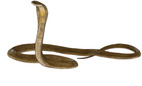
The King Cobra's average size is 10-12 feet, but can reach 18 feet. The full grown King Cobra is yellow, green, brown, or black. There are usually yellowish or white cross-bars or chevrons on its body. The belly may be uniform in color or ornamented with bars. The throat is light yellow or cream-colored. The juveniles are jet-black, with yellow or white cross-bars on the body and tail and four similar cross-bars on the head. The King Cobra is regarded as a fierce and aggressive snake, and its length and size give it an awesome appearance.
Reproduction
King Cobras are oviparous and lay 21-40 eggs. The female pushes leaves and branches into a nest pile where the eggs are incubated by the elevated temperatures of decomposition. The female remains on top of the nest to guard the eggs, and the male also remains close by. During the brood care period, the king cobra tends to be very aggressive toward approaching humans. Breeding usually occurs from January through April. The eggs of the king cobra incubate during spring and summer, hatching in the fall.
Lifespan/Longevity
-
- Average lifespan
Sex: male
Status: captivity - 17.1 years
- Max Planck Institute for Demographic Research
- Average lifespan
Behavior
These snakes are diurnal(active by day) whereas other cobras are commonly active in the evening but not exclusively nocturnal(active by night). Although the King Cobra is undoubtedly a very dangerous snake, it prefers to escape unless it is cornered or provoked. This is not true of nesting females, which may attack without provocation. When in a threat display, these snakes can raise the anterior part of their body about one meter off the ground and are able to follow their enemy in this position over considerable distances.
Food Habits
Ophiophagus hannah normally restricts its diet to cold-blooded animals, particularly other snakes. Some specimens develop a rigid diet of a single species of snake and will refuse any other type. The snakes eaten by the King Cobra are mostly the larger harmless species, such as Asian rat snakes, dhamans, and pythons up to about 10 feet in length.
Economic Importance for Humans: Positive
King Cobras are among the most attractive highlights in large display terrariums at zoos.
Economic Importance for Humans: Negative
The venom of Ophiophagus hannah is very potent. It is a strong neurotoxin, which affects respiratory centres in the medulla of the brain. Death results from respiratory arrest and cardiac failure. Death may occur in a very short time, but, as with any bite, the location of the bite and the efficacy of first aid and medical treatment may delay or prevent death. The anti-venom, sometimes referred to as anti-venin, reverses the actions of the neurotoxins (proteins and enzymes). Anti-venin, even after five or six decades, is still the most trusted and commonly used method in controlling snake venom poisoning.
Conservation Status
King Cobras, as well as all snakes, are threatened from the destruction of their habitats, and by persecution by humans afraid of them
-
- IUCN Red List
-
Vulnerable
More information
Contributors
Diana Young (author), University of Michigan-Ann Arbor.
Glossary
- forest
-
forest biomes are dominated by trees, otherwise forest biomes can vary widely in amount of precipitation and seasonality.
- native range
-
the area in which the animal is naturally found, the region in which it is endemic.
- oriental
-
found in the oriental region of the world. In other words, India and southeast Asia.

- rainforest
-
rainforests, both temperate and tropical, are dominated by trees often forming a closed canopy with little light reaching the ground. Epiphytes and climbing plants are also abundant. Precipitation is typically not limiting, but may be somewhat seasonal.
- scrub forest
-
scrub forests develop in areas that experience dry seasons.
- tropical savanna and grassland
-
A terrestrial biome. Savannas are grasslands with scattered individual trees that do not form a closed canopy. Extensive savannas are found in parts of subtropical and tropical Africa and South America, and in Australia.
- savanna
-
A grassland with scattered trees or scattered clumps of trees, a type of community intermediate between grassland and forest. See also Tropical savanna and grassland biome.
- temperate grassland
-
A terrestrial biome found in temperate latitudes (>23.5° N or S latitude). Vegetation is made up mostly of grasses, the height and species diversity of which depend largely on the amount of moisture available. Fire and grazing are important in the long-term maintenance of grasslands.
References
Cox, Merel J., 1991. The snakes of Thailand and Their Husbandry. Krieger Publishing Company, Malabar, Florida.
Gharpurey, K.G., 1962. Snakes of India & Pakistan. B.G. Dhawale at Karnatak Printing Press, Chira Bazar, Bombay 2.
Jacob, Udo Dr. Obst, Fritz Jurgen Obst, and Dr. Klaus Richter. 1984. The Completely Illustrated Atlas of Reptiles and Amphibians For The Terrarium. Edition Leipzig.
Mehrtens, John M. 1987. Living Snakes Of The World. Sterling Publishing Co., Inc. New York. Blanford Press. Dorset, England.
Minton, Sherman A., and Madge Rutherford Minton. 1973. Giant Reptiles. Library of Congress.
Pitman, R.S., 1974. A Guide To The Snakes of Uganda. Wheldon & Wesley, Ltd.
Reitinger, Frank F., 1978. Common Snakes of South East Asia and Hong Kong. 1978. South China Printing Company Limited.
Schneider, Greg., 1997. The University of Michigan Department of Herpetalogy.