Ondatra zibethicusmuskrat
Geographic Range
The muskrat is found in swamps, marshes, and wetlands from northern North America to the Gulf coast and the Mexican border. Early in the 20th century, muskrats were introduced to northern Eurasia (Baker, 1983).
- Biogeographic Regions
- nearctic
- palearctic
- neotropical
Habitat
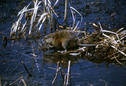
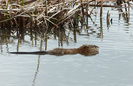
Muskrats are found in wet environments, favoring locations with four to six feet of water. While muskrats are found in ponds, lakes, and swamps, their favorite locations are marshes, where the water level stays constant. Marshes provide the best vegetation for muskrats. They find shelter in bank burrows and their distinctive nests. Bank burrows are tunnels excavated in a bank. The nests of the muskrats are formed by piles of vegetation placed on top of a good base, for example a tree stump, generally in 15 to 40 inches of water (Baker, 1983).
- Habitat Regions
- temperate
- Aquatic Biomes
- lakes and ponds
- rivers and streams
Physical Description
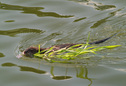
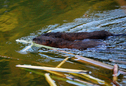
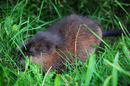
Muskrats have large, robust bodies, with a total body length of twelve and a half inches. The tail is flat and scaly and is nine and a half inches in length. Muskrats have dense fur that traps air underneath for insulation and buoyancy. Their heads are very large and their ears are almost invisible underneath the fur. The whiskers are mediun size. Muskrats have short legs and big feet; the back feet are slightly webbed for swimming. Adult muskrats have glossy upperparts that are dark brown, darker in winter and paler in the summer (Baker, 1983).
- Other Physical Features
- endothermic
- bilateral symmetry
- Sexual Dimorphism
- sexes alike
-
- Range mass
- 680.0 to 1800.0 g
- 23.96 to 63.44 oz
-
- Average mass
- 1135.8 g
- 40.03 oz
-
- Range length
- 410.0 to 620.0 mm
- 16.14 to 24.41 in
-
- Average basal metabolic rate
- 4.363 W
- AnAge
Lifespan/Longevity
Although muskrats have been known to live to 10 years old in captivity, they probably live about 3 years in the wild.
-
- Range lifespan
Status: captivity - 10.0 (high) years
- Range lifespan
-
- Average lifespan
Status: wild - 3.0 years
- Average lifespan
-
- Average lifespan
Status: wild - 4.0 years
- Max Planck Institute for Demographic Research
- Average lifespan
-
- Average lifespan
Status: wild - 3.0 years
- Max Planck Institute for Demographic Research
- Average lifespan
-
- Average lifespan
Status: captivity - 10.0 years
- Max Planck Institute for Demographic Research
- Average lifespan
Behavior
Muskrats are arranged in large family groups and live in definite territories. If the conditions are overcrowded, the females will kick their offspring out of the group. Muskrats continue to live in large grous even when fighting and cannibalism occur in high rates. Muskrats are active at all times of the day but most active from mid-afternoon until just after dusk. Muskrats are good swimmers and can stay underwater for 12 - 17 minutes. Muskrats, however, move relatively slowly on land. Muskrats communicate by musk, which also is used as a warning for intruders. They are capable of vocalizing by squeaks and squeals. Muskrats have poorly developed senses of sight, hearing, and smell. They are affected by quick changes in temperature, and dry, hot weather is especially bad for them. Their homes and burrows protect them from the elements. Muskrats also have a special adaptation called regional heterothermia, which regulates the flow of blood to the feet and tail, allowing these structures to be cooler than the body core (Baker, 1983).
- Key Behaviors
- nocturnal
- crepuscular
- motile
- sedentary
- territorial
- social
Communication and Perception
Muskrats communicate by a secretion from their glands called musk. This scent also serves to warn intruders. They are capable of vocalizing by squeaks and squeals. Muskrats have poorly developed senses of sight, hearing, and smell.
Food Habits
Muskrats are mainly vegetarians but will eat animals as well. Muskrats consume about one-third of their weight every day. Their digestive system is designed for green vegetation. In the summer they eat the roots of aquatic plants. In the winter, they swim under the surface ice to get to the plants. Muskrats also eat agricultural crops (Baker, 1983).
- Primary Diet
- herbivore
Predation
Muskrats are excellent swimmers and can evade many predators by escaping into water or into their burrows and nests. They can remain under water for up to 15 minutes.
-
- Known Predators
-
- American minks (Neovison vison)
- raccoons (Procyon lotor)
- Northern river otters (Lontra canadensis)
- coyotes (Canis latrans)
- barn owls (Tyto alba)
- barred owls (Strix varia)
- northern harriers (Circus cyaneus)
- American alligators (Alligator mississippiensis)
- cottonmouth water moccasins (Agkistrodon piscivorus)
Ecosystem Roles
Muskrats are very abundant in areas of good habitat, making them important prey animals for predator populations. By grazing on vegetation, muskrats influence the composition of local plant communities.
Economic Importance for Humans: Positive
The fur of a muskrat is important in the fur industry. Also, the meat from a muskrat is suitable for human consumption (Baker, 1983).
- Positive Impacts
- body parts are source of valuable material
Economic Importance for Humans: Negative
Muskrats not only eat the grain on a farm but they have also been known to plug the drain tiles on farms as well. Muskrats also have a habit of building their homes around dikes. These homes make the dikes weak and eventually destroy the structure (Baker, 1983).
- Negative Impacts
- crop pest
Conservation Status
Muskrats are widespread and abundant. Populations remain stable even when they are being hunted for fur, affected by disease, or a target for large predator populations because muskrats have the ability to reproduce quickly.
-
- IUCN Red List
-
Least Concern
More information
-
- IUCN Red List
-
Least Concern
More information
-
- US Federal List
- No special status
-
- CITES
- No special status
-
- State of Michigan List
- No special status
Contributors
Toni Lynn Newell (author), University of Michigan-Ann Arbor.
Glossary
- Nearctic
-
living in the Nearctic biogeographic province, the northern part of the New World. This includes Greenland, the Canadian Arctic islands, and all of the North American as far south as the highlands of central Mexico.

- Neotropical
-
living in the southern part of the New World. In other words, Central and South America.
- Palearctic
-
living in the northern part of the Old World. In otherwords, Europe and Asia and northern Africa.
- altricial
-
young are born in a relatively underdeveloped state; they are unable to feed or care for themselves or locomote independently for a period of time after birth/hatching. In birds, naked and helpless after hatching.
- bilateral symmetry
-
having body symmetry such that the animal can be divided in one plane into two mirror-image halves. Animals with bilateral symmetry have dorsal and ventral sides, as well as anterior and posterior ends. Synapomorphy of the Bilateria.
- bog
-
a wetland area rich in accumulated plant material and with acidic soils surrounding a body of open water. Bogs have a flora dominated by sedges, heaths, and sphagnum.
- chemical
-
uses smells or other chemicals to communicate
- crepuscular
-
active at dawn and dusk
- endothermic
-
animals that use metabolically generated heat to regulate body temperature independently of ambient temperature. Endothermy is a synapomorphy of the Mammalia, although it may have arisen in a (now extinct) synapsid ancestor; the fossil record does not distinguish these possibilities. Convergent in birds.
- female parental care
-
parental care is carried out by females
- fertilization
-
union of egg and spermatozoan
- herbivore
-
An animal that eats mainly plants or parts of plants.
- internal fertilization
-
fertilization takes place within the female's body
- introduced
-
referring to animal species that have been transported to and established populations in regions outside of their natural range, usually through human action.
- iteroparous
-
offspring are produced in more than one group (litters, clutches, etc.) and across multiple seasons (or other periods hospitable to reproduction). Iteroparous animals must, by definition, survive over multiple seasons (or periodic condition changes).
- marsh
-
marshes are wetland areas often dominated by grasses and reeds.
- motile
-
having the capacity to move from one place to another.
- native range
-
the area in which the animal is naturally found, the region in which it is endemic.
- nocturnal
-
active during the night
- sedentary
-
remains in the same area
- sexual
-
reproduction that includes combining the genetic contribution of two individuals, a male and a female
- social
-
associates with others of its species; forms social groups.
- swamp
-
a wetland area that may be permanently or intermittently covered in water, often dominated by woody vegetation.
- tactile
-
uses touch to communicate
- temperate
-
that region of the Earth between 23.5 degrees North and 60 degrees North (between the Tropic of Cancer and the Arctic Circle) and between 23.5 degrees South and 60 degrees South (between the Tropic of Capricorn and the Antarctic Circle).
- territorial
-
defends an area within the home range, occupied by a single animals or group of animals of the same species and held through overt defense, display, or advertisement
- viviparous
-
reproduction in which fertilization and development take place within the female body and the developing embryo derives nourishment from the female.
- year-round breeding
-
breeding takes place throughout the year
References
Baker, R.H. 1983. Michigan Mammals. Michigan State University Press. United States of America.
"Animal Life Histories Database" (On-line).