Oncorhynchus kisutchCoho(Also: Grilse; Hooknose)
Geographic Range
Oncorhynchus kisutch, commonly known as coho salmon, are primarily found in coastal waters. Coho salmon do not range widely in the open ocean like that of many other salmon species. Oncorhynchus kisutch are also found in fresh water, during their first year and later while spawning. They are found in fresh streams of the North Pacific, ranging from Baja, California to Alaska (Wheeley, 1985).
- Biogeographic Regions
- nearctic
- arctic ocean
- atlantic ocean
- pacific ocean
Habitat
Coho Salmon live in fresh and ocean water. In fresh water, coho like relatively slow moving water with fine gravel. In the ocean, coho tend to live closer to shores than in the open ocean. (StreamNet, 1996)
- Aquatic Biomes
- rivers and streams
- coastal
Physical Description
Oncorhynchus kisutch typically spend the first year of their life in fresh water. Upon moving to the ocean, growth increases dramatically. At about the third year, coho salmon reach maturity. They weigh from 6 to 12 pounds and can be up to 38 inches in length.
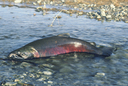
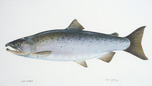
Oncorhynchus kisutch are deep-bodied salmon with unique color characteristics. The dorsal surface is a metallic blue while the sides are a silver color. Black spots appear on the back and upper lobe of the caudal fin. A lateral line is also present. The line is curved toward the front of the fish and straightens out as it approaches the back of the fish. While spawning, the fish's back and belly turn dark. Spawning males' sides develop a bright red line and their jaws become hooked (Clemens and Wilby, 1961).
- Other Physical Features
- ectothermic
- heterothermic
- bilateral symmetry
- Sexual Dimorphism
- sexes colored or patterned differently
-
- Range mass
- 3 to 6 kg
- 6.61 to 13.22 lb
Reproduction
At three to four years of age, coho salmon reach sexual maturity. From September to October, coho swim to the fresh water streams where they were born (up to 400 miles). Once the fish reach their natal site females dig a nest in a gravel-type area. After the nest is made a female and one male (occasionally 2) breed. In this breeding, the female lays her eggs and the male's sperm is spread over them, thus fertilizing them. After fertilization has occurred, the eggs are buried by other female coho that are digging their nests. Following reproduction, males and females die, giving the waters more nutrients. Larvae hatch 6-8 weeks after fertilization. The larvae remain in the gravel for 2-3 weeks. Coho live in streams or rivers for about a year until they move to the ocean. (Wheeler, 1985)
Lifespan/Longevity
-
- Average lifespan
Status: wild - 4.1 years
- Max Planck Institute for Demographic Research
- Average lifespan
-
- Average lifespan
Status: wild - 5.0 years
- Max Planck Institute for Demographic Research
- Average lifespan
-
- Average lifespan
Status: wild - 4.0 years
- Max Planck Institute for Demographic Research
- Average lifespan
Behavior
During the first part of coho salmon's lifetimes they begin defending territories. Young coho are faster than adult coho in order to escape predators. Oncorhynchus kisutch grows up in fresh water to avoid predators, as there are more predators in the ocean. After coho have grown, they are less likely to be attacked in the ocean. Coho have a smelling sensory organ in the cartilage of their noses that allows them to retrace the path to where they were born. On their return to spawn coho do not feed. (Groot et. al., 1995)
- Key Behaviors
- natatorial
- motile
Communication and Perception
Food Habits
In fresh water streams and rivers, juvenile coho salmon defend territories and compete for limited feeding sites with other fish. In order to attain these feeding sites, they may charge or chase other fish away, as growth and fitness depend on it. Coho salmon attack prey by sprinting and striking. They are able to maneuver well in order to capture prey. In fresh water, coho eat insects and smaller fish. When they move to the ocean they begin to grow rapidly due to the abundance of food. Once these fish reach the ocean their diet changes to other fish, such as herring and squid (Groot et. al., 1995).
Economic Importance for Humans: Positive
Oncorhynchus kisutch make a good meal. Often, coho are either sold frozen or canned by commercial fisherman. Twice as many coho salmon are harvested commercially in North America than in Asia. During the late 1950's about 10 million coho salmon per year were caught. These numbers declined to 4.5 million coho per year in the 60's and have now risen to about 10.5 million coho per year. Fishing for coho is also an important sport for trollers and flyfisherman. (McNeil et. al, 1980)
Conservation Status
There has been a serious decline of wild coho stocks in the Strait of Georgia, due to loss of habitat (from dams) and overfishing. A plan of harvest management has been developed and implemented by the Dept. of Fisheries and Oceans. (Pacific Salmon Foundation, 1995)
-
- IUCN Red List
- Not Evaluated
-
- US Federal List
- No special status
-
- CITES
- No special status
-
- State of Michigan List
- No special status
Other Comments
The scientific name Oncorhynchus kisutch was derived from the Greek roots onkos, (hook), rynchos (nose), and kisutch, the ordinary name in Siberia and Alaska. Some other common names for Oncorhynchus kisutch are coho, silver, blueback, and hook nose salmon. (StreamNet, 1996)
Contributors
Kyle Smith (author), University of Michigan-Ann Arbor, Tanya Dewey (editor), Animal Diversity Web.
Glossary
- Arctic Ocean
-
the body of water between Europe, Asia, and North America which occurs mostly north of the Arctic circle.
- Atlantic Ocean
-
the body of water between Africa, Europe, the southern ocean (above 60 degrees south latitude), and the western hemisphere. It is the second largest ocean in the world after the Pacific Ocean.

- Nearctic
-
living in the Nearctic biogeographic province, the northern part of the New World. This includes Greenland, the Canadian Arctic islands, and all of the North American as far south as the highlands of central Mexico.
- Pacific Ocean
-
body of water between the southern ocean (above 60 degrees south latitude), Australia, Asia, and the western hemisphere. This is the world's largest ocean, covering about 28% of the world's surface.
- bilateral symmetry
-
having body symmetry such that the animal can be divided in one plane into two mirror-image halves. Animals with bilateral symmetry have dorsal and ventral sides, as well as anterior and posterior ends. Synapomorphy of the Bilateria.
- chemical
-
uses smells or other chemicals to communicate
- coastal
-
the nearshore aquatic habitats near a coast, or shoreline.
- ectothermic
-
animals which must use heat acquired from the environment and behavioral adaptations to regulate body temperature
- heterothermic
-
having a body temperature that fluctuates with that of the immediate environment; having no mechanism or a poorly developed mechanism for regulating internal body temperature.
- motile
-
having the capacity to move from one place to another.
- natatorial
-
specialized for swimming
- native range
-
the area in which the animal is naturally found, the region in which it is endemic.
- tactile
-
uses touch to communicate
References
Clemens, W., G. Wilby. 1961. Fishes Of The Pacific Coast Of Canada. The Fisheries Research Board of Canada.
Groot, C., L. Margolis, W. Clarke. 1995. Pacific Salmon. Vancouver: UBC Press.
McNeil, W., D. Himsworth. 1980. Salmonid Ecosystems Of The North Pacific. Corvallis, Oregon: Oregeon State University Press and Oregon State University Sea Grant College Program.
Pacific Salmon Foundation, 1995. "Salmon Conservation" (On-line). Accessed March 20, 2000 at http://fishhotline.com/conserva.html.
StreamNet, 1996. "Coho Salmon" (On-line). Accessed March 20,2000 at http://www.psmfc.org/habitat/edu_coho_facts.htm.
Wheeler, A. 1985. The World Encyclopedia of Fishes. Ferndale Editions.