Oncorhynchus clarkii


Geographic Range
Cutthroat trout, Oncorhynchus clarkii, are widely distributed along the western coast of North America. They can be found as far north as Alaska’s Prince William Sound and as far south as California’s Eel River (Willers, 1991). Their range also extends inland where they can be found on most waterways with linkages to their western range along the Pacific coast (Trotter, 1987). (Trotter, 1987)
Habitat
Because O. clarkii is such a widespread species it occupies many different habitats. Cutthroat trout habitats range from coastal marine to freshwater rivers and streams with gravel substrates (Behnke, 1992). The diversity in habitat also leads to a diversity in the elevations in which the species can be found. They occur from mountainous streams in the Cascade, Rocky, and Sierra Nevada mountain ranges to the ocean. (Behnke, 1992)
- Habitat Regions
- temperate
- saltwater or marine
- freshwater
- Aquatic Biomes
- pelagic
- lakes and ponds
- rivers and streams
- coastal
- brackish water
- Other Habitat Features
- estuarine
Physical Description
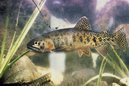
There are roughly ten subspecies of cutthroat trout described by Behnke (1992). They have the same morphology, but their coloration and spotting vary. Coastal cutthroat trout, O. c. clarki, are silvery to brassy in coloration with yellowish and irregular shaped spots. West slope cutthroat trout, O. c. lewisi, are silver in coloration with a yellowish tint, but can sometimes be bright yellow, orange, or red. Their spots are similar to those of coastal cutthroat except they do not extend below the lateral line. Yellowstone cutthroat trout, O. c. bouvieri, are yellowish brown, silver, or brass in coloration with round spots evenly distributed over the body. Lahontan cutthroat trout, O. c. henshawi, are dull in coloration with large round spots evenly distributed over the entire body. Paiute cutthroat trout, O. c. seleniris, closely resemble the Lahontan cutthroat with a dull coloration, but unlike the Lahontan, Paiute cutthroat lack spots. Bonneville cutthroat trout, O. c. utah, have the same coloration and spotting as Yellowstone cutthroat with one exception, the spots are larger on Bonneville cutthroat. Colorado river cutthroat trout, O. c. pleuriticus, are strong red in coloration along the lateral line and their lower sides are colored yellow. They have spots but they vary by individual. Greenback cutthroat trout, O. c. stomias, are similar to Colorado River cutthroat in coloration, however greenback cutthroat trout have larger spots. Rio Grande cutthroat trout, O. c. virginalis, are similar to greenback cutthroat in both coloration and spotting. Rio Grande cutthroat have, in addition, close spotting on the caudal peduncle. Yellowfin cutthroat trout, O. c. macdonaldi, have the coloration of the greenback but have a silvery tint and their spots are irregular. (Trotter, 1987; Willers, 1991; Behnke, 1992; Trotter, 1987; Willers, 1991)
The subspecies all share the following characteristics: red slash marks just below their gill covers on the lower jaws (Trotter, 1987) and a scale count above the lateral line of more than 150 (Willers, 1991). Where cutthroat and rainbow trout ranges overlap, the two species can be distinguished by the presence of basibranchial teeth, or teeth on the base of the tongue (Trotter, 1987). Cutthroat trout posses them, while rainbow trout do not. (Trotter, 1987; Willers, 1991)
The average length for a cutthroat trout is between 20 and 40 cm while the average weight is between 2 and 4 kg. Surprisingly, the environment a cutthroat trout occupies may be the limiting factor on how big a cutthroat can get, with genetic control only being a factor in an optimal environment (Behnke, 1993). (Behnke, 1992; Behnke, 1992)
- Other Physical Features
- ectothermic
- heterothermic
- bilateral symmetry
- polymorphic
- Sexual Dimorphism
- sexes alike
-
- Range mass
- 19 (high) kg
- 41.85 (high) lb
-
- Average mass
- 2-4 kg
- lb
-
- Range length
- 99 (high) cm
- 38.98 (high) in
-
- Average length
- 20-40 cm
- in
Development
Young cutthroat trout emerge from their eggs after two months (Elliot, 2005). Once they hatch they mature, spawn, then die. Cutthroat trout that migrate to the sea develop for up to four years in their natal stream, then migrate into the ocean only to return 2 to 3 months later to spawn (Behnke, 1992). (Behnke, 1992; Elliott, 2005)
- Development - Life Cycle
- indeterminate growth
Reproduction
Oncorhynchus clarkii are stream spawners like other fishes belonging to the Salmonidae family (Vinyard, 2004). During a spawning event a female will dig a redd, a nest in gravel (Vinyard, 2004). Males court females by nudging them with their noses and quivering (Elliott, 2005). The female lays her eggs in the redd and the male swims over and deposits his sperm. (Elliott, 2005; Vinyard, 2004; Willers, 1991)
- Mating System
- polygynous
Sea run cutthroat trout migrate from their marine environments to their natal streams to spawn from February to early June (Elliott, 2005). Likewise freshwater cutthroat migrate from larger rivers and lakes to smaller streams to spawn (Behnke, 1992). Females and males reach sexual maturity at around 6 years of age. Both river and sea run cutthroat can spawn several times; however, the probability of dieing during a spawning event increases with age (Behnke, 1992). A single spawning event produces 1000-2000 eggs, which, if fertilized, hatch just after 2 months of gestation (Elliott, 2005). (Behnke, 1992; Elliott, 2005; Willers, 1991)
- Key Reproductive Features
- semelparous
- iteroparous
- seasonal breeding
- gonochoric/gonochoristic/dioecious (sexes separate)
- sexual
- fertilization
- broadcast (group) spawning
-
- Breeding interval
- Breeding can occur once or twice in the lifetime of a cutthroat trout.
-
- Breeding season
- Spawning occurs from spring to early summer.
-
- Range number of offspring
- 1000 to 2000
-
- Range time to hatching
- 1 to 2 months
-
- Range age at sexual or reproductive maturity (female)
- 5 to 7 years
-
- Range age at sexual or reproductive maturity (male)
- 5 to 7 years
Prior to fertilizationm female cutthroat trout dig a redd, a nest in gravel (Vinyard, 2004). Once eggs are deposited and become fertilized, the female covers them and may defend the redd for some time (Vinyard, 2004). After a short period of guarding, the female departs, leaving the eggs to hatch on their own. Once hatched, the parent cutthroat shows no type of parental investment. (Vinyard, 2004; Vinyard, 2004)
- Parental Investment
-
pre-fertilization
- provisioning
-
protecting
- female
-
pre-hatching/birth
-
protecting
- female
-
protecting
Lifespan/Longevity
Cutthroat trout are not an exceptionally long lived fish. Depending on the subspecies a mature trout may live anywhere from 6-8 years (Behnke, 1992). (Behnke, 1992)
-
- Typical lifespan
Status: wild - 6 to 8 years
- Typical lifespan
Behavior
Cutthroat trout are solitary and sedentary, rarely moving or interacting unless it is to acquire food or to mate. When they do move, they propel themselves through the water by moving the latter half of their bodies (subcarangiforms). Some populations migrate from their natal streams to the ocean, while others migrate to lakes and ponds. (Behnke, 1992)
- Key Behaviors
- natatorial
- motile
- migratory
- sedentary
- solitary
- territorial
Home Range
Juvenile cutthroat establish their home ranges when they are about two years old (Behnke, 1992). These home ranges are relatively small. Sea run cutthroat rarely travel more than 60 km from their natal streams (Behnke, 1992). (Behnke, 1992)
Communication and Perception
Cutthroat trout are visual predators. They depend on a keen sense of sight to locate and consume their prey. Male cutthroat trout use body signals when trying to court females for spawning (Elliott, 2005). It has been demonstrated that trout use chemical cues to re-locate natal streams for spawning. (Elliott, 2005)
- Communication Channels
- tactile
Food Habits
A cutthroat trout's diet changes as they progress through the life stages. As fry they feed on small crustaceans and algae. As they progress into fingerlings they feed on small insects, and crustaceans. Juveniles and adults become opportunistic feeders, eating almost any prey item in their environment (Behnke, 1992). They are known to eat other fishes, crustaceans, and insects (Morrow, 1980). (Behnke, 1992; Morrow, 1980)
- Primary Diet
-
carnivore
- piscivore
- insectivore
- eats non-insect arthropods
- Animal Foods
- amphibians
- fish
- eggs
- insects
- terrestrial non-insect arthropods
- mollusks
- terrestrial worms
- aquatic or marine worms
- Plant Foods
- algae
Predation
Young cutthroat trout are preyed on by larger fish and large, wading birds. Adult trout are preyed on by large predators, such as bears. There are several life history adaptations they posses that increases their chances of survival. Cutthroat often select spawning grounds that are isolated from spawning grounds used by other fish (Elliott, 2005). Juveniles are also sit and wait predators darting out to capture food, minimizing the time during feeding that they are susceptible to predation (Elliott, 2005). Fry and fingerling cutthroat have parmarks on their sides, which camouflage them from possible predators (Behnke, 1992). (Behnke, 1992; Elliott, 2005)
- Anti-predator Adaptations
- cryptic
-
- Known Predators
-
- steelhead or rainbow trout (Oncorhynchus mykiss)
- coho salmon (Oncorhynchus kisutch)
- herons (Ardea)
- bears (Ursus)
Ecosystem Roles
Cutthroat trout are prey for larger fish as fry or fingerlings. As adults they become predators. When sea run cutthroat die in their natal streams, they release nutrients they acquired in the ocean as they decompose. (Elliott, 2005; Morrow, 1980)
Economic Importance for Humans: Positive
Cutthroat trout are an important sport fish throughout northwestern North America (Trotter, 1987; Coad, 1995). They are also indicative of healthy ecosystems. (Coad, 1995; Trotter, 1987)
- Positive Impacts
- food
Economic Importance for Humans: Negative
There are no negative impacts of cutthroat trout on humans.
Conservation Status
Currently, cutthroat trout are not on the IUCN red list. There are some factors that may put these fish on the list soon. Through stocking streams, rivers, and ponds with rainbow trout throughout the west we may be putting native cutthroat trout in harms way. Cutthroat trout and rainbow trout readily mate, creating hybrids that are themselves able to mate (Behnke, 1992). Cutthroat trout are also poor competitors, out-competed by all other trout species (Trotter, 1987). If we continue to introduce non-native trout to cutthroat streams and rivers, cutthroat trout may be eliminated. Another factor affecting cutthroat trout is habitat loss. Logging and excessive agriculture cause sedimentation in trout streams, making them inhabitable and unsuitable for reproduction (Behnke, 1992). Three subspecies of Oncorhynchus clarkii are threatened throughout the western states. (Behnke, 1992; Trotter, 1987)
-
- IUCN Red List
- Data Deficient
-
- CITES
- No special status
Contributors
Tanya Dewey (editor), Animal Diversity Web.
Lucas Spaete (author), University of Michigan-Ann Arbor, Kevin Wehrly (editor, instructor), University of Michigan-Ann Arbor.
Glossary
- Nearctic
-
living in the Nearctic biogeographic province, the northern part of the New World. This includes Greenland, the Canadian Arctic islands, and all of the North American as far south as the highlands of central Mexico.

- bilateral symmetry
-
having body symmetry such that the animal can be divided in one plane into two mirror-image halves. Animals with bilateral symmetry have dorsal and ventral sides, as well as anterior and posterior ends. Synapomorphy of the Bilateria.
- brackish water
-
areas with salty water, usually in coastal marshes and estuaries.
- carnivore
-
an animal that mainly eats meat
- chemical
-
uses smells or other chemicals to communicate
- coastal
-
the nearshore aquatic habitats near a coast, or shoreline.
- cryptic
-
having markings, coloration, shapes, or other features that cause an animal to be camouflaged in its natural environment; being difficult to see or otherwise detect.
- ectothermic
-
animals which must use heat acquired from the environment and behavioral adaptations to regulate body temperature
- estuarine
-
an area where a freshwater river meets the ocean and tidal influences result in fluctuations in salinity.
- external fertilization
-
fertilization takes place outside the female's body
- fertilization
-
union of egg and spermatozoan
- food
-
A substance that provides both nutrients and energy to a living thing.
- freshwater
-
mainly lives in water that is not salty.
- heterothermic
-
having a body temperature that fluctuates with that of the immediate environment; having no mechanism or a poorly developed mechanism for regulating internal body temperature.
- indeterminate growth
-
Animals with indeterminate growth continue to grow throughout their lives.
- insectivore
-
An animal that eats mainly insects or spiders.
- iteroparous
-
offspring are produced in more than one group (litters, clutches, etc.) and across multiple seasons (or other periods hospitable to reproduction). Iteroparous animals must, by definition, survive over multiple seasons (or periodic condition changes).
- migratory
-
makes seasonal movements between breeding and wintering grounds
- motile
-
having the capacity to move from one place to another.
- natatorial
-
specialized for swimming
- native range
-
the area in which the animal is naturally found, the region in which it is endemic.
- pelagic
-
An aquatic biome consisting of the open ocean, far from land, does not include sea bottom (benthic zone).
- piscivore
-
an animal that mainly eats fish
- polygynous
-
having more than one female as a mate at one time
- polymorphic
-
"many forms." A species is polymorphic if its individuals can be divided into two or more easily recognized groups, based on structure, color, or other similar characteristics. The term only applies when the distinct groups can be found in the same area; graded or clinal variation throughout the range of a species (e.g. a north-to-south decrease in size) is not polymorphism. Polymorphic characteristics may be inherited because the differences have a genetic basis, or they may be the result of environmental influences. We do not consider sexual differences (i.e. sexual dimorphism), seasonal changes (e.g. change in fur color), or age-related changes to be polymorphic. Polymorphism in a local population can be an adaptation to prevent density-dependent predation, where predators preferentially prey on the most common morph.
- saltwater or marine
-
mainly lives in oceans, seas, or other bodies of salt water.
- seasonal breeding
-
breeding is confined to a particular season
- sedentary
-
remains in the same area
- semelparous
-
offspring are all produced in a single group (litter, clutch, etc.), after which the parent usually dies. Semelparous organisms often only live through a single season/year (or other periodic change in conditions) but may live for many seasons. In both cases reproduction occurs as a single investment of energy in offspring, with no future chance for investment in reproduction.
- sexual
-
reproduction that includes combining the genetic contribution of two individuals, a male and a female
- solitary
-
lives alone
- tactile
-
uses touch to communicate
- temperate
-
that region of the Earth between 23.5 degrees North and 60 degrees North (between the Tropic of Cancer and the Arctic Circle) and between 23.5 degrees South and 60 degrees South (between the Tropic of Capricorn and the Antarctic Circle).
- territorial
-
defends an area within the home range, occupied by a single animals or group of animals of the same species and held through overt defense, display, or advertisement
- threatened
-
The term is used in the 1994 IUCN Red List of Threatened Animals to refer collectively to species categorized as Endangered (E), Vulnerable (V), Rare (R), Indeterminate (I), or Insufficiently Known (K) and in the 1996 IUCN Red List of Threatened Animals to refer collectively to species categorized as Critically Endangered (CR), Endangered (EN), or Vulnerable (VU).
- visual
-
uses sight to communicate
References
Behnke, R. 1992. Nativer Trout of Western North America. Bethesda Maryland: American Fisheries Society.
Coad, B. 1995. Encyclopedia of Canadian fishes. Singapore: Canadian Museum of Nature and Canadian Sportfishing Productions Inc.
Elliott, S. 2005. "Alaska Department of Fish & Game" (On-line). Accessed October 17, 2005 at http://www.adfg.state.ak.us/pubs/notebook/fish/c%5Etrout.php.
Morrow, J. 1980. The Freshwater Fishes of Alaska. Animal Resources Ecology Library: University of B.C..
Trotter, P. 1987. Cutthroat. Boulder Colorado: Colorado Associated University Press.
Vinyard, G. 2004. "Oncorhynchus clarkii henshawi" (On-line). Accessed October 16, 2005 at http://www.utexas.edu/tmm/sponsored_sites/dfc/na/salmonid/oncorhyn/ochensha/ochensha.html.
Willers, B. 1991. Trout Biology. New York New York: Lyons & Burford.