Odocoileus virginianuswhite-tailed deer



Geographic Range
Whitetail deer inhabit most of southern Canada and all of the mainland United States except two or three states in the west. Their range reaches throughout Central America to Bolivia.
- Biogeographic Regions
- nearctic
- neotropical
Habitat
Whitetail deer are able to survive in a variety of terrestrial habitats, from the big woods of northern Maine to the deep saw grass and hammock swamps of Florida. They also inhabit farmlands, brushy areas and such desolate areas of the west such as the cactus and thornbrush deserts of southern Texas and Mexico. Ideal whitetail deer habitat would contain dense thickets (in which to hide and move about) and edges (which furnish food).
- Terrestrial Biomes
- chaparral
- forest
- rainforest
- scrub forest
- Wetlands
- swamp
Physical Description
Head and body length is 150 to 200 cm, tail length is 10 to 28 cm, and height at the shoulders is between 80 and 100 cm.
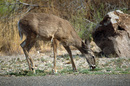
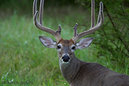
Odocoileus virginianus dorsal coloration differs in shading locally, seasonally, and among subspecies; however in general it is grayer in the winter and redder in the summer. White fur is located in a band behind the nose, in circles around the eyes, inside the ears, over the chin and throat, on the upper insides of the legs and beneath the tail. Whitetail deer have scent glands between the two parts of the hoof on all four feet, metatarsal glands on the outside of each hind leg, and a larger tarsal gland on the inside of each hind leg at the hock. Scent from these glands is used for intraspecies communication and secretions become especially strong during the rutting season. Males possess antlers which are shed from January to March and grow out again in April or May, losing their velvet in August or September. At birth, fawns are spotted with white in coloration and weight between 1.5 and 2.5 kg. Their coats become grayish lose their spots by their first winter. Whitetail deer have good eyesight and acute hearing, but depend mainly on their sense of smell to detect danger.
- Other Physical Features
- endothermic
- homoiothermic
- bilateral symmetry
- Sexual Dimorphism
- male larger
- ornamentation
-
- Range mass
- 57.0 to 137.0 kg
- 125.55 to 301.76 lb
-
- Range length
- 160.0 to 220.0 cm
- 62.99 to 86.61 in
-
- Average basal metabolic rate
- 123.447 W
- AnAge
Reproduction
- Mating System
- polygynous
Most whitetail deer (particularly males) mate in their second year, although some females occasionally mate as young as seven months. Bucks are polygamous although they may form an attachment and stay with a single doe for several days or even weeks until she reaches oestrus. Does are seasonally polyestrous and usually come into heat in November for a short twenty-four hour period. If a doe is not mated, a second estrus occurs approximately 28 days later. Mating occurs from October to December and gestation is approximately 6 and a half months. In her first year of breeding, a female generally has one fawn, but 2 per litter (occasionally 3 or 4) are born in subsequent years. Fawns are able to walk at birth and nibble on vegetation only a few days later.
- Key Reproductive Features
- iteroparous
- seasonal breeding
- gonochoric/gonochoristic/dioecious (sexes separate)
- sexual
- fertilization
- viviparous
-
- Breeding interval
- White-tailed deer breed once yearly.
-
- Breeding season
- Breeding occurs from October to December, fawns are born in the spring.
-
- Range number of offspring
- 1.0 to 3.0
-
- Average number of offspring
- 2
- AnAge
-
- Average gestation period
- 6.5 months
-
- Average gestation period
- 198 days
- AnAge
-
- Range weaning age
- 8.0 to 10.0 weeks
-
- Average age at sexual or reproductive maturity (female)
- 2.0 years
-
- Average age at sexual or reproductive maturity (female)
Sex: female - 309 days
- AnAge
- Average age at sexual or reproductive maturity (female)
-
- Average age at sexual or reproductive maturity (male)
- 2.0 years
-
- Average age at sexual or reproductive maturity (male)
Sex: male - 417 days
- AnAge
- Average age at sexual or reproductive maturity (male)
White-tailed females are very protective of their babies. When looking for food, females leave their offspring in a hiding place for about four hours at a time. While waiting for their mother to return, fawns lay flat on the ground with their necks outstretched, well camouflaged against the forest floor. Fawns begin to follow their mother on her foraging trips once they are about 4 weeks old and are fully ruminant at two months old. White-tailed deer fawns are nursed for 8 to 10 weeks before they are weaned. Young males leave their mother after one year but young females often stay with their mother for two years.
- Parental Investment
- precocial
-
pre-fertilization
- provisioning
-
protecting
- female
-
pre-hatching/birth
-
provisioning
- female
-
protecting
- female
-
provisioning
-
pre-weaning/fledging
-
provisioning
- female
-
protecting
- female
-
provisioning
-
pre-independence
-
protecting
- female
-
protecting
- post-independence association with parents
Lifespan/Longevity
Most white-tailed deer live about 2 to 3 years. Maximum life span in the wild is 20 years but few live past 10 years old.
-
- Typical lifespan
Status: wild - 10.0 (high) years
- Typical lifespan
-
- Average lifespan
Status: wild - 2.0 years
- Average lifespan
-
- Average lifespan
Status: captivity - 16.0 years
- Max Planck Institute for Demographic Research
- Average lifespan
-
- Average lifespan
Status: captivity - 23.0 years
- Max Planck Institute for Demographic Research
- Average lifespan
Behavior
Whitetail deer are the most nervous and shy of our deer. They wave their tails characteristically from side to side when they are startled and fleeing. They are extremely agile and may bound at speeds of up to 30 miles per hour through tangled terrain in a forest. Whitetail deer are also good swimmers and often enter large streams and lakes to escape predators or insects or to visit islands. Their home ranges are generally small, often a square kilometer or less. Whitetail deer do not migrate to a winter range but yard up in their own territories during heavy snow. They are notorious for continually using the same pathways when foraging, but will not bed down during the day in areas that they have used previously.
Whitetail deer are generally considered solitary, especially in summer. The basic social unit is a female and her fawns, although does have been observed to graze together in herds of up to hundreds of individuals. Females generally follow their mothers for about two years, but males leave the group within the first year. Bucks may form transient groups of 2-4 in the summer, but these disband prior to the mating season. Males begin rutting as early as September, and at this point become entirely preoccupied with obtaining matings. They do not guard harems (as with elk) but rather fight each other individually, clashing antlers to gain access to a particular female.
Whitetail does are painstakingly careful to keep their offspring hidden from predators. When foraging, females leave their offspring in dense vegetation for about four hours at a time. While waiting for the female to return, fawns lay flat on the ground with their necks outstretched, well camouflaged against the forest floor. Fawns withhold their feces and urine until the mother arrives, at which point she ingests whatever the fawn voids to deny predators any sign of the fawn.
Whitetail deer are not especially vocal, although young fawns bleat on occasion. Injured deer utter a startlingly loud "blatt" or bawl. Whistles or snorts of disturbed whitetails are the most commonly heard sounds.
- Key Behaviors
- cursorial
- terricolous
- crepuscular
- motile
- sedentary
- social
- dominance hierarchies
Communication and Perception
White-tailed deer have scent glands between the two parts of the hoof on all four feet, outside of each hind leg, and on the inside of each hind leg. Scent from these glands is used to communicate with other deer and secretions become especially strong during the mating season.
White-tailed deer produce several types of vocalizations such as grunts, wheezes, and bleats. These vocalizations, along with other sounds and postures, are used for communication (Smith, 1991). Injured deer utter a startlingly loud "blatt" or bawl. Whistles or snorts of disturbed white-tailed deer are the most commonly heard sounds.
- Other Communication Modes
- pheromones
- scent marks
Food Habits
Whitetail deer feed on a variety of vegetation, depending on what is available in their habitat. In eastern forests, buds and twigs of maple, sassafras, poplar, aspen and birch (to name a few) are consumed, as well as many shrubs. In desert areas, plants such as huajillo brush, yucca, prickly pear cactus, comal, ratama and various tough shrubs may be the main components of a whitetail's diet. Conifers are often utilized in winter when other foods are scarce. Whitetail deer are crepuscular, feeding mainly from before dawn until several hours after, and again from late afternoon until dusk.
- Primary Diet
- herbivore
Predation
White-tailed deer have good eyesight and acute hearing, but depend mainly on their sense of smell to detect danger and their ability to run and bound quickly through dense vegetation to escape danger. White-tailed deer are preyed on by large predators such as humans, wolves, mountain lions, bears, jaguars, and coyotes.
-
- Known Predators
-
- humans (Homo sapiens)
- gray wolves (Canis lupus)
- mountain lions (Puma concolor)
- coyotes (Canis latrans)
- bears (Ursidae)
- jaguars (Panthera onca)
Ecosystem Roles
White-tailed deer can greatly influence the composition of plant communities through their grazing, especially where they are abundant. In severe winters white-tailed deer can be responsible for girdling and killing large numbers of trees. White-tailed deer are also important prey animals for a number of large predators.
Economic Importance for Humans: Positive
Whitetail deer are commonly hunted for meat and sport. Early settlers and Native Americans also utilized whitetail deer hides to make buckskin leather. Whitetail heads are also commonly mounted on the walls of lodges and other places of outdoor recreation.
- Positive Impacts
- food
Economic Importance for Humans: Negative
Whitetail deer are destructive to crops, vegetable gardens, fruit trees, and ornamental plants where their ranges overlap with human habitation. When their numbers become too high, whitetail deer can cause serious damage to forest vegetation through overbrowsing. They are involved in accidents with cars, often resulting in serious injury to the human occupants of the vehicles.
Whitetail deer are important as vectors disease because they serve as hosts to the ticks which carry the bacteria responsible Lyme disease. This has become an increasingly common disease in certain parts of the United States, especially the northeastern states.
Conservation Status
Whitetail deer are extremely common throughout their ranges and are the most numerous of the large North American mammals. Precise estimates of their numbers have not been made, but there are probably somewhere between 8 and 15 million on this continent. Although their populations were decimated to the point of extinction in many areas at the turn of the century (due to overhunting), they have recently reached their highest numbers due to the improvement of their habitat by the cutting of climax forests, providing them with a greater amount of brush and shrubs on which to forage.
-
- IUCN Red List
-
Least Concern
More information
-
- IUCN Red List
-
Least Concern
More information
-
- US Federal List
- No special status
-
- CITES
- No special status
-
- State of Michigan List
- No special status
Contributors
Tanya Dewey (author, editor), Animal Diversity Web, (author).
Glossary
- Nearctic
-
living in the Nearctic biogeographic province, the northern part of the New World. This includes Greenland, the Canadian Arctic islands, and all of the North American as far south as the highlands of central Mexico.

- Neotropical
-
living in the southern part of the New World. In other words, Central and South America.
- acoustic
-
uses sound to communicate
- bilateral symmetry
-
having body symmetry such that the animal can be divided in one plane into two mirror-image halves. Animals with bilateral symmetry have dorsal and ventral sides, as well as anterior and posterior ends. Synapomorphy of the Bilateria.
- chaparral
-
Found in coastal areas between 30 and 40 degrees latitude, in areas with a Mediterranean climate. Vegetation is dominated by stands of dense, spiny shrubs with tough (hard or waxy) evergreen leaves. May be maintained by periodic fire. In South America it includes the scrub ecotone between forest and paramo.
- chemical
-
uses smells or other chemicals to communicate
- crepuscular
-
active at dawn and dusk
- dominance hierarchies
-
ranking system or pecking order among members of a long-term social group, where dominance status affects access to resources or mates
- endothermic
-
animals that use metabolically generated heat to regulate body temperature independently of ambient temperature. Endothermy is a synapomorphy of the Mammalia, although it may have arisen in a (now extinct) synapsid ancestor; the fossil record does not distinguish these possibilities. Convergent in birds.
- fertilization
-
union of egg and spermatozoan
- food
-
A substance that provides both nutrients and energy to a living thing.
- forest
-
forest biomes are dominated by trees, otherwise forest biomes can vary widely in amount of precipitation and seasonality.
- herbivore
-
An animal that eats mainly plants or parts of plants.
- iteroparous
-
offspring are produced in more than one group (litters, clutches, etc.) and across multiple seasons (or other periods hospitable to reproduction). Iteroparous animals must, by definition, survive over multiple seasons (or periodic condition changes).
- motile
-
having the capacity to move from one place to another.
- native range
-
the area in which the animal is naturally found, the region in which it is endemic.
- pheromones
-
chemicals released into air or water that are detected by and responded to by other animals of the same species
- polygynous
-
having more than one female as a mate at one time
- rainforest
-
rainforests, both temperate and tropical, are dominated by trees often forming a closed canopy with little light reaching the ground. Epiphytes and climbing plants are also abundant. Precipitation is typically not limiting, but may be somewhat seasonal.
- scent marks
-
communicates by producing scents from special gland(s) and placing them on a surface whether others can smell or taste them
- scrub forest
-
scrub forests develop in areas that experience dry seasons.
- seasonal breeding
-
breeding is confined to a particular season
- sedentary
-
remains in the same area
- sexual
-
reproduction that includes combining the genetic contribution of two individuals, a male and a female
- sexual ornamentation
-
one of the sexes (usually males) has special physical structures used in courting the other sex or fighting the same sex. For example: antlers, elongated tails, special spurs.
- social
-
associates with others of its species; forms social groups.
- swamp
-
a wetland area that may be permanently or intermittently covered in water, often dominated by woody vegetation.
- tactile
-
uses touch to communicate
- temperate
-
that region of the Earth between 23.5 degrees North and 60 degrees North (between the Tropic of Cancer and the Arctic Circle) and between 23.5 degrees South and 60 degrees South (between the Tropic of Capricorn and the Antarctic Circle).
- tropical
-
the region of the earth that surrounds the equator, from 23.5 degrees north to 23.5 degrees south.
- visual
-
uses sight to communicate
- viviparous
-
reproduction in which fertilization and development take place within the female body and the developing embryo derives nourishment from the female.
- young precocial
-
young are relatively well-developed when born
References
Banfield, A.W.F. 1974. The Mammals of Canada. University of Toronto Press, Toronto.
Darymple, B.W. 1985. North American Big-Game Animals. Outdoor Life Books, New York.
Nowak, R.M. and J.L Paradiso. 1983. Walker's Mammals of the World. 4th edition. John Hopkins University Press, Baltimore, MD.
Geist, V. 1979. Hoofed mammals. In: Wild Animals of North America. National Geographic Society, Washington, D.C.
"White-tail World.Com" (On-line). Accessed May, 2001 at http://www.kerrlake.com/deer/index.htm.
Smith, P. 1991. Odocoileus virginianus. Mammalian Species, 388: 1-13.