Octodontidaedegus, rock rats, and viscacha rats
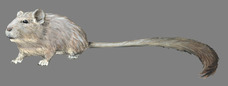
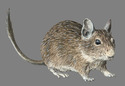
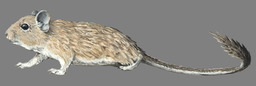

This family contains 9 species placed in 6 genera. They are found in Peru, Bolivia, Chile, and Argentina, occupying habitats ranging from coastal scrub at sea level to barren rocky outcrops at around 3500 m elevation.
Octodontids are small, rat-like rodents, with head and body up to around 200 mm in length, and 300 gms weight. Their tails are long, frequently tufted in scansorial species and short in fossorial ones. They are easily lost in encounters with predators. Members of this family have large heads, pointed noses, and moderately large and rounded ears. Long vibrissae arise from the face. The legs are short; the forefeet have 4 digits and the hindfeet 5; and the toes end in sharp, curved claws. The bodies of octodontids are usually covered with long, dense, and silky fur with well-developed underfur. Dense short hairs cover the tail; these increase in length toward the tip. A "comb" of stiff hairs extends slightly beyond the middle digits of the hind feet. Most species are grayish above and paler below, but one, Spalacopus, is almost entirely black.
The skulls of octodontids are relatively stout and angular in appearance. They are hystricomorphous and strongly hystricognathous, with the angular process markedly deflected. The dentary has a well-developed coronoid process. The zygomatic arch is simple and the jugal does not contact the lacrimal. A small canal separate from the infraorbital carries nerves to the face. The bullae are large except in the most fossorial forms, and the paroccipital processes are short and fused to the bullae. The dental formula of octodontids is 1/1, 0/0, 1/1, 3/3 = 20. Incisors are fairly strongly developed, and the cheekteeth are flat crowned, hypsodont, and distinctively "8"-shaped due to single labial and lingual folds (these folds are very shallow in Octodontomys).


All species are good diggers and live in burrows, but some genera ( Aconaemys and especially Spalacopus) are extremely fossorial, with the small limbs and fusiform bodies typical of rodents that spend most of their lives underground. Most live in colonies; some show complex social behavior. All are primarily herbivorous. Degus ( Octodon) are agricultural pests in some areas. Degus are unusual in that most of their activity is apparently diurnal.
References and literature cited:
Feldhamer, G. A., L. C. Drickamer, S. H. Vessey, and J. F. Merritt. 1999. Mammalogy. Adaptation, Diversity, and Ecology. WCB McGraw-Hill, Boston. xii+563pp.
Lawlor, Timothy. 1979. Handbook to the orders and families of living mammals. Mad River Press, Eureka, California.
Macdonald, David. 1984. The encyclopedia of mammals. Facts on File Publications, New York.
Nowak, Ronald M. and John L. Paradiso. 1983. Walker's mammals of the world. The Johns Hopkins University Press, Baltimore and London, pp 803-810.
Vaughan, T. A. 1986. Mammalogy. Third Edition. Saunders College Publishing, Fort Worth. vii+576 pp.
Vaughan, T. A., J. M. Ryan, N. J. Czaplewski. 2000. Mammalogy. Fourth Edition. Saunders College Publishing, Philadelphia. vii+565pp.
Wilson, Don E. and DeeAnn M. Reeder (eds.). 1993. Mammal species of the world: A taxonomic and geographic reference, 2nd ed.. Smithsonian Institution Press, Washington and London.
Woods, C. A. 1984. Hystricognath rodents. Pp. 389-446 in Anderson, Sydney and J. Know Jones, Jr. (eds.). Orders and familes of mammals of the world. John Wiley and Sons, New York.
Contributors
Phil Myers (author), Museum of Zoology, University of Michigan-Ann Arbor.
Glossary
- bilateral symmetry
-
having body symmetry such that the animal can be divided in one plane into two mirror-image halves. Animals with bilateral symmetry have dorsal and ventral sides, as well as anterior and posterior ends. Synapomorphy of the Bilateria.
- chemical
-
uses smells or other chemicals to communicate
- endothermic
-
animals that use metabolically generated heat to regulate body temperature independently of ambient temperature. Endothermy is a synapomorphy of the Mammalia, although it may have arisen in a (now extinct) synapsid ancestor; the fossil record does not distinguish these possibilities. Convergent in birds.
- motile
-
having the capacity to move from one place to another.
- sexual
-
reproduction that includes combining the genetic contribution of two individuals, a male and a female
- tactile
-
uses touch to communicate