Noctilionidaebulldog bats


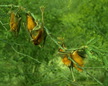

Two species (placed in a single genus) make up this family, the members of which are called bull-dog or mastiff bats. Noctilionids are medium-sized bats, often brightly colored (varying from bright rufous in males to drab gray-brown in females). The region around the mouth is distinctive. The lips are full and form cheek pouches, in which the bats store food as they feed while flying. A uropatagium extends somewhat beyond the knees. The tail of bulldog bats runs through the uropatagium for about half the length of the membrane, then exits dorsally, and the terminal part of the tail is free. The feet and claws range from relatively large (Noctilio albiventris) to relatively enormous (Noctilio leporinus) in size, and the legs are proportionately longer than in most other bats. The ears are moderately large and a tragus is present.
Bulldog bats have a pungent odor, described by some investigators as "fishy."
In the skull, the premaxillae are fused with each other and with the maxillae, and both nasal and palatal branches of the premaxillae are present (the latter very small and indistinct in adults). The auditory bullae are small. Postorbital processes, found in many other kinds of bats, are completely lacking. The dental formula of noctilionids is 2/2, 1/1, 1/2, 3/3 = 34; and the molars are dilambdodont.

Both species of noctilionids feed on insects, and N. leporinus takes fish, frogs, and crustaceans as well. To capture fish, these bats use their echolocation to locate exposed fins or ripples made by fish swimming near the surface. They then drag their claws through these ripples. Their hind claws are unusually large and sharp and serve as efficient gaffs. Once out of the water, the fish is carried to a perch, where it is eaten by the bat. Noctilio leporinus may also capture insects and crustaceans on the surface of the water.
These bats usually roost near water, often in hollow trees or in deep cracks in rocks.
Bulldog bats are a Neotropical group, found from northern Mexico, through Central America, south to Paraguay and northern Argentina. Few fossils are available, and those that are known are from the Pleistocene. Bulldog bats may be related to two other New World families, Phyllostomidae and Mormoopidae.
Literature and references cited
Feldhamer, G. A., L. C. Drickamer, S. H. Vessey, and J. F. Merritt. 1999. Mammalogy. Adaptation, Diversity, and Ecology. WCB McGraw-Hill, Boston. xii+563pp.
Hill, J. E., and J. D. Smith. 1984. Bats, a Natural History. University of Texas Press, Austin. 243 pp.
Koopman, K.F. 1984. Bats. Pp. 145-186 in Anderson, S. and J. K. Jones, Jr. (eds). Orders and Families of Recent Mammals of the World. John Wiley and Sons, N.Y. xii+686 pp.
Vaughan, T. A., J. M. Ryan, N. J. Czaplewski. 2000. Mammalogy. Fourth Edition. Saunders College Publishing, Philadelphia. vii+565pp.
Wilson, D. E., and D. M. Reeder. 1993. Mammal Species of the World, A Taxonomic and Geographic Reference. 2nd edition. Smithsonian Institution Press, Washington. xviii+1206 pp.
Contributors
Phil Myers (author), Museum of Zoology, University of Michigan-Ann Arbor.
Glossary
- bilateral symmetry
-
having body symmetry such that the animal can be divided in one plane into two mirror-image halves. Animals with bilateral symmetry have dorsal and ventral sides, as well as anterior and posterior ends. Synapomorphy of the Bilateria.
- chemical
-
uses smells or other chemicals to communicate
- endothermic
-
animals that use metabolically generated heat to regulate body temperature independently of ambient temperature. Endothermy is a synapomorphy of the Mammalia, although it may have arisen in a (now extinct) synapsid ancestor; the fossil record does not distinguish these possibilities. Convergent in birds.
- motile
-
having the capacity to move from one place to another.
- sexual
-
reproduction that includes combining the genetic contribution of two individuals, a male and a female
- tactile
-
uses touch to communicate