NandiniidaeAfrican palm civet
Diversity
The family Nandiniidae contains just one genus and species, Nandinia binotata, the African palm civet. (Wozencraft, 2005)
Geographic Range
African palm civets are distributed across sub-Saharan Africa, from southern Sudan to Guinea-Bissau and southward to eastern Zimbabwe and northern Angola. (Kingdon, 1988; Nowak, 1999)
Habitat
African palm civets are forest-dwelling mammals that spend the majority of their time in trees. Occasionally they cross open areas in search of food. (Kingdon, 1988)
- Habitat Regions
- tropical
- terrestrial
- Terrestrial Biomes
- forest
Physical Description
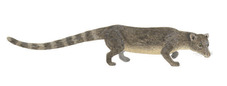
African palm civets are small, muscular carnivores, with powerful limbs and long, sturdy tails suited to agility in the treetops. These animals range in length from 440 to 580 mm, with the tail adding another 460 to 620 mm. Weight ranges from 1.7 to 5 kg, with males at the high end of this range. African palm civets have short, round ears and yellow eyes with pupils that narrow to a slit in sunlight. The claws are sharp, curved, and fully retractile. The soft, woolly coat gives these animals protection from the elements and the coloration provides camouflage: it is gray or brown and mottled with darker brown on the lower back, and the underparts are grayish-yellow. The tail is darker than the body and ringed with black. There are scent glands between the toes, on the palms, on the abdomen, and possibly on the chin. (Kingdon, 1988; Nowak, 1999; Wiig, 1985)
Nandinia can be set apart from other living feliform taxa by the primitive condition of its basicranium and auditory bulla. The bulla is not inflated and is single-chambered, and the paroccipital process is directed caudally and does not contact the bulla. Also, the caudal entotympanic is cartilaginous, which is a feature unknown in any other living carnivore. (Kingdon, 1988; Nowak, 1999; Wiig, 1985)
- Other Physical Features
- endothermic
- homoiothermic
- bilateral symmetry
- Sexual Dimorphism
- male larger
Reproduction
The mating system of African palm civets has not been reported, but they are presumed to be polygynous based on the fact that one adult male territory usually overlaps several adult female territories. Both males and females have been heard emitting loud cries during courtship. (Kingdon, 1988; Nowak, 1999)
- Mating System
- polygynous
African palm civets breed year round, with peak births in May and October. The gestation period is 64 days. Usually there are two young per litter, but litters of up to four have been reported. These animals reach sexual maturity at three years of age. (Kingdon, 1988; Nowak, 1999)
- Key Reproductive Features
- iteroparous
- year-round breeding
- gonochoric/gonochoristic/dioecious (sexes separate)
- sexual
- fertilization
- viviparous
Like all eutherian mammals, female African palm civets nourish their young through the placenta before giving birth, and then with milk afterwards. Males make no investment in their offspring besides providing sperm. For bearing young, females seek out arboreal shelters such as tree hollows. Age to weaning has not been reported, but it is known that male offspring leave their mothers' territories immediately afterward. Young females may remain somewhat longer. (Kingdon, 1988; Nowak, 1999)
- Parental Investment
-
pre-fertilization
- provisioning
-
protecting
- female
-
pre-hatching/birth
-
provisioning
- female
-
protecting
- female
-
provisioning
-
pre-weaning/fledging
-
provisioning
- female
-
protecting
- female
-
provisioning
-
pre-independence
-
protecting
- female
-
protecting
- post-independence association with parents
Lifespan/Longevity
The typical lifespan of wild African palm civets is not known. A longevity record of 15.8 years has been established in captivity. (Nowak, 1999)
Behavior
African palm civets are chiefly arboreal. They eat, sleep, and raise their young in the trees, usually between 10 and 30 meters off the ground. They are swift and agile climbers. These animals are nocturnal, sleeping on branches during the day and foraging at night. Peak activity occurs in the first four hours after dusk and in the hours just before dawn. (Kingdon, 1988; Nowak, 1999)
African palm civets are solitary and territorial, with adult females maintaining 45 hectare territories exclusive of other adult females, and adult males maintaining 100 hectare territories exclusive of other adult males. One male territory may overlap several female territories. Territorial encounters may be so severe that they result in the death of one of the combattants. Despite the establishment of territories, African palm civets may be somewhat nomadic, as they have been known to aggregate in forest patches with fruiting trees. The only true social bonds, however, are those between mothers and their young. (Kingdon, 1988; Nowak, 1999)
Communication and Perception
African palm civets sense visual, chemical, auditory, and tactile stimuli, as do other carnivores. Olfaction is particularly well-developed, and scent is the primary means of communication. Glands on the palms and between the toes leave scent trails when these animals walk along branches. Individuals have been observed rubbing their chins on tree bark, either to pick up scents from others or to leave their own. A strong-smelling brown secretion is produced by an area of glandular skin on the lower abdomen; this is also used for scent-marking. In addition, females have scent glands in the skin overlaying the mammary glands. Secretions from these scent glands stain the fur of the belly a bright orange-yellow and rub off on the nursing young. This scent appears to repel sexual approaches by males and perhaps neutralizes attacks on the young. African palm civets also communicate through vocalizations. Males and females cry out during courtship, and females "meow" to call their young. Nursing young purr like cats, a possible tactile form of communication. (Kingdon, 1988; Nowak, 1999)
- Other Communication Modes
- scent marks
Food Habits
African palm civets are omnivores, with fruit making up the largest portion of their diet. They also feed on small mammals, birds, bird eggs, and insects. They primarily forage in trees, but may also search for fallen fruit on the forest floor. African palm civets do not attack active birds and mammals, preferring to capture these larger prey animals when they are sleeping. They hold their prey steady with their forearms while they deliver a quick series of killing bites, after which they may swallow their food whole. (Kingdon, 1988; Nowak, 1999)
- Primary Diet
- omnivore
Predation
Potential predators of African palm civets include diurnal raptors, pythons, and leopards. African palm civets avoid predation through cryptic coloration and agility in the trees. (Kingdon, 1988; Nowak, 1999)
- Anti-predator Adaptations
- cryptic
-
- Known Predators
-
- diurnal raptors (Accipitridae)
- pythons (Python)
- leopards (Panthera pardus)
Ecosystem Roles
African palm civets are primary and higher-level consumers, because they eat both fruit and animals. They are also prey themselves for raptors, pythons, and leopards. (Kingdon, 1988; Nowak, 1999)
Economic Importance for Humans: Positive
Humans occasionally tame African palm civets and keep them in their homes to control rodents and cockroaches. (Nowak, 1999)
- Positive Impacts
- controls pest population
Economic Importance for Humans: Negative
Palm civets frequent chicken coops and steal roosting poultry. (Kingdon, 1988)
Conservation Status
Nandinia is classified as lower risk by the IUCN. African palm civets are still common and widespread. (IUCN, 2006)
-
- IUCN Red List [Link]
- Not Evaluated
Contributors
Tanya Dewey (editor), Animal Diversity Web.
Allison Poor (author), University of Michigan-Ann Arbor.
Glossary
- Ethiopian
-
living in sub-Saharan Africa (south of 30 degrees north) and Madagascar.

- acoustic
-
uses sound to communicate
- arboreal
-
Referring to an animal that lives in trees; tree-climbing.
- bilateral symmetry
-
having body symmetry such that the animal can be divided in one plane into two mirror-image halves. Animals with bilateral symmetry have dorsal and ventral sides, as well as anterior and posterior ends. Synapomorphy of the Bilateria.
- chemical
-
uses smells or other chemicals to communicate
- cryptic
-
having markings, coloration, shapes, or other features that cause an animal to be camouflaged in its natural environment; being difficult to see or otherwise detect.
- endothermic
-
animals that use metabolically generated heat to regulate body temperature independently of ambient temperature. Endothermy is a synapomorphy of the Mammalia, although it may have arisen in a (now extinct) synapsid ancestor; the fossil record does not distinguish these possibilities. Convergent in birds.
- fertilization
-
union of egg and spermatozoan
- forest
-
forest biomes are dominated by trees, otherwise forest biomes can vary widely in amount of precipitation and seasonality.
- iteroparous
-
offspring are produced in more than one group (litters, clutches, etc.) and across multiple seasons (or other periods hospitable to reproduction). Iteroparous animals must, by definition, survive over multiple seasons (or periodic condition changes).
- motile
-
having the capacity to move from one place to another.
- native range
-
the area in which the animal is naturally found, the region in which it is endemic.
- nocturnal
-
active during the night
- nomadic
-
generally wanders from place to place, usually within a well-defined range.
- omnivore
-
an animal that mainly eats all kinds of things, including plants and animals
- polygynous
-
having more than one female as a mate at one time
- scent marks
-
communicates by producing scents from special gland(s) and placing them on a surface whether others can smell or taste them
- sexual
-
reproduction that includes combining the genetic contribution of two individuals, a male and a female
- solitary
-
lives alone
- tactile
-
uses touch to communicate
- terrestrial
-
Living on the ground.
- territorial
-
defends an area within the home range, occupied by a single animals or group of animals of the same species and held through overt defense, display, or advertisement
- tropical
-
the region of the earth that surrounds the equator, from 23.5 degrees north to 23.5 degrees south.
- visual
-
uses sight to communicate
- viviparous
-
reproduction in which fertilization and development take place within the female body and the developing embryo derives nourishment from the female.
- year-round breeding
-
breeding takes place throughout the year
References
Coetzee, C. 1977. Order Carnivora. Part 8. Pp. 1-42 in J Meester, H Setzer, eds. The Mammals of Africa: An Identification Manual. Washington, D. C.: Smithsonian Institution Press.
Flynn, J., J. Finarelli, S. Zehr, J. Hsu, M. Nedbal. 2005. Molecular phylogeny of the Carnivora (Mammalia): Assessing the impact of increased sampling on resolving enigmatic relationships. Systematic Biology, 54(2): 317-337.
Gaubert, P., W. Wozencraft, P. Cordeiro-Estrela, G. Veron. 2005. Mosaics of convergences and noise in morphological phylogenies: What's in a viverrid-like carnivoran?. Systematic Biology, 54(6): 865-894.
Hunt, R. 1987. Evolution of the Aeluoid Carnivora: Significance of auditory structure in the Nimravid Cat Dinictis. American Museum Novitates, 2886: 1-74.
Hunt, R. 1974. The auditory bulla in Carnivora: An anatomical basis for reappraisal of Carnivore evolution. Journal of Morphology, 143: 21-76.
IUCN, 2006. "2006 IUCN Red List of Threatened Species" (On-line). Accessed September 20, 2006 at www.redlist.org.
Kingdon, J. 1988. East African Mammals: An Atlas of Evolution in Africa, Volume 3, Part A: Carnivores. Chicago: University of Chicago Press.
Nowak, R. 1999. Walker's Mammals of the World. Baltimore and London: The Johns Hopkins University Press.
Pocock, R. 1915. On the feet and glands and other external characters of the Paradoxurinae Genera Paradoxurus, Arctictis, Arctogalidia, and Nandinia. Proceedings of the Zoological Society of London, 1915: 387-412.
Wiig, O. 1985. Relationship of Nandinia binotata (Gray) to the Superfamily Feloidea (Mammalia, Carnivora). Zoologica Scripta, 14(2): 155-159.
Wozencraft, W. 1993. Order Carnivora. Pp. 279-348 in D Wilson, D Reeder, eds. Mammal Species of the World. Washington, D. C.: Smithsonian Institution Press.
Wozencraft, W. 2005. Order Carnivora. Pp. 532-628 in D Wilson, D Reeder, eds. Mammal Species of the World. Baltimore and London: Johns Hopkins University Press.
Yoder, A., M. Burns, S. Zehr, T. Delefosse, G. Veron, S. Goodman, J. Flynn. 2003. Single origin of Malagasy Carnivora from an African ancestor. Nature, 421: 734-737.