Myrmecophaga tridactylagiant anteater


Geographic Range
Giant anteaters are found in Central and South America, from southern Belize and Guatemala to northern Argentina. (Redford and Eisenberg, 1992)
- Biogeographic Regions
- neotropical
Habitat
Giant anteaters use a variety of habitats, including swamp, forests, and grasslands. They choose secluded, covered areas for sleeping. Giant anteaters can be found in both rural and densely populated areas. (Shaw, et al., 1987; Anderson, 1967)
- Habitat Regions
- tropical
- terrestrial
- Terrestrial Biomes
- savanna or grassland
Physical Description
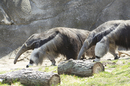
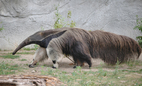
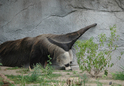
Giant anteaters are quite distinctive morphologically, they are the largest of the anteater species. The snout is long (up to 45 cm in length) and the skull is streamlined with small eyes and ears. The tail is large and bushy and is nearly as long as the body. Head and body length measures 1,000 to 1,200 mm and tail length 650 to 900 mm. Weight ranges from 18 to 39 kg. Giant anteaters have fur that is thick and coarse and longer towards the tail. Their coat is brown with black and white stripes on the shoulders and a crest of hair along the middle of the back. The forelegs are white with black bands at the toes. Their hindfeet have 5 short claws, while their forefeet have 5 claws with the inner 3 being very long and sharp. They walk on the wrists of their forefeet, with these large claws curled out of the way. Giant anteaters have no teeth. The tongue can be extended 610 mm outside of the mouth and has spine-like protrusions. (Naples, 1999; Shaw, et al., 1987)
- Other Physical Features
- endothermic
- homoiothermic
- bilateral symmetry
- Sexual Dimorphism
- sexes alike
-
- Range mass
- 18 to 39 kg
- 39.65 to 85.90 lb
-
- Range length
- 1 to 1.2 m
- 3.28 to 3.94 ft
-
- Average basal metabolic rate
- 14.543 W
- AnAge
Reproduction
The mating system of M. tridactyla is not known. Reproductive behavior is primarily observed in captivity. The male stands over the female who lays on her side during copulation. (Jones, 1982)
Gestation is approximately 190 days, after which females give birth to a single young which weighs about 1.3 kg. Females give birth standing up and immediately the young anteater climbs onto her back. Young are born with a full coat of hair and adult-like markings. Breeding occurs year-round in captivity and the wild, though seasonal breeding times have been reported in portions of their range. Inter-birth intervals can be as low as 9 months. Sexual maturity is reached between 2.5 and 4 years. The mammary glands are lateral to the 'armpits' on the chest. (Shaw, et al., 1987; Redford and Eisenberg, 1992; Nowak, 1999)
- Key Reproductive Features
- iteroparous
- seasonal breeding
- year-round breeding
- gonochoric/gonochoristic/dioecious (sexes separate)
- sexual
- viviparous
-
- Breeding interval
- Giant anteaters can breed as often as every 9 months, though it is often longer.
-
- Breeding season
- Giant anteaters may breed year round, or seasonally depending on region.
-
- Average number of offspring
- 1
-
- Average number of offspring
- 1
- AnAge
-
- Average gestation period
- 190 days
-
- Average gestation period
- 184 days
- AnAge
-
- Average weaning age
- 6 months
-
- Average time to independence
- 24 months
-
- Range age at sexual or reproductive maturity (female)
- 2.5 to 4 years
-
- Range age at sexual or reproductive maturity (male)
- 2.5 to 4 years
Young are born with a full coat of hair and adult markings and are capable of clinging to their mother at birth. A mother will carry the baby on her back until it is almost half her size, about 6 to 9 months. Young suckle for 2 to 6 months. They become independent after about 2 years, or when the mother becomes pregnant again, which may be sooner. (Nowak, 1999)
- Parental Investment
- precocial
- female parental care
Lifespan/Longevity
Giant anteaters have been known to live up to 25 years and 10 months in captivity. Their longevity in the wild is unknown. (Jones, 1982)
-
- Range lifespan
Status: captivity - 25 (high) years
- Range lifespan
-
- Average lifespan
Status: captivity - 26.0 years
- Max Planck Institute for Demographic Research
- Average lifespan
-
- Average lifespan
Status: captivity - 25.8 years
- Max Planck Institute for Demographic Research
- Average lifespan
Behavior
Giant anteaters are usually solitary, except for mother-young pairs, only coming together for brief periods for courtship and agonistic encounters. They may have large, defined home ranges up to 9,000 ha in area, but they also wander extensively. When giant anteaters encounter each other in the wild they often simply ignore each other or run away, though agonistic encounters do also occur. Usually diurnal, giant anteaters will become nocturnal in areas of high human density or during certain kinds of weather. They are terrestrial but are good swimmers as well and, though they don't often climb in the wild, they are reported to be skilled at climbing out of enclosures in captivity. Sleeping occurs in abandoned burrows, dense vegetation, or depressions in the ground. Although they have the ability to dig well, they do not construct burrows. When fights occur individuals rear into a bipedal stance using the tail to balance and the forelimbs to fight. They shuffle while walking and move slowly but are capable of running quickly if necessary. Their weight is born on the knuckles and wrist to protect the claws. (Shaw, et al., 1987; Anderson, 1967)
Home Range
Home ranges may be as big as 9,000 hectares in area. (Redford and Eisenberg, 1992; Nowak, 1999)
Communication and Perception
Most communication occurs between young and their mothers or during fighting. It consists of snorts, sniffs, and hisses, as well as roaring during fights. Sight and hearing are diminished. Smell is highly developed-40 times that of humans. (Shaw, et al., 1987; Redford and Eisenberg, 1992)
Food Habits
Giant anteaters eat ants, termites, and soft-bodied grubs. Using the long, sharp claws on their forelimbs, they open insect colonies and tree trunks. They then use the tongue to collect the eggs, larvae, and adult insects. The salivary glands secrete sticky saliva during feeding that coats the tongue. They only stay at one ant colony for a short period of time because soldier ants arrive but giant anteaters can consume a few thousand insects in minutes. The tongue is attached to the sternum and moves very quickly, flicking 150 times per minute. They may sometimes eat fruit. (Naples, 1999)
- Primary Diet
- carnivore
- Animal Foods
- insects
- Plant Foods
- fruit
Predation
Giant anteaters can use their immense front claws to defend themselves from predators, though their typical response to threat is to run away. Their size makes them invulnerable to all but the largest of predators, jaguars and pumas primarily. They are often killed by humans, either intentionally through hunting or unintentionally through collisions with cars. (Nowak, 1999)
-
- Known Predators
-
- Jaguars (Panthera onca)
- mountain lions (Puma concolor)
Ecosystem Roles
Giant anteaters, through their diet, have an enormous impact on local insect communities. (Nowak, 1999)
Economic Importance for Humans: Positive
Giant anteaters are hunted for food, fur, and sport. They are also valuable for the criical ecosystem roles they play. (Shaw, et al., 1987; Anderson, 1967)
- Positive Impacts
- body parts are source of valuable material
- controls pest population
Economic Importance for Humans: Negative
Giant anteaters are increasingly killed in car accidents. ("Rainforest Conservation Fund: Species Data for Giant Anteater", 2001)
Conservation Status
Habitat destruction is the primary threat to giant anteaters. They are listed as Appendix II by the Convention on International Trade in Endangered Species (CITES). Appendix II is defined as a species not necessarily threatened to extinction but one that should be controlled in trade to avoid overuse. They are listed as vulnerable by the International Union for Conservation of Nature and Natural Resources (IUCN). 'Vulnerable' is defined as an estimated population reduction of 20% in the next 10 years. ("Convention on International Trade in Endangered Species of Wild Flora and Fauna", 2003; "International Union for Conservation of Nature and Natural Resources", 1997)
-
- IUCN Red List
-
Vulnerable
More information
-
- IUCN Red List
-
Vulnerable
More information
-
- CITES
- Appendix II
Contributors
Amy Woltanski (author), Michigan State University, Barbara Lundrigan (editor), Michigan State University.
Glossary
- Neotropical
-
living in the southern part of the New World. In other words, Central and South America.

- acoustic
-
uses sound to communicate
- bilateral symmetry
-
having body symmetry such that the animal can be divided in one plane into two mirror-image halves. Animals with bilateral symmetry have dorsal and ventral sides, as well as anterior and posterior ends. Synapomorphy of the Bilateria.
- carnivore
-
an animal that mainly eats meat
- chemical
-
uses smells or other chemicals to communicate
- diurnal
-
- active during the day, 2. lasting for one day.
- endothermic
-
animals that use metabolically generated heat to regulate body temperature independently of ambient temperature. Endothermy is a synapomorphy of the Mammalia, although it may have arisen in a (now extinct) synapsid ancestor; the fossil record does not distinguish these possibilities. Convergent in birds.
- female parental care
-
parental care is carried out by females
- insectivore
-
An animal that eats mainly insects or spiders.
- iteroparous
-
offspring are produced in more than one group (litters, clutches, etc.) and across multiple seasons (or other periods hospitable to reproduction). Iteroparous animals must, by definition, survive over multiple seasons (or periodic condition changes).
- motile
-
having the capacity to move from one place to another.
- nomadic
-
generally wanders from place to place, usually within a well-defined range.
- seasonal breeding
-
breeding is confined to a particular season
- sexual
-
reproduction that includes combining the genetic contribution of two individuals, a male and a female
- solitary
-
lives alone
- tactile
-
uses touch to communicate
- terrestrial
-
Living on the ground.
- tropical
-
the region of the earth that surrounds the equator, from 23.5 degrees north to 23.5 degrees south.
- tropical savanna and grassland
-
A terrestrial biome. Savannas are grasslands with scattered individual trees that do not form a closed canopy. Extensive savannas are found in parts of subtropical and tropical Africa and South America, and in Australia.
- savanna
-
A grassland with scattered trees or scattered clumps of trees, a type of community intermediate between grassland and forest. See also Tropical savanna and grassland biome.
- temperate grassland
-
A terrestrial biome found in temperate latitudes (>23.5° N or S latitude). Vegetation is made up mostly of grasses, the height and species diversity of which depend largely on the amount of moisture available. Fire and grazing are important in the long-term maintenance of grasslands.
- visual
-
uses sight to communicate
- viviparous
-
reproduction in which fertilization and development take place within the female body and the developing embryo derives nourishment from the female.
- year-round breeding
-
breeding takes place throughout the year
- young precocial
-
young are relatively well-developed when born
References
CITES Secretariat. 2003. "Convention on International Trade in Endangered Species of Wild Flora and Fauna" (On-line ). Accessed 02/02/03 at http://www.cites.org.
IUCN. 1997. "International Union for Conservation of Nature and Natural Resources" (On-line ). Accessed 02/02/03 at http://www.redlist.org.
Rain Forest Conservation Fund. 2001. "Rainforest Conservation Fund: Species Data for Giant Anteater" (On-line ). Accessed 02/02/03 at http://www.rainforestconservation.org/data_sheets/mammals/anteater.html.
Anderson, S. 1967. Recent Mammals of the World. New York: The Ronald Press Company.
Jones, M. 1982. Longevity of captive mammals. Zool. Garten, 52: 113-128.
Naples, V. 1999. Morphology, evolution, and function of feeding in the giant anteater. Journal of Zoology-London, 249: 19-41.
Nowak, R. 1999. Walker's Mammals of the World, Volume I. Baltimore and London: The Johns Hopkins University Press.
Redford, K., J. Eisenberg. 1992. Mammals of the Neotropics. Chicago, IL: University of Chicago Press.
Shaw, , Machado-Neto, Carter. 1987. Behavior of free-living giant anteaters. Biotropica, 19(3): 255-259.