Myotis sodalisIndiana bat

Geographic Range
Myotis sodalis, also known as the Indiana bat, is found only in North America. Their range spans from Iowa, Missouri, and northern Arkansas east to western Virginia and North Carolina, and north into New York, Vermont, New Hampshire, and Massachusetts. These areas include both their winter hibernation sites and summer ranges. Indiana bats hibernate in the northern reaches of their range in caves during the winter. In the summer and autumn months Myotis sodalis migrate to summer roosting sites. (Kurta, et al., 2002; Thomson, 1982)
Habitat
Indiana bats hibernate predominantly in limestone caves, though some hibernate under the bark of dead trees. Cave temperatures range from 3.0 to 7.2 degrees Celsius; warmer temperatures are at the start of the hibernating season in October to November and cooler temperatures during March to April. They roost at elevations from 0 to 1,746 m above sea level (average 1047 m). During the summer, Indiana bats roost under the bark of large trees, under bridges, and sometimes in buildings. Trees in which Indiana bats are known to roost include bitternut hickory (Carya cordiformis), oaks (Quercus), elms (Ulmus), pines (Pinus), American sycamore (Platanus occidentalis), and eastern cottonwood (Populus deltoides). (Barclay and Kurta, 2007; Brack, et al., 2002; Butchkoski and Hassinger, 2002; Gardner and Cook, 2002; Tuttle and Kennedy, 2002)
- Habitat Regions
- temperate
- terrestrial
- Other Habitat Features
- caves
-
- Range elevation
- 0 to 1,746 m
- 0.00 to ft
-
- Average elevation
- 1,047 m
- ft
Physical Description
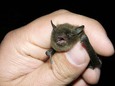
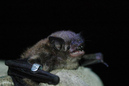
Indiana bats are small, weighing approximately 7 g with a forearm range of 35 to 41 mm. They are dark grey or brown in color and their fur is considered soft. They are distinguished from other, similar, co-occuring members of M. myotis by their distinctly keeled calcar, a small cartilage projection from the foot, giving added stability to the wing. Indiana bat fur is soft in comparison to that of the very similar and closely-related little brown bat, Myotis lucifugus, which has fur that tends to be more shiny. Male and female Indiana bats are very similar with the female tending to be a little larger than the male. (Barbour and Davis, 1969; Whitaker and Hamilton, 1998)
- Other Physical Features
- endothermic
- heterothermic
- bilateral symmetry
- Sexual Dimorphism
- female larger
-
- Range mass
- 5 to 11 g
- 0.18 to 0.39 oz
-
- Range length
- 70.8 to 90.6 mm
- 2.79 to 3.57 in
-
- Average length
- 81.7 mm
- 3.22 in
-
- Range wingspan
- 240 to 267 mm
- 9.45 to 10.51 in
Reproduction
Indiana bats are polygynous, with one male mating with multiple females. Males wait at the entrance to winter hibernacula for the opportunity to copulate with un-mated females. This occurs during the "fall swarming" period in October or November. There have been some accounts of Indiana bats copulating in late winter or early spring but this is rare. (Whitaker and Hamilton, 1998)
- Mating System
- polygynous
Myotis sodalis copulate in the fall, generally in late October. This is the time right before they enter into hibernation. Pregnancy does not begin at this time, as the females can store sperm over winter. This delayed fertilization allows the young to be born in summer (up to 68 days post fertilization). Females give birth to only one pup (on rare occasions twins) per year. Most pups are born between late June and early July with weaning at about 31 days (range 25 to 37 days). The first born of the season may be volant as early as mid-July. (Barbour and Davis, 1969; Barnard, 2009; Fenton, 1985; Whitaker and Hamilton, 1998)
- Key Reproductive Features
- iteroparous
- seasonal breeding
- gonochoric/gonochoristic/dioecious (sexes separate)
- sexual
- induced ovulation
- fertilization
- viviparous
- delayed fertilization
-
- Breeding interval
- Indiana bats breed once yearly.
-
- Breeding season
- Copulation generally occurs in October, before hibernation.
-
- Range number of offspring
- 1 to 2
-
- Average number of offspring
- 1
-
- Average number of offspring
- 1
- AnAge
-
- Range gestation period
- 68 (high) days
-
- Range weaning age
- 25 to 37 days
-
- Range time to independence
- 2 to 3 months
Females provide care for pups after birth at summer roosting sites. Often maternity colonies are formed and male presence is rare. Females are responsible for providing nourishment for their pups through lactation. Time to weaning is about 31 days and pups are fully independent from their mothers in 2 to 3 months. (Whitaker and Hamilton, 1998)
- Parental Investment
- altricial
- female parental care
-
pre-fertilization
- provisioning
-
protecting
- female
-
pre-hatching/birth
-
provisioning
- female
-
protecting
- female
-
provisioning
-
pre-weaning/fledging
-
provisioning
- female
-
protecting
- female
-
provisioning
Lifespan/Longevity
Indiana bats have lived as long as 20 years in the wild. Their expected lifespan in the wild is 15 years. (Miller and Allen, 1928)
-
- Range lifespan
Status: wild - 20 (high) years
- Range lifespan
-
- Typical lifespan
Status: wild - 15 (high) years
- Typical lifespan
Behavior
Indiana bats are social, which may account for their alternate common name, "social myotis." There have been no documented cases of social hierarchies within the species. Males and females hibernate together, but adults separate in the summer months. Maternity colonies contain juvenile males and only rarely adult males. Indiana bats migrate seasonally; to travel from winter hibernacula to summer roosts Indiana bats travel distances up to thousands of kilometers. For example, a banded female caught by mist netting over a river in southern Iowa that had come from a hibernaculum in Missouri. (Gardner and Cook, 2002; Pierson, 1998; Whitaker and Hamilton, 1998)
They have a wide nocturnal foraging area during the summer months. Perhaps this is why the area of suitable summer habitat does not correspond to population densities for this bat. For example, in a forest of up to 5 million hectares, population estimates were small as 10,000 bats. Another area of forest covering 1.7 million hectares was estimated to have 112,500 Indiana bats. (Gardner and Cook, 2002; Pierson, 1998; Whitaker and Hamilton, 1998)
- Key Behaviors
- troglophilic
- flies
- nocturnal
- crepuscular
- motile
- migratory
- hibernation
- social
- colonial
-
- Range territory size
- 2 to 8 m^2
Home Range
Home range size of Indiana bats varies by individual as well as time of year. They are an average of 625 ha during the fall, and 255 +/- 89 ha in the spring. These home ranges are not defended. Perhaps the only territory defended is a space within a maternity colony or a hibernaculum, where bats might interact with individuals within 5 square meters of themselves. (Romme, et al., 2002; Whitaker and Hamilton, 1998)
Communication and Perception
Indiana bats, like other insectivorous bat species, use echolocation to maneuver through their various habitat types. They have well-developed eyesight which they use to aid with their travels from their winter hibernacula to their summer roosting sites. We can assume that Myotis sodalis individuals do communicate with each other using sound, but there have been no studies to further investigate this. Like other mammals, it is likely that these bats use chemical cues to communicate reproductive state. (Linzey, 2001)
- Perception Channels
- visual
- tactile
- echolocation
- chemical
Food Habits
Indiana bats consume a diet of insects. A study found that Indiana bats eat insects from five main taxa: Coleoptera (beetles), Diptera (flies), Hymenoptera (bees, wasps), Lepidoptera (butterflies and moths), and Trichoptera (caddisflies). There are also differences in what females eat based on whether they are pregnant or lactating or neither. Lactating females eat greater amounts of coleopterans and trichoperans compared to non-lactating female bats. There are slight differences in diet based on location; southern colonies feed more on terrestrial insect species, whereas more northern bats fed on insects around wetlands. (Linzey, 2001; Murray and Kurta, 2002)
- Primary Diet
- carnivore
- Animal Foods
- insects
Predation
Predators of Indiana bats include carnivorous animals such as snakes, owls, raccoons (Procyon lotor), and other medium-sized mammals. The main adaptations Indiana bats have against predation is that they roost in caves and inaccessible tree crevices, putting them out of reach of many predators. They are also active at night and agile in flight. Myotis sodalis individuals hibernate in large clusters which help ensure survival (and warmth) between October and April. Their cryptic coloration also helps to protect them from predation. (Hart, 2010; Mohr, 1976; Whitaker and Brack, 2002; Whitaker and Hamilton, 1998)
Humans have been known to kill these bats, although they are not eaten. For example, at Carter Caves State park in Kentucky, two men clubbed 105 Indiana bats to death. Humans also unintentionally kill bats by destroying or cutting down summer roost trees or disturbing hibernation sites. (Hart, 2010; Mohr, 1976; Whitaker and Brack, 2002; Whitaker and Hamilton, 1998)
- Anti-predator Adaptations
- cryptic
-
- Known Predators
-
- black rat snakes (Pantherophis obsoletus)
- owls (Strigiformes)
- raccoons (Procyon lotor)
- snakes (Serpentes)
Ecosystem Roles
Indiana bats help control insect populations and are prey for bat predators. They are hosts for species of mites (Steatonyssus occidentalis and Macronyssus crosbyi) but there have been no documented intestinal parasites. Indiana bats have a direct impact on their cave environment by adding nutrients to the cave with their guano and decomposing bodies. (LaRoe, et al., 1995; Whitaker and Mumford, 1971; Whitaker, 1973)
- mites (Steatonyssus occidentalis)
- mites (Macronyssus crosbyi)
Economic Importance for Humans: Positive
Indiana bats may impact humans by helping to control pest insect populations. (Whitaker and Hamilton, 1998)
- Positive Impacts
- controls pest population
Economic Importance for Humans: Negative
Indiana bats can become a nuisance in some places where their summer roots have been destroyed due to increasing human populations. Bats will then find their way into homes and attics to roost. Like most mammals in the United States, Indiana bats also may be carriers of rabies. However, documented incidence of rabies infection in Indiana bats is low. It is also very unlikely that humans will come into close contact with Indiana bats for the disease to be transmitted. (Butchkoski and Hassinger, 2002)
- Negative Impacts
-
injures humans
- carries human disease
Conservation Status
Indiana bats are a federally endangered species and are endangered on the IUCN Red List. They are mostly threatened by habitat loss, and their numbers are monitored. For example, any organization intending to change a habitat where they live must first check for roosting locations, and accommodate the bats if they find them. Humans also disturb Indiana bats through recreational caving, so many of their hibernation areas are now closed off to humans. ("Indiana Bat (Myotis sodalis) Draft Recovery Plan: First Revision", 2007; Gargas, et al., 2009)
Temperate North American bats, including Indiana bats, are now threatened by a fungal disease called “white-nose syndrome.” This disease has devastated eastern North American bat populations at hibernation sites since 2007. The fungus, Geomyces destructans, grows best in cold, humid conditions that are typical of many bat hibernacula. The fungus grows on, and in some cases invades, the bodies of hibernating bats and seems to result in disturbance from hibernation, causing a debilitating loss of important metabolic resources and mass deaths. Mortality rates at some hibernation sites have been as high as 90%. Currently, there is no known cure for white nose syndrome. ("Indiana Bat (Myotis sodalis) Draft Recovery Plan: First Revision", 2007; Cryan, 2010; Gargas, et al., 2009)
-
- IUCN Red List
-
Endangered
More information
-
- IUCN Red List
-
Endangered
More information
-
- US Federal List
- Endangered
-
- CITES
- No special status
-
- State of Michigan List
- Endangered
Contributors
Anna Burgess (author), Radford University, Gail McCormick (editor), Animal Diversity Web Staff, Karen Powers (editor), Radford University, Tanya Dewey (editor), University of Michigan-Ann Arbor, Catherine Kent (editor), Special Projects.
Glossary
- Nearctic
-
living in the Nearctic biogeographic province, the northern part of the New World. This includes Greenland, the Canadian Arctic islands, and all of the North American as far south as the highlands of central Mexico.

- acoustic
-
uses sound to communicate
- altricial
-
young are born in a relatively underdeveloped state; they are unable to feed or care for themselves or locomote independently for a period of time after birth/hatching. In birds, naked and helpless after hatching.
- bilateral symmetry
-
having body symmetry such that the animal can be divided in one plane into two mirror-image halves. Animals with bilateral symmetry have dorsal and ventral sides, as well as anterior and posterior ends. Synapomorphy of the Bilateria.
- carnivore
-
an animal that mainly eats meat
- chemical
-
uses smells or other chemicals to communicate
- colonial
-
used loosely to describe any group of organisms living together or in close proximity to each other - for example nesting shorebirds that live in large colonies. More specifically refers to a group of organisms in which members act as specialized subunits (a continuous, modular society) - as in clonal organisms.
- crepuscular
-
active at dawn and dusk
- cryptic
-
having markings, coloration, shapes, or other features that cause an animal to be camouflaged in its natural environment; being difficult to see or otherwise detect.
- delayed fertilization
-
a substantial delay (longer than the minimum time required for sperm to travel to the egg) takes place between copulation and fertilization, used to describe female sperm storage.
- echolocation
-
The process by which an animal locates itself with respect to other animals and objects by emitting sound waves and sensing the pattern of the reflected sound waves.
- endothermic
-
animals that use metabolically generated heat to regulate body temperature independently of ambient temperature. Endothermy is a synapomorphy of the Mammalia, although it may have arisen in a (now extinct) synapsid ancestor; the fossil record does not distinguish these possibilities. Convergent in birds.
- female parental care
-
parental care is carried out by females
- fertilization
-
union of egg and spermatozoan
- forest
-
forest biomes are dominated by trees, otherwise forest biomes can vary widely in amount of precipitation and seasonality.
- heterothermic
-
having a body temperature that fluctuates with that of the immediate environment; having no mechanism or a poorly developed mechanism for regulating internal body temperature.
- hibernation
-
the state that some animals enter during winter in which normal physiological processes are significantly reduced, thus lowering the animal's energy requirements. The act or condition of passing winter in a torpid or resting state, typically involving the abandonment of homoiothermy in mammals.
- induced ovulation
-
ovulation is stimulated by the act of copulation (does not occur spontaneously)
- insectivore
-
An animal that eats mainly insects or spiders.
- iteroparous
-
offspring are produced in more than one group (litters, clutches, etc.) and across multiple seasons (or other periods hospitable to reproduction). Iteroparous animals must, by definition, survive over multiple seasons (or periodic condition changes).
- migratory
-
makes seasonal movements between breeding and wintering grounds
- motile
-
having the capacity to move from one place to another.
- mountains
-
This terrestrial biome includes summits of high mountains, either without vegetation or covered by low, tundra-like vegetation.
- native range
-
the area in which the animal is naturally found, the region in which it is endemic.
- nocturnal
-
active during the night
- polygynous
-
having more than one female as a mate at one time
- seasonal breeding
-
breeding is confined to a particular season
- sexual
-
reproduction that includes combining the genetic contribution of two individuals, a male and a female
- social
-
associates with others of its species; forms social groups.
- tactile
-
uses touch to communicate
- temperate
-
that region of the Earth between 23.5 degrees North and 60 degrees North (between the Tropic of Cancer and the Arctic Circle) and between 23.5 degrees South and 60 degrees South (between the Tropic of Capricorn and the Antarctic Circle).
- terrestrial
-
Living on the ground.
- visual
-
uses sight to communicate
- viviparous
-
reproduction in which fertilization and development take place within the female body and the developing embryo derives nourishment from the female.
References
U.S. Fish and Wildlife Service. Indiana Bat (Myotis sodalis) Draft Recovery Plan: First Revision. Fort Snelling: Fort Snelling. 2007.
Barbour, R., W. Davis. 1969. Bats of America. Lexington, Kentucky: The University Press of Kentucky.
Barclay, R., A. Kurta. 2007. Ecology and Behavior of Bats Roosting in Tree Cavities and Under Bark. Pp. 17-50 in M Lacki, J Hayes, A Kurta, eds. Bats in Forests: Conservation and Management. Baltimore: The Johns Hopkins University Press.
Barnard, S. 2009. Maintaining Bats for Captive Study. Pp. 351 in T Kunz, S Parsons, eds. Ecological and Behavioral Methods for the Study of Bats. Baltimore: The Johns Hopkins University Press.
Brack, V., C. Stihler, R. Reynolds, C. Butchkoski, C. Hobson. 2002. Effect of Climate and Elevation on Distribution and Abundance in the Midestern United States. Pp. 21-28 in A Kurta, J Kennedy, eds. The Indiana Bat: Biology and Management of an Endangered Species. Austin, Texas: Bat Conservation International.
Butchkoski, C., J. Hassinger. 2002. Ecology of a Maternity Colony Roosting in a Building. Pp. 130-142 in A Kurta, J Kennedy, eds. The Indiana Bat: Biology and Management of an Endangered Species. Austin, Texas: Bat Conservation International.
Clawson, R. 2002. Trends in Population Size and Current Status. Pp. 2-8 in A Kutra, J Kennedy, eds. The Indiand Bat: Biology and Management of an Endangered Species. Austin, Texas: Bat Conservation International.
Cryan, P. 2010. "White-nose syndrome threatens the survival of hibernating bats in North America" (On-line). U.S. Geological Survey, Fort Collins Science Center. Accessed September 20, 2012 at http://www.fort.usgs.gov/WNS.
Currie, R. 2002. Response to Gates at Hibernacula. Pp. 86-99 in A Kurta, J Kennedy, eds. The Indiana Bat: Biology and Management of an Endangered Species. Austin, Texas: Bat Conservation International.
Fenton, M. 1985. Communication in the Chiroptera. Bloomington: Indiana University Press.
Gardner, J., E. Cook. 2002. Seasonal and Geographic Distribution and Quantification of Potential Summer Habitat. Pp. 9-20 in A Kurta, J Kennedy, eds. The Indiana Bat: Biology and Management of an Endangered Species. Austin, Texas: Bat Conservation International.
Gargas, A., M. Trest, M. Christensen, T. Volk, D. Blehert. 2009. Geomyces destructans sp. no. associated with bat white-nose syndrome. Mycotaxon, 108: 147-154.
Hallam, T., P. Federico. 2009. Application of Dynamic Population Models to Bats. Pp. 184 in T Kunz, S Parsons, eds. Ecological and behavioral methods for the study of bats. Baltimore: The Johns Hopkins University Press.
Handley Jr., C. 1991. Virginia's Endangered Species. Blacksburg, Virginia: The McDonald and Woodward Publishing Company.
Hart, K. 2010. "Bat killers sentenced in federal court" (On-line). Accessed December 01, 2010 at http://dailyindependent.com/local/x434655806/Bat-killers-sentenced-in-federal-court.
Kiser, J., J. MacGregor, H. Bryan, A. Howard. 2002. Use of Concrete Bridges as Nightroosts. Pp. 208-215 in A Kurta, J Kennedy, eds. The Indiana Bat: Biology and Management of an Endangered Species. Austin, Texas: Bat Conservation International.
Kurta, A., S. Murray, D. Miller. 2002. Roost Selection and Movements Across the Summer Landscape. Pp. 118-129 in A Kurta, J Kennedy, eds. The Indiana Bat: Biology and Management of an Endangered Species. Austin, Texas: Bat Conservation International.
LaRoe, E., G. Farris, C. Puckett, P. Doran, M. Mac. 1995. Our Living Resources: a report to the nation on the distribution, abundance, and health of U.S. plants, animals, and ecosystems. Washington DC: U.S. Department of the Interior, National Biological Service.
Linzey, D. 2001. Vertebrate Biology. New York: McGraw-Hill.
Miller, , Allen. 1928. Indiana Myotis: Myotis Sodalis. Pp. 205-211 in M Trani, W Ford, B Chapman, eds. The Land Manager's Guide to Mammals of the South. Durham, NC: USDA Forest Service, Southern Region and The Nature Conservancy.
Mohr, C. 1976. The World of the Bat. Philadelphia and New York: J. B. Lippincott Company.
Murray, S., A. Kurta. 2002. Spatial and Temporal Variation in Diet. Pp. 182-192 in A Kurta, J Kennedy, eds. The Indiana Bat: Biology and Management of an Endangered Species. Austin, Texas: Bat Conservation International.
Pierson, E. 1998. Tall Trees, Deep Holes, and Scarred Landscapes: Conservation Biology of North American Bats. Pp. 312-313 in T Kunz, P Racey, eds. Bat Biology and Conservation. Washington and London: Smithsonian Institution Press.
Romme, R., A. Henry, R. King, T. Glueck, K. Tyrell. 2002. Home Range Near Hibernacula in Spring and Autumn. Pp. 153-164 in A Kurta, J Kennedy, eds. The Indiana Bat: Biology and Management of an Endangered Species. Austin, Texas: Bat Conservation International.
Thomson, C. 1982. Myotis sodalis. Mammalian Species, 163: 1-5.
Tuttle, M., J. Kennedy. 2002. Thermal Requirements During Hibernation. Pp. 68-78 in A Kurta, J Kennedy, eds. The Indiana Bat: Biology and Management of an Endangered Species. Austin, Texas: Bat Conservation International.
Viele, D., A. Kurta, J. Kath. 2002. Timing of Nightly Emergence. Pp. 199-207 in A Kurta, J Kennedy, eds. The Indiana Bat: Biology and Management of an Endangered Species. Austin, Texas: Bat Conservation International.
Whitaker, J. 1973. External Parasites of Bats of Indiana. The Journal of Parasitology, 59/6: 1148-1150.
Whitaker, J., V. Brack. 2002. Distribution and Summer Ecology in Indiana. Pp. 48-54 in A Kurta, J Kennedy, eds. The Indiana Bat: Biology and Management of an Endangered Species. Austin, Texas: Bat Conservation International.
Whitaker, J., W. Hamilton. 1998. Mammals of the Eastern United States. Cornell University Press: Comstock Publishing Associates.
Whitaker, J., R. Mumford. 1971. Notes on a COllection of Bats Taken by Mis-Netting at an Indiana Cave. American Midlans Naturalist, 85/1: 277-279.
Whitaker, J., C. Ritzi, C. Dick. 2009. Collecting and Preserving Bat Ectoparasites for Ecological Study. Pp. 813 in T Kunz, S Parsons, eds. Ecological and Behavioral Methods for the Study of Bats. Baltimore: The Johns Hopkins University Press.