Mustela ermineaermine


Geographic Range
Ermine have a circumpolar distribution. They are found in the north temperate regions of Eurasia and North America. In the New World, they range from east to west in a broad belt from the Arctic Ocean and adjacent islands of the Canadian Archipelago southward into the northern United States. Ermine are absent from the Great Plains. (Ruff and Wilson, 1999)
- Biogeographic Regions
- nearctic
- palearctic
- Other Geographic Terms
- holarctic
Habitat
Ermine prefer riparian woodlands, marshes, shrubby fencerows, and open areas adjacent to forests or shrub borders. Although ermine are primarily terrestrial, they climb trees and swim well. Tree roots, hollow logs, stone walls, and rodent burrows are used as dens. Dens are usually around 300 mm below ground. Ermine line their nests with dry vegetation, and fur and feathers from prey. Side cavities of burrows are used as food caches and latrines. (Ruff and Wilson, 1999)
- Habitat Regions
- temperate
- terrestrial
- Terrestrial Biomes
- tundra
- taiga
- savanna or grassland
- forest
- scrub forest
- mountains
- Other Habitat Features
- riparian
Physical Description
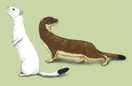
At full adult size total body length from head to rump is 170 mm to 330 mm. Males are generally twice as large as females, with males weighing from 67 to 116 grams and females from 25 to 80 grams. The tail length is about 35% of the total body length, ranging from 42 mm to 120 mm. Ermine have the typical weasel form: long body, short legs, long neck supporting a triangular head, slightly protruding round ears, bright black eyes, and long whiskers. Their short, moderately fine fur is white in the winter and the tip of the tail is black. In the summer, the dorsal fur is chocolate brown while the ventral fur extending to the upper lip is yellowish white.
- Other Physical Features
- endothermic
- homoiothermic
- bilateral symmetry
- Sexual Dimorphism
- male larger
-
- Range mass
- 25 to 116 g
- 0.88 to 4.09 oz
-
- Range length
- 170 to 330 mm
- 6.69 to 12.99 in
-
- Average basal metabolic rate
- 1.276 W
- AnAge
Reproduction
Ermine are a polygynous-promiscuous species, with males and females mating opportunistically.
- Mating System
- polygynandrous (promiscuous)
Ermine mate in late spring to early summer. Females are polyestrous, but produce only 1 litter per year. Young are born in April or May after an average gestation period of 280 days, which includes an 8 to 9 month period of developmental delay. Longer days beginning in March trigger the resumption of fetal development. Litter size ranges from 3 to 18 offspring and averages 4 to 9. The sex ratio is unequal. Young are blind and helpless. They are covered with fine white hair, and a prominent dark mane of dense fur develops around the neck by the third week (function unknown). The young grow quickly and are able to hunt with their mother by their eighth week. Although females do not reach adult size until a least 6 weeks after birth, they are able to mate when they are 60 to 70 days old, often before they are weaned. Males do not breed or gain adult dimensions until their second summer.
Females in nature may survive for at least 2 breeding seasons, while males generally do not survive this long. Reproductive success is highly dependent on food availability.
- Key Reproductive Features
- iteroparous
- seasonal breeding
- gonochoric/gonochoristic/dioecious (sexes separate)
- sexual
- fertilization
- viviparous
- delayed implantation
- embryonic diapause
-
- Breeding interval
- Ermine generally breed once yearly.
-
- Breeding season
- Ermine mate in late spring to early summer.
-
- Range number of offspring
- 3 to 18
-
- Average number of offspring
- 4-9
-
- Average number of offspring
- 6.77
- AnAge
-
- Average gestation period
- 280 days
-
- Average gestation period
- 43 days
- AnAge
-
- Average weaning age
- 8-10 weeks
-
- Average age at sexual or reproductive maturity (female)
- 60-70 days
-
- Average age at sexual or reproductive maturity (female)
Sex: female - 95 days
- AnAge
- Average age at sexual or reproductive maturity (female)
-
- Average age at sexual or reproductive maturity (male)
- 2 years
-
- Average age at sexual or reproductive maturity (male)
Sex: male - 365 days
- AnAge
- Average age at sexual or reproductive maturity (male)
Females exclusively care for their offspring, nursing and protecting them until they become independent. The young are born blind and helpless.
- Parental Investment
- no parental involvement
- altricial
-
pre-fertilization
- provisioning
-
protecting
- female
-
pre-hatching/birth
-
provisioning
- female
-
protecting
- female
-
provisioning
-
pre-weaning/fledging
-
provisioning
- female
-
protecting
- female
-
provisioning
-
pre-independence
-
provisioning
- female
-
protecting
- female
-
provisioning
Lifespan/Longevity
The average life span of an ermine is 1 to 2 years; the maximum is 7 years. (Ruff and Wilson, 1999)
-
- Range lifespan
Status: wild - 7 (high) years
- Range lifespan
-
- Typical lifespan
Status: wild - 1 to 2 years
- Typical lifespan
-
- Average lifespan
Status: wild - 1-2 years
- Average lifespan
-
- Range lifespan
Status: captivity - 12.5 (high) years
- AnAge
- Range lifespan
Behavior
The ermine's lithe, agile body allows it to move swiftly both above ground and through underground burrows. Females hunt in tunnels more than males, which may explain the higher number of males that are trapped. Ermine can also run easily across snow. This ideal predator hunts in a zigzag pattern, progressing by a series of leaps of up to 50 cm each. Ermine investigate every hole and crevice, often stopping to survey their surroundings by raising their heads and standing upright on their hindlegs. They may travel up to 15 km in one night.
Adult males dominate females and young. Females tend to remain in their birth place throughout their lives. Males disperse and attain large territories that usually encompass or overlap females' territories.
Male and female ermine only associate with one another during the breeding season. (Ruff and Wilson, 1999)
- Key Behaviors
- terricolous
- nocturnal
- crepuscular
- motile
- sedentary
- solitary
- territorial
-
- Range territory size
- 0.1 to 0.2 km^2
Home Range
Ermine population densities fluctuate with prey abundance. When conditions are good, an individual may occupy a 10ha area. The maximum home range size is about 20ha. Home ranges of males are usually twice the size of female home ranges. These solitary mammals maintain exclusive boundaries that are patrolled and marked by scent. (Ruff and Wilson, 1999)
Communication and Perception
Ermine have keen senses of smell, vision, hearing, and touch that help them to locate prey. Most mustelids are fairly quiet animals, but some vocalizations may be used in intra-specific communication. Chemical cues are probably the main means of communicating reproductive readiness to potential mates.
- Other Communication Modes
- scent marks
Food Habits
Ermine are carnivores that hunt primarily at night. They are specialist predators on small, warm-blooded vertebrates, preferably mammals of rabbit size and smaller. When mammalian prey is scarce, ermine eat birds, eggs, frogs, fish, and insects. In severe climates, ermine frequently hunt under snow and survive entirely on small rodents and lemmings. Daily meals are essential to meet the ermine's exhorbitant energy and heat production demands. Ermine cache leftover meals as a way of dealing with these demands. (Ruff and Wilson, 1999)
Once a potential prey is identified, the ermine approaches as closely as possible. With incredible speed it grasps the back of the victim's head and neck with sharp teeth, and wraps its body and feet around the victim. The victim dies from repeated bites to the base of the skull. Ermine have keen senses that help them locate prey. Hares and rodents are mainly followed by scent, insects by sound, and fish by sight. (Ruff and Wilson, 1999)
- Primary Diet
-
carnivore
- eats terrestrial vertebrates
- Animal Foods
- birds
- mammals
- amphibians
- fish
- eggs
- insects
- Foraging Behavior
- stores or caches food
Predation
Ermine are fierce and aggressive, although diminutive, animals. Potential predators are larger carnivores including red fox, gray fox, martens, fishers, badgers, raptors, and occasionally domestic cats.
-
- Known Predators
-
- red foxes (Vulpes vulpes)
- gray foxes (Urocyon cinereoargenteus)
- American martens (Martes americana)
- fishers (Martes pennanti)
- American badgers (Taxidea taxus)
- raptors (Accipitridae)
- domestic cats (Felis silvestris)
Ecosystem Roles
Ermine are important predators on small mammal communities in the ecosystems in which they live.
Many ermine die from a parasitic nematode (Skrjabingylus nasicola) that infects the nasal passage, distorting the sinuses. Eventually the skull is perforated and pressure is exerted on the brain, causing death. Shrews are believed to be the carrier hosts of this parasite. (Ruff and Wilson, 1999)
- nematode worms
Economic Importance for Humans: Positive
Humans trap thousands of ermine each season, but the demand for pelts has recently decreased. The white winter fur has long been used in trimming coats and making stoles. Ermine are excellent mousers, which makes them valuable to humans.
- Positive Impacts
- body parts are source of valuable material
- controls pest population
Economic Importance for Humans: Negative
Ermine, and other Mustela species can take domestic fowl when they can gain access to them.
Conservation Status
Ermine are not considered threatened or endangered, although hunting pressure in some areas may impact populations severely. (Ruff and Wilson, 1999)
-
- IUCN Red List
-
Least Concern
More information
-
- IUCN Red List
-
Least Concern
More information
-
- US Federal List
- No special status
-
- CITES
- No special status
-
- State of Michigan List
- No special status
Other Comments
There are 16 Palearctic and 10 Nearctic subspecies recognized.
Contributors
Allison Poor (editor), University of Michigan-Ann Arbor.
Heather Loso (author), University of Michigan-Ann Arbor.
Glossary
- Nearctic
-
living in the Nearctic biogeographic province, the northern part of the New World. This includes Greenland, the Canadian Arctic islands, and all of the North American as far south as the highlands of central Mexico.

- Palearctic
-
living in the northern part of the Old World. In otherwords, Europe and Asia and northern Africa.
- acoustic
-
uses sound to communicate
- altricial
-
young are born in a relatively underdeveloped state; they are unable to feed or care for themselves or locomote independently for a period of time after birth/hatching. In birds, naked and helpless after hatching.
- bilateral symmetry
-
having body symmetry such that the animal can be divided in one plane into two mirror-image halves. Animals with bilateral symmetry have dorsal and ventral sides, as well as anterior and posterior ends. Synapomorphy of the Bilateria.
- carnivore
-
an animal that mainly eats meat
- chemical
-
uses smells or other chemicals to communicate
- crepuscular
-
active at dawn and dusk
- delayed implantation
-
in mammals, a condition in which a fertilized egg reaches the uterus but delays its implantation in the uterine lining, sometimes for several months.
- embryonic diapause
-
At about the time a female gives birth (e.g. in most kangaroo species), she also becomes receptive and mates. Embryos produced at this mating develop only as far as a hollow ball of cells (the blastocyst) and then become quiescent, entering a state of suspended animation or embryonic diapause. The hormonal signal (prolactin) which blocks further development of the blastocyst is produced in response to the sucking stimulus from the young in the pouch. When sucking decreases as the young begins to eat other food and to leave the pouch, or if the young is lost from the pouch, the quiescent blastocyst resumes development, the embryo is born, and the cycle begins again. (Macdonald 1984)
- endothermic
-
animals that use metabolically generated heat to regulate body temperature independently of ambient temperature. Endothermy is a synapomorphy of the Mammalia, although it may have arisen in a (now extinct) synapsid ancestor; the fossil record does not distinguish these possibilities. Convergent in birds.
- fertilization
-
union of egg and spermatozoan
- forest
-
forest biomes are dominated by trees, otherwise forest biomes can vary widely in amount of precipitation and seasonality.
- holarctic
-
a distribution that more or less circles the Arctic, so occurring in both the Nearctic and Palearctic biogeographic regions.
Found in northern North America and northern Europe or Asia.
- iteroparous
-
offspring are produced in more than one group (litters, clutches, etc.) and across multiple seasons (or other periods hospitable to reproduction). Iteroparous animals must, by definition, survive over multiple seasons (or periodic condition changes).
- motile
-
having the capacity to move from one place to another.
- mountains
-
This terrestrial biome includes summits of high mountains, either without vegetation or covered by low, tundra-like vegetation.
- native range
-
the area in which the animal is naturally found, the region in which it is endemic.
- nocturnal
-
active during the night
- polygynandrous
-
the kind of polygamy in which a female pairs with several males, each of which also pairs with several different females.
- riparian
-
Referring to something living or located adjacent to a waterbody (usually, but not always, a river or stream).
- scent marks
-
communicates by producing scents from special gland(s) and placing them on a surface whether others can smell or taste them
- scrub forest
-
scrub forests develop in areas that experience dry seasons.
- seasonal breeding
-
breeding is confined to a particular season
- sedentary
-
remains in the same area
- sexual
-
reproduction that includes combining the genetic contribution of two individuals, a male and a female
- solitary
-
lives alone
- stores or caches food
-
places a food item in a special place to be eaten later. Also called "hoarding"
- tactile
-
uses touch to communicate
- taiga
-
Coniferous or boreal forest, located in a band across northern North America, Europe, and Asia. This terrestrial biome also occurs at high elevations. Long, cold winters and short, wet summers. Few species of trees are present; these are primarily conifers that grow in dense stands with little undergrowth. Some deciduous trees also may be present.
- temperate
-
that region of the Earth between 23.5 degrees North and 60 degrees North (between the Tropic of Cancer and the Arctic Circle) and between 23.5 degrees South and 60 degrees South (between the Tropic of Capricorn and the Antarctic Circle).
- terrestrial
-
Living on the ground.
- territorial
-
defends an area within the home range, occupied by a single animals or group of animals of the same species and held through overt defense, display, or advertisement
- tropical savanna and grassland
-
A terrestrial biome. Savannas are grasslands with scattered individual trees that do not form a closed canopy. Extensive savannas are found in parts of subtropical and tropical Africa and South America, and in Australia.
- savanna
-
A grassland with scattered trees or scattered clumps of trees, a type of community intermediate between grassland and forest. See also Tropical savanna and grassland biome.
- temperate grassland
-
A terrestrial biome found in temperate latitudes (>23.5° N or S latitude). Vegetation is made up mostly of grasses, the height and species diversity of which depend largely on the amount of moisture available. Fire and grazing are important in the long-term maintenance of grasslands.
- tundra
-
A terrestrial biome with low, shrubby or mat-like vegetation found at extremely high latitudes or elevations, near the limit of plant growth. Soils usually subject to permafrost. Plant diversity is typically low and the growing season is short.
- visual
-
uses sight to communicate
- viviparous
-
reproduction in which fertilization and development take place within the female body and the developing embryo derives nourishment from the female.
References
Baker, Rollin H. 1983. Michigan Mammals, pg.472-478. Michigan State Univeristy
Press, Michigan.
Edger, Judith L. 1990. Patterns of geographic variation in the skull of Nearctic Ermine (Mustela erminea). Canadian Journal of Zoology, 68:1241-1248. National Research
Council of Canada, Ontario.
Jones, J. Knox and Elmer C. Birney. 1988. Handbook of Mammals of the North-Central States, pg. 254. University of Minnesota Press, Minnesota.
King, Carolyn M. 1983. Mammalian Species,195:1-8. The American Society of Mammalogists, New York.
Kurta, Allen. 1995. Mammals of the Great Lakes, pg. 228-231. University of Michigan Press, Michigan.
Nowak, Ronald M. and J.L. Paradiso. 1983. Walker's Mammals of the World, 2:988-989.
The John Hopkins University Press, Baltimore and London.
"Animal Life Histories Database" (On-line).
Ruff, S., D. Wilson. 1999. The Smithsonian Book of North American Mammals. Washington [D.C.]: Smithsonian Institution Press in association with the American Society of Mammalogists.