Muntiacus reevesiReeves's muntjac




Geographic Range
Muntiacus reevesi has a native range that extends throughout the subtropical forests of southeastern China and Taiwan. It has also become established in England after being introduced at Woburn, England (located in the middle of Bedfordshire county) around 1900. Feral populations may also exist in France, where introduced individuals escaped gardens and zoos. (Chapman, et al., 1994; Helin, et al., 1999; Nowak, ed. and Paradiso, ed., 1983; Southern, 1964)
- Biogeographic Regions
- palearctic
- oriental
Habitat
Muntiacus reevesi is a forest creature in its native country of China. It creates paths through the subtropical rainforests at moderate elevations, which is why it has been termed by some as a bush hugger. It was observed that muntjacs in general tend to prefer habitats near streams, but evidence of this preference is not strongly demonstrated in the literature for this particular species of muntjac. Chinese muntjacs will fight to defend a fairly specific territory, but males have been shown to tolerate the presence of a subordinate male in their territory so long as that male is not in rut.
In England, M. reevesi exhibits slightly different preferences for habitat. It appears that the feral muntjacs of Britain are equally happy in habitats with and without cover; that is, muntjacs have been found in deciduous and coniferous forests as well as agricultural land, and even suburban and urban areas. In some respects, it is difficult to consider habitat preferences when a number of the metapopulations within the British population were specifically released into certain environments, so their presence in some habitats may not actually be an indication of a preference.
Reliable information on elevation preferences could not be found for the British population of M. reevesi, but in its native environment, it appears that M. reevesi prefers moderate elevations (moderate was not defined). (Chapman, et al., 1994; Geist, 1998; Helin, et al., 1999; Nowak, ed. and Paradiso, ed., 1983)
- Terrestrial Biomes
- forest
- rainforest
- scrub forest
- Other Habitat Features
- urban
- suburban
- agricultural
Physical Description
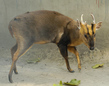
Muntiacus reevesi has a chestnut-colored coat with a 4-inch tail that is black above and white below. It has been reported that the females tend to be slightly lighter in color than males, but these observations were mainly made on captive and feral M. reevesi in England and have not been corroborated with observations of M. reevesi in its native China. Chinese muntjacs stand 43 to 45 cm in height at the shoulder.
Sexual dimorphism in M. reevesi leads to larger, heavier males that have short antlers (125 to 150 mm) that grow from their pedicles and that have long, tusk-like canines (1 to 2 inches long). The canines are not entirely fixed to the premaxilla so they are less likely to be broken off during a fight. Both the male and female Chinese muntjacs have bony ridges on their faces that are lined with black hair along the inside. These ridges extend into hair-covered pedicles from which antlers (male) or black tufts of hair (females) project. Both the male and female Chinese muntjacs also have preorbital glands that produce a creamy liquid used for chemical communication.
As with all Muntiacus species, M. reevesi has only the upper parts of the 2nd and 5th digit metacarpals present, a physiology known as plesiometacarpalia. However, unlike other deer species that have 2 hooves of the same size and shape, M. reevesi has one hoof that is smaller than the other and that is lined with hairs that are visible in its footprints. (Burrage, 2000; Grzimek, 1990; Helin, et al., 1999; Marshall, 1967; Nowak, ed. and Paradiso, ed., 1983; Southern, 1964)
- Other Physical Features
- endothermic
- homoiothermic
- bilateral symmetry
- Sexual Dimorphism
- male larger
- sexes colored or patterned differently
- ornamentation
-
- Range mass
- 11 to 28 kg
- 24.23 to 61.67 lb
-
- Average mass
- 18 kg
- 39.65 lb
-
- Range length
- 700 to 1130 mm
- 27.56 to 44.49 in
-
- Average length
- 800 mm
- 31.50 in
Reproduction
Males gain access to females by defending territory that overlaps that of females. The males will fight with the tusk-like canines for access to females in estrous. The males do not use their antlers in offensive moves while fighting like the white-tailed deer Odocoileus virginianus, but they spar extensively while still young, and use the horns in defensive moves while fighting. (Chapman, et al., 1997; Geist, 1998; Grzimek, 1990; Lawson, et al., 2001; Pei, et al., 1995; Southern, 1964; Yahner, 1980)
- Mating System
- polygynous
Muntiacus reevesi has year round breeding in its natural habitat in China. In England, Chinese muntjacs appear to have a more seasonal breeding cycle that occurs between late October and early March. Both sexes of M. reevesi develop rapidly so that they may reach their reproductive threshold weights (12 kg for bucks, 10 kg for does) within a few months of birth (36 weeks for bucks, 24 weeks for does). It is unlikely that very young males will be able to gain access to a doe in estrus, but younger males tend to be more reproductively successful than older males due to the quality of their canines.
Unlike other antlered deer, muntjacs use tusk-like canines to defend territory and gain access to females. When a doe in estrus is located, the male will make a buzzing sound and the female will respond by lying flat, weaving her head and emitting a cat-like whine that is a sign of submission. After copulation, male are no longer involved with the females and once the rut is over, males lose their antlers. Males may grow antlers in a period as rapid as 103 days, which is useful for a species that can breed year-round. (Chapman, et al., 1997; Geist, 1998; Grzimek, 1990; Nowak, ed. and Paradiso, ed., 1983; Southern, 1964; Yahner, 1980)
- Key Reproductive Features
- iteroparous
- year-round breeding
- gonochoric/gonochoristic/dioecious (sexes separate)
- sexual
- viviparous
- post-partum estrous
-
- Breeding interval
- The mean inter-birth interval is approximately 233 days.
-
- Breeding season
- Breeding can occur year round in the subtropics, but in England, the breeding tends to be somewhat seasonal, occuring between late October and early March.
-
- Range number of offspring
- 1 to 2
-
- Average number of offspring
- 1
-
- Average number of offspring
- 1
- AnAge
-
- Range gestation period
- 6.97 to 7.33 months
-
- Average gestation period
- 7 months
-
- Average weaning age
- 2 months
-
- Average time to independence
- 6 months
-
- Range age at sexual or reproductive maturity (female)
- 24 (low) weeks
-
- Range age at sexual or reproductive maturity (male)
- 36 to 59 weeks
Parental investment is minimal in M. reevesi. The young develop extremely rapidly and are weaned early enough so that by the time that the caloric needs of the young really begin to escalate, they have begun to eat solid foods and are no longer dependent on their mother’s milk. Lactation generally occurs for only the first 17 weeks. Because the young become independent so early, there is no extra cost to a female to produce males (which would generally cost more in nutritional needs from a mother). By the age of 6 months, adulthood is reached and the young must leave the mother's territory. (Chapman, et al., 1997; Grzimek, 1990)
- Parental Investment
- precocial
-
pre-weaning/fledging
-
provisioning
- female
-
protecting
- female
-
provisioning
-
pre-independence
-
protecting
- female
-
protecting
Lifespan/Longevity
Little is known about the lifespan of M. reevesi in the wild. Anecdotal evidence would indicate that Chinese muntjacs, which are described as a duiker-like (for example, Cepalophus niger) organism due to its rapid development and its generalist tendencies, would probably have a similar life expectancy: 10 to 12 years. In England, with a lack of predators and abundant food sources, it may be expected that Chinese muntjacs may live even longer. (Chapman, et al., 1994; Grzimek, 1990; Nowak, ed. and Paradiso, ed., 1983)
-
- Range lifespan
Status: wild - unknown (low) hours
- Range lifespan
-
- Range lifespan
Status: captivity - 18 (high) years
- Range lifespan
-
- Average lifespan
Status: wild - 10-12 years
- Average lifespan
-
- Average lifespan
Status: captivity - 23.2 years
- AnAge
- Average lifespan
Behavior
Muntiacus reevesi is a solitary, territorial deer that uses its tusk-like canines to defend its territory and gain access to females. It uses its short antlers for parrying and sparring and for defensive moves while fighting. Unlike other antlered deer, the muntjac uses its horns to shove an opponent off balance and inflict a tusk blow to the face or head that will hopefully puncture the skin of the face, neck or ears.
Chinese muntjacs create trails through their territory that they use for ease of movement, similar to white-tailed deer of North America (Odocoileus virginianus). The foliage along these trails often becomes worn with use. Muntjacs will also trample down and clear areas for bedding down or urinating.
Feeding bouts in Chinese muntjacs typically last 30-40 minutes; they are most active at dawn and dusk. As with other ruminants, muntjacs will browse for a short time, then chew their cud for some time. Muntiacus reevesi is a particularly unfussy eater and will browse on a wide variety of plant and animal materials, as well as carrion and fungus. In Britain, M. reevesi has been found to walk up the stems of small saplings in order to reach foliage that would otherwise be out of reach. Muntiacus reevesi tends to forage with its head held low, making soft growling noises as it moves.
As is further explained in the communication section, Chinese muntjacs use vocalizations and chemical signals as forms of communication. Muntiacus reevesi tends to bark when it is feeling anxious, generally due to the presence of a predator or a dominant conspecific. Chemical communication consists primarily of scent marks that are placed on vegetation in order to mark territory. The odors produced by the scent glands themselves may be used for the identification of individuals, but this has not been extensively tested.
Territories of M. reevesi females tend to overlap, but male territories tend only to overlap those of females, not of other males. An exception can be observed when males will tolerate the presence of a younger, antlerless male that is not a competitor for females in estrus. This serves the subservient male well because he does not have to fight other males for his own territory and he can get practice sparring with a dominant male. The dominant male benefits because he is gaining a co-defender of territory without giving up any access to females. (Chapman, et al., 1993; Chapman, et al., 1997; Geist, 1998; Unavailable, Unavailable; Yahner, 1980)
- Key Behaviors
- terricolous
- crepuscular
- motile
- sedentary
- solitary
- territorial
-
- Range territory size
- 0.11 to 0.28 km^2
Home Range
The home range of the Chinese muntjacs has been studied in feral populations in England. In those studies, it was found that range size and usage areas of the range did not differ seasonally or diurnally. These studies also noted that female territories tended to overlap. The minimum range size for adult male M. reevesi in Britain is about 20 hectares. The maximum range size for bucks is approximately 28 hectares. For M. reevesi in Britain, the minimum range size is 11 hectares, and the maximum range size is 14 hectares. Information on range sizes for M. reevesi in its native China are not available. It is noted that gathering data on muntjacs in their native habitats (i.e. dense vegetation), is often difficult because they are heard more often than they are seen. (Chapman, et al., 1993; Marshall, 1967)
Communication and Perception
Muntiacus reevesi, as a member of the Muntiacus genus, is often known as a barking deer, yet the function of barking may be overestimated by casual observers. While it was originally thought that muntjacs used their barks to communicate with other muntjacs to communicate danger or location information, it appears that the barks of muntjacs have a more limited function than expected. Barks are primarily used in two circumstances; when predators are suspected in the environment and during social encounters when subordinate and dominant animals come into contact. The hypothesis that barks are used as a part of reproductive processes has not been substantiated. Likewise, expectations that barks were used to communicate danger to other muntjacs could not be corroborated in studies. The frequency of the barks of muntjacs prevents them from traveling any substantial distance, particularly in dense vegetation, so it is unlikely that barks evolved as a warning response. It has been hypothesized that the barking of muntjacs is actually a vocalization of inner anxiety that accompanies being hunted by predators or challenged by a dominant individual and that it has little to do with mating, defending territory, food procurement or identification of individuals. Evidence supporting this hypothesis is found in the observations of increased barking by the muntjac at dawn and dusk and in environments that have decreased visibility, such as very dense grassland environments.
Chinese muntjacs send signals to others about their identity, their territory and their sexual state using a combination of non-bark vocalizations and chemicals. The non-bark vocalizations that may be emitted by Muntiacus reevesi are used in reproductive situations where the male makes a buzzing sound and a female that is willing will make a cat-like whine. A main form of communication in M. reevesi comes through chemicals emitted by the preorbital gland. These chemicals are used as scent markers to define territories and to advertise presence of an individual. Studies have shown that the chemical composition of these secretions would permit muntjacs to identify an individual’s age, sex and population of origin, but the mere presence of these capabilities within the chemical does not mean that the muntjac are using chemical communication in that way. (Boardman and Bourne, 2001; Geist, 1998; Grzimek, 1990; Nowak, ed. and Paradiso, ed., 1983; Southern, 1964; Yahner, 1980)
- Other Communication Modes
- pheromones
- scent marks
Food Habits
Muntiacus reevesi is surprisingly omnivorous. It eats bamboo, seeds, bark, fruit and foliage, as most other deer species, but it has also been found to eat eggs and carrion and is reported to be able to hunt small mammals and ground-nesting birds. It is reported to eat hunters' snared pheasants in China. In China, M. reevesi tends to be aggressively defensive of its territory because while food is available year-round, it is not plentiful. (Burrage, 2000; Grzimek, 1990; Marshall, 1967)
- Primary Diet
- omnivore
- Animal Foods
- birds
- mammals
- eggs
- carrion
- Plant Foods
- leaves
- wood, bark, or stems
- seeds, grains, and nuts
- fruit
- flowers
- Other Foods
- fungus
Predation
Muntiacus reevesi is predated upon by a number of larger mammals and reptiles in southeast China. These natural enemies include leopards, tigers, dholes, jackals, crocodiles and pythons. In the introduced populations in England, the only potential predator is the fox. Behavioral differences may be noted between the English populations and those of China as the lack of predators leads M. reevesi to be much less vigilent in England and is therefore considered to be comfortable with the presence of man and human-altered surroundings.
When alarmed, Chinese muntjacs will bark for up to one hour. This distress call, however, does not appear to be meant to warn others but may simply be a vocalized expression of internal anxiety. This is mainly evidenced by the fact that muntjac barks tend to be emitted within a frequency range that would not carry through the dense vegetation that they inhabit. (Burrage, 2000; Grzimek, 1990; Marshall, 1967; Yahner, 1980)
-
- Known Predators
-
- leopards (Panthera pardus)
- tigers (Panthera tigris)
- jackals (Canis)
- foxes (Canidae)
- dholes (Cuon alpinus)
- crocodiles (Crocodylus)
- pythons (Boidae)
Ecosystem Roles
The alarm barks of Chinese muntjacs are excellent warnings for other small mammals that a predator, such as a tiger or leopard, is in the area. In China, the behavior and distribution of M. reevesi is interdependent with the behavior and distribution of other Cervinae species, especially M. crinifrons, M. muntjak and Elaphodus cephalophus. As the most generalized in its food habits of the muntjacs, M. reevesi has the widest range, preferring subtropical forest areas and tending to occur near water. The other Cervinae species have become distributed in either higher elevations, drier, open environments, or wetter, denser environments. These habitat types have led the other Cervinae to become more specialized in their diet and behavior than M. reevesi.
The impacts of muntjacs and other deer on plant diversity and woodland invertebrates in England have been studied and it appears that with natural deer populations, vegetation browsing may create more habitats for invertebrates and the presence of dung may allow for an increased diversity of invertebrates. This is contrasted with high-density deer populations, where deer will overbrowse an area and leave minimal plant diversity and reduce remaining plant quality for invertebrates. Similar impacts have been observed on small mammal populations, where muntjacs may act as direct competitors for resources or act as habitat modifiers. Just as with the invertebrate study, observations made about Chinese muntjacs’ impact on small mammals are density-dependent. Essentially, at high densities, the competition for resources and habitat modification through loss of cover will cause a decline in the populations of small mammals (such as Apodemus sylvaticus, Micromys minutus, Sorex anareus, Sorex minutus, Myodes glareolus, Apodemus flavicollis, Muscardinus avellanarius) that ripples through the food chain, especially affecting the predators of small mammals: Mustela nivalis, Mustela erminea and Vulpes vulpes. (Burrage, 2000; Cooke and Farrell, 2001; Flowerdew and Ellwood, 2001; Stewart, 2001)
- Ecosystem Impact
- creates habitat
- keystone species
Economic Importance for Humans: Positive
Muntiacus reevesi has positive impacts for humans in both China and western European feral populations. In both environments, M. reevesi is hunted for meat (and in Britain, for sport). They have also been appreciated in their native environments for warning humans in the woods of the presence of a predator animal, such as a tiger or leopard, with their barks. (Burrage, 2000; Grzimek, 1990; Nowak, ed. and Paradiso, ed., 1983)
- Positive Impacts
- food
Economic Importance for Humans: Negative
Muntiacus reevesi does not have any reported negative impacts in its native habitat because its populations are controlled by predator species and because it tends to live in forest environments. In England, however, M. reevesi, unchecked by predators, has become the most widely distributed deer and has been found to inhabit urban and suburban areas, as well as forests. They may be a nuisance to farmers and foresters due to their browsing on vegetation, particularly coppice. (Burrage, 2000; Cooke and Farrell, 2001; Nowak, ed. and Paradiso, ed., 1983; Southern, 1964)
- Negative Impacts
- crop pest
Conservation Status
Muntiacus reevesi is common in southeast China, therefore it is not listed as a threatened or endangered species. It appears not to have been studied by many conservation organizations, which most likely indicates that it is not a species of concern for those involved in protecting biodiversity.
-
- IUCN Red List
-
Least Concern
More information
-
- IUCN Red List
-
Least Concern
More information
-
- US Federal List
- No special status
-
- CITES
- No special status
Other Comments
Muntiacus reevesi and other members of the Cervinae subfamily are interesting to geneticists due to their strange genetic history. It appears that while M. reevesi is 2n=46, M. feae is 2n=14 F/13 M, M. crinifrons and M. gongshanenis are 2n=8 F/9 M, and M. muntjak is 2n=6 F/7 M, the smallest known chromosome number for any mammal. It is also noted that evolution from the more primitive to more derived Muntiacus species was rapid, with the fastest evolution occurring in M. feae, where two different karyotypes emerged in only 0.5 Myr. Taxonomists recently added a potential new genus Megamuntjacus to the subfamily Cervinae, although it is still being disputed whether or not this new species should be its own genus or should fall under the genus Muntiacus. (Geist, 1998; Randi, et al., 1998; Wang and Lan, 2000)
Contributors
Matthew Wund (editor), University of Michigan-Ann Arbor.
Sara Deuling (author), University of Michigan-Ann Arbor, Phil Myers (editor, instructor), Museum of Zoology, University of Michigan-Ann Arbor.
Glossary
- Palearctic
-
living in the northern part of the Old World. In otherwords, Europe and Asia and northern Africa.

- acoustic
-
uses sound to communicate
- agricultural
-
living in landscapes dominated by human agriculture.
- bilateral symmetry
-
having body symmetry such that the animal can be divided in one plane into two mirror-image halves. Animals with bilateral symmetry have dorsal and ventral sides, as well as anterior and posterior ends. Synapomorphy of the Bilateria.
- carrion
-
flesh of dead animals.
- chemical
-
uses smells or other chemicals to communicate
- crepuscular
-
active at dawn and dusk
- endothermic
-
animals that use metabolically generated heat to regulate body temperature independently of ambient temperature. Endothermy is a synapomorphy of the Mammalia, although it may have arisen in a (now extinct) synapsid ancestor; the fossil record does not distinguish these possibilities. Convergent in birds.
- food
-
A substance that provides both nutrients and energy to a living thing.
- forest
-
forest biomes are dominated by trees, otherwise forest biomes can vary widely in amount of precipitation and seasonality.
- introduced
-
referring to animal species that have been transported to and established populations in regions outside of their natural range, usually through human action.
- iteroparous
-
offspring are produced in more than one group (litters, clutches, etc.) and across multiple seasons (or other periods hospitable to reproduction). Iteroparous animals must, by definition, survive over multiple seasons (or periodic condition changes).
- keystone species
-
a species whose presence or absence strongly affects populations of other species in that area such that the extirpation of the keystone species in an area will result in the ultimate extirpation of many more species in that area (Example: sea otter).
- motile
-
having the capacity to move from one place to another.
- native range
-
the area in which the animal is naturally found, the region in which it is endemic.
- omnivore
-
an animal that mainly eats all kinds of things, including plants and animals
- oriental
-
found in the oriental region of the world. In other words, India and southeast Asia.
- pheromones
-
chemicals released into air or water that are detected by and responded to by other animals of the same species
- polygynous
-
having more than one female as a mate at one time
- rainforest
-
rainforests, both temperate and tropical, are dominated by trees often forming a closed canopy with little light reaching the ground. Epiphytes and climbing plants are also abundant. Precipitation is typically not limiting, but may be somewhat seasonal.
- scent marks
-
communicates by producing scents from special gland(s) and placing them on a surface whether others can smell or taste them
- scrub forest
-
scrub forests develop in areas that experience dry seasons.
- sedentary
-
remains in the same area
- sexual
-
reproduction that includes combining the genetic contribution of two individuals, a male and a female
- sexual ornamentation
-
one of the sexes (usually males) has special physical structures used in courting the other sex or fighting the same sex. For example: antlers, elongated tails, special spurs.
- solitary
-
lives alone
- suburban
-
living in residential areas on the outskirts of large cities or towns.
- tactile
-
uses touch to communicate
- temperate
-
that region of the Earth between 23.5 degrees North and 60 degrees North (between the Tropic of Cancer and the Arctic Circle) and between 23.5 degrees South and 60 degrees South (between the Tropic of Capricorn and the Antarctic Circle).
- territorial
-
defends an area within the home range, occupied by a single animals or group of animals of the same species and held through overt defense, display, or advertisement
- tropical
-
the region of the earth that surrounds the equator, from 23.5 degrees north to 23.5 degrees south.
- urban
-
living in cities and large towns, landscapes dominated by human structures and activity.
- viviparous
-
reproduction in which fertilization and development take place within the female body and the developing embryo derives nourishment from the female.
- year-round breeding
-
breeding takes place throughout the year
- young precocial
-
young are relatively well-developed when born
References
Boardman, S., D. Bourne. 2001. "Muntiacus reevesi Chinese muntjac" (On-line). Managing Foot and Mouth Disease. Accessed February 12, 2004 at http://212.187.155.84/pass_06june/Subdirectories_for_Search/SpeciesKingdoms/0Families_ACrM_Artiodactyla/Cervidae/Muntiacus/Muntiacus_reevesi/Muntiacus_reevesi.html#Sexual.
Burrage, M. 2000. "Deer in the UK" (On-line). Muntjac Deer. Accessed February 07, 2004 at http://www.wilddeer.co.uk/muntjac-deer.htm.
Chapman, N., S. Harris, A. Stanford. 1994. Reeves' Muntjac Muntiacus reevesi in Britain: their history, spread, habitat selection, and the role of human intervention in accelerating their dispersal. Mammal Review, Vol. 24, No. 3: 113-160.
Chapman, N., K. Claydon, M. Claydon, P. Forde, S. Harris. 1993. Sympatric populations of muntjac (Muntiacus reevesi) and roe deer (Capreolus capreolus): a comparative analysis of their ranging behaviour, social organization and activity. Journal of Zoology, Vol. 229: 623-640.
Chapman, N., M. Furlong, S. Harris. 1997. Reproductive Strategies and the influence of date of birth on growth and sexual development of an aseasonally-breeding ungulate: Reeves' muntjac (Muntiacus reevesi). Journal of Zoology, Vol. 241: 551-570.
Cooke, A., L. Farrell. 2001. Impact of muntjac deer (Muntiacus reevesi) at Monks Wood National Nature Reserve, Cambridgeshire, eastern England. Forestry, Vol. 74, No. 3: 241-250.
Flowerdew, J., S. Ellwood. 2001. Impacts of woodland deer on small mammal ecology. Forestry, Vol. 74, No. 3: 277-287.
Geist, V. 1998. Deer of the World: Their Evolution, Behaviour and Ecology. find this out: Stackpole Books.
Grzimek, B. 1990. Grzimek's Encyclopedia of Mammals (Vol. 5). New York: McGraw-Hill Publishing Co..
Helin, S., N. Ohtaishi, L. Houji. 1999. The Mammalian of China. Beijing, China.: China Forestry Publishing House.
Jackson, J., D. Chapman, O. Dansie. 1977. A note on the food of Muntjac deer (Muntiacus reevesi). Journal of Zoology, Vol. 183: 546-548.
Lawson, R., R. Putnam, A. Fielding. 2001. Chemical communication in Eurasian deer (Cervidae): do individual odours also code for attributes?. Journal of Zoology, 253: 91-99.
Marshall, P. 1967. Wild Mammals of Hong Kong. Hong Kong: Oxford University Press.
Nowak, ed., R., J. Paradiso, ed.. 1983. Walker's Mammals of the World: Fourth ed. Vol. 1.. Baltimore: Johns Hopkins University Press.
Pei, K., R. Taber, B. O'Gara, Y. Wang. 1995. Breeding cycle of the Formosan Reeves' muntjac (Muntiacus reevesi micrurus) in northern Taiwan, Republic of China. Mammalia, Vol. 59, No. 2: 223-228.
Randi, E., N. Mucci, M. Pierpaoli, E. Douzery. 1998. New phylogenetic perspectives on the Cervidae (Artiodactyla) are provided by the mitochondrial cytochrome b gene. Proceedings of the Royal Society of London, Series B, Vol. 265: 793-801.
Southern, H. 1964. The Handbook of British Mammals. Oxford, England.: Blackwell Scientific Publications.
Stewart, A. 2001. The impact of deer on lowland woodland invertebrates: a review of the evidence and priorities for future research. Forestry, Vol. 74, No. 3: 259-270.
Unavailable, Unavailable. "Deer-UK" (On-line). The Ecology of the Reeves' Muntjac. Accessed February 12, 2004 at http://www.deer-uk.com/muntjac_deer.htm.
Wang, W., H. Lan. 2000. Rapid and Parallel Chromosomal Number Reductions in Muntjac Deer Inferred from Mitochondrial DNA Phylogeny. Molecular Biology and Evolution, Vol. 17, No. 9: 1326-1333.
Yahner, R. 1980. Barking in a Primitive Ungulate, Muntiacus reevesi: Function and Adaptiveness. American Naturalist, Vol. 116, No. 2: 157-177.