Monoplacophora

Living representatives of this Class were not discovered until 1952, although Paleozoic fossil monoplacophorans had been known for some time. At present, 11 species are known. Most live at great depths and all are marine. Monoplacophorans are small and have a single, caplike shell, giving them a limpet-like appearance. A number of their organs (nephridia, heart, etc.) are repeated serially, making them resemble metamerically-arranged species such as annelids and arthropods. Whether this resemblance indicates a close relationship between monoplacophorans and phyla exhibiting true metamerism is an open question.
Source:
Hickman, C.P. and L. S. Roberts. 1994. Animal Diversity. Wm. C. Brown, Dubuque, IA.
Brusca, R. C., and G. J. Brusca. Invertebrates. 1990. Sinauer Associates, Sunderland, MA.

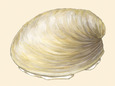
Neopilina galatheae, top (dorsal) view. Neopilina is peculiar because of the replication of various of its organs and organ systems, reminiscent of metameric animals. The class Monoplacophora is well known as fossils, and until 1952 all of its members were believed to have been extinct since the Devonian period, about 350 million years ago. [This shell, relatively thin, was damaged while being dredged.]

Neopilina galatheae, bottom (ventral) view. The oval, flat foot is characteristic of the classes Monoplacophora, Polyplacophora and Gastropoda. The foot is bordered on each (left and right) sides by five gills.

Neopilina galatheae, side (lateral) view. The anterior end, denoted by the slightly coiled apex, is on the right.
Contributors
Phil Myers (author), Museum of Zoology, University of Michigan-Ann Arbor, John B. Burch (author), Mollusk Division, Museum of Zoology, University of Michigan-Ann Arbor.
Glossary
- bilateral symmetry
-
having body symmetry such that the animal can be divided in one plane into two mirror-image halves. Animals with bilateral symmetry have dorsal and ventral sides, as well as anterior and posterior ends. Synapomorphy of the Bilateria.
- ectothermic
-
animals which must use heat acquired from the environment and behavioral adaptations to regulate body temperature