Microtus pennsylvanicusmeadow vole


Geographic Range
Meadow voles (Microtus pennsylvanicus) have a wide range that includes most of North America. These rodents are found in Canada, throughout most of Alaska, and across approximately half of the United States. They inhabit areas as far north as the Northwest Territories of Canada, and as far south as Folly Beach, South Carolina. These mammals are also found as far east as St. John, Canada and as far west as Unalakleet, Alaska, in the Norton Sound. They are found throughout the northeast and the east coast states of the United States, southward to South Carolina and Georgia. They inhabit western states that include parts of Washington, Idaho and Colorado. These voles are also found as far southwest as northern New Mexico. Although they are found across the Midwest to the East Coast, they are absent in Oklahoma, Kansas and most of Missouri. Disjunct populations of this species are found west of Gainesville, Florida as well as in Chihuahua, Mexico, and sparsely across sections of New Mexico. (Linzey and Hammerson, 2008)
Habitat
Meadow voles are found in grassy areas across their geographic range. They are known to inhabit areas close to roadways, as long as there is grass coverage for tunneling and nesting. These voles almost exclusively use early successional habitats, which also include agricultural fields, sedge marshes, and open-canopied bogs. They are occasionally found in more densely wooded areas. Studies have shown that meadow voles have a denser distribution in uncut grass, which is likely due to their nesting habits above ground. (Francl, et al., 2008; Grant, 1971; Klatt, et al., 2015)
- Habitat Regions
- temperate
- terrestrial
- Terrestrial Biomes
- savanna or grassland
- forest
- Other Habitat Features
- agricultural
Physical Description
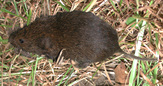
The average length of adult meadow voles is 167.5 mm (range 140-195). The length of the voles’ tails is between 33 mm and 64 mm, which is one-third to one-half the length of their body length. The length of the hind feet of these voles ranges from 18 to 24 mm, and their ear length ranges from 12 to 16 mm. The average mass of an adult male is 44.2 g (range 37.91-50.49), and the average mass of an adult female is 44.0 g (range 33.75-54.25). The average cranial length of an adult male is 27.4 mm. The average cranial breadth of an adult male is 11.0 mm. The cephalic index, the ratio of the maximum breadth of a skull to its length, of adult male meadow voles is only marginally larger than that of adult females. The dental formula for these voles is I 1/1, C 0/0, P 0/0, M 3/3 = 16. (Ford, et al., 2007; Reich, 1981; Unangst and Wunder, 2004)
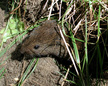
With sexes alike in coloration, meadow voles’ coats are made up of two types of hair with color variation throughout each individual. The soft tricolored hair on their posterior end is colored with dark gray at the roots, orange and yellow sections in the middle, and darker tips. The soft hair on the anterior portion of the voles is bicolored with gray at the root, and fading to white at the tip. The softer hair is found underneath the longer, firmer, hair. The firmer hair is bicolored with a gray color near the roots and dark brown ends, mostly located on the posterior side. During molting it is noted that the softer hair found under the firmer hair is thinner during the summer months. The variance in color is dependent upon maturity in these mammals. Newborn meadow voles are born hairless, and weigh between 1.6 g and 3.0 g. Between 4 and 7 days after birth, the offspring develop hair that is slightly darker than hair of the adult voles. As they mature into adults, the voles’ hair color begins to vary. (Reich, 1981; Unangst and Wunder, 2004)
- Other Physical Features
- endothermic
- bilateral symmetry
- Sexual Dimorphism
- sexes alike
-
- Range mass
- 33.75 to 50.49 g
- 1.19 to 1.78 oz
-
- Average mass
- 44.0-44.2 g
- oz
-
- Range length
- 140 to 195 mm
- 5.51 to 7.68 in
-
- Average basal metabolic rate
- 0.428 W
- AnAge
Reproduction
Meadow voles demonstrate a polygynandrous mating system. Boonstra et al. (1983) found that 33.1% of the tested female meadow voles had single litters consisting of offspring with multiple fathers. Female meadow voles are territorial during their mating season, and nest alone. They are aggressive towards other females as well as some males throughout the mating season. Male meadow voles are not territorial and share domains with multiple females at once. Pheromones are used amongst these voles to initiate mating. After mating has taken place, male meadow voles depart from the females, and female meadow voles strictly defend their territory. (Boonstra, et al., 1993; Elbroch and Rinehart, 2011; Ferkin and Johnston, 1995; Naughton, 2012; Reich, 1981)
- Mating System
- polygynandrous (promiscuous)
Meadow voles can mate year-round, although mating is most common from March to November. The average age of sexual maturity occurs in females at around 25 days (range 20-30), and around 40 days in males (range 35-45). The average gestation period for these voles is 21 days (range 20-23), and they are able to reproduce approximately every three weeks. Post-partum estrous takes place after the birth of a litter more than 50% of the time. This means that female meadow voles can produce multiple litters per breeding season, and can mate immediately after giving birth. Litters consist of 1 to 11 pups, with the average being 4-6. Meadow voles are born altricial, without hair, and with their eyes and ears closed. They weigh between 1.6 and 3.0 g at birth, averaging at around 2.3 g. Pups grow fur between 4 and 7 days, and their eyes and ears open around day 8. They are weaned, at 12-14 days, and once weaned they become independent. (Boonstra, et al., 1993; Dietloff, et al., 2010; Elbroch and Rinehart, 2011; Naughton, 2012; Reich, 1981)
- Key Reproductive Features
- iteroparous
- seasonal breeding
- year-round breeding
- gonochoric/gonochoristic/dioecious (sexes separate)
- sexual
- induced ovulation
- viviparous
- post-partum estrous
-
- Breeding interval
- Meadow voles breed as frequently as every 3 weeks from spring to fall and less frequently during the winter.
-
- Breeding season
- Mating occurs most commonly from March to November.
-
- Range number of offspring
- 1 to 11
-
- Average number of offspring
- 4-6
-
- Average number of offspring
- 5.5
- AnAge
-
- Range gestation period
- 20 to 23 days
-
- Average gestation period
- 21 days
-
- Average weaning age
- 12-14 days
-
- Average time to independence
- 12-14 days
-
- Range age at sexual or reproductive maturity (female)
- 20 to 30 days
-
- Range age at sexual or reproductive maturity (male)
- 35 to 45 days
Female meadow voles solely take care of their pups. Males are not involved in any caring for the offspring. Litters of pups are born within the females’ home range. Shortly after giving birth, females place pups into a nest they have built out of various plant stems, grasses, and leaves. Pups are born altricial, and must be nursed and protected by their mothers. Using ultrasonic calling, pups are able to communicate their temperature to their mother. Often this is an indication that a pup has wandered out of the nest. Maternal care is shown until the pups are weaned at 12-14 days. McGuire and Novak (1984) found that meadow voles show notably less parental investment toward pups than pine voles Mictrotus pinetorum and prairie voles Microtus ochrogaster. (Boonstra, et al., 1993; Elbroch and Rinehart, 2011; Gruder-Adams and Getz, 1985; Klatt, et al., 2015; McGuire and Novak, 1984; Naughton, 2012; Reich, 1981; Sabau and Ferkin, 2013)
- Parental Investment
- altricial
- female parental care
-
pre-weaning/fledging
-
protecting
- female
-
protecting
Lifespan/Longevity
On average, in the wild, these voles have a life span of 2-3 months, though some can live up to 16 months. Meadow voles in captivity can live longer than 2.5 years. (Naughton, 2012)
-
- Range lifespan
Status: wild - 16 (high) months
- Range lifespan
-
- Range lifespan
Status: captivity - greater than 2.5 (high) years
- Range lifespan
-
- Typical lifespan
Status: wild - 2 to 3 months
- Typical lifespan
Behavior
The behavior of meadow voles is dependent upon the season. Throughout the more active breeding season (March-November) females are highly aggressive and territorial. Females are aggressive towards both other females and males, when mating and caring for their pups. Aggressiveness is often characterized by the bearing or chattering of teeth, as well as vocalizations like squeaking or screeching. Females are solitary and defend a small portion, approximately 38 m^2, of their home ranges during this time. Males are not generally territorial towards other meadow voles. They have larger home ranges that can overlap with several females’ at once. An occasional male- to-male confrontation occurs when multiple males are attracted to the same female. This can lead to a short show of dominance between males and only lasts until mating is complete. Meadow voles may nest together during the colder months when mating is less common. These voles are active during the day and night. Although variable, they usually are diurnal during the cooler months and nocturnal during the warmer months. (Elbroch and Rinehart, 2011; Klatt, et al., 2015; Naughton, 2012; Reich, 1981)
-
- Average territory size
- 38 m^2
Home Range
Meadow voles have a home range size relative to their sex. Males have a much larger home range than females. The home ranges of males are 405-3480 m^2 while the home ranges of females are 160-3115 m^2. Female meadow voles are territorial of only about 38 m^2 of their home ranges. (Elbroch and Rinehart, 2011; Naughton, 2012)
Communication and Perception
Males and females interact more frequently during their breeding season (March-November), using sex hormones to communicate. Scents from urine and feces are used as communication tools when establishing territories. Although most communication occurs through chemical signaling and scent, when male or female voles are acting with aggressive tendencies, vocalizations may occur. As newborns, these rodents are able to communicate using ultrasonic calling. Blake (2012) found that ultrasonic calling peaked at 5-9 days, with the rate of 9 calls per minute in Greensboro, North Carolina. This is used when the pups are left alone and their body temperatures drop. Generally, the ultrasonic calling subsides within three weeks of birth. (Blake, 2012; Ferkin and Johnston, 1995; Reich, 1981; Vlautin and Ferkin, 2013)
- Communication Channels
- chemical
- Other Communication Modes
- pheromones
- scent marks
- Perception Channels
- visual
- tactile
- acoustic
- ultrasound
- chemical
Food Habits
The diet of meadow voles consists mostly of different types of grasses, and other plants. Barry (1976) showed that more than 90% of these voles’ diets consist of greenery. Zimmerman (1965) reported that Canada bluegrass Poa compressa, rock muhly Muhlenbergia sobolifera, witchgrass Panicum capillare, and narrowleaf plantain Plantago lanceolate make up more than eighty percent of their regular diet in a study conducted near Terre Haute, Illinois. Although these voles are considered herbivores, when greenery is scarce in the winter months they may turn to insects, larvae, dead and decaying animals, as well as occasionally their own offspring for survival. A negligible amount of fungi has been recorded in the diet of these rodents. Meadow voles may consume grains, fruits and vegetables, and even woody material, including trees and roots. (Barry, 1976; Dietloff, et al., 2010; Reich, 1981; Thompson, 1965; Zimmerman, 1965)
- Animal Foods
- mammals
- insects
- Plant Foods
- leaves
- roots and tubers
- wood, bark, or stems
- seeds, grains, and nuts
- fruit
- Other Foods
- fungus
Predation
Meadow voles have a very wide range of predators. Most carnivorous animals that inhabit the same areas as these voles prey on them. Their most common predators include owls, hawks, red foxes Vulpes vulpes, coyotes Canis latrans, bobcats Lynx rufus, and snakes. Northern short-tailed shrews Blarina brevicauda are a major predator of meadow voles in the eastern portions of North America. Black bears Ursus americanus and brown bears Ursus arctos have been known to scavenge for these rodents as well. Other mammals known to prey on meadow voles include grey wolves Canis lupus, fishers Martes pennanti, skunks, and ringtails Bassariscus astutus. Various birds such as jaegers Stercorarius, shrikes Lanius, and gulls also are predators of these rodents. (Elbroch and Rinehart, 2011; Naughton, 2012; Reich, 1981)
Meadow voles create tunnels both above and slightly below the ground. These tunnels are built under vegetation and used for protection against their many predators. (Elbroch and Rinehart, 2011; Naughton, 2012)
-
- Known Predators
-
- jaegers (Stercorarius species)
- shrikes (Lanius species)
- gulls (Larus species)
- owls (Strigiformes)
- hawks (Accipitriformes)
- red foxes (Vulpes vulpes)
- coyotes (Canis latrans)
- bobcats (Lynx rufus)
- northern short-tailed shrews (Blarina brevicauda)
- black bears (Ursus americanus)
- brown bears (Ursus arctos)
- grey wolves (Canis lupus)
- fishers (Martes pennanti)
- ringtails (Bassariscus astutus)
- skunks (Mephitis species)
- snakes (Serpentes)
Ecosystem Roles
Meadow voles are hosts to many endo- and ecto-parasites. Durden (1992) found 12 parasitic arthropods on meadow voles in Fort Detrick, MD. These arthropods included species of lice Hoplopleura acanthopus, fleas (Ctenophthalmus pseudagyrtes, Orghopeas leucopus), mites (Androlaelaps casalis, Androlaelapes fahrenholzi, Haemogamasus liponyssoides, Laelaps alaskensis, Laelaps kochi, Listrophorus mexicanus, Ornithonyssus bacoti), American dog ticks Dermacentor variabilis, and chiggers Neotrombicula whartoni. Other parasitic species groups include trematodes, cestodes, nematodes, acanthocephalans, and members of the phyla Anoplura and Acarina and order Diptera. In Pennsylvania, Holland and Benton (1953) found additional species of fleas (Epitedia wenmanni wenmanni, Catallagia borealis, Ctenophthalmus pseudagyrtes pseudagyrtes, Megabothris asio asio, Nosopsyllus fasciatus, Opisodasys pseudarctomys, Peromyscopsylla hamifer hamifer, Peromyscopsylla catatina) hosted by meadow voles. Meadow voles help with plant succession to contribute to biodiversity in ecosystems. These voles are also an important source of food for many other animals. (Holland and Benton, 1968; Jackson, 1961; Pearson, 2000; Reich, 1981)
- lice (Hoplopleura acanthopus)
- fleas (Ctenophthalmus pseudagyrtes)
- fleas (Orghopeas leucopus)
- fleas (Epitedia wenmanni wenmanni)
- fleas (Catallagia borealis)
- fleas (Ctenophthalmus pseudagyrtes pseudagyrtes)
- fleas (Megabothris asio asio)
- fleas (Nosopsyllus fasciatus)
- fleas (Opisodasys pseudarctomys)
- fleas (Peromyscopsylla hamifer hamifer)
- fleas (Peromyscopsylla catatina)
- mites (Androlaelaps casalis)
- mites (Androlaelapes fahrenholzi)
- mites (Haemogamasus liponyssoides)
- mites (Laelaps alaskensis)
- mites (Laelaps kochi)
- mites (Listrophorus mexicanus)
- mites (Ornithonyssus bacoti)
- American dog ticks (Dermacentor variabilis)
- chiggers (Neotrombicula whartoni)
- trematodes (Trematoda)
- cestodes (Cestoda)
- nematodes (Nematoda)
- acanthocephalans (Acanthocephala)
- Anoplura species
- flies (Diptera)
- ticks (Acarina)
Economic Importance for Humans: Positive
There are no known direct positive economic effects of meadow voles.
Economic Importance for Humans: Negative
Meadow voles are considered agricultural pests. Prevalent damage occurs during times of dense populations. They destroy many crops including alfalfa Medicago sativa, artichokes Cynara cardunculus, Brussels sprouts (Gemmifera group Brassica oleracea), carrots Daucus carota, cauliflower (Botrytis cultivar group Brassica oleracea), potatoes Solanum tuberosum, sugar beets Beta vulgaris, and tomatoes Solanum lycopersicum. These voles can damage fields of wheat Triticum and grain (Poaceae), and harm trees in orchards. (Clark, 1984; Jackson, 1961; Reich, 1981)
- Negative Impacts
- crop pest
Conservation Status
The IUCN Red List of Threatened Species lists meadow voles as a species of “least concern.” Meadow voles are abundant throughout their range and have no major threats. Because these voles cause damage to agriculture, there are anti-conservation measures to try and control their abundance. Controlling weed growth, lethal removal via snap-traps, and poison baiting are all used to reduce populations of meadow voles, and reduce damage to crops. Meadow voles have no special status on the U.S. Fish & Wildlife Service Endangered Species Database (US Federal List), Convention on International Trade in Endangered Species of Wild Fauna and Flora (CITES), or the Michigan Natural Features Inventory (State of Michigan List). (Clark, 1984; Linzey and Hammerson, 2008)
-
- IUCN Red List
-
Least Concern
More information
-
- IUCN Red List
-
Least Concern
More information
-
- US Federal List
- No special status
-
- CITES
- No special status
-
- State of Michigan List
- No special status
Contributors
Stephanie Rowe (author), Radford University, Alex Atwood (editor), Radford University, Marisa Dameron (editor), Radford University, Karen Powers (editor), Radford University, Tanya Dewey (editor), University of Michigan-Ann Arbor.
Glossary
- Nearctic
-
living in the Nearctic biogeographic province, the northern part of the New World. This includes Greenland, the Canadian Arctic islands, and all of the North American as far south as the highlands of central Mexico.

- acoustic
-
uses sound to communicate
- agricultural
-
living in landscapes dominated by human agriculture.
- altricial
-
young are born in a relatively underdeveloped state; they are unable to feed or care for themselves or locomote independently for a period of time after birth/hatching. In birds, naked and helpless after hatching.
- bilateral symmetry
-
having body symmetry such that the animal can be divided in one plane into two mirror-image halves. Animals with bilateral symmetry have dorsal and ventral sides, as well as anterior and posterior ends. Synapomorphy of the Bilateria.
- bog
-
a wetland area rich in accumulated plant material and with acidic soils surrounding a body of open water. Bogs have a flora dominated by sedges, heaths, and sphagnum.
- chemical
-
uses smells or other chemicals to communicate
- diurnal
-
- active during the day, 2. lasting for one day.
- endothermic
-
animals that use metabolically generated heat to regulate body temperature independently of ambient temperature. Endothermy is a synapomorphy of the Mammalia, although it may have arisen in a (now extinct) synapsid ancestor; the fossil record does not distinguish these possibilities. Convergent in birds.
- female parental care
-
parental care is carried out by females
- folivore
-
an animal that mainly eats leaves.
- forest
-
forest biomes are dominated by trees, otherwise forest biomes can vary widely in amount of precipitation and seasonality.
- fossorial
-
Referring to a burrowing life-style or behavior, specialized for digging or burrowing.
- frugivore
-
an animal that mainly eats fruit
- granivore
-
an animal that mainly eats seeds
- herbivore
-
An animal that eats mainly plants or parts of plants.
- induced ovulation
-
ovulation is stimulated by the act of copulation (does not occur spontaneously)
- iteroparous
-
offspring are produced in more than one group (litters, clutches, etc.) and across multiple seasons (or other periods hospitable to reproduction). Iteroparous animals must, by definition, survive over multiple seasons (or periodic condition changes).
- marsh
-
marshes are wetland areas often dominated by grasses and reeds.
- motile
-
having the capacity to move from one place to another.
- native range
-
the area in which the animal is naturally found, the region in which it is endemic.
- nocturnal
-
active during the night
- pheromones
-
chemicals released into air or water that are detected by and responded to by other animals of the same species
- polygynandrous
-
the kind of polygamy in which a female pairs with several males, each of which also pairs with several different females.
- scent marks
-
communicates by producing scents from special gland(s) and placing them on a surface whether others can smell or taste them
- seasonal breeding
-
breeding is confined to a particular season
- sedentary
-
remains in the same area
- sexual
-
reproduction that includes combining the genetic contribution of two individuals, a male and a female
- solitary
-
lives alone
- tactile
-
uses touch to communicate
- temperate
-
that region of the Earth between 23.5 degrees North and 60 degrees North (between the Tropic of Cancer and the Arctic Circle) and between 23.5 degrees South and 60 degrees South (between the Tropic of Capricorn and the Antarctic Circle).
- terrestrial
-
Living on the ground.
- territorial
-
defends an area within the home range, occupied by a single animals or group of animals of the same species and held through overt defense, display, or advertisement
- tropical savanna and grassland
-
A terrestrial biome. Savannas are grasslands with scattered individual trees that do not form a closed canopy. Extensive savannas are found in parts of subtropical and tropical Africa and South America, and in Australia.
- savanna
-
A grassland with scattered trees or scattered clumps of trees, a type of community intermediate between grassland and forest. See also Tropical savanna and grassland biome.
- temperate grassland
-
A terrestrial biome found in temperate latitudes (>23.5° N or S latitude). Vegetation is made up mostly of grasses, the height and species diversity of which depend largely on the amount of moisture available. Fire and grazing are important in the long-term maintenance of grasslands.
- ultrasound
-
uses sound above the range of human hearing for either navigation or communication or both
- visual
-
uses sight to communicate
- viviparous
-
reproduction in which fertilization and development take place within the female body and the developing embryo derives nourishment from the female.
- year-round breeding
-
breeding takes place throughout the year
References
Barry, R. 1976. Mucosal surface areas and villous morphology of the small intestine of small mammals: Functional interpretations. Journal of Mammalogy, 57/2: 273-290.
Blake, B. 2012. Ultrasonic calling in 2 species of voles, Microtus pinetorum and M. pennsylvanicus, with different social system. Journal of Mammalogy, 93/4: 1051-1060.
Boonstra, R., X. Xia, L. Pavone. 1993. Mating system of the meadow vole, Microtus pennsylvanicus. Behavioral Ecology, 4/1: 83-89.
Clark, J. 1984. Vole control in field crops. Proceedings of the Eleventh Vertebrate Pest Conference, Paper 9: 5-6.
Dietloff, J., M. Falcy, J. Krenz, B. McMillan. 2010. Correlating small mammal abundance to climatic variation over twenty years. Journal of Mammalogy, 91/1: 193-199.
Elbroch, M., K. Rinehart. 2011. Behavior of North American Mammals. New York, New York: Houghton Mifflin Harcourt.
Ferkin, M., R. Johnston. 1995. Meadow voles, Microtus pennsylvanicus, use multiple sources of scent for sex recognition. Animal Behaviour, 49/1: 37-44.
Ford, W., J. Rodrigue, J. Laerm. 2007. Meadow vole (Microtus pennsylvanicus). Pp. 284-288 in M Trani, W Ford, B Chapman, eds. The Land Manager's Guide to Mammals of the South. Durham, North Carolina: USDA Forest Service & The Nature Conservancy.
Francl, K., W. Ford, S. Castleberry, T. Glenn. 2008. Genetic relationships of meadow vole (Microtus pennsylvanicus) populations in central Appalachian wetlands. Canadian Journal of Zoology, 86/5: 344-355.
Grant, P. 1971. The habitat preference of Microtus pennsylvanicus, and its relevance to the distribution of this species on islands. Journal of Mammalogy, 52/2: 351-361.
Gruder-Adams, S., L. Getz. 1985. Comparison of the mating system and paternal behavior in Microtus ochrogaster and M. pennsylvanicus. Journal of Mammalogy, 66/1: 165-167.
Holland, G., A. Benton. 1968. Siphonaptera from Pennsylvania mammals. The American Midland Naturalist, 80/1: 252-261.
Jackson, H. 1961. Mammals of Wisconsin. Madison, Wisconsin: The University of Wisconsin Press.
Klatt, B., L. Getz, B. McGuire. 2015. Interspecific interactions and habitat use by prairie voles (Microtus ochrogaster) and meadow voles (M. pennsylvanicus). The American Midland Naturalist, 173/2: 241-252.
Linzey, A., G. Hammerson. 2008. "Microtus pennsylvanicus" (On-line). The IUCN Red List of Threatened Species 2008: e.T13452A3970160. Accessed September 15, 2016 at http://dx.doi.org/10.2305/IUCN.UK.2008.RLTS.T13452A3970160.en.
Lomolino, M. 1984. Immigrant selection, predation, and the distributions of Microtus pennsylvanicus and Blarina brevicauda on islands. The American Naturalist, 123/4: 468-483.
Madison, D. 1978. Behavioral and sociochemical susceptibility of meadow voles (Microtus pennsylvanicus) to snake predators. The American Midland Naturalist, 100/1: 23-28.
McGuire, B., M. Novak. 1984. A comparison of maternal behaviour in the meadow vole (Microtus pennsylvanicus), prairie vole (M. ochrogaster) and pine vole (M. pinetorum). Animal Behaviour, 32/4: 1132-1141.
Naughton, D. 2012. The Natural History of Canadian Mammals. Toronto, Canada: University of Toronto Press.
Pearson, D. 2000. Small mammals of the Bitterroot National Forest: Ecological significance and guidelines for management. Pp. 45-47 in H Smith, ed. The Bitterroot Ecosystem Management Research Project: What We Have Learned. Missoula, Montana: United States Department of Agriculture, Forest Service.
Reich, L. 1981. Microtus pennsylvanicus. Mammalian Species, 159: 1-8.
Sabau, R., M. Ferkin. 2013. Food restriction affects the maternal behavior provided by female meadow voles (Microtus pennsylvanicus). Journal of Mammalogy, 94/5: 1068-1076.
Thompson, D. 1965. Food preferences of the meadow vole (Microtus pennsylvanicus) in relation to habitat affinities. The American Midland Naturalist, 74/1: 76-86.
Unangst, E., B. Wunder. 2004. Effect of supplemental high-fat forage on body composition in wild meadow voles (Microtus pennsylvanicus). The American Midland Naturalist, 151/1: 146-153.
Vlautin, C., M. Ferkin. 2013. The outcome of a previous social interaction with a same-sex conspecific affects the behavior of meadow voles, Microtus pennsylvanicus. Ethology International Journal of Behavioural Biology, 119/3: 212-220.
Zimmerman, E. 1965. A comparison of habitat and food of two species of Microtus. Journal of Mammalogy, 46/4: 605-612.