Melanerpes carolinusred-bellied woodpecker


Geographic Range
Red-bellied woodpeckers are found in the eastern half of the United States. Their range extends east from the wooded portion of the Great Plain states to the Atlantic coast and from the Gulf of Mexico to southern portions of Ontario and northern Minnesota, Wisconsin, Michigan, and New York. ()
Habitat
Red-bellied woodpeckers are adaptable to a variety of forested habitats. Though they are most commonly associated with mature hardwood forests, they also thrive in mixed pine-hardwood forests, mesic pine flatwoods, heavily timbered bottomlands, swampy woods, and riparian forests. They usually live below 600 m elevation, but can be found at up to 900 m in the Apalachian mountains. (Shackelford, et al., 2000)
- Habitat Regions
- temperate
- terrestrial
- Terrestrial Biomes
- forest
- Other Habitat Features
- riparian
-
- Range elevation
- 900 (high) m
- 2952.76 (high) ft
Physical Description
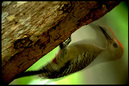
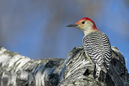
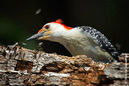
Red-bellied woodpeckers are medium sized birds with a distinctive black-and-white patterned back and a long, chisel-shaped bill. Adults weigh about 72.5 grams (range 56 to 91 g), and are 22.9 to 26.7 cm long. They have a wingspan of 38 to 46 cm. Males are about 8-9% larger, on average, than females. Two characteristics that distinguish red-bellied woodpeckers from woodpeckers native to North America are the black and white zebra pattern on their backs, and the red belly found in a small section of the ventral region. The face and belly are a dull grayish color. Male red-bellied woodpeckers have a bright red cap that covers from the forehead to the nape of the neck. Females have red only on the napes of their necks. The legs and zygodactyl feet (two toes forward, two toes back) are dark gray, and the chisel shaped bill is black.
Juvenile red-bellied woodpeckers are similar in appearance to adults, but have a horn-colored bill and lack any red on their heads. Unlike many birds, red-bellied woodpeckers do not show seasonal variation in the coloration. ("Chipper Woods Bird Observatory: Red Bellied Woodpecker", 2001; Shackelford, et al., 2000)
- Other Physical Features
- endothermic
- bilateral symmetry
- Sexual Dimorphism
- male larger
- sexes colored or patterned differently
- male more colorful
-
- Average mass
- 75.2 g
- 2.65 oz
-
- Average mass
- 72.5 g
- 2.56 oz
- AnAge
-
- Range length
- 22.9 to 26.7 cm
- 9.02 to 10.51 in
-
- Range wingspan
- 38 to 46 cm
- 14.96 to 18.11 in
Reproduction
Red-bellied woodpeckers are thought to be monogamous. Pairs form any time from early winter to late spring. Males attract females with a combination of tapping, "kwirr" calls, and drumming. Mutual tapping is an important part of communication between the pair and in nest-site selection, which may be an important part of establishing a pair bond. Breeding pairs do not appear to stay together for more than one season. (Shackelford, et al., 2000)
- Mating System
- monogamous
Breeding pairs begin forming any time between early winter and late spring, and nesting usually begins in March and April. The male and female select a nest site together. The process of selecting the nest site is highly ritualized in this species, and involves much mutual tapping, in which one member of the pair taps softly on the wood from inside a cavity, and the other taps back from the outside. Nests are usually excavated in dead trees or the dead limbs of live trees. Both male and female excavate the nest cavity, which has an opening approximately 5.9 x 5.7 cm. When the nest is complete, the female lays about four eggs at one-day intervals. The eggs are smooth, oval, and glossy white. Both parents incubate the eggs, which hatch after about 12 days.
"Pip"-ing sounds come from the egg two hours before hatching. The chicks are altricial at hatching; they are naked, their eyes are shut, and egg teeth can be seen on the upper and lower mandibles. About six days after hatching, their eyes begin to open and claws, rectrices, and remiges appear. Around the tenth to twelfth day feathers project from skin. Around the fifteenth day the eyes open completely and the sex can be determined. Around the twenty-first day the young have all of their feathers and the egg teeth are gone. The young vocalize throughout their development. During this time, both parents bring food to the chicks in the nest. They begin to leave the nest 24 to 27 days after hatching.
Fledglings usually stay near the nest for a few days after fledging. About two days after leaving the nest the fledglings start to follow their parents. The parents continue to help feed the young for up to 10 weeks after they fledge. Toward the end of this period, the adults drive the fledglings away. The young birds are probably able to breed the next spring. While red-bellied woodpeckers occasionally raise two broods per season, most pairs are only able to raise one brood per season. (Shackelford, et al., 2000)
- Key Reproductive Features
- iteroparous
- seasonal breeding
- gonochoric/gonochoristic/dioecious (sexes separate)
- sexual
- oviparous
-
- Breeding interval
- Red-bellied woodpeckers breed once per year.
-
- Breeding season
- Nesting usually begins in March or April.
-
- Average eggs per season
- 4
-
- Average eggs per season
- 4
- AnAge
-
- Average time to hatching
- 12 days
-
- Average time to hatching
- 11 days
- AnAge
-
- Range fledging age
- 24 to 27 days
-
- Range time to independence
- 2 to 10 weeks
-
- Range age at sexual or reproductive maturity (female)
- 1 (low) years
-
- Range age at sexual or reproductive maturity (male)
- 1 (low) years
Both male and female red-bellied woodpeckers invest heavily in parental care. Both sexes select the nest site and excavate the nest, as well as incubating the eggs and feeding the chicks for up to 10 weeks after they fledge. (Shackelford, et al., 2000)
- Parental Investment
- altricial
-
pre-fertilization
- provisioning
-
protecting
- female
-
pre-hatching/birth
-
protecting
- male
- female
-
protecting
-
pre-weaning/fledging
-
provisioning
- male
- female
-
protecting
- male
- female
-
provisioning
-
pre-independence
-
provisioning
- male
- female
-
protecting
- male
- female
-
provisioning
Lifespan/Longevity
The oldest known red-bellied woodpecker lived to be at least 12 years and 1 month old. (Shackelford, et al., 2000)
-
- Average lifespan
Status: wild - 12.1 years
- Average lifespan
-
- Average lifespan
Status: wild - 145 months
- Bird Banding Laboratory
- Average lifespan
Behavior
Red-bellied woodpeckers are non-migratory, though northern populations do show some seasonal movements southward during cold winters. They are diurnal and solitary, except during the breeding season when they consort with mates and offspring. Red-bellied woodpeckers defend a territory year round. The size of these territories varies with habitat quality, but estimates range from 0.016 to 0.16 square kilometers.
Walking, climbing and hopping are all forms of locomotion used by red-bellied woodpeckers. An interesting form of locomotion used by woodpeckers is called "hitching," hopping upward along a vertical surface such as a tree trunk interspersed with pauses to look for food.
Red-bellied woodpeckers have been observed playing when predators are not around. They may fly spontaneously and dodge among trees and shrubs as if evading a predator. Within-gender conflicts are common and usually involve a chase and collisions in mid-air. Red-bellied woodpeckers exhibit many threat displays, for example, raising their feathers on their neck and the crown of their head and spreading their wings and tail to appear larger to the threatening individual. In the presence of predators red-bellied woodpeckers sound alarm calls and retreat to nearby trees or shrubs. (Shackelford, et al., 2000)
-
- Range territory size
- 0.016 to 0.16 km^2
Home Range
Red-bellied woodpecker home ranges that have been measured have ranged from 3.5 to 19 ha.
Communication and Perception
Red-bellied woodpeckers communicate using vocalizations, non-vocal sounds, and physical display. This is a very vocal species throughout the year, though they are most noisy during the breeding season. Red-bellied woodpeckers use six calls to communicate. They also communicate by drumming on dead trees, dead stubs and utility poles with their beaks. Drumming is used to announce ownership of a territory and in pair bond formation and maintenance. (Shackelford, et al., 2000)
Food Habits
Red-bellied woodpeckers are omnivorous. They eat a wide variety of fruits, nuts, seeds, berries and tree sap, as well as arboreal arthropods and other invertebrates. These include ants, flies, grasshoppers, beetle larvae and caterpillars. Red-bellied woodpeckers also take small vertebrates, including brown and green anoles, tree frogs, small fish, nestling birds and bird eggs.
Gleaning, probing, excavating, pecking, bark scaling, and hawking are all methods used by red-bellied woodpeckers to forage for food. Once captured, small food is consumed by swallowing it whole. Large prey is thrashed against a tree and pecked at. An interesting feeding adaptation of red-bellied woodpeckers is their tongue. Their tongue is long, cylindrical, pointed, sticky, and has a spear-like tip. It is well adapted for excavating prey from cracks.
Red-bellied woodpeckers forage primarily on the trunks and limbs of trees and snags. Studies have shown that males and females forage differently. Males forage primarily on trunks, while females forage primarily on tree limbs. Females also forage higher on the trees than males.
Red-bellied woodpeckers are known to store extra food for later consumption. Food items such as nuts, acorns, corn, fruits, seeds and insects are stored deep in pre-existing cracks and crevices of trees or posts. ("Chipper Woods Bird Observatory: Red Bellied Woodpecker", 2001; Shackelford, et al., 2000)
- Primary Diet
- omnivore
- Animal Foods
- birds
- amphibians
- reptiles
- fish
- eggs
- insects
- terrestrial non-insect arthropods
- Plant Foods
- seeds, grains, and nuts
- fruit
- sap or other plant fluids
- Foraging Behavior
- stores or caches food
Predation
Predators of adult red-bellied woodpeckers include birds of prey such as sharp-shinned hawks and Cooper's hawks, black rat snakes and house cats. Known predators of nestlings and eggs include red-headed woodpeckers, European starlings, pileated woodpeckers, gray rat snakes and black rat snakes.
When approached by a predator, red-bellied woodpeckers either hide from the predator, or harass it with alarm calls. They defend their nests and young aggressively, and may directly attack predators that come near the nest.
-
- Known Predators
-
- sharp-shinned hawks (Accipiter striatus)
- Cooper's hawks (Accipiter cooperii)
- black rat snakes (Pantherophis obsoletus)
- domestic cats (Felis silvestris)
- red-headed woodpeckers (Melanerpes erythrocephalus)
- European starlings (Sturnus vulgaris)
- pileated woodpeckers (Dryocopus pileatus)
- gray rat snakes (Elaphe obsoleta spiloides)
Ecosystem Roles
Red-bellied woodpeckers affect the populations of the animals they eat. They also provide food for their predators. They host at least two species of mites, Menacanthus precursor and Philopterus californiensis.
Red-bellied woodpeckers compete for food with blue jays and several other species of woodpeckers. They compete for nest sites with red-cockaded woodpeckers, European starlings, northern flickers, flying squirrels, red-headed woodpeckers and downy woodpeckers. Abandoned red-bellied woodpecker nest holes are used by a variety of other cavity-nesting birds and mammals. (Shackelford, et al., 2000)
- Ecosystem Impact
- creates habitat
Economic Importance for Humans: Positive
Red-bellied woodpeckers help to control insects that are considered pest species. ("Chipper Woods Bird Observatory: Red Bellied Woodpecker", 2001)
- Positive Impacts
- controls pest population
Economic Importance for Humans: Negative
There are no known adverse effects of red-bellied woodpeckers on humans.
Conservation Status
Red-bellied woodpecker populations appear to have grown in recent years. Because this species can inhabit a variety of forest types and stages, it is more adaptable and less likely to be threatened or endangered than other woodpecker species. This species' success may be partially attributable to it's ability to adapt to the environment provided by spreading suburbs in many areas. There are an estimated 10,000,000 red-bellied woodpeckers across the geographic range. This species is protected under the U.S. Migratory Bird Act. ("Chipper Woods Bird Observatory: Red Bellied Woodpecker", 2001; Shackelford, et al., 2000)
-
- IUCN Red List
-
Least Concern
More information
-
- IUCN Red List
-
Least Concern
More information
-
- US Migratory Bird Act
- Protected
-
- US Federal List
- No special status
-
- CITES
- No special status
-
- State of Michigan List
- No special status
Contributors
Kari Kirschbaum (author, editor), Animal Diversity Web.
Liesl Eckhardt (author), University of Michigan-Ann Arbor, Phil Myers (editor), Museum of Zoology, University of Michigan-Ann Arbor.
Glossary
- Nearctic
-
living in the Nearctic biogeographic province, the northern part of the New World. This includes Greenland, the Canadian Arctic islands, and all of the North American as far south as the highlands of central Mexico.

- acoustic
-
uses sound to communicate
- altricial
-
young are born in a relatively underdeveloped state; they are unable to feed or care for themselves or locomote independently for a period of time after birth/hatching. In birds, naked and helpless after hatching.
- arboreal
-
Referring to an animal that lives in trees; tree-climbing.
- bilateral symmetry
-
having body symmetry such that the animal can be divided in one plane into two mirror-image halves. Animals with bilateral symmetry have dorsal and ventral sides, as well as anterior and posterior ends. Synapomorphy of the Bilateria.
- chemical
-
uses smells or other chemicals to communicate
- diurnal
-
- active during the day, 2. lasting for one day.
- endothermic
-
animals that use metabolically generated heat to regulate body temperature independently of ambient temperature. Endothermy is a synapomorphy of the Mammalia, although it may have arisen in a (now extinct) synapsid ancestor; the fossil record does not distinguish these possibilities. Convergent in birds.
- forest
-
forest biomes are dominated by trees, otherwise forest biomes can vary widely in amount of precipitation and seasonality.
- iteroparous
-
offspring are produced in more than one group (litters, clutches, etc.) and across multiple seasons (or other periods hospitable to reproduction). Iteroparous animals must, by definition, survive over multiple seasons (or periodic condition changes).
- monogamous
-
Having one mate at a time.
- motile
-
having the capacity to move from one place to another.
- native range
-
the area in which the animal is naturally found, the region in which it is endemic.
- omnivore
-
an animal that mainly eats all kinds of things, including plants and animals
- oviparous
-
reproduction in which eggs are released by the female; development of offspring occurs outside the mother's body.
- riparian
-
Referring to something living or located adjacent to a waterbody (usually, but not always, a river or stream).
- seasonal breeding
-
breeding is confined to a particular season
- sedentary
-
remains in the same area
- sexual
-
reproduction that includes combining the genetic contribution of two individuals, a male and a female
- solitary
-
lives alone
- stores or caches food
-
places a food item in a special place to be eaten later. Also called "hoarding"
- tactile
-
uses touch to communicate
- temperate
-
that region of the Earth between 23.5 degrees North and 60 degrees North (between the Tropic of Cancer and the Arctic Circle) and between 23.5 degrees South and 60 degrees South (between the Tropic of Capricorn and the Antarctic Circle).
- terrestrial
-
Living on the ground.
- territorial
-
defends an area within the home range, occupied by a single animals or group of animals of the same species and held through overt defense, display, or advertisement
- visual
-
uses sight to communicate
References
2001. "Chipper Woods Bird Observatory: Red Bellied Woodpecker" (On-line). Accessed March 21, 2001 at http://wbu.com/chipperwoods/photos/redbel.htm.
1990. Red-Bellied Woodpecker. Pp. 203 in Book of North American Birds. New York: The Reader's Digest Association, Inc.
Perring, C., A. Middleton. 1985. Woodpeckers. Pp. 296-301 in The Encyclopedia of Birds. New York: Facts on File Publications.
Shackelford, C., R. Brown, R. Conner. 2000. Red-bellied woodpecker (Melanerpes carolinus). Pp. 1-24 in A Poole, F Gill, eds. The Birds of North America, Vol. 500. Philadelphia, PA: The Birds of North America, Inc.