Marmota flaviventrisyellow-bellied marmot




Geographic Range
Yellow-bellied marmots are distributed widely in the western United States and Canada. They range as far north as southcentral British Columbia and Alberta in Canada and as far south as the Sierra Nevada. (Frase and Hoffmann, 1980)
Habitat
Yellow-bellied marmots generally live in moderately warm, dry habitats at low to mid elevations. They are found in many different habitats, including semi-desert, woodland and forest openings, and the alpine zone. Those that live further south live at higher elevations. For example, in the White Mountains of California they are found only above 2000 m. Moreover, because of absence from valleys, southern populations are isolated from one other, forming isolated populations. In addition, congeners may affect their distribution. It can be inferred that the presence of hoary marmots inhibit the distribution of yellow-bellied marmots in certain high elevation areas, as both occupy subalpine and alpine areas. Yellow-bellied marmots inhabit vegetated fortified slopes or rock outcrops in meadows, which serve as support for the burrows that they reside in, as well as sunning and observation posts. The main entrance of burrow, which they dig themselves, is usually about 0.6 m deep into the ground, and extends about 3.8 to 4.4 m horizontally into the hillside. Many short tunnels branch from main passageway, sometimes connecting to other burrows. Burrows stay relatively stable and thus serve as preferable places to raise young, hibernate, and hide from potential predators. Burrow availability may affect marmot distribution, as well as visibility and safety from predators. Most yellow-bellied marmots occur around 2000 m in elevation. (Blumstein, et al., 2006; Frase and Hoffmann, 1980)
- Habitat Regions
- terrestrial
- Terrestrial Biomes
- desert or dune
- savanna or grassland
- forest
- mountains
-
- Average elevation
- 2000 m
- 6561.68 ft
Physical Description
Yellow-bellied marmots are a small to medium-sized rodents. Males weigh from 2.95 to 5.22 kg, with an average of 3.9 kg. Females range in mass from 1.59 to 3.57 kg, with an average of 2.8 kg. Total length ranges from 470 to 700 mm, with tail length ranging from 130 to 220 mm. Hind-foot length from 70 to 90 mm, and condylobasal length ranges from 68.0 to 99.8 mm. Males are longer than females and weigh significantly more. Also, individuals from low, arid-land habitats tend to be smaller than those from mesic, montane habitats. They have robust bodies, with short and broad heads. The head has a narrow interorbital region, with temporal ridges brought joining to form a low, short, sagittal crest. The posterior end of the palate lies obtusely, and the teeth of the upper jaw lie slightly more anterior than the teeth of the bottom jaw. The dental formula is 1/1, 0/0, 2/1, 3/3 = 22. The cheek teeth are high-crowned. Yellow-bellied marmots have small, well-furred ears, feet with five digits and an oval pad in the center of the sole of the hind foot, short and slightly curved claws with a rudimentary nail-bearing thumb, and ten mammae – two pectoral, two abdominal, and one inguinal pair. (Frase and Hoffmann, 1980)
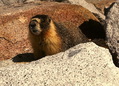
The underfur of yellow-bellied marmots is soft, dense, and wooly on the back and sides of the body. Longer, coarse outer guard hairs with lighter tips and darker bases cover the entire body, making the overall color yellow-brown to tawny. Individuals are rarely dark brown and never black, except in melanistic individuals (common in populations in southern Rocky Mountains). There are also noticeable buffy yellowish patches on the side of the neck, white spots between the eyes, and a yellow or orange-russet color covering the belly, with feet a buffy, hazel, or dark brown color. There is great variety in color within subspecies. Yellow-belied marmots molt once annually during summer. (Frase and Hoffmann, 1980)
- Other Physical Features
- endothermic
- homoiothermic
- bilateral symmetry
- Sexual Dimorphism
- male larger
-
- Range mass
- 1.59 to 5.22 kg
- 3.50 to 11.50 lb
-
- Average mass
- 3.35 kg
- 7.38 lb
-
- Range length
- 470 to 700 mm
- 18.50 to 27.56 in
-
- Average basal metabolic rate
- 8.626 W
- AnAge
Reproduction
Yellow-bellied marmots are most often classified as polygynous. They can live as members of a colony, or as single or paired animals. About 75% of individuals live in colonies, 16% in “satellite sites”, and 7% in temporary sites. Satellite sites are secondary habitats consisting of only a few burrows. Those in colonies are members of harems, groups consisting of adult males, and females and their offspring. All males and about 40% of females are recruited from outside the colony. Reproductive rates at “satellite sites” are lower than in colonies and have more size fluctuation and shorter residencies than colonies and temporary/transient sites. (Blumstein, et al., 2004; Frase and Hoffmann, 1980; Wey and Blumstein, 2010)
- Mating System
- polygynous
- cooperative breeder
Yellow-bellied marmots reach reproductive maturity by two years of age. Hence, no female yearlings produce offspring. Only 25% of two-year old females produce a litter. The testes of adult males are enlarged for several weeks when they awake from winter hibernation and then eventually regress to become the same size as juveniles. There is one breeding season per year, which starts and is concentrated in the first two weeks after they awake from winter hibernation. Gestation lasts for approximately 30 days, and litter sizes range from 3 to 8 pups, with an average of 4.32 pups. Adult females have an average corpus luteum count of 4.7. Newborn pups are 111 mm in length and weigh 33.8 g on average. (Blumstein, et al., 2004; Frase and Hoffmann, 1980; Wey and Blumstein, 2010)
- Key Reproductive Features
- iteroparous
- seasonal breeding
- gonochoric/gonochoristic/dioecious (sexes separate)
- sexual
- viviparous
-
- Breeding interval
- Yellow-bellied breed once yearly.
-
- Breeding season
- Most populations of yellow-bellied marmots breed during May and June.
-
- Range number of offspring
- 3 to 8
-
- Average number of offspring
- 4.32
-
- Average number of offspring
- 4
- AnAge
-
- Average gestation period
- 30 days
-
- Average gestation period
- 30 days
- AnAge
-
- Average weaning age
- 7 weeks
-
- Average time to independence
- 7 weeks
-
- Average age at sexual or reproductive maturity (female)
- 2 years
-
- Average age at sexual or reproductive maturity (female)
Sex: female - 730 days
- AnAge
- Average age at sexual or reproductive maturity (female)
-
- Average age at sexual or reproductive maturity (male)
- 2 years
-
- Average age at sexual or reproductive maturity (male)
Sex: male - 730 days
- AnAge
- Average age at sexual or reproductive maturity (male)
There is little information available regarding parental care in yellow-bellied marmots. Mothers nurse pups for about 3 weeks, at which time pups emerge from the burrow. Parental care decreases substantially once pups emerge; however, strong social bonds remain for an extended period, especially in colonial populations. (Blumstein, et al., 2004; Frase and Hoffmann, 1980; Wey and Blumstein, 2010)
- Parental Investment
- altricial
- female parental care
-
pre-weaning/fledging
-
provisioning
- female
-
provisioning
- post-independence association with parents
Lifespan/Longevity
Most yellow-bellied marmots live for 13 to 15 years in the wild. Predation, which accounts for 98% of summer mortality significantly limits the average lifespan of this species. A significant number of deaths occur during hibernation and emigration. Recently, sylvatic plague, caused by the bacterium Yersinia pestis, has had a significant impact on populations in California. (Frase and Hoffmann, 1980)
-
- Range lifespan
Status: wild - 13 to 15 years
- Range lifespan
Behavior
Yellow-bellied marmots normally appear from burrows soon after sunrise, defecate, and spend time grooming and sunning. They forage by mid-morning, followed by sunning, grooming, and long intervals in the burrow. They feed again by late afternoon. Most time spent above-ground involves sunning with head in an alert position. Social interactions that have been observed are either amicable or agonistic. Amicable behavior includes play, grooming, and greeting behavior. Play occurs often between young, young and adults, and between yearlings, and may help individuals to socially integrate. Furthermore, grooming may suggest a dominant-subordinate role. Agonistic behavior includes grooming, social mounting, alert behavior, chasing, and fighting. Interactions between those of the same burrow are amicable, while agonistic interactions happen in those of different burrows. Rates of amicable behavior are also related to length of time the individuals live together - amicable behavior increases when all individuals have lived in the same burrow for longer than a year. In addition, territorial males are more hostile towards male yearlings and adults. Territorial behavior includes tail flagging, and marking habitat with anal glands. All males and most females leave the colony one year after birth. Female aggressive behavior towards litters is partly responsible for dispersal. Agonistic behavior by the male affects the leaving of male yearlings, but is not the primary cause of dispersal. Dispersal of yearlings may be delayed if there are a lot of yearlings, if they are underweight, and if there are high levels of amicable behavior between yearlings and adults. (Blumstein, et al., 2004; Frase and Hoffmann, 1980; Wey and Blumstein, 2010)
Yellow-bellied marmots spend about 80% of their lives in burrows due to winter hibernation. Hibernation lasts about eight months and occurs from early September to May, but may vary from year to year. Of the time spent underground, 60% is allocated to hibernation. Young marmots lose 50% of their body weight hibernating, thus reaching the threshold weight is important by fall. Hibernation is a cause of great mortality rates of all age groups of yellow-bellied marmots. Of the 14 species of M. marmota, only two (Marmota monax and M. flaviventris), are not social hibernators. Only the young of M. flaviventris have been reported to hibernate socially. (Blumstein, et al., 2004; Frase and Hoffmann, 1980; Wey and Blumstein, 2010)
- Key Behaviors
- fossorial
- diurnal
- motile
- sedentary
- hibernation
- territorial
- social
- colonial
- dominance hierarchies
Home Range
There is no information available regarding the average home range of yellow-bellied marmots.
Scientists don't know the size of the area where yellow-bellied marmots usually live and travel.
Communication and Perception
Communication between yellow-bellied marmots is mostly auditory and visual. There are three main vocalizations: the whistle, the undulating scream, and the tooth chatter. Six different whistles are recognized and may have more than one function, such as alerting and threatening. Screams usually respond to excitement or fear, and tooth chattering is used as a threat. Other animals such as American pikas and golden-mantled ground squirrels may respond to marmot alarm calls. Yellow-bellied marmots have cheek and anal glands. Scent marking occurs with cheek glands in conflict situations, having more of a dominance rather than territoriality function. (Blumstein, et al., 2004; Frase and Hoffmann, 1980; Wey and Blumstein, 2010)
- Other Communication Modes
- scent marks
Food Habits
Yellow-bellied marmots are herbivorous, eating a large range of plant types, including grasses, flowers, and forbs. In late summer, large numbers of seeds are eaten. They are most likely not food limited, eating only 0.8 to 3.1% of available net primary production. Food might be limited in areas where snow cover remains into the spring. They are selective feeders and are known to reject parts of plants that are toxic. (Frase and Hoffmann, 1980)
- Plant Foods
- seeds, grains, and nuts
- flowers
Predation
Yellow-bellied marmots have a variety of aerial and terrestrial predators. Coyotes are their most important predator, followed by badgers, American martens, black bears, and golden eagles. Risk of predation may influence foraging behavior, social behavior, and habitat selection, as individuals attempt to reduce risk of predation by remaining in burrows for extended periods of time. Predation appears to be only a minor cause of mortality for colonial animals and is more significant among populations residing at habitat margins. (Armitage, 2004; Blumstein, et al., 2006; Van Vuren, 2001)
- Anti-predator Adaptations
- cryptic
-
- Known Predators
-
- coyotes (Canis latrans)
- badgers (Taxidea taxus)
- American martens (Martes americana)
- black bears (Ursus americanus)
- golden eagles (Aguila chrysaetos)
Ecosystem Roles
Interspecific competition with other species, such as hoary marmots may affect the distribution and density of yellow-bellied marmots. As seed predators, yellow-bellied marmots may serve as habitat engineers that contribute to the density and composition of plant communities throughout their geographic range. In addition, yellow-bellied marmots are important prey for a number of different aerial and terrestrial predators. Once abandoned, burrows likely serve as important habitat for other fossorial and semi-fossorial species. (Nelson, 1980)
- Ecosystem Impact
- disperses seeds
- creates habitat
Economic Importance for Humans: Positive
In certain regions of its geographic range, yellow-bellied marmots killed for sport, food, or fur. (Frase and Hoffmann, 1980)
- Positive Impacts
- food
- body parts are source of valuable material
Economic Importance for Humans: Negative
Yellow-bellied marmots are known carriers of the plague, caused by the bacterium Y. pestis. Although uncommon, humans that come into direct physical contact with this species may be at risk of contracting the plague. (Nelson, 1980)
- Negative Impacts
- injures humans
Conservation Status
Yellow-bellied marmots are classified as a species of "least concern" on the IUCN's Red List of Threatened Species. Currently, there are no major threats to the long-term persistence of this species. (Armitage, 2004; Blumstein, et al., 2006; Van Vuren, 2001)
-
- IUCN Red List
-
Least Concern
More information
-
- IUCN Red List
-
Least Concern
More information
Other Comments
There are 11 recognized subspecies of yellow-bellied marmot. These include Marmota flaviventris avara, M. f. dacota, M. f. engelhardti, M. f. flaviventris, M. f. fortirostris, M. f. luteola, M. f. nosophora, M. f. notioros, M. f. obscura, M. f. parvula, and M. f. sierrae. Yellow-bellied marmots are closely related to hoary marmots. The two species overlap in a small range in northwestern Montana and western Washington. Significantly high genetic variation between colonies is a result of moderately low gene flow from colony to colony coupled with genetic drift. Despite great genetic variation, gene flow is adequate enough to circulate genetic variants between colonies. This is due to the dispersal of many young yellow-bellied marmots from their birth colonies. (Frase and Hoffmann, 1980)
Contributors
Stefanie Hwang (author), The College of New Jersey, Matthew Wund (editor), The College of New Jersey, John Berini (editor), Animal Diversity Web Staff, Catherine Kent (editor), Special Projects.
Glossary
- Nearctic
-
living in the Nearctic biogeographic province, the northern part of the New World. This includes Greenland, the Canadian Arctic islands, and all of the North American as far south as the highlands of central Mexico.

- acoustic
-
uses sound to communicate
- altricial
-
young are born in a relatively underdeveloped state; they are unable to feed or care for themselves or locomote independently for a period of time after birth/hatching. In birds, naked and helpless after hatching.
- bilateral symmetry
-
having body symmetry such that the animal can be divided in one plane into two mirror-image halves. Animals with bilateral symmetry have dorsal and ventral sides, as well as anterior and posterior ends. Synapomorphy of the Bilateria.
- causes disease in humans
-
an animal which directly causes disease in humans. For example, diseases caused by infection of filarial nematodes (elephantiasis and river blindness).
- chemical
-
uses smells or other chemicals to communicate
- colonial
-
used loosely to describe any group of organisms living together or in close proximity to each other - for example nesting shorebirds that live in large colonies. More specifically refers to a group of organisms in which members act as specialized subunits (a continuous, modular society) - as in clonal organisms.
- cooperative breeder
-
helpers provide assistance in raising young that are not their own
- cryptic
-
having markings, coloration, shapes, or other features that cause an animal to be camouflaged in its natural environment; being difficult to see or otherwise detect.
- desert or dunes
-
in deserts low (less than 30 cm per year) and unpredictable rainfall results in landscapes dominated by plants and animals adapted to aridity. Vegetation is typically sparse, though spectacular blooms may occur following rain. Deserts can be cold or warm and daily temperates typically fluctuate. In dune areas vegetation is also sparse and conditions are dry. This is because sand does not hold water well so little is available to plants. In dunes near seas and oceans this is compounded by the influence of salt in the air and soil. Salt limits the ability of plants to take up water through their roots.
- diurnal
-
- active during the day, 2. lasting for one day.
- dominance hierarchies
-
ranking system or pecking order among members of a long-term social group, where dominance status affects access to resources or mates
- endothermic
-
animals that use metabolically generated heat to regulate body temperature independently of ambient temperature. Endothermy is a synapomorphy of the Mammalia, although it may have arisen in a (now extinct) synapsid ancestor; the fossil record does not distinguish these possibilities. Convergent in birds.
- female parental care
-
parental care is carried out by females
- folivore
-
an animal that mainly eats leaves.
- food
-
A substance that provides both nutrients and energy to a living thing.
- forest
-
forest biomes are dominated by trees, otherwise forest biomes can vary widely in amount of precipitation and seasonality.
- fossorial
-
Referring to a burrowing life-style or behavior, specialized for digging or burrowing.
- granivore
-
an animal that mainly eats seeds
- herbivore
-
An animal that eats mainly plants or parts of plants.
- hibernation
-
the state that some animals enter during winter in which normal physiological processes are significantly reduced, thus lowering the animal's energy requirements. The act or condition of passing winter in a torpid or resting state, typically involving the abandonment of homoiothermy in mammals.
- iteroparous
-
offspring are produced in more than one group (litters, clutches, etc.) and across multiple seasons (or other periods hospitable to reproduction). Iteroparous animals must, by definition, survive over multiple seasons (or periodic condition changes).
- motile
-
having the capacity to move from one place to another.
- mountains
-
This terrestrial biome includes summits of high mountains, either without vegetation or covered by low, tundra-like vegetation.
- native range
-
the area in which the animal is naturally found, the region in which it is endemic.
- polygynous
-
having more than one female as a mate at one time
- scent marks
-
communicates by producing scents from special gland(s) and placing them on a surface whether others can smell or taste them
- seasonal breeding
-
breeding is confined to a particular season
- sedentary
-
remains in the same area
- sexual
-
reproduction that includes combining the genetic contribution of two individuals, a male and a female
- social
-
associates with others of its species; forms social groups.
- tactile
-
uses touch to communicate
- terrestrial
-
Living on the ground.
- territorial
-
defends an area within the home range, occupied by a single animals or group of animals of the same species and held through overt defense, display, or advertisement
- tropical savanna and grassland
-
A terrestrial biome. Savannas are grasslands with scattered individual trees that do not form a closed canopy. Extensive savannas are found in parts of subtropical and tropical Africa and South America, and in Australia.
- savanna
-
A grassland with scattered trees or scattered clumps of trees, a type of community intermediate between grassland and forest. See also Tropical savanna and grassland biome.
- temperate grassland
-
A terrestrial biome found in temperate latitudes (>23.5° N or S latitude). Vegetation is made up mostly of grasses, the height and species diversity of which depend largely on the amount of moisture available. Fire and grazing are important in the long-term maintenance of grasslands.
- visual
-
uses sight to communicate
- viviparous
-
reproduction in which fertilization and development take place within the female body and the developing embryo derives nourishment from the female.
References
Armitage, K. 2004. Badger Predation on Yellow-bellied Marmots. The American Midland Naturalist, v. 151 no. 2: 378-387. Accessed February 23, 2011 at http://vnweb.hwwilsonweb.com/hww/results/external_link_maincontentframe.jhtml?_DARGS=/hww/results/results_common.jhtml.44.
Blumstein, D., A. Ozgu, V. Yovovich. 2006. Effect of predation risk on the presence and persistence of yellow-bellied marmot (Marmota flaviventris) colonies. Journal of Zoology, v. 270 no. 1: 132-138. Accessed February 23, 2011 at http://web.ebscohost.com/ehost/pdfviewer/pdfviewer?hid=113&sid=d0bb74af-5002-40cc-acc3-d8f2b6e902d3%40sessionmgr115&vid=3.
Blumstein, D., S. Im, A. Nicodemus. 2004. Yellow-bellied Marmots (Marmota flaviventris) Hibernate Socially. Journal of Mammalogy, v. 85 no. 1: 25-29. Accessed February 23, 2011 at http://web.ebscohost.com/ehost/pdfviewer/pdfviewer?hid=113&sid=dab8744a-8939-4ad8-ad04-24a32b9c2f9e%40sessionmgr111&vid=3.
Frase, B., R. Hoffmann. 1980. Marmota flaviventris. Mammalian Species, No. 135: 1-8. Accessed February 23, 2011 at http://www.science.smith.edu/departments/Biology/VHAYSSEN/msi/pdf/i0076-3519-135-01-0001.pdf.
Nelson, B. 1980. Plague studies in California—the roles of various species of sylvatic rodents in plague ecology in California. Proceedings of the 9th Vertebrate Pest Conference: 89-96. Accessed February 23, 2011 at http://digitalcommons.unl.edu/cgi/viewcontent.cgi?article=1029&context=vpc9.
Van Vuren, D. 2001. Predation on Yellow-Bellied Marmots (Marmota Flaviventris). American Midland Naturalist, Vol. 145, No. 1: 94-100. Accessed February 23, 2011 at http://www.jstor.org/stable/3083083?seq=3&Search=yes&searchText=marmots&searchText=risk&searchText=predation&searchText=yellow-bellied&searchText=Foraging&list=hide&searchUri=%2Faction%2FdoBasicSearch%3FQuery%3DForaging%2Band%2Bpredation%2Brisk%2Bin%2Byellow-bellied%2Bmarmots%26acc%3Don%26wc%3Don&prevSearch=&item=1&ttl=40&returnArticleService=showFullText&resultsServiceName=null.
Wey, T., D. Blumstein. 2010. Social cohesion in yellow-bellied marmots is established through age and kin structuring. Animal Behaviour, Volume 79, Issue 6: 1343-1352. Accessed February 23, 2011 at http://www.sciencedirect.com/science?_ob=ArticleURL&_udi=B6W9W-4YT6NFR-4&_user=1086025&_coverDate=06%2F30%2F2010&_alid=1653968587&_rdoc=1&_fmt=high&_orig=search&_origin=search&_zone=rslt_list_item&_cdi=6693&_sort=r&_st=13&_docanchor=&view=c&_ct=2&_acct=C000051441&_version=1&_urlVersion=0&_userid=1086025&md5=73a3138382c8b5605940f8c589f96915&searchtype=a.