Macropus parryiwhiptail wallaby

Geographic Range
Macropus parryi, also known as Parry's wallaby, has been found only in the Australian areas of northern New South Wales and eastern coastal Queensland.
- Biogeographic Regions
- australian
Habitat
The whiptail wallaby is found at a higher density at high altitudes on slopes under canopy cover. No other wallaby prefers this exact combination of habitat characteristics.
However, another inhabitant of this area is Macropus parryi's only predator other than humans, the dingo.
- Terrestrial Biomes
- savanna or grassland
- mountains
Physical Description
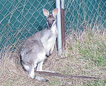
More commonly known as pretty-faced or whiptail wallaby, Macropus parryi is identified by its distinct white cheeks and long tail. In fact, the tail of this creature often equals or exceeds the length of its body and head combined. Total length can exceed 7 feet in males of the species. The majority of the body is colored pale brown except for the base of the ears, the forehead and the tip of the tail, which are dark brown.
- Other Physical Features
- endothermic
- homoiothermic
- bilateral symmetry
-
- Range mass
- 7 to 26 kg
- 15.42 to 57.27 lb
Reproduction
The whiptail wallaby reaches sexual maturity between 18 and 24 months for females and at over 2 years for males.
Macropus parryi gives birth to a single young, frequently around January, after a gestation period of approximately 34-38 days. This is followed by 37 weeks of nursing, during which the young wallaby suckles on one of four teats in its mother's pouch. Unlike some other species of wallaby, in which a mother forceably removes her young when the time is right, the young Macropus parryi leaves the protective pouch on its own. Newborn young have a mass of about one gram (less than 0.03 ounces.)
- Key Reproductive Features
- gonochoric/gonochoristic/dioecious (sexes separate)
- sexual
Lifespan/Longevity
-
- Average lifespan
Status: captivity - 9.7 years
- Max Planck Institute for Demographic Research
- Average lifespan
-
- Average lifespan
Status: wild - 10.0 years
- Max Planck Institute for Demographic Research
- Average lifespan
Behavior
The most identifying behavioral characteristic of Macropus parryi is its social structure. These animals are often seen in mobs of 50 to 80 individuals, with inner subgroups of around 10 individuals.
During hot weather, Parry's wallaby often licks its forearms to keep itself cool.
- Key Behaviors
- motile
Communication and Perception
Food Habits
During seasons with high temperatures, the whiptail wallaby feeds only in the early morning and late afternoon, taking cover under foliage during the temperature peak. During the winter months it is seen feeding at all times of day.
Grasses, ferns and herbaceous plants are the foods of choice.
Economic Importance for Humans: Positive
Macropus parryi positively benefits humans as a pet. In fact, the first of its species ever to be found and identified, by Sir Edward Parry in 1834 was kept by him as a pet at his home where it behaved much like a domesticated dog.
Economic Importance for Humans: Negative
The only negative effect of the whiptail wallaby on humans is that in developed areas the wallaby may be intrusive. This primarily includes being hit by cars.
Conservation Status
Currently there is no special conservation effort for whiptail wallabies in particular because they are common and are not used for commercial harvesting. They consist of a small percentage of the commercial quota for all types of macropods and are not typically used as a meat source.
-
- IUCN Red List
-
Least Concern
More information
-
- IUCN Red List
-
Least Concern
More information
-
- US Federal List
- No special status
-
- CITES
- No special status
Contributors
Erika Detweiler (author), University of Michigan-Ann Arbor, Phil Myers (editor), Museum of Zoology, University of Michigan-Ann Arbor.
Glossary
- Australian
-
Living in Australia, New Zealand, Tasmania, New Guinea and associated islands.

- bilateral symmetry
-
having body symmetry such that the animal can be divided in one plane into two mirror-image halves. Animals with bilateral symmetry have dorsal and ventral sides, as well as anterior and posterior ends. Synapomorphy of the Bilateria.
- chemical
-
uses smells or other chemicals to communicate
- endothermic
-
animals that use metabolically generated heat to regulate body temperature independently of ambient temperature. Endothermy is a synapomorphy of the Mammalia, although it may have arisen in a (now extinct) synapsid ancestor; the fossil record does not distinguish these possibilities. Convergent in birds.
- motile
-
having the capacity to move from one place to another.
- mountains
-
This terrestrial biome includes summits of high mountains, either without vegetation or covered by low, tundra-like vegetation.
- native range
-
the area in which the animal is naturally found, the region in which it is endemic.
- sexual
-
reproduction that includes combining the genetic contribution of two individuals, a male and a female
- tactile
-
uses touch to communicate
- tropical savanna and grassland
-
A terrestrial biome. Savannas are grasslands with scattered individual trees that do not form a closed canopy. Extensive savannas are found in parts of subtropical and tropical Africa and South America, and in Australia.
- savanna
-
A grassland with scattered trees or scattered clumps of trees, a type of community intermediate between grassland and forest. See also Tropical savanna and grassland biome.
- temperate grassland
-
A terrestrial biome found in temperate latitudes (>23.5° N or S latitude). Vegetation is made up mostly of grasses, the height and species diversity of which depend largely on the amount of moisture available. Fire and grazing are important in the long-term maintenance of grasslands.
References
1990. Grzimek's Encyclopedia of Mammals. New Jersey: McGraw - Hill Publishing Company.
1989. Kangaroos, Wallabies and Rat-Kangaroos. Australia: Surrey Beatty & Sons Pty Limited.
"Pretty Face Wallaby at Lone Pine Koala Sanctuary" (On-line). Accessed October 7, 1999 at http://www.koala.net/animals/mammals/marsupials/macropod/prettyface.htm.
"Species" (On-line). Accessed October 7, 1999 at http://www.sgm.com.au/Species2.htm.
Line, G. 1967. Marsupials and Monotremes of Australia. Sydney: Angus and Robertson.
Lydekker, R. 1894. A Handbook to the Marsupialia and Monotremata. London: W.H. Allen & Co., Limited.