Macropus giganteuseastern gray kangaroo



Geographic Range
Eastern grey kangaroos can be found on the eastern coastlines of Australia, all of Queensland with the exception of western Cape York, South Wales, and parts of Tasmania, most notably the north eastern portion. (Strahan, 1995)
- Biogeographic Regions
- australian
- Other Geographic Terms
- island endemic
Habitat
Eastern grey kangaroos inhabit a wide variety of habitats ranging from open woodlands to grasslands. They can also be found in mountains with extensive forest cover. The habitats of this species are usually areas of high rainfall, but this can also range to semi-arid areas. (; BBC, 2004; Poole, 1982; "Environmental Protection Agency/Queensland Parks and Wildlife Services", 2003)
- Habitat Regions
- temperate
- terrestrial
- Terrestrial Biomes
- savanna or grassland
- forest
- mountains
Physical Description
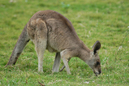
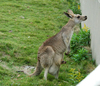
Eastern grey kangaroos are often confused with the western grey kangaroos, which were initially considered a subspecies of the eastern grey. While a stark contrast in fur color can be seen in the throat and other areas of the western grey, eastern grey kangaroos have a more even distribution in fur color. The faces of the two species differ in that the western grey has a darker complexion as opposed to the almost white face of the eastern grey. Eastern greys also lacks the white patch on the upper thigh which is characteristic of a western grey. There is great sexual dimorphism in size, with the males ranging from twice to three times the mass of an average female. Eastern grey kangaroos on the coastline will usually exhibit lighter colored fur than those inland, which are considerably darker in color. Eastern greys in Tasmania and the southern portions of Queensland also exhibit longer fur than in other areas. One other identifying characteristic is the black tip on the tails of this species. Females usually weigh up to about 40 kg, while males can weigh over twice as much, up to 90 kg. The standard metabolic rates of both eastern grey kangaroos and western grey kangaroos are lower than eutherians, although eastern grey kangaroos have a lower standard metabolic rate than western grey kangaroos. (Dawson, et al., 2000; McCarron, et al., 2001; Poole, 1982; "Environmental Protection Agency/Queensland Parks and Wildlife Services", 2003)
- Other Physical Features
- endothermic
- homoiothermic
- bilateral symmetry
- Sexual Dimorphism
- male larger
-
- Range mass
- 3.5 to 90 kg
- 7.71 to 198.24 lb
-
- Range length
- 1.5 to 1.8 m
- 4.92 to 5.91 ft
Reproduction
Male eastern grey kangaroos often 'box' or exhibit other types of aggressive behavior to establish dominance. The dominant male is the most likely individuals to mate with a female in estrus. When a female eastern grey kangaroo reaches estrus, the male will approach and sniff various parts of her body including her pouch and urogenital area. He may also make clucking noises and paw her head and tail, a behavior characteristic of many kangaroo species. (Poole, 1982; Strahan, 1995)
- Mating System
- polygynous
Eastern grey kangaroos are seasonal breeders (spring and early summer), unlike some kangroo species such as the red kangaroo or even the closely related western grey kangaroo, which breeds continously as long as the conditions are good. The eastern grey kangaroo exhibits embryonic diapause, a condition in which development of the zygote is halted. This is similar to all kangaroo species with the exception of the western grey. The estrous period for eastern grey kangaroos lasts about 46 days, which is longer than the gestation period of 36 days. Sexual maturity for males is reached at about 20 months and for females at 17 months. ("Australian Wildlife", 2002; BBC, 2004; Poole, 1982)
- Key Reproductive Features
- seasonal breeding
- gonochoric/gonochoristic/dioecious (sexes separate)
- sexual
- viviparous
- embryonic diapause
-
- Breeding interval
- Eastern grey kangaroos breed seasonally
-
- Breeding season
- Usually breed in the spring and early summer
-
- Range number of offspring
- 1 to 2
-
- Average number of offspring
- 1
- AnAge
-
- Range gestation period
- 34.8 to 38 days
-
- Average weaning age
- 9.5 months
-
- Average time to independence
- 11 months
-
- Range age at sexual or reproductive maturity (female)
- 15 to 20 months
-
- Average age at sexual or reproductive maturity (male)
- 20 months
-
- Average age at sexual or reproductive maturity (male)
Sex: male - 1290 days
- AnAge
- Average age at sexual or reproductive maturity (male)
A joey, or baby kangaroo, usually stays in the pouch for 11 months during which it feeds from its mother's milk. It feeds for an additional 9 months, on average, from the mother's milk, although it leaves the pouch at 11 months. During this time, the mother provides protection and food and also guidance as the joey comes closer to becoming fully independent. An interesting point about the milk produced by the female kangaroo is that its nutrional content changes depending upon the nutrional requirements of the joey. Thus, the milk produced while the joey is exclusively inside the pouch differs from the milk produced when the joey spends part of its time outside the pouch. Females with joeys that are semi-independent to fully-independent from the pouch usually stay away from large groups, a behavior thought to avoid the risk of predation. ("Australian Wildlife", 2002; Banks, 2001; BBC, 2004; Strahan, 1995)
- Parental Investment
- altricial
-
pre-hatching/birth
-
protecting
- male
-
protecting
-
pre-weaning/fledging
-
provisioning
- female
-
protecting
- male
- female
-
provisioning
-
pre-independence
-
provisioning
- female
-
protecting
- male
- female
-
provisioning
Lifespan/Longevity
Eastern grey kangaroos live for about 7-10 years in the wild, while there are records of those in captivity that have lived in excess of 20 years. Research in southern Queensland has shown that approximately 50% of young joeys fail to live to independence. (; BBC, 2004; Strahan, 1995)
-
- Range lifespan
Status: captivity - 25 (high) years
- Range lifespan
-
- Average lifespan
Status: wild - 8 years
- Average lifespan
-
- Typical lifespan
Status: captivity - 18 to 20 years
- Typical lifespan
-
- Average lifespan
Status: wild - 20.0 years
- Max Planck Institute for Demographic Research
- Average lifespan
-
- Average lifespan
Status: wild - 19.8 years
- Max Planck Institute for Demographic Research
- Average lifespan
Behavior
Eastern grey kangaroos are a social species and usually live in small groups called 'mobs'. These 'mobs' include one dominant male, about 2-3 females with their young, and about 2-3 young males. As is common in all kangaroos, eastern greys move by hopping, usually around 9 meters every hop. Also characteristic of most kangaroos, the legs of eastern greys are designed so that they expend less energy the faster they are moving, which can be up to speeds of 30 miles per hour. Eastern grey kangaroos spend most of their day under the shade, then move out at dusk to feed until dawn. ("Lamington National Park", 2003; BBC, 2004; McCarron, et al., 2001; Poole, 1982; Strahan, 1995)
- Key Behaviors
- terricolous
- saltatorial
- nocturnal
- motile
- territorial
- social
- dominance hierarchies
-
- Average territory size
- 429 km^2
Home Range
Eastern grey kangaroos do not have a broad home range like western grey kangaroos, which can have ranges in upwards of 500 ha. On average, eastern grey kangaroos have a mean home range of about 42.9 ha, but this value can range about 29.2 ha above and below this point. Density dependence and the availablity of renewable resources may be the determining factors that limitg the range of eastern grey kangaroos. ("Australian Wildlife", 2002; Grice, et al., 1988; Moore, et al., 2002)
Communication and Perception
Both male and female eastern grey kangaroos usually communicate with each other and their young using clucking noises. When alarmed, they can also emit a guttural cough. This cough is also heard when males warn each other, fight, or display dominance. All grey kangaroos stamp their hind legs on the ground when they sense danger. This stamping, along with the guttural noise, sends a warning that travels quite distantly. ("San Francisco Zoo", 2004; Moore, et al., 2002; Poole, 1982)
Food Habits
Eastern grey kangaroos are grazers and eat a wide variety of foliage ranging from grasses to forbs (broad-leaved herbs besides grass that grow on plains and meadows). The main choice of food, however, is grass, which grows on the plains that these kangaroos usually inhabit. In captivity, eastern greys may also feed upon fruits, although this is not part of the usual diet in the wild. ("San Francisco Zoo", 2004; BBC, 2004; Strahan, 1995)
- Plant Foods
- leaves
- seeds, grains, and nuts
- fruit
Predation
Eastern grey kangaroos have few natural predators. They have been hunted for thousands of years by Australian aborigines for fur and meat and later by European settlers. However, in the wild there are no species of animals that truly prey upon this species of kangaroo, with the exception of dingos. The effect of dingos is considered minimal. (; Strahan, 1995)
-
- Known Predators
-
- humans (Homo sapiens)
- dingos (Canis lupus dingo)
Ecosystem Roles
Eastern grey kangaroos have a similar impact on the ecoystem as most other species of kangaroo. They are grazers and control the growth and spread of grass and other types of foliage. As with other grazers, this leads to soil dessication if unchecked, but their numbers are not great enough to be considered a serious ecological hazard. (BBC, 2004; Meeves and Adams, 2003; Miller, 2002)
Economic Importance for Humans: Positive
Eastern grey kangaroos are endemic to the continent of Australia. There is not enough information to suggest that these kangaroos have a positive economic impact on human populations except for the fact that they have been hunted for food by Australian aborignes and Europeans settlers. The kangaroo industry is fairly large in Australia and the number hunted annually is based upon a quota set by the government of Australia. (; Strahan, 1995)
- Positive Impacts
- food
- body parts are source of valuable material
Economic Importance for Humans: Negative
Eastern grey kangaroos do not have much of a negative economic impact on human populations except that they sometimes have a tendency to wander into gardens and grazing lands to feed. This leads to the destruction of private land or property. They are sometimes shot by farmers who want to protect their grazing land, but are not considered a serious economic problem. (; Strahan, 1995; Meeves and Adams, 2003; Miller, 2002; Strahan, 1995)
- Negative Impacts
- crop pest
Conservation Status
There are almost 2 million eastern grey kangaroos in Australia and the surrounding areas, and thus, are not considered to be in any immediate danger of extinction. There was a sharp decline in the popluation of eastern grey kangaroos in the late 1990's especially in Tasmania. However, these kangaroos are now protected by law by the Australian government and most of their range is now on private property. This has enabled the eastern grey kangaroo population to increase and continue growing. There is a large kangaroo industry in Australia but the number of kangaroos killed each year is striclty monitored and regulated by the Australian government. (Strahan, 1995)
-
- IUCN Red List
-
Least Concern
More information
-
- IUCN Red List
-
Least Concern
More information
-
- US Federal List
- No special status
-
- CITES
- No special status
Other Comments
Eastern grey kangaroos are the only species of kangaroo found in Tasmania. Their population took a sharp decline before laws were passed to protect eastern grey kangaroo populations. ("Australian Wildlife", 2002; Strahan, 1995; "Australian Wildlife", 2002; ; Strahan, 1995)
Contributors
Matthew Wund (editor), University of Michigan-Ann Arbor.
Michael S. Joo (author), University of Michigan-Ann Arbor, Phil Myers (editor, instructor), Museum of Zoology, University of Michigan-Ann Arbor.
Glossary
- Australian
-
Living in Australia, New Zealand, Tasmania, New Guinea and associated islands.

- acoustic
-
uses sound to communicate
- altricial
-
young are born in a relatively underdeveloped state; they are unable to feed or care for themselves or locomote independently for a period of time after birth/hatching. In birds, naked and helpless after hatching.
- bilateral symmetry
-
having body symmetry such that the animal can be divided in one plane into two mirror-image halves. Animals with bilateral symmetry have dorsal and ventral sides, as well as anterior and posterior ends. Synapomorphy of the Bilateria.
- chemical
-
uses smells or other chemicals to communicate
- dominance hierarchies
-
ranking system or pecking order among members of a long-term social group, where dominance status affects access to resources or mates
- embryonic diapause
-
At about the time a female gives birth (e.g. in most kangaroo species), she also becomes receptive and mates. Embryos produced at this mating develop only as far as a hollow ball of cells (the blastocyst) and then become quiescent, entering a state of suspended animation or embryonic diapause. The hormonal signal (prolactin) which blocks further development of the blastocyst is produced in response to the sucking stimulus from the young in the pouch. When sucking decreases as the young begins to eat other food and to leave the pouch, or if the young is lost from the pouch, the quiescent blastocyst resumes development, the embryo is born, and the cycle begins again. (Macdonald 1984)
- endothermic
-
animals that use metabolically generated heat to regulate body temperature independently of ambient temperature. Endothermy is a synapomorphy of the Mammalia, although it may have arisen in a (now extinct) synapsid ancestor; the fossil record does not distinguish these possibilities. Convergent in birds.
- folivore
-
an animal that mainly eats leaves.
- food
-
A substance that provides both nutrients and energy to a living thing.
- forest
-
forest biomes are dominated by trees, otherwise forest biomes can vary widely in amount of precipitation and seasonality.
- herbivore
-
An animal that eats mainly plants or parts of plants.
- island endemic
-
animals that live only on an island or set of islands.
- motile
-
having the capacity to move from one place to another.
- mountains
-
This terrestrial biome includes summits of high mountains, either without vegetation or covered by low, tundra-like vegetation.
- native range
-
the area in which the animal is naturally found, the region in which it is endemic.
- nocturnal
-
active during the night
- polygynous
-
having more than one female as a mate at one time
- saltatorial
-
specialized for leaping or bounding locomotion; jumps or hops.
- seasonal breeding
-
breeding is confined to a particular season
- sexual
-
reproduction that includes combining the genetic contribution of two individuals, a male and a female
- social
-
associates with others of its species; forms social groups.
- tactile
-
uses touch to communicate
- temperate
-
that region of the Earth between 23.5 degrees North and 60 degrees North (between the Tropic of Cancer and the Arctic Circle) and between 23.5 degrees South and 60 degrees South (between the Tropic of Capricorn and the Antarctic Circle).
- terrestrial
-
Living on the ground.
- territorial
-
defends an area within the home range, occupied by a single animals or group of animals of the same species and held through overt defense, display, or advertisement
- tropical savanna and grassland
-
A terrestrial biome. Savannas are grasslands with scattered individual trees that do not form a closed canopy. Extensive savannas are found in parts of subtropical and tropical Africa and South America, and in Australia.
- savanna
-
A grassland with scattered trees or scattered clumps of trees, a type of community intermediate between grassland and forest. See also Tropical savanna and grassland biome.
- temperate grassland
-
A terrestrial biome found in temperate latitudes (>23.5° N or S latitude). Vegetation is made up mostly of grasses, the height and species diversity of which depend largely on the amount of moisture available. Fire and grazing are important in the long-term maintenance of grasslands.
- visual
-
uses sight to communicate
- viviparous
-
reproduction in which fertilization and development take place within the female body and the developing embryo derives nourishment from the female.
References
2002. "Australian Wildlife" (On-line). Accessed February 06, 2004 at http://www.australianwildlife.com.au/features/kangaroo.htm.
The State of Queensland. Environmental Protection Agency. 2003. "Environmental Protection Agency/Queensland Parks and Wildlife Services" (On-line). Accessed February 04, 2004 at http://www.epa.qld.gov.au/nature_conservation/wildlife/native_animals/permits_and_licences/western_grey_kangaroo/.
2003. "Lamington National Park" (On-line). Accessed February 12, 2004 at http://lamington.nrsm.uq.edu.au/Documents/Anim/eastern_grey_kangaroo.htm.
2004. "San Francisco Zoo" (On-line). Accessed February 11, 2004 at http://www.sfzoo.org/cgi-bin/animals.py?ID=16.
BBC, 2004. "Nature Wildfacts: Eastern grey kangaroo" (On-line). Accessed February 10, 2004 at http://www.bbc.co.uk/nature/wildfacts/factfiles/673.shtml.
Banks, P. 2001. Predation-sensitive grouping and habitat use by eastern grey kangaroos: A field experiment. Animal Behaviour, 61(5): 1013-1021.
Dawson, T., C. Blaney, A. Munn, A. Krockenberger, S. Maloney. 2000. Thermoregulation by kangaroos from mesic and arid habitats: Influence of temperature on routes of heat loss in eastern grey kangaroos (Macropus giganteus) and red kangaroos (Macropus rufus). PHYSIOLOGICAL AND BIOCHEMICAL ZOOLOGY, 73 (3): 374-381.
Grice, D., R. Barker, B. Brown, G. Caughley. 1988. The edge of range. Journal of Animal Ecology, 57(3): 771-786.
McCarron, H., R. Buffenstein, F. Fanning, T. Dawson. 2001. Free-ranging heart rate, body temperature and energy metabolism in eastern grey kangaroos (Macropus giganteus) and red kangaroos (Macropus rufus) in the arid regions of South East Australia. Journal of Comparative Physiology B: Biochemical, Systemic, and Environmental Physiology, 171(5): 401-411.
Meeves, T., R. Adams. 2003. The impact of grazing by eastern grey kangaroos (Macropus giganteus) on vegetation recovery after fire at Reef Hills Regional Park, Victoria.. Ecological Management & Restoration, 4(2): 126-132.
Miller, D. 2002. "Animal Diversity Web" (On-line). Accessed February 12, 2004 at http://animaldiversity.ummz.umich.edu/site/accounts/information/Macropus_fuliginosus.html.
Moore, B., G. Coulson, S. Way. 2002. Habitat selection by adult female eastern grey kangaroos. Wildlife Research, 29(5): 439-445.
Poole, W. 1982. Macropus giganteus. Mammalian Species, 187: 1-8.
Strahan, R. 1995. Mammals of Australia. New York: Smithsonian Institution press.