Macaca mulattarhesus monkey


Geographic Range
Populations of rhesus monkeys (Macaca mulatta) are most commonly found in western Afghanistan, through India to northern Thailand. This species was abundant historically in southern China and Tibet, but humans have caused drastic decline of populations in these areas over the last sixty years. Because M. mulatta is often used for research, today populations are kept in captivity world wide.
(Nowak, 1991; Parker, 1990; Wilson and Reeder, 1993)
- Biogeographic Regions
- palearctic
- oriental
Habitat
Macaca mulatta lives in a wide range of habitats, and shows a great deal of adaptability. Some populations live in flatlands, while others, in northern India and Pakistan, live in the Himalayas at elevations up to 3,000 m. These primates are able to aclimate to a variety of climatic extremes, from the hot, dry temperatures found in deserts, to cold winter temperatures which fall to well below the freezing point.
In addition to living in the wilderness, some populations of M. mulatta have become accustomed to living alongside humans. Occasionally, small groups can be found living in the densely populated urban areas of northern India. Groups of rhesus monkeys that become used to living in areas occupied by people usually search out other human-populated areas if people attempt to relocate them away from civilization.
(Nowak, 1991; Parker, 1990)
- Habitat Regions
- temperate
- tropical
- terrestrial
- Terrestrial Biomes
- desert or dune
- savanna or grassland
- forest
- mountains
- Other Habitat Features
- urban
- suburban
- agricultural
-
- Range elevation
- 3,000 (high) m
- ft
Physical Description
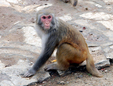
These smallish monkeys have grizzled-brown fur dorsally, with the fur on the ventrum being slightly lighter in color. The hair is short on the head. The face and buttocks of adults are red.
Length varies in this species, ranging between 45 and 64 cm. The tail adds an additional 19 to 32 cm to the total length. Males are somewhat heavier than females, weighing between 6.5 and 12 kg. Females weigh a mere 5.5 kg on average. (BBC, 2005)
- Other Physical Features
- endothermic
- homoiothermic
- bilateral symmetry
- Sexual Dimorphism
- male larger
-
- Range mass
- 4 to 12 kg
- 8.81 to 26.43 lb
-
- Range length
- 45 to 64 cm
- 17.72 to 25.20 in
Reproduction
Although rhesus monkeys show mate preferences, in general they are highly promiscuous. As they live in multi-male, multifemale groups, there are ample opportunities for individuals to copulate with multiple partners.
Female rhesus monkeys have a sexual cycle of 29 days. They are receptive to copulation for between 8 and 11 days during that cycle. To solicit copulations, females present their hindquarters to males. The skin of the perineal region becomes redded when the female is in estrus, and aliphatic acids are present, proving a potential chemical cue to their state of fertility.
Rhesus monkeys are serial mounters, meaning that males mount a female multiple times before ejaculating.
Males attract mates either by having high dominance status within the social group, or sometimes by being friendly (grooming, carrying infants, etc) to females. (Hrdy and Whitten, 1987)
- Mating System
- polygynandrous (promiscuous)
The breeding season varies widely amongst populations. Populations that live in areas where the winters are cold mate in the fall so that the young are born in the spring. Macaca mulatta that live where seasonal changes are less pronounced have less well-defined mating seasons.
The gestation period is around 165 days, and almost all pregnancies results in birth of a single young. When kept under uniform conditions in captivity, females maintain a steady estrus cycle of 26 to 28 days.
Unlike many primate species, the estrus cycle of M. mulatta is not accompanied by major changes in the females' genital region. There is only minor swelling and redness around the genital area.
In populations that have distinct breeding seasons, testes swell to almost double their normal size during the breeding season. The disproportionately large testicles of male rhesus monkeys, and the increase in size of their testicles during the breeding season, is probably related to the number of times a male can copulate over a short period of time.
(Buscovitch, 1993; Nowak, 1991; Parker, 1990)
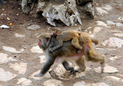
Newborn macaques weigh between 400 and 500g. They nurse from their mother for about 1 year. Although young macaques typically cling to their mother's ventrum for the first few weeks of life, as their ability to keep themselves upright improves, they ride upon the mother's back. Females reach nreproductive maturity at 2.5 to 3 years of age. Males take longer to complete the transition to adulthood, reaching sexual maturity at 4.5 to 7 years of age. (Nowak, 1991)
- Key Reproductive Features
- iteroparous
- seasonal breeding
- year-round breeding
- gonochoric/gonochoristic/dioecious (sexes separate)
- sexual
- fertilization
- viviparous
- post-partum estrous
-
- Breeding interval
- Females are capable of producing one young per year under good conditions.
-
- Breeding season
- Populations that live in areas where the winters are cold mate in the fall; those that live where seasonal changes are less pronounced have less well defined mating seasons
-
- Average number of offspring
- 1
-
- Average number of offspring
- 1
- AnAge
-
- Range gestation period
- 133 to 200 days
-
- Average gestation period
- 165 days
-
- Average weaning age
- 12 months
-
- Range age at sexual or reproductive maturity (female)
- 2.5 to 4 years
-
- Range age at sexual or reproductive maturity (male)
- 4.5 to 7 years
As is common to most primates, the bulk of parental care falls to females. Mothers provide their young with protection, nutrition, grooming, and social experience from birth until independence.
The role of males in parental care is somewhat confusing. Because social groups contain multiple males, and because females mate with many of these males, there is no certainty of paternity, so males don't even know which young are theirs. There may be some care given to young by close male friends of the mother. These males may be more likely to have sired the offspring.
- Parental Investment
- altricial
-
pre-fertilization
- provisioning
-
protecting
- female
-
pre-hatching/birth
-
provisioning
- female
-
protecting
- female
-
provisioning
-
pre-weaning/fledging
-
provisioning
- female
-
protecting
- female
-
provisioning
-
pre-independence
-
protecting
- female
-
protecting
- post-independence association with parents
- extended period of juvenile learning
- inherits maternal/paternal territory
- maternal position in the dominance hierarchy affects status of young
Lifespan/Longevity
Rhesus monkeys can live up to 30 years.
-
- Range lifespan
Status: wild - 30 (high) hours
- Range lifespan
-
- Range lifespan
Status: captivity - 30 (high) hours
- Range lifespan
-
- Average lifespan
Status: captivity - 36.0 years
- Max Planck Institute for Demographic Research
- Average lifespan
-
- Average lifespan
Sex: female
Status: captivity - 23.0 years
- Max Planck Institute for Demographic Research
- Average lifespan
-
- Average lifespan
Status: captivity - 35.0 years
- Max Planck Institute for Demographic Research
- Average lifespan
-
- Average lifespan
Status: captivity - 26.0 years
- Max Planck Institute for Demographic Research
- Average lifespan
-
- Average lifespan
Status: wild - 30.0 years
- Max Planck Institute for Demographic Research
- Average lifespan
Behavior
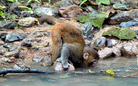
Rhesus monkeys are highly active and very loud. They enjoy being in water and are good swimmers. They live in groups of up to two hundred individuals. When a group's size reaches 80 to 100 members, a subgroup of females may split off to form a new group. Populations generally consist of a few unrelated males and many closely related females. Sometimes small groups form that consist of only males. Males usually leave the group in which they were born shortly after they reach sexual maturity. Offspring born to a mother and son, or to siblings, are very rare. Both males and females in a group show a preference for high ranking members of the opposite sex.
Dominance hierarchies exist in both sexes. This is far more evident in males, where competition for mates may occur regularly. The female members of a group usually live in complete harmony and rarely have violent interactions with one another.
Although rhesus monkeys live in groups, they are not territorial. Each group of individuals usually has its own sleeping space, but the territories of neighboring groups may overlap considerably. Confrontations between groups are rare. Usually when groups meet, the weaker group will avoid the stronger group. Any confrontations that arise are because of an uncertainty concerning strength and dominance.
(Buscovitch, 1993; Dotta, 1988; Nowak, 1991; Tate, 1947)
Communication and Perception
Communication in all monkeys involves a variety of visual signals (such as body postures and facial expression), tactile communication (such as grooming, playing and fighting), vocalizations, and scent cues.
Food Habits
The dietary habits of rhesus monkeys can vary greatly depending upon where they live. Macaca mulatta is omnivorous, and often eat roots, herbs, fruits, insects, crops, and small animals. The diet can also vary with the season. For example, rhesus that live in the mountain forests of northern Pakistan feed primarily on clovers during the summer, but during winter when snow covers the ground they are forced to switch to foods with lower nutritional values and higher fiber contents, such as pine needles and oak leaves. These monkeys seem to choose their environments carefully with respect to food resources. Even when they are forced to switch to lower quality food sources during the winter months they do not exhibit higher mortality rates, although they may lose a considerable percentage of their body weight.
(Macdonald, 1984; Nowak, 1991; Parker, 1990)
- Primary Diet
- omnivore
- Animal Foods
- birds
- mammals
- amphibians
- reptiles
- insects
- Plant Foods
- leaves
- roots and tubers
- fruit
Predation
Primates are often wary of potential predators. It is likey that large carnivores, raptors, and snakes could prey upon these macaques.
Ecosystem Roles
The role of these animals in their ecosystems has not been fully described. Because of their frugivory, rhesus monkeys may help to disperse seeds. As a prey species, they may affect predator populations.
Economic Importance for Humans: Positive
Macaca mulatta is a popular zoo animal because of its innate curiosity and active lifestyle. These monkeys are also used extensively for research. They are especially useful in biological, medicinal, and psychological research. Macaca mulatta is most often used in psychological research when the emphasis is on perception, learning, or behavior.
(Nowak, 1991; Parker, 1990)
- Positive Impacts
- source of medicine or drug
- research and education
Economic Importance for Humans: Negative
In India, rhesus monkeys do significant damage to crops and gardens in many areas. Because they are viewed as sacred animals by Hindus, often little is done to stop them from stealing crops.
As is true of most nonhuman primates, there is a high risk that they could carry diseases which affect humans.
(Nowak, 1991; Parker, 1990)
- Negative Impacts
-
injures humans
- bites or stings
- crop pest
Conservation Status
IUCN considers this species Lower risk/ near threatened.
-
- IUCN Red List
-
Least Concern
More information
-
- IUCN Red List
-
Least Concern
More information
-
- US Federal List
- No special status
-
- CITES
- Appendix II
Other Comments
The common name, rhesus monkey, is responsible for the naming of the hereditary blood antigen Rh-factor that was discovered on their red blood cells in 1940. Rh-factor is also found in humans. The mixing of Rh blood with non-Rh blood during blood transfusions or the later stages of pregnancy can result in potentially dangerous defense reactions.
(Nowak 1991)
The name "rhesus" comes from Greek, Rhesos, the King of Thrace who assisted Priam at Troy. Audebert, the person who applied the name to the species, stated that it had no meaning.
(Jaeger 1972)
Contributors
Nancy Shefferly (editor), Animal Diversity Web.
Joshua Seinfeld (author), University of Michigan-Ann Arbor.
Glossary
- Palearctic
-
living in the northern part of the Old World. In otherwords, Europe and Asia and northern Africa.

- acoustic
-
uses sound to communicate
- agricultural
-
living in landscapes dominated by human agriculture.
- altricial
-
young are born in a relatively underdeveloped state; they are unable to feed or care for themselves or locomote independently for a period of time after birth/hatching. In birds, naked and helpless after hatching.
- arboreal
-
Referring to an animal that lives in trees; tree-climbing.
- bilateral symmetry
-
having body symmetry such that the animal can be divided in one plane into two mirror-image halves. Animals with bilateral symmetry have dorsal and ventral sides, as well as anterior and posterior ends. Synapomorphy of the Bilateria.
- chemical
-
uses smells or other chemicals to communicate
- desert or dunes
-
in deserts low (less than 30 cm per year) and unpredictable rainfall results in landscapes dominated by plants and animals adapted to aridity. Vegetation is typically sparse, though spectacular blooms may occur following rain. Deserts can be cold or warm and daily temperates typically fluctuate. In dune areas vegetation is also sparse and conditions are dry. This is because sand does not hold water well so little is available to plants. In dunes near seas and oceans this is compounded by the influence of salt in the air and soil. Salt limits the ability of plants to take up water through their roots.
- diurnal
-
- active during the day, 2. lasting for one day.
- dominance hierarchies
-
ranking system or pecking order among members of a long-term social group, where dominance status affects access to resources or mates
- drug
-
a substance used for the diagnosis, cure, mitigation, treatment, or prevention of disease
- endothermic
-
animals that use metabolically generated heat to regulate body temperature independently of ambient temperature. Endothermy is a synapomorphy of the Mammalia, although it may have arisen in a (now extinct) synapsid ancestor; the fossil record does not distinguish these possibilities. Convergent in birds.
- fertilization
-
union of egg and spermatozoan
- forest
-
forest biomes are dominated by trees, otherwise forest biomes can vary widely in amount of precipitation and seasonality.
- iteroparous
-
offspring are produced in more than one group (litters, clutches, etc.) and across multiple seasons (or other periods hospitable to reproduction). Iteroparous animals must, by definition, survive over multiple seasons (or periodic condition changes).
- motile
-
having the capacity to move from one place to another.
- mountains
-
This terrestrial biome includes summits of high mountains, either without vegetation or covered by low, tundra-like vegetation.
- native range
-
the area in which the animal is naturally found, the region in which it is endemic.
- omnivore
-
an animal that mainly eats all kinds of things, including plants and animals
- oriental
-
found in the oriental region of the world. In other words, India and southeast Asia.
- polygynandrous
-
the kind of polygamy in which a female pairs with several males, each of which also pairs with several different females.
- seasonal breeding
-
breeding is confined to a particular season
- sedentary
-
remains in the same area
- sexual
-
reproduction that includes combining the genetic contribution of two individuals, a male and a female
- social
-
associates with others of its species; forms social groups.
- suburban
-
living in residential areas on the outskirts of large cities or towns.
- tactile
-
uses touch to communicate
- temperate
-
that region of the Earth between 23.5 degrees North and 60 degrees North (between the Tropic of Cancer and the Arctic Circle) and between 23.5 degrees South and 60 degrees South (between the Tropic of Capricorn and the Antarctic Circle).
- terrestrial
-
Living on the ground.
- tropical
-
the region of the earth that surrounds the equator, from 23.5 degrees north to 23.5 degrees south.
- tropical savanna and grassland
-
A terrestrial biome. Savannas are grasslands with scattered individual trees that do not form a closed canopy. Extensive savannas are found in parts of subtropical and tropical Africa and South America, and in Australia.
- savanna
-
A grassland with scattered trees or scattered clumps of trees, a type of community intermediate between grassland and forest. See also Tropical savanna and grassland biome.
- temperate grassland
-
A terrestrial biome found in temperate latitudes (>23.5° N or S latitude). Vegetation is made up mostly of grasses, the height and species diversity of which depend largely on the amount of moisture available. Fire and grazing are important in the long-term maintenance of grasslands.
- urban
-
living in cities and large towns, landscapes dominated by human structures and activity.
- visual
-
uses sight to communicate
- viviparous
-
reproduction in which fertilization and development take place within the female body and the developing embryo derives nourishment from the female.
- year-round breeding
-
breeding takes place throughout the year
References
Buscovitch, F.B. The acquisition of dominance among free-ranging rhesus monkey siblings. Animal Behavior. 36: 754-72. Jun. 1988
Dotta, S. Dominance, rank, and reproduction maturation in male rhesus macaques (Macaca mulatta). Journal of Reproduction and Fertility. 99: 113-20. Sept. 1993
Macdonald, D. The Encyclopedia of Mammals. Facts on File Publishing, NY. 1984
Nowak, R.M. Walker's Mammals of the World: Fifth Edition, vol. I. The Johns Hopkins University Press, Baltimore and London. 1990 Parker, S.P. Grzimek's Encyclopedia of Mammals, vol. II. McGraw-Hill Publishing Co. 1990
Tate, G.H.H. Mammals of Eastern Asia. The Macmillan Co. 1947
Wilson, E.D., D.M. Reeder. Mammal Species of the World: a taxonomical and geographical reference. Smithsonian Institution Press, Washington. 1993
BBC, 2005. "Rhesus Monkey" (On-line). Accessed May 30, 2005 at http://www.bbc.co.uk/nature/wildfacts/factfiles/211.shtml.
Hrdy, S., P. Whitten. 1987. Patterning of Sexual Activity. Pp. 370-384 in B Smuts, D Cheney, R Seyfarth, R Wrangham, T Struhsaker, eds. Primate Societies. Chicago and London: The University of Chicago Press.
Jaeger, E. 1972. A source-book of biological names and terms. Springfield, Illinois: Charles C. Thomas.